
The label your package needs depends on the UN number of the battery and on how it ships. Small lithium-ion batteries packed with or inside equipment usually carry the lithium battery mark. Larger, fully regulated shipments need the Class 9 lithium battery hazard label, sometimes a Cargo Aircraft Only label, and dangerous-goods paperwork. This guide shows how to work out which case is yours, how to read the marks, what USPS accepts, and what to check on the pallet the carton rides on.
TL;DR
- Find the UN number first: UN 3480 is lithium-ion batteries shipped alone, UN 3481 is lithium-ion packed with or contained in equipment. Lithium-metal equivalents are UN 3090 and UN 3091.
- The lithium battery mark (red-hatched border, battery-and-flame symbol, UN number) and the Class 9 hazard label are two different things, and some shipments need both.
- USPS international mail is much narrower than general transport rules: installed batteries only, strict quantity limits, and rigid packaging.
- If your cartons ride on wooden pallets, the ISPM 15 stamp is a separate requirement from any battery label. Check it before the freight leaves.
Table of Contents
- Battery mark vs Class 9 label: two different signals
- Start with the UN number
- Which label goes on which shipment
- What USPS asks for
- Reading a battery label in practice
- The pallet under the carton: ISPM 15
- Perspective
- Building a label routine that scales
- Common mistakes to avoid
- Source your bulk goods with documentation built in
- FAQ
- Sources
Battery mark vs Class 9 label: two different signals
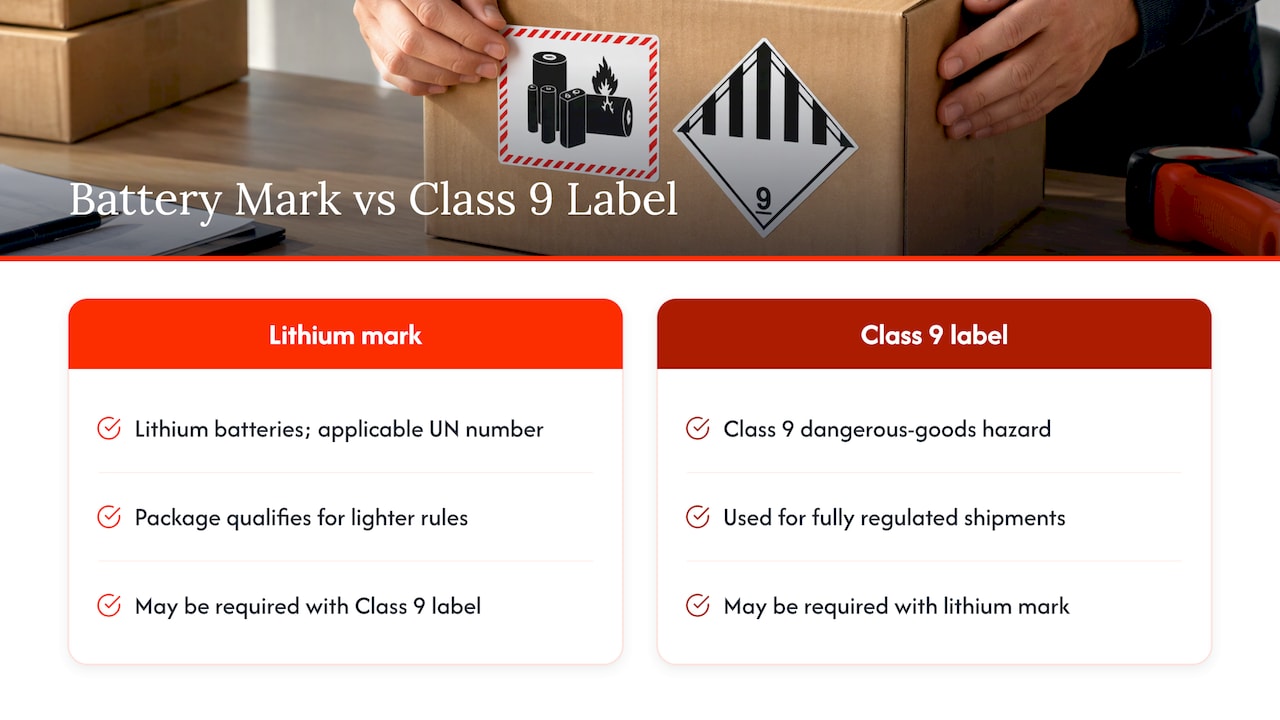
People search for “battery shipping labels” as if there were one sticker. There are two, and they say different things.
The lithium battery mark is a rectangular or square package mark with red diagonal hatching, a battery-and-flame symbol and the applicable UN number. IATA’s 2026 battery guidance describes the hatching as at least 5 mm wide and gives a normal minimum size of 100 mm × 100 mm, which can be reduced to 100 mm × 70 mm when the package is too small for the full size.
The Class 9 lithium battery hazard label is the dangerous-goods class label used for fully regulated shipments. Transport Canada notes that UN 3480 and UN 3481 are both Class 9 entries and that the Class 9 lithium-battery label is prescribed for them under Special Provision 159.
In short, the mark tells handlers there are lithium batteries in a package that qualifies for the lighter set of rules. The hazard label tells them the package is fully regulated dangerous goods. The two communicate different information and may both be required on the same package.
What the mark must show
The UN number sits beneath the battery-and-flame symbol, inside the hatched border. IATA says the number should be at least 12 mm high and may list UN 3090, UN 3091, UN 3480, UN 3481, UN 3551 and/or UN 3552 as applicable. If a package holds more than one type, the mark can list more than one number.
Two practical points for anyone buying printed labels:
- Check the size against the carton before you order. A 100 mm × 100 mm mark does not fit on every small box, and the 100 mm × 70 mm reduction is only for packages that are too small.
- Never confuse a generic “lithium battery” caution sticker with the mark. A sticker without the correct hatching, symbol and UN number is not the mark.
Start with the UN number
Before buying any label, classify the battery. The table below summarizes the entries most shippers meet.
| UN number | What it covers | Typical example |
|---|---|---|
| UN 3480 | Lithium-ion batteries shipped by themselves | Loose replacement battery packs |
| UN 3481 | Lithium-ion batteries packed with or contained in equipment | Laptop with its battery installed, or a spare pack in the same box |
| UN 3090 | Lithium-metal batteries shipped by themselves | Loose lithium-metal cells |
| UN 3091 | Lithium-metal batteries packed with or contained in equipment | Device with a lithium-metal battery inside |
The classification follows the guidance in IATA’s 2026 battery document. Once you have the UN entry, you can find the packing instruction for your mode of transport. That packing instruction, not the product’s name, decides the label.
Which label goes on which shipment
The pattern below applies to air transport, where the rules are strictest. Ground and sea rules follow related logic, but always confirm with your carrier and the regulations for the mode you use.
Small, qualifying shipments (Section II)
The FAA’s ICAO summary chart states that UN 3481 packed with equipment under Packing Instruction 966 Section II, within the stated small-battery limits, requires the lithium battery mark. It does not require a shipper’s declaration or UN-specification packaging.
IATA’s 2026 guidance confirms the mark is required for the additional requirements of Section II of Packing Instructions 966, 967, 969, 970, 977 and 978.
Fully regulated shipments (Section I)
Larger shipments fall under Section I. For UN 3480 under Packing Instruction 965 Section IA, the FAA chart lists the Class 9 lithium battery label, a Cargo Aircraft Only label, UN-specification Packing Group II packaging and a shipper’s declaration. Section IB adds the lithium battery mark. IATA’s guidance says the mark is needed for Section IB of Packing Instructions 965 and 968 in addition to the Class 9 hazard label and, where required, the Cargo Aircraft Only label.
A quick way to remember it:
- Small qualifying configuration: battery mark.
- Fully regulated configuration: Class 9 label, often a Cargo Aircraft Only label, a declaration and tested packaging.
- Section IB sits in between and needs the mark on top of the Class 9 label.
If your shipment is near a limit, do not guess. Ask your carrier’s dangerous-goods desk or a trained hazmat employee to confirm the section, because the wrong section means the wrong label and the wrong paperwork.
What USPS asks for
Searchers often type “shipping label for a lithium battery required by USPS”. For international mail, the answer is narrower than general transport rules. USPS Packaging Instruction 9E allows qualifying batteries only when they are properly installed in the equipment they operate, classed as UN 3481 or UN 3091 as applicable, and the pieces carry no lithium-battery marking. USPS also requires rigid protective packaging and acceptance by the destination country.
The quantity limits for installed lithium-ion batteries are tight:
- Maximum of four cells or two batteries per shipment.
- No more than 20 Wh per cell and 100 Wh per battery.
- A lithium-battery consignment is limited to two mailpieces.
This is a different regime from the carrier rules above. A package that is acceptable in the mail may need a mark and a hazard label in a courier or freight network, and the reverse can also be true. Pick the channel first, then follow that channel’s rules.
Reading a battery label in practice
When a carton arrives with several stickers, work through this order:
- Find the UN number on the mark or the hazard label. UN 3480 means lithium-ion alone, UN 3481 means lithium-ion with or in equipment.
- Look at the shape. Red-hatched rectangle with a battery and flame: the mark. Class 9 hazard label (the one with the vertical stripes on the upper half): the hazard label.
- Look for extra labels such as Cargo Aircraft Only. If present, the shipment is fully regulated and should have a declaration.
- Check that the label is on the outside of the package and not covered by tape or strapping.
The last point matters more than it sounds. Compression straps, film and bale wrap can hide a mark. On palletized cargo, place labels on a face that stays visible after loading.
The pallet under the carton: ISPM 15
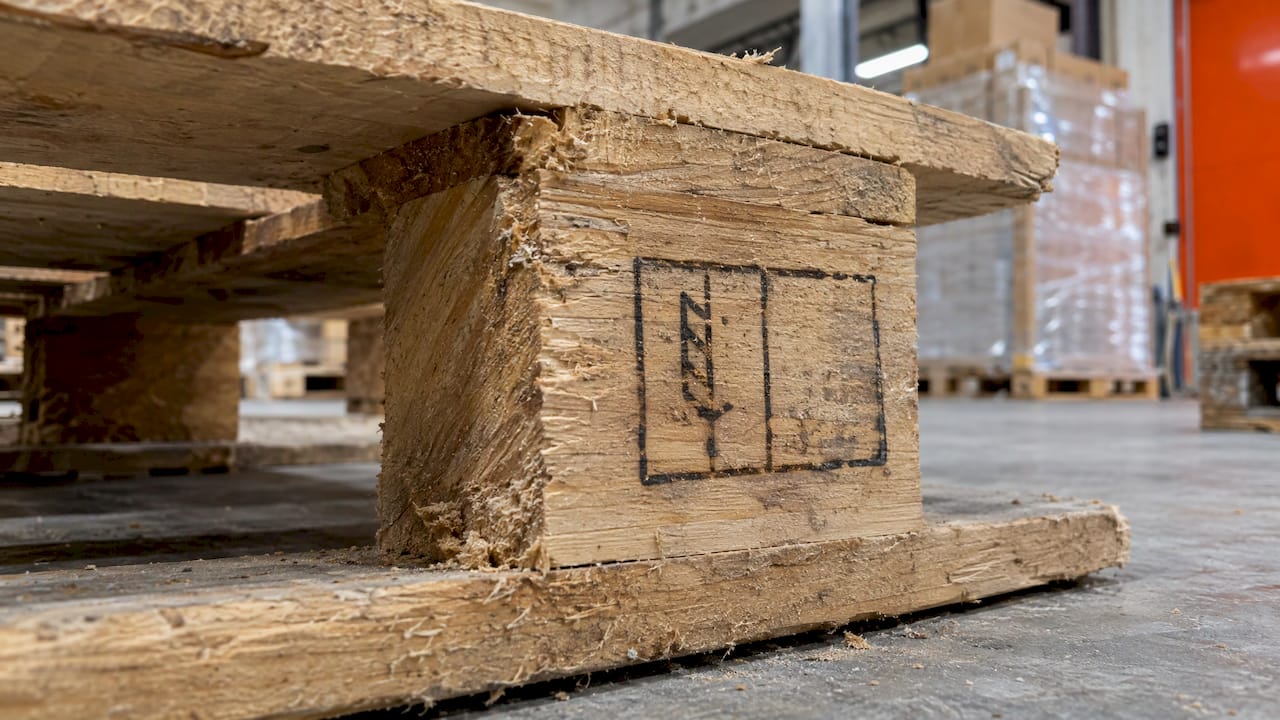
Many readers asking about battery labels also ask about “ISPM 15 pallets” and “heat treated pallets certification”. They are separate requirements that meet on the same shipment: the battery mark covers the contents, and the ISPM 15 stamp covers the wood.
What the mark means
An ISPM 15 stamp means the solid-wood packaging was treated by an approved method and certified under an authorized marking system. According to Australia’s DAFF FAQ on ISPM 15, the stamp carries the IPPC symbol, the treatment-country code, a traceable provider or facility code and a treatment code. Only certified treatment providers or wood-packaging manufacturers may apply it.
The Australian government’s ISPM 15 page lists the treatment codes:
| Code | Treatment |
|---|---|
| HT | Conventional steam or dry-kiln heat treatment to a minimum wood-core temperature of 56°C for at least 30 minutes |
| DH | Dielectric heating |
| MB | Methyl-bromide fumigation |
| SF | Sulphuryl-fluoride fumigation |
So “heat treated” on a pallet means the letters HT in the stamp, together with the IPPC symbol, the two-letter ISO country code and the unique certification number.
How to verify heat treatment
Treatment cannot be inspected directly. Canada’s CFIA explains in directive D-98-08 that it is assessed by checking the IPPC mark and looking for live pests or signs such as frass. The certification system relies on the national plant protection organization approving and monitoring the facilities that may apply the mark.
In the United States, APHIS says heat-treated export wood packaging must either be made from lumber bearing an ALSC-accredited agency mark or be heat-treated to a 56°C core temperature for at least 30 minutes and then marked with an ALSC-accredited agency quality mark. The takeaway for buyers: heat treatment is proven by an officially recognized certification chain, so look for a legible stamp with a full code set.
A short pallet check before dispatch:
- The stamp is present on at least one visible side and is legible, not smeared or partly sanded off.
- It shows the IPPC symbol, country code, producer number and a treatment code.
- The wood is clean, with no bark or signs of insects.
- The pallet has not been repaired or altered after marking. DAFF says marked packaging can be reused if it has not been altered, but treatment does not permanently prevent reinfestation.
Paperwork and destination rules
DAFF notes that treatment certificates are generally not required under the standard, although some importing countries ask for a packing declaration, packing list or invoice. Rules also differ by country. Canada, for example, exempts certain wood packaging made entirely of continental U.S. or Canadian wood moving directly between those countries, and requires treated, debarked and IPPC-marked packaging for other covered material. Canada also accepts a phytosanitary certificate in place of the stamp, and if heat treatment is stated, the certificate must confirm at least 56°C throughout the profile, including the core, for at least 30 minutes.
Confirm the importing country’s current rules before you load.
Perspective
In our daily work we pack and ship bales of used clothing, shoes, bags, toys and other goods to buyers in over 40 countries. We treat the label as part of the product. A bale that arrives with a clear, correct, visible mark moves through checks faster than one that makes an inspector search for information.
Our advanced packaging machinery is designed for rapid turnaround, and we pair that speed with documentation that follows the shipment: consistent marking on each bale, a packing list that matches what is inside, and the right information for the destination. Our view is simple: the faster a warehouse can pack, the more discipline it needs on labeling, because errors multiply at speed.
Our advice to wholesalers is to decide the label before the freight is booked, not after. Classify first, choose the channel, then print. Where electronics such as laptops are part of a consignment, we recommend working through the UN entry and packing instruction with your carrier before dispatch, and keeping all wooden pallets certified and stamped.
rodrigues
Building a label routine that scales
If you ship several cartons a week, a repeatable routine beats checking from scratch each time.
- Classify at the product level. Record the UN number for each product that contains or ships with a battery, and keep it in the same sheet as your SKU list.
- Record the configuration. Alone, packed with equipment, or contained in equipment changes the entry (for example UN 3480 versus UN 3481).
- Map the channel. Postal, courier, air freight and sea freight each have their own conditions. A package that works in one may not work in another.
- Stock the right labels. Keep the lithium battery mark in the sizes you use, and the Class 9 label for the fully regulated cases.
- Photograph the final carton. A photo of the labeled, sealed package with the pallet stamp visible makes disputes much easier to resolve.
- Train the packers. Anyone who prepares a regulated shipment should have the training your regulator and carrier require.
For ecommerce sellers, speed matters as much as compliance. Guidance on fast shipping bulk supplies covers the fulfillment side of getting parcels out in days, and labeling is one of the checks that keeps those parcels from stopping at the first scan.
Wholesale exporters have the same discipline on the textile side. Our guides on bale labeling standards, what belongs on a packing list and machine strapping and packing specs show how marking and documentation work for bales. Customs paperwork is the other half: see our note on HS codes that prevent port holds.
Common mistakes to avoid
- Using only a generic caution sticker. It does not replace the mark or the Class 9 label.
- Treating the mark and the hazard label as interchangeable. Section IB, for example, calls for both.
- Assuming postal and courier rules are the same. USPS international mail wants installed batteries and no lithium-battery marking on qualifying pieces, while carrier networks follow packing instructions.
- Covering the label with strapping or wrap. Leave the mark visible and flat.
- Ignoring the pallet. Cartons that are correctly labeled can still be held if the wood has no legible ISPM 15 stamp.
- Reusing a repaired pallet. An altered pallet may no longer be valid under its original stamp.
Source your bulk goods with documentation built in
We export used clothing, shoes, purses and bags, wiping rags, toys, bric-a-brac and other second-hand goods in bulk bales, with packaging designed for fast turnaround and shipments documented for global import requirements. If you are a reseller, importer or wholesaler planning your next container, start with our used clothing offer or tell us your destination through our main site and we will walk through the documents your market expects.
FAQ
What is the lithium battery mark?
It is a rectangular or square package mark with red diagonal hatching, a battery-and-flame symbol and the applicable UN number. IATA’s 2026 guidance sets the usual minimum size at 100 mm × 100 mm. It signals a lithium battery package under the lighter set of rules and is separate from the Class 9 hazard label.
What is the difference between UN3480 and UN3481?
UN 3480 covers lithium-ion batteries shipped by themselves. UN 3481 covers lithium-ion batteries packed with or contained in equipment. The number appears on the battery mark beneath the symbol, and it decides which packing instruction applies.
Does USPS require a lithium battery label?
For qualifying international mail, USPS Packaging Instruction 9E requires batteries installed in the equipment, classed as UN 3481 or UN 3091, and says the pieces carry no lithium-battery marking. Quantity limits and rigid packaging apply. Carrier and freight shipments follow different rules, so check the channel you use.
What does HT mean on a pallet?
HT means heat treatment with steam or a dry kiln, bringing the wood core to at least 56°C for at least 30 minutes. It sits in the ISPM 15 stamp beside the IPPC symbol, the country code and the producer number. Only certified providers may apply the stamp.
Do I need a certificate for heat-treated pallets?
Under the standard, the stamp itself is the proof and treatment certificates are generally not required. Some importing countries ask for supporting documents such as a packing declaration, packing list or invoice, and Canada accepts a phytosanitary certificate instead of the stamp. Confirm the destination’s current rules before shipping.
Sources
- IATA Lithium Battery Guidance Document (2026)
- Transport Canada: Transporting batteries
- FAA: ICAO lithium battery summary chart
- USPS Packaging Instruction 9E, Postal Explorer
- DAFF: ISPM 15 for export FAQ
- Australian government: ISPM 15 timber packaging
- APHIS: Export ISPM 15-compliant wood packaging material
- CFIA directive D-98-08: wood packaging material
- Fast shipping bulk supplies