
Countries around the world either ban or tightly restrict used clothing imports, according to a Law Library of Congress survey covering nations from Algeria to Vietnam. Some impose blanket prohibitions, others target specific items like underwear or footwear, and many rely on tariffs, permits, or sanitation rules instead of outright bans. The dominant motives cited across these policies are protecting domestic textile industries, managing public health risks, and avoiding becoming a dumping ground for textile waste.
TL;DR:
- Algeria, Bolivia, China, Ecuador, Indonesia, Paraguay, the Philippines, Sudan, and Vietnam prohibit commercial imports, though some allow humanitarian or diplomatic shipments.
- Worn clothing usually falls under HS 6309, while textile scraps use HS 6310; verify destination rules and required permits or sanitation records before shipping.
- After a U.S. threat to suspend trade benefits, Kenya, Tanzania, Uganda, and Burundi shifted to tariffs, while Rwanda kept duties and lost textile benefits.
- A domestic garment industry needs capital, reliable electricity, skilled labor, machinery, and training; import restrictions alone cannot supply those conditions.
- UNECE recommends distinguishing resalable used textiles from textile waste, then requiring sorting before export and bale declarations instead of restricting both alike.
Table of Contents
- 1. Which countries restrict used clothing imports and what they target
- 2. Why governments adopt bans, levies, or restrictions
- 3. How bans and restrictions get enforced at the border
- 4. What bans and restrictions do to trade, industry, and the environment
- 5. Trade law limits and diplomatic consequences
- 6. Smarter alternatives than a blanket ban
- 7. Country case studies: how bans actually played out
- 8. A practical checklist before shipping used clothing
- 9. Why documentation separates reliable importers from the rest
- How we help buyers source compliant, pre-sorted bales
- FAQ
- Sources
1. Which countries restrict used clothing imports and what they target
The clearest map of global policy comes from the Law Library of Congress survey, which documents blanket bans in Algeria, Bolivia, China, Ecuador, Indonesia, Paraguay, the Philippines, Sudan, and Vietnam. These countries prohibit the commercial import of used clothing outright, though several carve out exceptions for humanitarian aid shipments or diplomatic donations.
Other governments take a narrower approach, restricting specific categories rather than banning secondhand garments wholesale. Common targets include:
- Undergarments and intimate apparel, flagged in sanitation-focused regulations.
- Hospital wear and other medical textiles, due to contamination risk.
- Used footwear, often singled out separately from general clothing bales.
- Towels and bedding, sometimes grouped with hygiene-sensitive items.
Implementation varies as much as the scope. Some countries write the restriction into customs law by targeting specific harmonized system codes, commonly HS 6309 for worn clothing and HS 6310 for rags and used textile scraps. Others issue standalone ministerial orders or decrees that reference these codes without rewriting the broader customs tariff schedule. A smaller group layers humanitarian exemptions on top of the restriction, allowing registered charities or aid organizations to import items that commercial traders cannot.
The practical effect for anyone sourcing or shipping secondhand goods is that the same product category can face different regulatory postures from port to port: a flat ban, a tariff-heavy permit system, or no meaningful restriction at all. Checking the current national list before booking a shipment matters more than relying on regional assumptions, since neighboring countries in the same trade bloc sometimes diverge sharply, as the East African Community later demonstrated.
2. Why governments adopt bans, levies, or restrictions
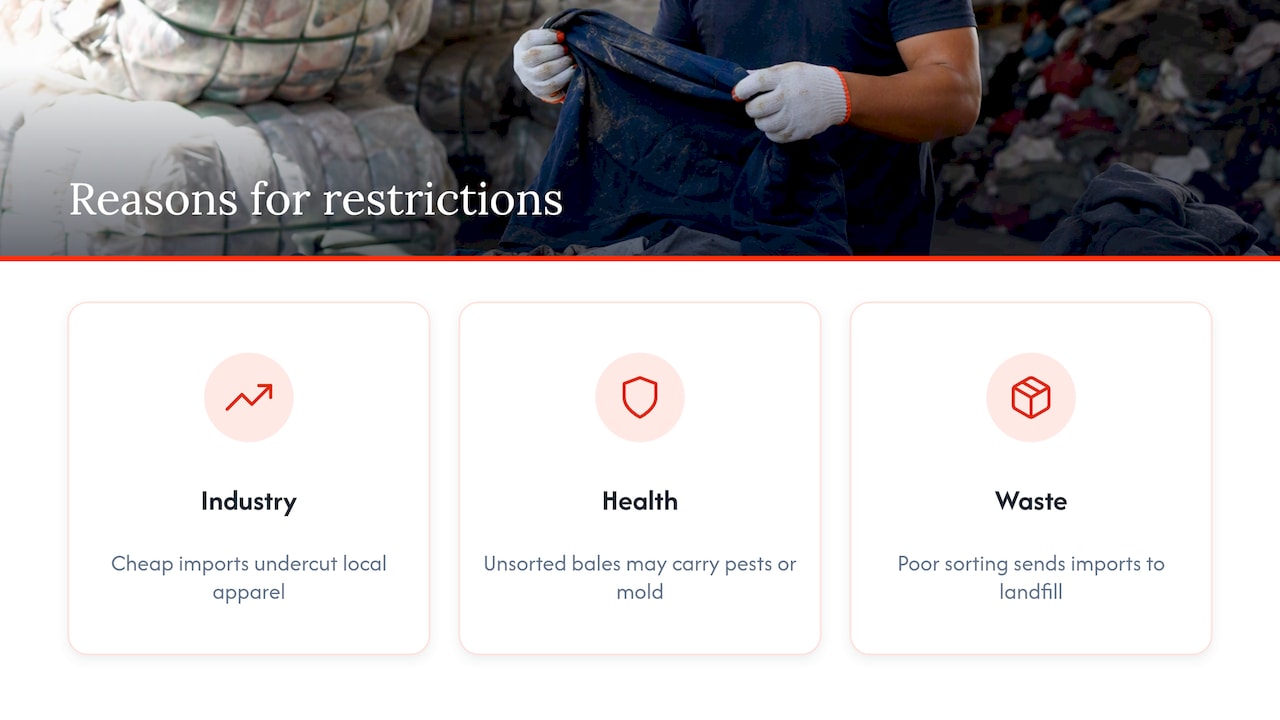
Three rationales recur across the countries that restrict secondhand clothing imports, and they rarely appear in isolation.
The first is industrial protection. Domestic textile and garment manufacturers, particularly small and medium enterprises, argue that cheap imported used clothing undercuts locally produced goods and suppresses demand for new domestic apparel. This argument has driven policy across sub-Saharan Africa and parts of Latin America, where governments frame restrictions as a tool to rebuild manufacturing capacity that shrank after decades of secondhand imports.
The second rationale is public health and sanitation. Regulators frame unsorted used clothing as a potential vector for pests, mold, or contamination, and several national frameworks require fumigation, sanitation certificates, or pre-shipment inspection before bales clear customs. Indonesia’s trade ministry has framed its ban in exactly these terms, citing health protection alongside support for local micro, small, and medium enterprises.
The third is environmental concern: a fear of becoming a destination for textile waste disguised as reusable clothing. UNCTAD and related technical research notes that textiles are genuinely hard to recycle, sorting is labor-intensive, and clean, dry, non-hazardous material is required for any reuse or recycling pathway to work. When sorting happens poorly or not at all, a share of every import bale ends up in landfill or informal dump sites rather than resale racks.
A working paper on Tanzania’s experience with the East African Community phase-out estimated net imports at over 540 million pieces of used clothing per year, a volume that illustrates why policymakers see the secondhand trade as large enough to matter for industrial strategy, not a marginal footnote.
These three motives create a genuine trade-off. Restrictions can relieve pressure on domestic producers and formal retailers, but they also raise prices for low-income consumers who rely on secondhand clothing, and they squeeze informal traders who have no formal-sector job to fall back on. Policymakers weighing a ban are rarely choosing between a good option and a bad one. They are choosing which group absorbs the cost.
3. How bans and restrictions get enforced at the border
Governments translate the rationale into border controls through a handful of recurring mechanisms, and the gap between the written rule and what customs officers can actually check explains a lot of the real-world confusion around these policies.
- Legal instruments. Ministerial regulations, presidential decrees, and customs tariff schedules do the heavy lifting. Indonesia’s enforcement runs through a ministerial regulation explicitly targeting used clothing imports, with destruction provisions for seized consignments.
- HS code targeting. Customs systems flag shipments under HS 6309 (worn clothing) and HS 6310 (used rags and textile scrap) for closer scrutiny, non-automatic licensing, or outright rejection depending on the jurisdiction.
- Pre-import controls. Sanitation certificates, fumigation records, and bale-level labelling are increasingly requested before a shipment is cleared, particularly where health framing drives the restriction.
- Tariff and levy alternatives. Rather than banning imports outright, some governments raise ad-valorem tariffs or add environmental levies, letting trade continue at a higher cost rather than stopping it.
- Import permits. Non-automatic licensing schemes require an importer to secure government approval before each shipment, giving authorities a checkpoint short of a full ban.
Enforcement runs into the same obstacles almost everywhere. Misclassification lets banned goods cross under a different HS code. Porous land borders in regions with high informal cross-border trade make smuggling difficult to stop. Customs agencies in lower-income countries often lack the staffing or lab capacity to inspect every flagged container, so enforcement ends up uneven: strict at major ports, thin everywhere else. That gap between the rule on paper and the rule in practice is one reason researchers caution against treating a ban’s existence as proof of its effect.
4. What bans and restrictions do to trade, industry, and the environment
The consumer effect shows up fastest. When a government restricts or bans imports, the immediate result is higher prices and reduced availability of low-cost clothing, since used garments typically undercut new apparel by a wide margin and absorb a large share of demand among lower-income households.
Whether restrictions actually revive domestic industry is a separate question, and the evidence is mixed. A working paper on the East African Community phase-out concluded that removing secondhand imports alone is unlikely to spur the domestic garment sector unless governments also address structural constraints like access to capital, electricity reliability, and skilled labor. A ban removes competition, but it does not automatically create the financing, machinery, or training a garment sector needs to fill the gap.
Several effects play out simultaneously:
- Consumers facing higher prices often shift toward lower-quality new apparel or reduce clothing purchases altogether.
- Informal traders selling secondhand clothing, who form a substantial part of the retail economy in many developing markets, face direct income loss with no formal safety net.
- Downstream workers, including tailors, repair shops, and resale market vendors who depend on secondhand supply, face disruption when the goods they rely on disappear from legal channels.
- Domestic manufacturers gain relief from import competition but still need investment and infrastructure to convert that relief into new capacity.
Environmental outcomes cut both ways. A ban can prevent a country from absorbing textile waste disguised as reusable clothing, which protects local waste management systems from an influx they are not equipped to handle. But UNCTAD and related research notes that without a functioning domestic collection and sorting system, restricting exports of the problem elsewhere does not solve it: the textiles that would have been exported still need somewhere to go, and that somewhere is often a municipal landfill if no circular alternative exists. Restricting trade without building sorting and recycling capacity at home can simply relocate the waste problem rather than resolve it.
A UN Africa Renewal commentary frames this tension plainly: protectionist goals and environmental goals do not always point in the same direction, and a ban designed for one can create friction with the other.
5. Trade law limits and diplomatic consequences
International trade rules constrain how far a government can go in banning imports, and the clearest limit comes from the General Agreement on Tariffs and Trade. GATT Article XI generally prohibits quantitative restrictions on imports, meaning a flat ban on used clothing sits in legally contested territory unless a government can justify it under one of the agreement’s narrow exceptions.
Article XX allows exceptions for public health, public morals, or conservation of exhaustible natural resources, but these exceptions require specific justification and are not a blanket shield for any import restriction a government wants to impose. A country citing sanitation concerns to justify a used-clothing ban needs to show the measure is necessary and not simply a disguised trade barrier, which is why so many national frameworks lean on sanitation certificates and fumigation requirements rather than a pure prohibition with no health rationale attached.
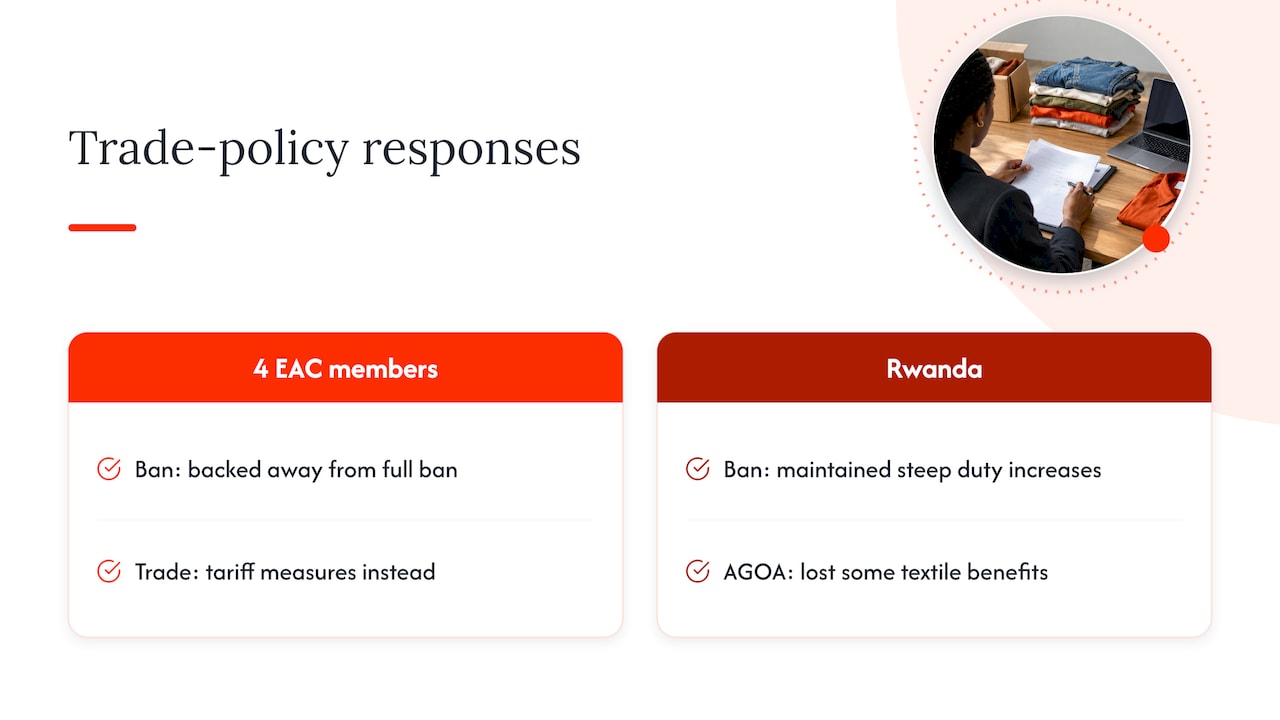
The East African Community’s 2016 phase-out plan became the clearest real-world test of how far trade-preference leverage can push back against a ban. When EAC members, including Kenya, Tanzania, Uganda, Rwanda, and Burundi, agreed to phase out secondhand clothing imports to protect regional textile manufacturing, the United States responded through the African Growth and Opportunity Act. USTR materials document that the US initiated an out-of-cycle review and threatened to suspend AGOA trade benefits for members pursuing the ban, since the policy conflicted with US textile export interests tied to the secondhand clothing trade.
The outcome split the bloc. Facing the risk of losing duty-free access to the US market, Kenya, Tanzania, Uganda, and Burundi backed away from a full ban and reverted to tariff-based measures instead. Rwanda chose a different path and maintained steep duty increases on used clothing imports despite losing some AGOA textile benefits as a result, a trade-off documented in BBC reporting on the dispute.
The practical lesson for any government weighing a ban is that trade-preference relationships can shape the policy long before it reaches a courtroom or a WTO panel. A country dependent on preferential market access for other exports has to weigh a used-clothing ban against what it stands to lose elsewhere, and that calculation often pushes governments toward tariffs, levies, or permits rather than an outright prohibition that invites a formal trade dispute.
6. Smarter alternatives than a blanket ban
International trade bodies increasingly argue that the goals behind most bans, protecting health, supporting domestic industry, and avoiding waste dumping, can be met without the trade disruption and legal exposure of a flat prohibition.
UNECE trade recommendations argue that the first step is a clear legal distinction between “textile waste” and “used textiles,” since the two get conflated constantly in both policy debates and customs enforcement. A garment with resale value and a contaminated, unsortable textile scrap are not the same regulatory problem, and treating them identically either lets genuine waste slip through as “used clothing” or blocks legitimate reusable goods under a waste label.
Once that distinction exists, several measures can do the work a ban is meant to do with less collateral damage:
- Require pre-export sorting so unsellable or contaminated material never leaves the exporting country in the first place.
- Mandate bale-level declarations that specify grade, condition, and item mix before a shipment clears export customs.
- Adopt digital labelling or product passports that let importing customs agencies verify a bale’s contents and origin without physically opening every unit.
- Register importers and require financial guarantees covering the cost of returning or destroying non-compliant shipments.
- Reserve outright prohibitions for genuinely unsorted or contaminated waste rather than applying them to graded, resalable clothing.
Policy guidance from a joint UNECE and ECLAC study reaches a similar conclusion: blanket bans frequently conflict with WTO commitments and are difficult to enforce through HS codes alone, while quality-based standards paired with sorting requirements give customs agencies something concrete to check.
On the import side, extended producer responsibility schemes and investment in local sorting and upcycling infrastructure address the root problem rather than just the symptom at the border. EU regulatory text on textile producer responsibility emphasizes exactly this: sorting operations and accompanying documentation requirements that make the reuse chain traceable from collection to resale, rather than relying on a border ban to filter quality after the fact.
Pro Tip: When evaluating a secondhand consignment’s quality before purchase, treat grading transparency the way auction platforms assess items: a clear, documented condition standard protects both buyer and seller from disputes down the line.
7. Country case studies: how bans actually played out
Looking at specific countries shows how the same policy tool produces different outcomes depending on enforcement capacity, trade relationships, and what followed the initial decision.
- East African Community, 2016 to present. The bloc’s joint phase-out plan for secondhand clothing imports triggered a US threat to suspend AGOA benefits, documented in USTR fact sheets. Kenya, Tanzania, Uganda, and Burundi reversed course and shifted to tariffs instead of a full ban, while Rwanda held its stricter duty increases and accepted the loss of some textile-related trade benefits.
- Indonesia, 2025 to 2026. A ministerial regulation framed as health and MSME protection has moved into stepped-up enforcement, and Channel News Asia reporting from December 2025 documents the on-the-ground effect: thrift sellers facing inventory shortages and informal-market buyers losing access to low-cost clothing as customs enforcement tightened.
- China, 2017. China moved to prohibit imports of specific categories of used textile waste as part of a broader restriction on waste imports, a shift that reshaped global secondhand clothing flows by removing one of the largest potential destination markets and pushing more volume toward Africa and Southeast Asia.
- Latin America. Bolivia maintains a blanket ban consistent with the Law Library of Congress survey, while Ecuador and Peru apply more targeted restrictions, often with humanitarian exemptions carved out for donated clothing distributed through registered charitable channels.
The through-line across these cases is that a ban’s stated purpose and its measured outcome frequently diverge. Rwanda accepted a trade cost to hold its policy; Indonesia’s enforcement push has visibly strained the informal thrifting economy it also claims to protect indirectly through MSME support; and China’s restriction rerouted global supply rather than eliminating secondhand clothing trade.
8. A practical checklist before shipping used clothing
Anyone sourcing, exporting, or importing secondhand clothing bales can avoid most port delays and seizures by working through the same sequence every time.
- Verify the current national list and HS code status for the destination country before booking a shipment, since regulations change and a country that allowed imports last year may have added a ministerial restriction since.
- Secure pre-export sorting certificates and sanitation documentation where the destination requires them, including fumigation records for countries with health-framed restrictions.
- Prepare bale-level declarations specifying grade, condition, and item mix, since customs agencies increasingly expect this level of detail rather than a generic “used clothing” label.
- Work only with certified sorters and request sample test consignments before committing to a large order, which limits exposure if a grading mismatch surfaces at the destination port.
- Keep audit-ready records of sourcing, sorting, and shipment documentation, since a compliance audit or random customs inspection can happen well after the goods have cleared.
- Engage an experienced customs broker familiar with the destination country’s current rules, and budget for possible levies, duties, or processing delays rather than assuming the lowest-cost route will clear without friction.
Buyers researching detailed compliance steps for specific markets can go deeper with a practical overview on importing used clothing for resale, a guide to supplier certificates and import permits, or a breakdown of HS code classification to prevent port holds.
9. Why documentation separates reliable importers from the rest
Watching how these regulations shift over the past few years, the pattern that stands out is how often enforcement, not the law itself, decides whether a shipment clears. A ban on paper and a ban in practice are two different things, and the gap between them is almost always filled by documentation: sorting certificates, bale declarations, sanitation records.
Buyers who treat documentation as a formality learn the hard way that it is actually the product. A pre-sorted, clearly graded, well-documented consignment moves through customs in countries with strict rules; an undocumented one gets held, inspected, or rejected regardless of what it actually contains. Prioritizing suppliers who can produce clean paperwork alongside clean goods is the single highest-leverage compliance decision an importer makes, and it costs less than the alternative of a seized container.
— rodrigues
How we help buyers source compliant, pre-sorted bales
We pack and ship wholesale bales of used clothing, shoes, bags, and industrial wiping rags to partners in countries around the world, and the compliance questions in this article shape how we prepare every shipment. Our advanced packaging machinery supports faster turnaround on bales, which matters when a buyer is working against a customs deadline or a changing national regulation.
We maintain a large warehouse to keep a broad, consistent supply of used clothing, used shoes, recycled industrial wiping rags, and used purses and bags on hand, so buyers are not waiting on a single sourcing run to fill an order. Our long-term partners point to a trustworthy relationship as the reason they keep ordering from us rather than sourcing from unverified suppliers.
If a destination market requires sanitation certificates, bale-level declarations, or specific HS code documentation, our team works through those requirements with buyers before the shipment leaves our warehouse. Get in touch to check current bale availability and confirm what documentation your market requires.
FAQ
Who is the biggest importer of secondhand clothes?
Public trade data on secondhand clothing imports varies by year and reporting source, and the article does not have a single verified figure to cite here. Buyers researching current import volumes by country should consult UNCTAD trade reporting directly for the latest figures.
Can you get in trouble for reselling used clothing?
Reselling used clothing is legal in most markets, but importing it commercially without the required permits, sanitation certificates, or HS code compliance can lead to seized shipments or penalties under national customs law. Checking a destination country’s current import rules before shipping protects against holds at the port.
What is the HS code for secondhand clothes?
Worn clothing typically falls under HS code 6309, while used rags and textile scrap for industrial use fall under HS code 6310. Customs agencies in countries with import restrictions often flag shipments under these codes for additional licensing, inspection, or documentation requirements.
Can you catch anything from used clothing?
Health authorities generally consider properly cleaned and sorted used clothing low risk, which is why many countries require sanitation certificates or fumigation rather than banning imports outright for health reasons. Governments citing health concerns in their regulations, including Indonesia’s trade ministry, frame sorting and sanitation compliance as the safeguard rather than treating all used clothing as inherently unsafe.