
For short-term carton storage, use silica gel or clay sachets. For multi-week container transit, add container-grade calcium chloride desiccants and pair them with carton sachets of about 10–50 g each. Desiccants only manage moisture that enters later, so pack goods dry first and watch the indicators on long voyages.
TL;DR:
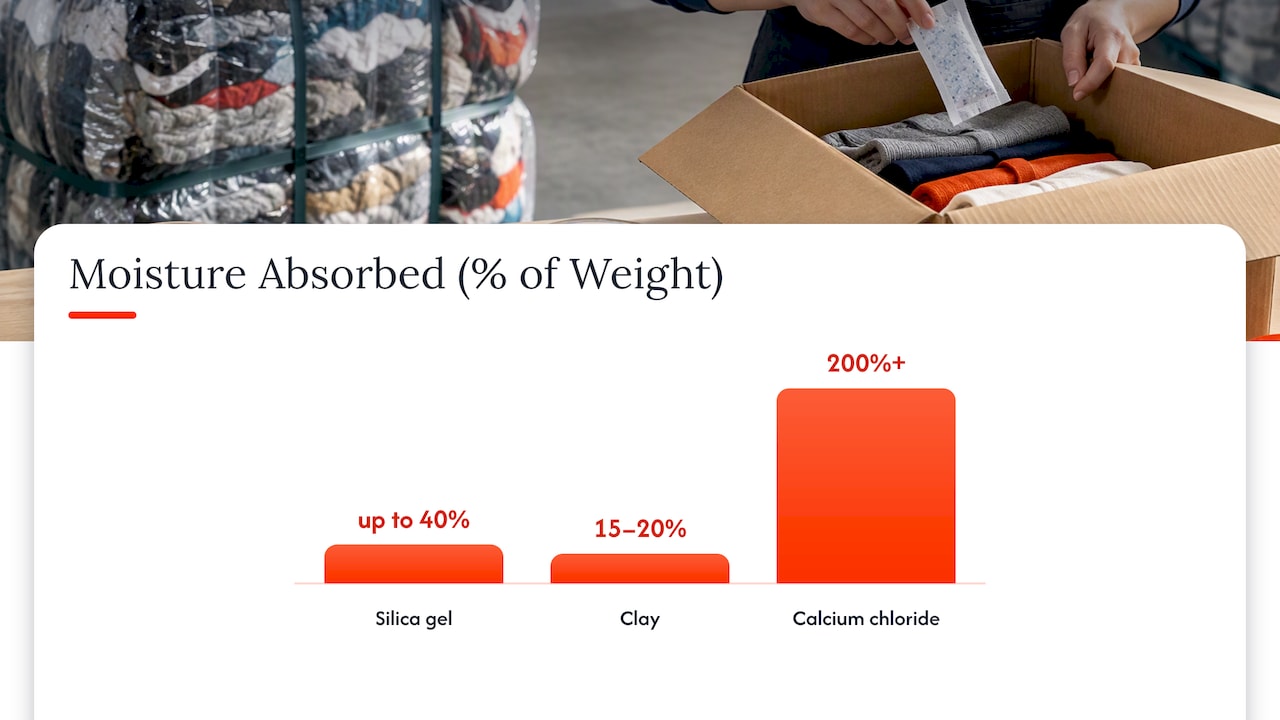
- Silica gel holds up to 40% of its weight in moisture, while calcium chloride can exceed 200% and must never touch clothing.
- Use 10–50 g per carton as a starting range, then increase the amount for larger loads, humid storage, or routes crossing climate zones.
- Place sachets evenly between folded layers, secure them in a secondary pouch, and distribute container strips with clear airflow around the cargo.
- Keep relative humidity below 65%, with 45% to 55% as the ideal range; desiccants buffer humidity but do not replace environmental control.
- Use indicating silica gel or humidity cards to identify saturation, then dry packs again or replace them; saturated desiccant no longer protects cargo.
Table of Contents
- 1. Which desiccant types suit clothing bales?
- 2. How much desiccant do you need per carton and container?
- 3. Where should you place desiccants in bales, cartons and containers?
- 4. How do you monitor and replace desiccants on long voyages?
- 5. What should you check before sealing a clothing bale?
- 6. Why do we pack dry first and desiccate second?
- 7. How can we help you get export-ready, moisture-managed bales?
- FAQ
- Sources
1. Which desiccant types suit clothing bales?
Two mechanisms matter. Silica gel and clay adsorb moisture onto their surfaces and stay solid. Calcium chloride absorbs moisture and turns it into a liquid brine, which is why it grabs so much water and also why it is risky near fabric. Industry desiccant comparison guidance rates silica gel as medium performance for small sealed packs, clay as lower performance but common for garments and cartons, and calcium chloride as very high, designed for containers and export shipments.
- Silica gel: absorbs up to 40% of its weight in moisture, according to National Park Service conservation guidance. It is non-toxic and comes in self-indicating forms.
- Clay: lower capacity, commonly cited at roughly 15–20% of its weight. It is a practical, low-cost choice for cartons of garments.
- Calcium chloride: very high capacity, often quoted at 200% of its weight or more. Use it at container level, never loose among clothing.
- Molecular sieves and hybrid gels: worth considering when you need tight humidity control, such as archival-style buffering. They are overkill for ordinary bale shipments.
Safety is the deciding factor. Calcium chloride is chemically aggressive, and the CTU Code reference warns it should never contact clothing directly because it can cause corrosion and staining if the packaging fails. For garments, fiber-based or clay-based desiccants are generally the safer choice.
Whatever you pick, buy sealed sachets or put them in a secondary pouch. Desiccant dust or leakage on a white T-shirt becomes a claim, not a saving.
2. How much desiccant do you need per carton and container?
Exporter guidance for textiles recommends 10 g to 50 g of desiccant per carton, combined with container-level strips for full loads. Sachets inside bales alone are not enough on long routes, because temperature swings during multi-week ocean transit keep generating fresh moisture.
For bulk exports, carton sachets of 10–50 g plus container-level strips are recommended together for multi-week ocean transit. One layer of protection is rarely enough when humidity fluctuates daily on the voyage. (Drycon)
Size upward when any of these apply:
- The carton or bale is large, so there is more air and more fabric to buffer.
- The goods were stored in a humid warehouse before packing.
- The route is long or crosses climate zones.
- The season is humid at origin or destination.
Here is a simple, illustrative worked example. Say you ship cartons of about 1 cubic foot and plan roughly 10 g per cubic foot as your starting point. A carton of 3 cubic feet then gets about 30 g, which sits inside the 10–50 g range. If the goods read slightly high on moisture or the route is humid, move toward 50 g for that carton. These starting inputs are ours for illustration, not market data, so confirm the final grams with your desiccant supplier’s sizing table.
For the container, the logic changes. The humidity management statement from the marine insurance community explains that moisture forms inside containers daily because of temperature changes, which is why container-level desiccants exist. A calcium chloride bag or strip handles that daily load far better than carton sachets can. The usual approach is to take the manufacturer’s table for your container size, choose the number of bags or strips it specifies for your voyage length, and add the carton sachets on top.
Our conservative rule: for any ocean voyage of several weeks, use both layers. Carton sachets protect the microclimate around the clothing, and container desiccants protect against the container itself sweating.
3. Where should you place desiccants in bales, cartons and containers?
Placement decides whether the desiccant can actually reach the moisture. Follow these patterns:
- Put small sachets evenly inside each carton and between folded layers, so no pocket of clothing is far from one.
- Secure each sachet in a secondary pouch or sealed envelope. Never sprinkle loose desiccant into a bale.
- Keep desiccant bags away from direct fabric contact where leakage is possible, especially with calcium chloride types.
- In containers, distribute bags or strips following the manufacturer’s layout, usually near the doors and along mid-floor positions, rather than clustering them in one corner.
- Leave air paths in the stow. Desiccant buried inside a tightly compressed pocket with no air exchange is starved and does little.
- Keep container strips off the cargo itself, and keep them clear of metal strapping edges that could puncture the packaging.
Textile transport guidance from Germany’s TIS service points out that textiles are sensitive to moisture, dirt and contact with metal, which can cause staining or mildew. That is one more reason to keep strapping, desiccant packs and fabric from touching in ways that trap damp spots.
If you want to see how bale securing fits with container loading, our notes on CTU Code packing specs and machine strapping cover the stowage side.
Pro Tip: Write the desiccant type, quantity and conditioning date on the packing list and the carton label. Warehouse staff and buyers can then track replacements without opening sealed cartons.
4. How do you monitor and replace desiccants on long voyages?
Desiccants are a buffer, not a cure. National Park Service conservators state that desiccants must be monitored and re-dried or replaced because they become ineffective once fully saturated. A saturated sachet is just a bag of inert beads.
Practical monitoring steps:
- Use indicating silica gel or humidity indicator cards. Mixing a few indicator beads in with standard gel is a low-cost way to see when a pack is spent.
- If you need a specific humidity target, condition silica gel to that relative humidity before use. Museum guidance notes this may take repeated exposure steps over days or weeks.
- Replace or re-dry sachets when indicators show saturation, and document the date.
- For long storage rather than shipping, inspect periodically and set a replacement interval based on how fast the packs saturate in your warehouse.
Controlling relative humidity is essential to preventing mold on textiles, with archival guidance advising RH below 65% and ideally between 45% and 55%. Desiccants help buffer that range but must sit inside a wider environment-control plan. (National Archives)
The most important point comes from cargo-loss specialists: moisture damage usually traces back to the cargo’s condition at packing, and desiccants fail if goods or packing materials are damp because they cannot keep up with continuous moisture release. Monitoring catches problems. It does not fix wet goods.
5. What should you check before sealing a clothing bale?
Run this checklist right before sealing bales and containers. It prevents most of the mold and odor claims we see described by buyers.
- Test bale moisture. Check the moisture limit specified by your buyer, and keep the test result on file. Our guide to verifying bale moisture limits explains testing and lab reports.
- Do not pack damp goods. Dry or condition items that read high, and record the retest. Museum guidance on mold and mildew in textiles recommends isolating or cleaning affected items rather than sealing them in with the rest.
- Calculate desiccant needs. Work out carton grams and container bags using the sizing steps above and your supplier’s table.
- Secure the sachets. Use pouches or envelopes, position them evenly, and keep strong desiccants clear of fabric.
- Use dry packaging. Moisture-resistant cartons, dry pallets and dry strapping matter, since wet packing materials keep releasing water into the load.
- Label everything. Note the desiccant type, quantity and date on carton labels and the packing list.
- Check the container. Inspect it for leaks, damp floors and condensation before loading.
If you vacuum pack, read how that interacts with inspections in our guide to preventing port holds on vacuum packed used clothing.
6. Why do we pack dry first and desiccate second?
In our view, the biggest mistake in bale moisture control is treating desiccants as a rescue. A sachet cannot out-compete a bale that was sealed damp. Reliable moisture-control programs start with testing and drying, then add a desiccant specification, then verify with indicators on arrival.
Combining carton sachets with container bags is simply standard practice for dependable export shipments. A written packing specification with marked desiccant use also gives both sides something to point to if a dispute comes up, which cuts port holds and buyer arguments before they start. The desiccant is the cheapest line item on the packing list. The goods are the expensive one.
— rodrigues
7. How can we help you get export-ready, moisture-managed bales?
We pack and ship used clothing in bulk to buyers around the world, using packaging machinery and warehouse capacity. Our packaging options can be tailored to a long route.

When you order, you can discuss:
- Moisture testing of the bales you are buying
- Specified desiccant placement at carton and container level
- Export-ready packaging with documentation on the packing list
If you want to compare packaging options or request samples, start with our used clothing page and tell us your route, container size and transit time. We will work through the packing specification with you.
FAQ
What is the best desiccant to use for clothes storage?
For cartons and short-term storage, sealed silica gel or clay sachets are the safest choices for garments. For container-level moisture control on long shipments, calcium chloride-based products are preferred, but they must be kept out of direct contact with clothing. Industry guidance on desiccant selection draws this same split.
What can I use as a substitute for desiccant?
Controlling the environment is the real alternative: dry the goods first, ventilate the storage area and use a dehumidifier. Archival guidance lists desiccant bags, dehumidifiers and monitored humidity together as options for removing dampness. For sealed export shipments, no household substitute matches a proper desiccant.
Why should you never throw away silica packets?
Used packets can often be re-dried and conditioned rather than discarded, which saves cost and waste. Conservator guidance on silica gel in microenvironments describes conditioning gel to a target humidity for reuse. Check the indicator first, since saturated gel only works again after re-drying.
How many desiccant sachets should go in a clothing carton?
Start with a typical range of 10 g to 50 g per carton and size upward for larger cartons, humid routes or longer transit. For ocean freight, add container-level desiccants as well, following your supplier’s table for container size and voyage length.