
Yes, importing used clothing for resale is legal in most markets, and it runs through a single customs code: HS 6309. Whether a shipment clears smoothly or gets held at port depends almost entirely on what you do before it ships, not after it arrives.
Three things separate a profitable first order from a seized container. First, confirm your HS/HTS classification and look up the actual duty rate for your destination country. Second, verify that country’s specific prohibitions, since some ban used undergarments outright and most require fumigation or disinfection certificates. Third, vet your supplier and physically inspect a sample bale before you wire full payment.
- Classify the shipment under HS 6309 and pull the duty rate for your import country
- Check destination-specific bans, sanitary rules, and fumigation requirements
- Request supplier documentation and a sample bale before committing to a full container
Key Takeaways
Successful used clothing imports depend on correct HS 6309 classification, destination-specific compliance, verified suppliers, and accurate landed-cost planning before any payment is sent.
| Point | Details |
|---|---|
| Classify under HS 6309 | Confirm the exact duty rate for your destination country before sourcing any inventory. |
| Check country-specific bans | Some markets restrict used undergarments or require fumigation certificates before clearance. |
| Verify suppliers with documentation | Request business registration, sample bales, and video proof before paying in full. |
| Budget the full landed cost | Include freight, insurance, duties, port handling, and fumigation fees in your cost formula. |
| Work with an established exporter | Msexpspzoo ships graded bulk used clothing and shoes from Poland to more than 40 countries. |
Table of Contents
- How to Import Used Clothing: The HS 6309 Trade Snapshot
- Regulations and Country Bans That Can Stop Your Shipment
- Step-by-Step: How to Import Used Clothing From Order to Delivery
- Shipping Used Clothing: Bales, Containers, and What It Actually Costs
- Verifying a Used Clothing Supplier Before You Pay
- Valuation, Duties, and Declaring Fair Market Value
- Common Compliance Pitfalls That Delay or Kill a Shipment
- Negotiating Contracts With Overseas Used Clothing Suppliers
- Insurance for Used Clothing Shipments
- Managing Currency Risk When Paying Overseas Suppliers
- Sourcing Bulk Used Clothing Without the Guesswork
- Where to Verify HS 6309 Rules and Trade Data
- Frequently Asked Questions
- Sources
How to Import Used Clothing: The HS 6309 Trade Snapshot
Used clothing sits under HS/HTS code 6309, the classification customs authorities worldwide use to tax and track secondhand apparel. Before you source a single bale, look up 6309 in your country’s tariff schedule (the USITC’s HTS chapter index is the reference point for U.S. importers) to confirm your landed duty rate.
The scale of this trade is bigger than most newcomers expect. Global trade in used clothing hit roughly $4.96 billion in 2024, with the United States, China, and the United Kingdom as the leading exporters. On the demand side, Pakistan, the United Arab Emirates, and Kenya rank among the top importers, reflecting strong resale markets across South Asia, the Gulf, and East Africa.
- Top exporters: United States, China, United Kingdom
- Top importers: Pakistan, United Arab Emirates, Kenya
- Lookup tool: UN ComtradePlus for bilateral trade volumes by country and year
Pulling your own trade data before you commit to a sourcing region tells you whether demand is growing or shrinking in that market, not just whether a supplier says it is.
Regulations and Country Bans That Can Stop Your Shipment
Rules for secondhand apparel vary so much by country that assuming “used clothing” is a single global category is the fastest way to lose a shipment. Some nations restrict specific categories rather than banning imports outright. Zimbabwe, for instance, has banned the sale of secondhand undergarments on public health grounds, and similar restrictions on undergarments appear elsewhere in East and Southern Africa.
Fumigation is the requirement that trips up the most first-time importers. Many countries in Africa and Latin America require a fumigation or disinfection certificate before a bale of used textiles can clear port, and customs authorities in Kenya will seize or return shipments arriving without one.
Before placing an order, check:
- The destination country’s official customs or trade portal for prohibited or restricted textile categories
- Whether a fumigation or phytosanitary certificate is mandatory for used textiles on arrival
- Local marking, labeling, or grading requirements that apply specifically to secondhand goods
Pro Tip: Ask your freight forwarder for the exact document checklist port inspectors use in your destination country. Forwarders who work that route regularly usually know which paperwork triggers manual inspection versus which sails through automated clearance.
Step-by-Step: How to Import Used Clothing From Order to Delivery
A first commercial shipment of used clothing moves through the same broad sequence everywhere, even though the paperwork changes by country. Here’s the order that keeps most shipments moving.
- Source and sample. Request photos and a small sample bale from your supplier before committing to a container.
- Agree on contract terms and Incoterms. Lock in grade, weight, price per kilo, and who’s responsible for freight, insurance, and customs at each leg of the journey.
- Book transport and confirm packing. Decide on baled bulk versus boxed cargo and reserve container space (FCL or LCL, covered below).
- Collect pre-shipment documents. Commercial invoice, packing list, certificate of origin, and fumigation certificate if your destination requires one.
- Track transit and prepare for arrival. Share your HS 6309 classification and duty estimate with your customs broker before the vessel docks.
- Clear customs. Your broker files entry, pays duties, and coordinates any physical inspection.
- Take delivery and quality-check the full lot. Compare what arrived against your original sample.
Attach a document owner to each step: the supplier handles the invoice and packing list, the freight forwarder manages booking and the bill of lading, and your customs broker files entry paperwork and pays duty on your behalf.
- Confirm who pays for demurrage if customs inspection delays container release
- Keep a digital copy of every document in case of a repeat order dispute
Pro Tip: For a first-time supplier relationship, negotiate FOB or CIF terms rather than EXW. It shifts more logistics responsibility onto the seller and gives you a clearer, single point of contact if something goes wrong in transit. Pay a deposit through a method that offers dispute protection, and hold the balance until the sample or first container clears inspection.
Shipping Used Clothing: Bales, Containers, and What It Actually Costs
Used clothing almost always ships as compressed bales, typically 45 to 100 kilograms each, either loaded loose into a container or stacked on pallets. Boxed or palletized cargo costs more per kilo but simplifies inspection and reduces the risk of contamination between grades. Air freight is rarely used for this category since the value per kilo doesn’t justify the cost.
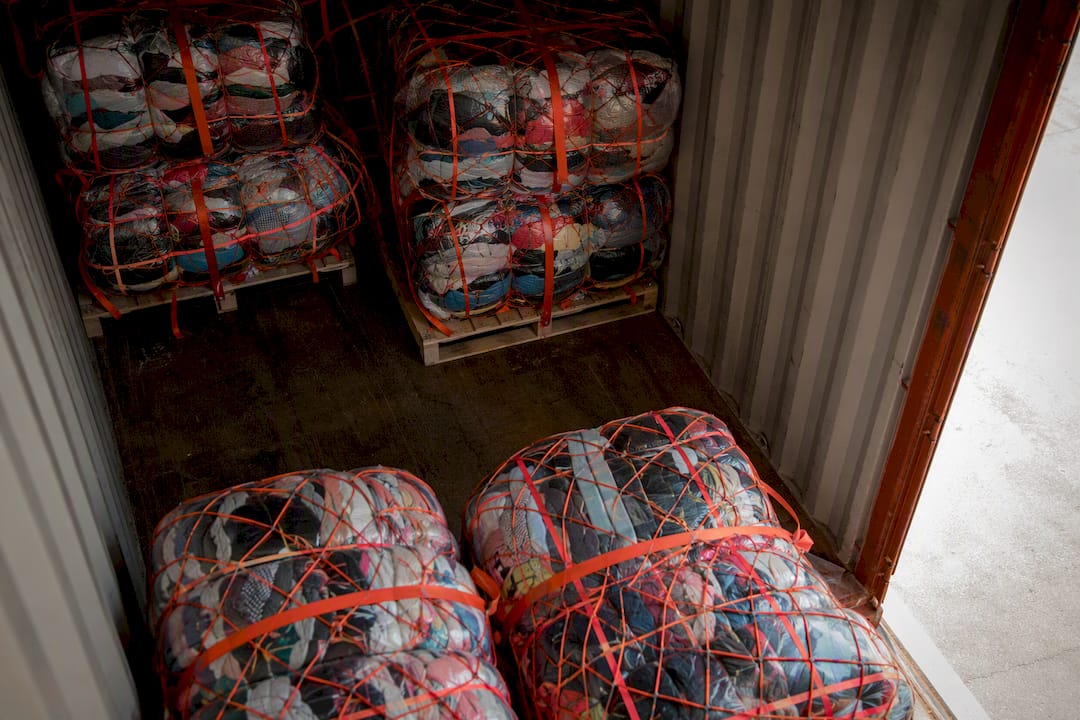
Full container load (FCL) is the standard for established buyers moving 15 to 25 tons at a time, since it lowers the per-kilo freight rate and reduces handling. Less than container load (LCL) suits smaller test orders but adds per-shipment handling fees and often extends transit time because cargo gets consolidated with other shippers’ goods.
Your landed cost stacks up from several line items:
- Purchase price per kilo or per bale
- Ocean or land freight
- Cargo insurance
- Import duty and VAT/sales tax based on your HS 6309 rate
- Port handling and terminal fees
- Customs broker fees
- Fumigation or disinfection certificate costs where required
A simple working formula: landed cost = (purchase price + freight + insurance) × (1 + duty rate) + port and broker fees. Ocean transit alone typically runs two to six weeks depending on origin and destination, and customs clearance can add anywhere from a few days to several weeks if your shipment gets flagged for physical inspection, particularly when fumigation documents are missing or incomplete.
Verifying a Used Clothing Supplier Before You Pay
Fraud in the secondhand apparel trade usually shows up as low-grade product, mislabeled sorting, or bales that never ship at all. A short verification checklist catches most of it before money changes hands.
Ask every new supplier for:
- A commercial invoice and packing list matching the agreed grade and weight
- Proof of business registration in their operating country
- A fumigation or disinfection certificate if your destination requires one
- Recent photos and short video of the actual bales being packed, not stock images
- References from at least one existing buyer, ideally one you can contact directly
Request a small sample bale before your first full container. A legitimate wholesaler will send one for a reasonable fee or credit it against your first order, since it’s standard practice in this trade.
Pro Tip: Treat any supplier who refuses video verification, insists on full upfront payment via untraceable transfer, or can’t produce a business registration number as a red flag. Third-party pre-shipment inspection services exist specifically to check grade and weight on your behalf before the container leaves origin, and the cost is small compared to eating a bad lot.
Valuation, Duties, and Declaring Fair Market Value
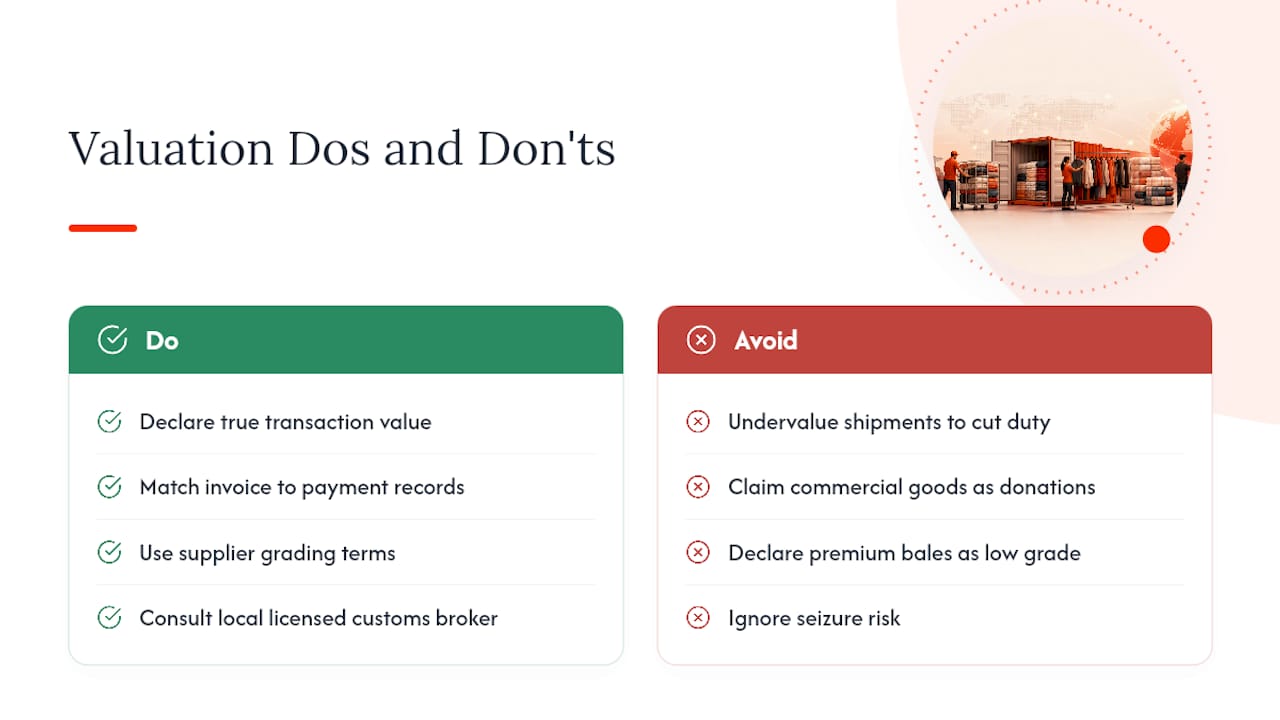
Customs authorities assess duty on used clothing based on its declared transaction value, not on the original retail price of the garments when new. Undervaluing a shipment to reduce duty is a common temptation and a common way to trigger a customs audit, since inspectors compare declared values against typical wholesale prices for that grade and weight of secondhand textile.
Fair market value for used apparel generally reflects what a buyer actually paid the supplier per kilo or per bale, documented on the commercial invoice. Keep that invoice consistent with your payment records and any wire transfer or letter of credit, because customs authorities treat commercial imports differently from donated goods, and a shipment declared as a commercial resale lot faces duty, marking, and sometimes flammability standards that donated clothing does not.
Grading matters too. Bales sold as “cream” or “A grade” secondhand clothing command a higher per-kilo price than mixed or “B grade” lots, and declaring a premium bale as low-grade to shave duty is exactly the kind of mismatch that gets flagged during inspection. Keep your supplier’s grading terminology consistent with what you declare, and retain the original invoice language.
If you’re unsure how your destination country treats a specific valuation method, a licensed customs broker in that country is worth the fee before your first shipment, not after a dispute. Misdeclared value doesn’t just risk a fine. In several jurisdictions it can result in the entire shipment being seized pending review, which ties up your capital for weeks while the paperwork gets sorted out.
Common Compliance Pitfalls That Delay or Kill a Shipment
Most shipment delays trace back to a small number of repeat mistakes, and nearly all of them are preventable with paperwork done a week earlier.
Missing fumigation certificates top the list in markets across Africa and Latin America, where ports routinely hold or return uncertified used-textile shipments. The fix is simple: confirm the requirement before booking freight, not after the container is at sea.
Misclassification under the wrong HS code is the second most common issue. Some importers try to classify used clothing under codes meant for new apparel to access a lower duty rate, which customs systems are specifically built to catch through document cross-referencing.
A few other patterns worth watching:
- Inconsistent invoice values across the commercial invoice, packing list, and insurance certificate raise automatic red flags in most customs systems.
- Missing certificates of origin delay preferential duty treatment where trade agreements apply.
- Prohibited item mixing, such as undergarments shipped into a market that bans them, can result in the whole bale being rejected rather than just the offending items.
- Late or incomplete pre-shipment notifications in countries that require advance cargo information can trigger automatic inspection holds.
Building a standard document checklist per destination country and reusing it for every order is the single highest-leverage habit an importer in this category can build. Once you’ve cleared a route successfully, the second shipment moves far faster than the first.
Negotiating Contracts With Overseas Used Clothing Suppliers
Contract terms in this trade are more flexible than in most manufactured-goods sourcing, which cuts both ways: you have room to negotiate, but vague terms create real risk when a dispute happens mid-shipment.
Lock in grade definitions in writing. “Cream,” “A grade,” “mixed,” and “B grade” mean different things to different suppliers, so specify the exact sorting standard, and ask for a written grading sheet or sample photos referenced by name in the contract itself.
Negotiate Incoterms deliberately rather than defaulting to whatever the supplier proposes. FOB (Free on Board) shifts freight booking and cost to you but gives you control over the carrier and insurance. CIF (Cost, Insurance, Freight) puts more responsibility on the supplier, which suits first-time buyers who want fewer logistics variables to manage.
Payment structure matters as much as price per kilo. A common, lower-risk structure for new supplier relationships is a partial deposit, often 30%, with the balance due against a copy of the bill of lading or after a pre-shipment inspection confirms the container’s contents. Full upfront payment on a first order with an unverified supplier is the single riskiest term you can accept, regardless of how attractive the price looks.
Put a dispute resolution clause in writing, including which country’s law governs the contract and how quality disagreements get resolved, before your first order rather than during a disagreement over a bad bale.
Insurance for Used Clothing Shipments
Cargo insurance for used clothing imports covers loss or damage during ocean transit, something that matters more than new buyers often assume given how many hands a container passes through between origin warehouse and destination port.
Marine cargo insurance typically costs a small percentage of the shipment’s declared value and covers scenarios like water damage, container loss overboard, and theft during transit or port handling. Given how relatively low-cost insurance is compared to the value of a full container of bales, skipping it to save a marginal amount on a shipment worth tens of thousands of dollars is a false economy.
Check whether your Incoterm already includes insurance. CIF terms mean the supplier arranges coverage, but confirm the policy actually names you as the beneficiary and covers the full transit route, not just the origin port. Under FOB terms, insurance is entirely your responsibility to arrange, typically through a freight forwarder or a dedicated marine cargo insurer.
Also confirm what your policy excludes. Some cargo insurance policies exclude damage from improper packing, which matters for baled textile cargo where compression and moisture during a long ocean transit can affect certain fabric types. Ask your insurer directly whether baled secondhand clothing falls under standard cargo terms or requires a specific rider, and get that answer in writing before you rely on it during a claim.
Managing Currency Risk When Paying Overseas Suppliers
Most used clothing suppliers invoice in U.S. dollars or euros regardless of where they’re based, which means your actual cost can shift between the day you agree on a price and the day you pay, especially on larger orders with 30 to 60 day payment terms split across a deposit and balance.
A few practical approaches reduce that exposure. Locking in the exchange rate at the time of contract signing, through a forward contract with your bank, protects your margin on larger orders where even a small currency swing meaningfully changes your landed cost per kilo. Many banks and payment platforms offer this for business accounts moving amounts above a certain threshold.
Paying in the supplier’s preferred currency rather than converting twice, once from your currency to a third currency and again to theirs, also reduces the fees and spread you absorb on each transaction. If you’re placing repeat orders with the same supplier, negotiating a fixed price in a single currency for a defined period removes a layer of uncertainty from your cost planning entirely.
For smaller or first-time orders, using a business payment platform with transparent, published exchange rates beats a traditional bank wire, where the built-in spread on the conversion is often not disclosed upfront. Compare the total cost, not just the headline transfer fee, before choosing a payment method for your first supplier relationship.
A Wholesaler’s View on Sourcing Reliability
Running bulk exports of secondhand goods across dozens of destination markets teaches you fast that paperwork problems, not product quality, sink most first shipments. Warehouse capacity and shipping experience across many countries matter less as marketing points and more as the practical difference between a supplier who’s seen your destination’s customs quirks before and one who hasn’t. If you’re weighing a first order, ask any prospective supplier how many countries they currently ship to and what breaks most often.
Sourcing Bulk Used Clothing Without the Guesswork
If everything above sounds like a lot to manage on a first order, that’s because it is, and it’s exactly the gap Msexpspzoo was built to close. Operating from a 133,000 square foot warehouse in Poland with shipping relationships across more than 40 countries, Msexpspzoo handles the sourcing, grading, and packaging so your team isn’t chasing fumigation certificates and supplier verification from scratch.
That means bulk supply of graded used clothing alongside used shoes for buyers building multi-category orders, advanced baling machinery for faster turnaround, and support navigating the international paperwork this guide just walked you through. If you’d rather work with a supplier who already knows the fumigation and documentation requirements for your destination market than learn them the hard way on your first container, request a bulk quote and minimum order details directly from Msexpspzoo’s used clothing page.
Where to Verify HS 6309 Rules and Trade Data
Confirm your numbers before you commit to a shipment, not after.
- USITC HTS chapter index to look up HS 6309 duty rates by chapter
- UN ComtradePlus to check trade volumes between specific countries
- CBP Customer Service for U.S. entry documentation requirements
- Destination country customs or trade ministry sites for local bans and fumigation rules
Frequently Asked Questions
Is it legal to import used clothing for resale?
Yes, in most countries, provided you classify the shipment correctly under HS 6309 and meet destination-specific requirements like fumigation certificates or restrictions on certain garment categories.
Do I need a fumigation certificate for every shipment?
Not everywhere, but many countries across Africa and Latin America require one for used textiles, and shipments arriving without it risk seizure or return at the importer’s cost.
What’s the cheapest way to ship used clothing in bulk?
Baled cargo in a full container load (FCL) offers the lowest per-kilo freight cost for buyers moving 15 to 25 tons; smaller test orders typically use LCL at a higher per-unit rate.
How do I verify a used clothing supplier is legitimate?
Request business registration proof, recent photos and video of bales being packed, a sample shipment, and references from an existing buyer before paying in full.
How is duty calculated on used clothing imports?
Duty is based on the declared transaction value under HS 6309, not the original retail price, so keep your invoice consistent with actual payment records to avoid valuation disputes.
Sources
- Used Clothing (HS: 6309) Product Trade, Exporters and Importers | The Observatory of Economic Complexity
- UN ComtradePlus — trade query for HS 6309
- CBP Customer Service
- Kenya importation protocols for used textiles and shoes | Cotecna
- Import Norms of Second Hand Clothing – Fibre2Fashion