
Industrial used clothing warehousing covers the sorting, grading, and bale-packing operations that turn mixed secondhand donations into resale-ready inventory for wholesale and export. Before you commit to any lot, insist on bale-level specifications and full documentation. Msexpspzoo operates this kind of facility, and providers like it are worth evaluating against the checklist below.
TL;DR:
- Quality and consistency of grading standards vary across warehouses, making detailed bale specifications essential for verifying expected product mix.
- Export regulations require written sorting records, classification declarations, and pre-shipment evidence to avoid misclassifying used textiles as waste.
- Suppliers who cannot provide detailed bale specs, documentation, or local inspection reports increase the buyer’s legal and quality risk.
- Automated baling and documentation systems improve packing density, reduce costs, and support compliance, giving early movers an advantage amid tightening regulations.
- Weighing bales upon arrival and matching them against specified weights helps detect discrepancies early and supports valid claims if needed.
Table of Contents
- What Warehousing Operations Mean for Resale
- When Can a Used Clothing Shipment Be Treated as Waste?
- What Bale Specs and Paperwork Should You Demand?
- How Should Buyers Verify Bale Quality Before Shipment?
- A Step-by-Step Buyer Checklist for Ordering Bulk Bales
- Warehousing as Both a Circularity Tool and a Business Safeguard
- Get Bale Specs and a Quote From Msexpspzoo
- Sources
- FAQ
What Warehousing Operations Mean for Resale
A warehouse’s intake process decides what you end up selling. Incoming stock gets separated into reuse candidates and material headed for recycling or disposal, then graded by condition, season, and category before it goes into a bale. That grading step is what makes one bale of “grade A” mixed clothing worth more than a bale of unsorted originals, since the buyer already knows roughly what’s inside.
Packing method matters just as much as sorting quality. Machine-assisted balers compress stock into denser, more uniform units, which lowers shipping cost per pound and speeds up container loading. Manual baling still exists at smaller operations, but density and shape vary more, which complicates freight planning. Automated sorting also tends to raise throughput and consistency, though that capability often comes with a price premium buyers should weigh against faster turnaround.
Before you place an order, check on:
- Turnaround time from order confirmation to bale readiness
- Stock breadth across categories (clothing, shoes, bags, rags)
- Warehouse capacity and whether it can fill repeat orders at scale
- Consistency of grading standards across different production runs
When Can a Used Clothing Shipment Be Treated as Waste?
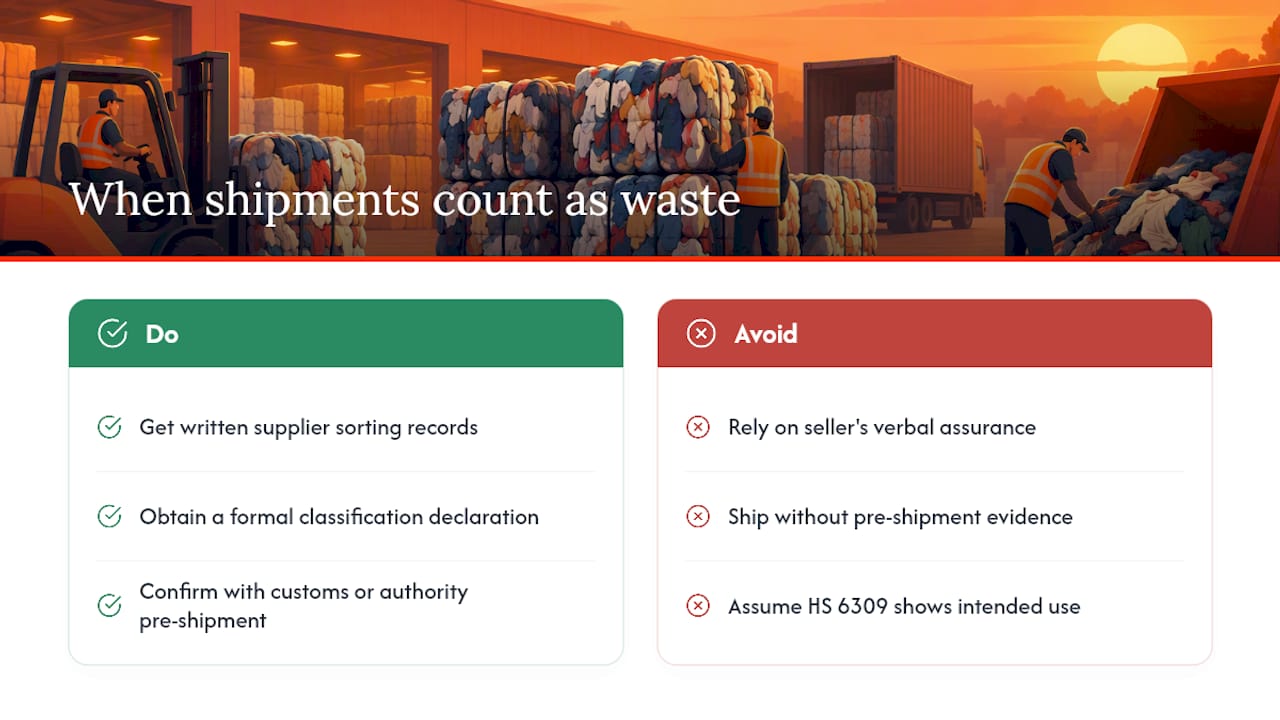
This is the risk that catches new importers off guard. Under the European Union’s revised Waste Framework Directive, separately collected textiles can remain classified as waste until they’re sorted and formally declared fit for reuse. Classification hinges on origin, destination, composition, and the judgment of the competent authority at the border, not on what the seller calls the shipment.
Misclassification carries real cost. A container flagged as waste rather than used goods can face port delays, forced return to the country of origin, or fines, depending on the jurisdiction. Compounding the problem, the current HS 6309 trade code lumps reuse, recycling, and waste flows together, which reform proposals argue makes it harder for customs officers to identify intended end-use at a glance.
Regulation (EU) 2024/1157 pushes in the opposite direction, calling for harmonized sorting requirements and pre-shipment evidence specifically to stop waste from moving under the “used goods” label. For a buyer, that means three safeguards are non-negotiable: written sorting records from the supplier, a formal classification declaration, and a conversation with your customs broker or the destination country’s authority before the container leaves port. Don’t rely on a seller’s verbal assurance that “it’s all fine” once it lands. Confirm it in writing, and confirm it with someone who isn’t selling you the goods.
What Bale Specs and Paperwork Should You Demand?
A bale spec is the single most useful document you can request before paying a deposit. Without one, you’re buying blind, and disputes over “what was actually in the bale” become nearly impossible to resolve.
Ask every supplier for these fields on every bale, before you order:
- Category and intended wearer (men’s, women’s, children’s, mixed)
- Product mix (percentage breakdown by garment type)
- Season (summer, winter, or mixed seasonal)
- Quality grade (A, B, cream, or the supplier’s own grading scale, explained)
- Size profile (dominant size range)
- Packing format and target weight, with a stated tolerance for variance
- Bale ID and labeling that ties the physical unit back to its paperwork
On the commercial side, you need a commercial invoice, a packing list that references bale IDs individually, a transport document, clear origin information, and any classification declarations or permits the destination market requires. Suppliers that can’t produce this consistently, as recommended in end-of-waste position papers, are asking you to take on risk that should sit with them.
Pro Tip: Save every bale spec you receive, even from orders you don’t complete. A supplier’s specs from six months ago are your best evidence if a later shipment doesn’t match what was promised.
How Should Buyers Verify Bale Quality Before Shipment?
Photographs feel like proof. They aren’t, on their own. Representative bale photographs help buyers get a sense of condition and mix, but they don’t substitute for written specifications or customs review once a shipment is under legal scrutiny. Treat images as a supplement to paperwork, never as the paperwork itself.
The stronger verification method is documentation that ties directly to the physical goods. Ask for sorting logs, lot references, and, on larger orders, representative sampling where a set number of bales from a given production run get opened and checked against the stated grade. Some buyers arrange third-party pre-shipment inspection for first orders or high-value containers. It costs money upfront, but it’s cheaper than a rejected container.
Before you sign off on payment, confirm the supplier can provide:
- Sorting logs that show how the batch was graded, not just the final tally
- Lot references connecting specific bales to specific production runs
- Photographs of representative, randomly selected bales, not staged samples
- A written claims process for what happens if delivered bales don’t match spec
On arrival, match physical bales against the original spec, weight class by weight class, before you distribute inventory to your own buyers. Field research on sorting hubs shows real variation in bale weights and packing formats between operations, which is exactly why matching against your own written spec matters more than trusting the label on the bale. Record any discrepancy with photos and weights the day the container is opened, not weeks later when memory and evidence have both degraded.
Pro Tip: Weigh a random sample of five bales the moment they’re unloaded. If the average deviates more than a few percentage points from the spec’s stated tolerance, you have a documented claim, not just a complaint.
A Step-by-Step Buyer Checklist for Ordering Bulk Bales
Treat every order as a four-stage process, and don’t skip stages just because a supplier feels trustworthy on the first call.
- Pre-order. Issue a written bale spec and purchase order that states category, grade, weight tolerance, and acceptance criteria in plain terms.
- Pre-shipment. Request documentation, representative photos, or a formal inspection, and confirm transport and customs paperwork are ready before the container ships.
- On receipt. Match delivered bales against the spec, weigh a sample, and log any discrepancy immediately with photos and numbers.
- Claims. Follow the contractual resolution process you agreed to before ordering, not an improvised negotiation after the fact.
Watch for red flags at every stage: a supplier who refuses inspection requests, packing lists too vague to reference specific bales, “unsorted originals” marketed as graded stock, or bale labels that don’t match each other from one shipment to the next. Any one of these should slow you down before you slow down on the dock.
Warehousing as Both a Circularity Tool and a Business Safeguard
Pre-export sorting does two jobs at once. It separates genuinely rewearable clothing from material that should be recycled or discarded, which supports circular trade objectives that regulators and trade bodies increasingly track. It also functions as a commercial control: a supplier who documents every bale is a supplier who has already absorbed the compliance risk you’d otherwise inherit.
As sorting rules tighten across major import markets, the warehouses that invested early in grading systems and packaging machinery will be the ones still shipping smoothly while others scramble to catch up on paperwork.
— rodrigues
Get Bale Specs and a Quote From Msexpspzoo
A wholesale used goods provider runs a large warehouse and uses packaging machinery to ensure faster bale turnaround compared with manual operations. That combination matters for the checklist above: homogeneous, labeled bales; documented sorting; and pre-shipment photos or inspection available on request instead of promised and forgotten.
If you’re comparing suppliers against the bale-spec standards outlined here, start by requesting a template directly. Visit the used clothing landing page to ask for bale photos, sorting documentation, and a quote sized to your order volume. Buyers sourcing footwear alongside apparel can request the same level of detail through the used shoes page, and anyone stocking non-clothing lines can check the recycled industrial wiping rags catalog for a separate product stream. Get the paperwork before you get the container.
Sources
- ECOS and EEB position on End-of-Waste criteria for reuse textiles
- Revised Waste Framework Directive enters into force (European Commission)
- Making trade work for circularity (WTI / ECE-ECLAC joint study)
- UNECE report on second-hand clothing trade and sorting hubs
- Regulation (EU) 2024/1157 on shipments of waste (excerpts)
FAQ
What documents should I request before paying for a bale order?
Ask for a commercial invoice, a packing list that references individual bale IDs, a transport document, and origin information at minimum. If your destination market requires classification declarations or permits, get those in writing before the container ships, not after it arrives.
How do I know if a shipment could be classified as waste instead of used goods?
Under the EU’s revised Waste Framework Directive, separately collected textiles can be treated as waste until sorted and formally declared fit for reuse. Confirm sorting records and classification status with your customs broker before committing to an order, since rules vary by destination.
Are bale photographs enough to verify quality before shipment?
No. Photographs help but don’t replace written specifications or customs review, since a single image can’t show weight tolerance, grade consistency, or product mix across a whole bale. Request sorting logs and lot references alongside any photos.
What is a bale specification and why does it matter?
A bale specification lists the category, product mix, season, grade, size profile, packing format, and weight tolerance for a given bale before you order it. It’s your primary evidence if delivered goods don’t match what was promised, and suppliers who can’t produce one consistently are shifting risk onto you.
Does Msexpspzoo provide bale documentation and photos for wholesale orders?
Msexpspzoo operates a large warehouse and can provide bale documentation and photos on request for buyers evaluating an order. Reach out through the used clothing page for current specs, availability, and pricing.