
Safe bale storage comes down to four things: stacks that cannot slide or collapse, mechanical handling instead of muscle, aisles and fire controls that keep people and flames apart, and a named person with the authority to stop work. Most serious bale injuries trace back to one of those four being missing. This guide covers each, with the U.S. rules that apply and the practical checks a warehouse manager can run this week. It is written for operators handling heavy compressed bales, such as used clothing, shoes, bags and textile waste.
TL;DR
- Stack bales evenly on firm, level ground, interlock them, and cap stack height for your floor, your bale type and your layout. OSHA requires tiered bundles to be stacked, blocked, interlocked and limited in height so they resist sliding or collapse.
- Move bales with forklifts, clamp trucks or conveyors. Export bales are too heavy for manual handling, and only trained operators should drive powered trucks.
- Keep aisles at least 4 feet wide, limit block sizes, and have sprinklers inspected every year by a qualified contractor.
- Inspect stacks weekly and record what you find. A stack that looks stable can shift within minutes.
- Put one competent person in charge of stacking, with the authority to halt operations.
Table of Contents
- Why bales hurt people
- The U.S. rules that apply
- Build stacks that stay up
- Handle bales mechanically
- Layout does half the work
- Fire: bales burn, and they burn deep
- Hygiene, pests and paperwork
- A weekly bale safety routine
- Our perspective
- Buying bales that are easier to store safely
- FAQ
- Sources
Why bales hurt people
A compressed bale is a dense, heavy block, and it falls the way a block falls: all at once. OSHA’s emphasis program for warehousing notes that heavy clothing bales weighing 500 to 780 pounds are among the hazards behind struck-by injuries, alongside powered industrial truck incidents. The same document reports a rate of 5.5 cases per 100 full-time workers in warehousing and storage in 2021, against 2.9 for all private industry.
The human cost is documented. A NIOSH fatality investigation covers a supervisor at a used clothing processing facility who died when clothing bales fell on him. Its recommendations are plain: perform a job analysis and hazard assessment of bale storage practices, then write a safe stacking guide and train employees on it.
The UK Health and Safety Executive lists the recurring causes of serious bale injuries, including unsafe manoeuvring and loading of vehicles and unsafe stacking. The HSE is a British regulator, so its pages are guidance rather than U.S. law, but the physics of a 45 kg or 500 pound block does not change at the border. In the U.S., the binding rules are OSHA’s.
The U.S. rules that apply
OSHA has no standard written only for bales. Several general standards do the work:
| Topic | Rule | What it means for bales |
|---|---|---|
| Storage | 29 CFR 1910.176 | Stacks must be stable and secure against sliding or collapse. Storage areas must be free of accumulations that create tripping, fire or pest hazards. |
| Powered trucks | 29 CFR 1910.178 | Operators must complete training and evaluation before driving, and trainees work under direct supervision. |
| Program emphasis | OSHA’s warehousing National Emphasis Program | Sets how inspectors approach warehouses and distribution centers. |
OSHA’s materials handling and storage guide adds the practical expectation that stored materials must not create a hazard and that workers must be made aware of factors such as height, weight and accessibility. If your state runs its own OSHA-approved plan, check its version of these rules too.
Build stacks that stay up
Start with the ground
Stack on firm, level ground. A slab with a slope, a soft patch or a damaged section turns a good pattern into a slow-motion collapse. Check the floor’s load rating before you decide how high to go, not after.
Interlock, don’t just pile
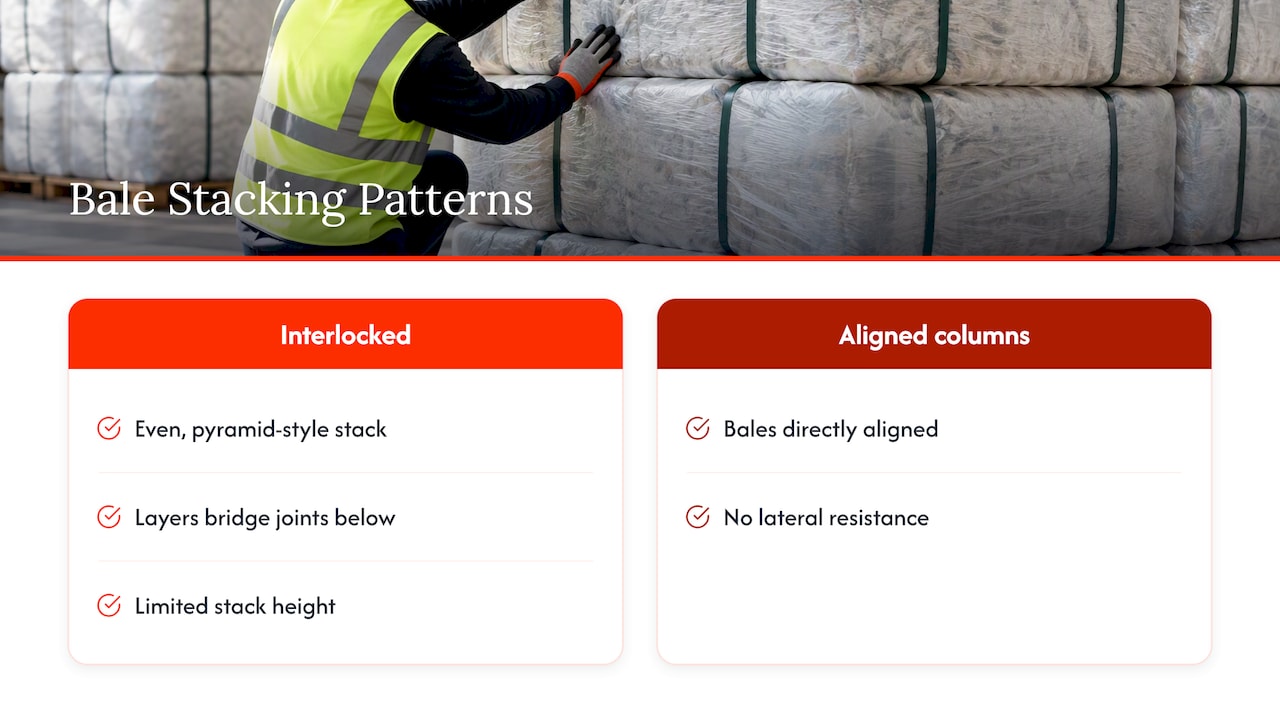
HSE guidance on safely stacking bales of waste material and on bale handling in textiles points to the same habits: even stacking, pyramid-style construction, interlocked layers and limited height. Each layer should bridge the joints of the layer beneath it. Columns of bales sitting directly on top of each other have no lateral resistance at all.
Know your wrapping
Surface texture matters more than most teams expect. HSE notes that plastic-wrapped bales slip far more readily than cloth-bound ones, so the same stacking pattern can behave differently from one consignment to the next. If a container arrives with a different wrap, treat it as a new stacking problem and lower the stack until you have seen how it behaves. For more on how bales are wrapped and strapped before they reach you, see our guide to machine strapping and packing specs for used clothing and our note on vacuum-packed used clothing.
Set height by the facility, not the catalog
There is no universal safe height. It depends on bale weight, wrap, floor, aisle width, and how your trucks place and retrieve bales. Write the limit down for each bale type and mark it on the floor or racking. A written limit is also what a hazard assessment of the kind NIOSH recommends should produce.
Keep the stack alive in your head
The most common mistake is treating bale storage as static. A stack that looked solid at 8 a.m. can lean by noon because a bottom bale has compressed, a strap has failed or a neighbor was pulled. Inspect weekly at minimum, record the result, and look for leaning columns, torn wrap, snapped straps, crushed lower bales and bulging sides. Remove damaged bales from the stack before anything else is loaded.
Routine checklists work best when they have owners and dates. A daily-to-annual checklist approach written for retail point-of-sale managers shows the same rhythm, with tasks split by frequency, and it adapts easily to a stack inspection log.
Handle bales mechanically
HSE’s manual handling guidance for textiles is blunt: bales are generally too heavy to be handled without mechanical help, and even hand trucks carry serious injury risk. Small bundles may weigh 9 to 22 kg, and export bales are far heavier.
In practice:
- Use the right attachment. Forklifts with clamps or properly rated forks, clamp trucks and conveyors should do the lifting. Never let someone steady a bale by hand while it is raised.
- Train and evaluate every driver. OSHA requires operators to complete training and evaluation before operating a powered industrial truck, and trainees work only under direct supervision by someone qualified.
- Separate people from trucks. Mark pedestrian routes, keep walkers out of loading zones, and never allow anyone to stand beside a stack that is being worked.
- Plan vehicle loading. Loading and unloading trailers and containers is a recognized injury point. Chock wheels, check the floor of the container, and unload from the door end in a controlled sequence so bales do not fall out when the doors open.
- Plan the pick order. Take from the top and from the front of a stack. Never pull a bale out of the middle or bottom.
Layout does half the work
Physical design prevents injuries that worker caution cannot. Leave aisles wide enough for trucks and pedestrians to pass without conflict. Keep stack faces away from doors and walkways where a collapse would land on traffic. Store bales in designated areas rather than wherever there is a gap.
Floors matter too. Spills, loose strapping, shredded wrap and dust create slip and trip hazards at exactly the spots where people walk beside heavy loads. A commercial cleaning guide for retail floors is written for stores in Australia, but its floor-hygiene routines translate well to a receiving dock or pick aisle.
Fire: bales burn, and they burn deep
Compressed textiles are combustible, and a fire inside a dense block is hard to reach. The ILO’s fire risk management guidance supports the following controls for combustible bale storage:
- Restrict storage to designated areas.
- Keep clear aisles of at least 4 feet.
- Limit block sizes. The ILO example for compressed cotton is 700 bales per block.
- Have automatic sprinkler systems inspected annually by qualified contractors.
- Keep exit routes and doors unobstructed and unlocked during working hours.
OSHA’s housekeeping rule on accumulations that create fire or pest hazards points the same way. Ask your insurer and local fire marshal what they require, because local fire codes can be stricter than any general guidance. Sprinkler clearance also limits how high you can stack: bales that crowd the heads defeat the system.
Hygiene, pests and paperwork
Safety extends past stacking. Used textiles and footwear can carry pests, and some importing countries require treatment. Kenya’s protocol, for example, says used clothing and shoes must be cleaned and fumigated before baling and accompanied by a certificate from a competent authority in the country of supply. That is a Kenyan import rule, not a universal one, but it shows why clean storage, inventory records and consignment traceability belong in the same system as stack safety. Moisture is another quiet hazard, which is why many exporters use desiccants in clothing bales.
Good records also help when a bale has to be traced. Clear marking is covered in our piece on bale labeling standards, and storage specs buyers should ask suppliers about are in 7 bale specs for used clothing warehousing.
A weekly bale safety routine
Use this as a starting template and adapt it to your site.
Daily
- Walk aisles and exits for obstructions, spills, loose strapping and wrap.
- Check truck pre-use inspections.
- Confirm nobody is working beside an active stack.
Weekly
- Inspect every stack for lean, crushed lower bales, torn wrap and broken straps, and log the result.
- Compare stack heights against your written limits.
- Remove or restack any damaged bales.
Monthly
- Review near misses with the team.
- Check floor condition where stacks stand.
- Confirm block sizes and aisle widths still meet your plan.
Annually
- Have sprinklers inspected by a qualified contractor.
- Refresh and re-evaluate truck operators.
- Repeat the hazard assessment and update the written stacking guide.
Our perspective
We ship bales for a living, so we see this problem from both ends: the packing line and the receiving dock. Bale quality and bale safety are connected. A bale that is evenly pressed, strapped consistently and labeled clearly is easier to stack, easier to count and less likely to burst a strap in your racking. That is one reason we invest in advanced packing machinery: it lets us produce uniform bales quickly, and uniformity is what makes a stacking plan predictable.
Our warehouse covers 133,000 square feet, and we ship to more than 40 countries, so we never assume a receiver’s setup. Our advice is the same everywhere: decide your height limits before the container arrives, make sure your forklift attachments match the bale size, and give one person the authority to stop the job. The cheapest safety control is a supervisor who is allowed to say no.
If a shipment arrives with wrap or strapping that behaves differently from what you expected, tell us. We would rather hear about it early and fix it at the source.
— rodrigues
Buying bales that are easier to store safely
Safe storage starts with what you buy. When you source from us, you get bales packed on advanced machinery for consistent shape, with documented shipments and support on import requirements. Browse our used clothing and used shoes bales, or see the full range on our main site. If you want to check quality before committing, read how buyers can use bale sampling methods and what a 45 kg bale contract checklist should cover.
FAQ
What are the most common OSHA violations in a warehouse?
OSHA’s warehousing emphasis programs focus on powered industrial truck operation and hazards such as employees being struck by falling or moving loads. For bale storage, the usual exposure is unstable stacking under 1910.176 and untrained truck operators under 1910.178. Check the current warehousing emphasis program for the full scope.
How high can I stack bales?
There is no single number. OSHA requires only that stacks be limited in height so they are stable and secure, so the limit depends on bale weight, wrap, floor and layout. Set it through a written hazard assessment, and lower it when a new bale type or wrap arrives.
Can workers move bales by hand?
Almost never. HSE guidance says bales are generally too heavy to handle without mechanical help, and even hand trucks carry injury risk. Use forklifts, clamp trucks or conveyors, operated by trained and evaluated drivers.
How often should stacks be inspected?
HSE-based guidance recommends at least weekly inspections, recorded, to catch damage or instability before a collapse. Add a quick visual check each shift where stacks are actively worked. Any leaning or damaged stack should be corrected before anyone works beside it.
How wide should aisles be?
The ILO fire guidance cited above calls for clear aisles of at least 4 feet in combustible bale storage. Where forklifts and pedestrians share space, you will usually need more, so size aisles to your trucks and your fire code.
Sources
- OSHA 29 CFR 1910.176, Handling materials, general
- OSHA 29 CFR 1910.178, Powered industrial trucks
- OSHA CPL 04-09-2403, Regional Emphasis Program for Powered Industrial Vehicles and Warehousing
- OSHA National Emphasis Program on Warehousing and Distribution Center Operations
- OSHA, Materials Handling and Storage
- HSE, Bales and bale handling
- HSE, Safely stacking bales of waste material
- HSE, Manual handling in the textile industry
- ILO, Fire Risk Management
- Protocols for importation of used textiles and used footwear into Kenya