
Oil absorbent rags are reusable or disposable textile wipers that soak up oil, grease and coolant from machinery, floors and small spills. Oil-only pads are a different product: they are made to pick up oil and leave water behind. For wiping down equipment and catching drips in a shop, a rag is the everyday tool. For a spill on or near water, a purpose-made sorbent is the better fit. Whichever you use, oily rags need a covered metal container and a disposal plan, because oil-soaked textile can heat up and ignite.
This guide covers what the terms mean, how to match the material to the job, how to store and dispose of used rags under US rules, and what to check when you buy rags in bulk.
TL;DR
- Rags are for wiping and small cleanups. Oil-only pads and rolls are for spills, especially where water is present.
- The EPA’s sorbent classes (sheets, particulate, enclosed forms) explain why a pad, a pillow and a loose granule behave differently.
- Keep oily rags in a covered metal container. Oil oxidizing in a pile can build heat and start a fire.
- Disposal depends on your state, whether the rags can be laundered, and whether they hold free liquid. Check your state agency first.
- For bulk supply, ask for the grade and the test results behind it, not just the price per pound.
Table of Contents
- What counts as an oil absorbent rag
- Rags, pads, rolls and booms: which one for which job
- How to use oil absorbent rags well
- Why oily rags catch fire
- Storage and disposal rules in the US
- Reading absorbency claims
- Buying rags in bulk
- Recycled wiping rags from MS EXP SP Z O O
- FAQ
- Sources
What counts as an oil absorbent rag
The term is informal. No regulation defines “oil absorbent rag”, so it helps to start from the EPA’s vocabulary for sorbents. The EPA’s National Response Team describes sorbents as essentially inert, insoluble materials that remove oil and hazardous materials through adsorption, absorption, or both. They are generally made as loose particles, or as sheets, rolls, pillows or booms.
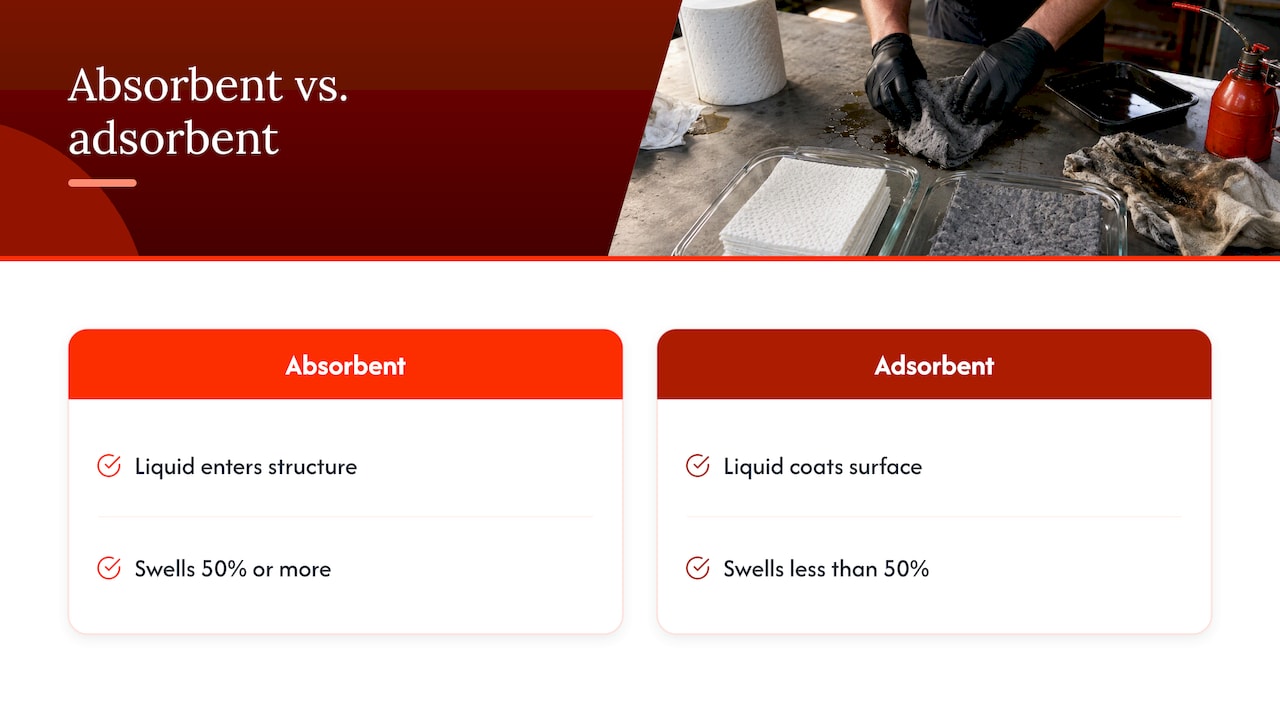
The same fact sheet draws a technical line between two words people use as synonyms. An absorbent takes a liquid into its structure and swells by 50% or more. An adsorbent is coated by the liquid on its surface, including its pores and capillaries, and swells less than that. In daily shop talk, “absorbent” covers both, and that is fine. The distinction matters mostly when you read a spill-response specification.
The EPA Pollution Prevention Information Exchange sorts absorbents into two broad groups, absorbent fabrics and disposable granular absorbents. Fabrics include rags, towels, pads, pillows, sheets, rolls, blankets, booms and socks, and can often be laundered and reused. Granular products include wood fiber, paper, corncobs, peat, sawdust, clay and similar materials, and are generally used once.
So an oil absorbent rag is best understood as the textile end of that range: a fabric wiper you use to pick up oil, grease or coolant, and that you can often reuse if it is handled correctly.
Rags, pads, rolls and booms: which one for which job
The EPA splits sorbents into three types. Type I covers rolls, films, sheets, pads, blankets and webs, whose length and width are much greater than their thickness and which are strong enough to be handled wet or dry. Type II is loose particulate handled with scoops. Type III is enclosed forms such as pillows and booms, held in an outer fabric or netting that oil can pass through.
A wiping rag is a Type I-style product in practice: a flexible sheet you can pick up, wring, and move. That makes it the right choice for some jobs and the wrong one for others.
| Job | Usually the better fit | Why |
|---|---|---|
| Wiping a machine, pump or component | Reusable wiping rag | You need to wipe, not just soak. The rag can be laundered afterward. |
| Small drips under a leaking fitting | Rag or pad placed underneath | Catches the drip before it reaches the floor. |
| Spill on a shop floor | Pad, roll or granular absorbent | Covers a larger area and is easy to bag. |
| Oil on water | Oil-only sorbent pad, roll or boom | Designed to pick up oil and leave water behind. |
| Large spill needing containment | Boom or pillow | Encloses the spill and limits spread. |
Lawrence Berkeley National Laboratory’s environmental health and safety office describes the typical rag use: wiping or cleaning machinery, components, pumps or equipment that contain non-PCB oil or coolants. It adds that rags and absorbent pads or pigs can also clean up small oil spills. Small amounts of non-halogenated solvent can be applied directly to a rag to dissolve oil and dirt.
Where oil-only pads differ
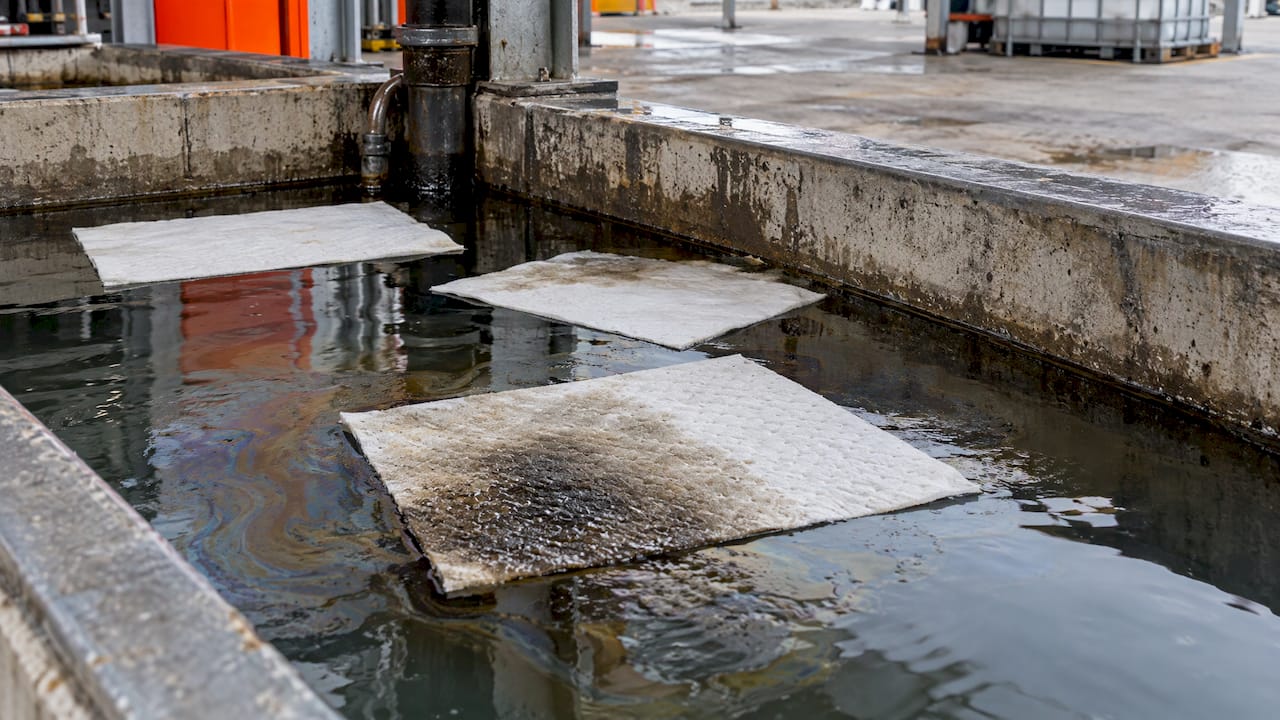
Oil-only pads, usually white, are made from synthetic fiber and sold in sheets and rolls. They are built to take up petroleum-based liquids while shedding water, which is why they are used on ponds, drains and wet floors. A cotton or recycled textile rag works differently: it holds whatever liquid it meets, water included. If water is present and you only want the oil, an oil-only product is the tool designed for it. If you are wiping a part, the water question rarely comes up and a rag does the job.
How much will a pad or rag hold
Be careful with capacity claims. The Massachusetts Department of Public Utilities notes that one pound of absorbent pad can hold an average of one gallon of oil or other liquid, and that pads work best placed over a spill or under a potential drip as prevention. That is an average for pads in general, not a promise for any particular rag. Capacity varies with fiber, weave, weight and the thickness of the oil.
How to use oil absorbent rags well
A few habits make rags work harder and stay safer.
- Place them before the spill. Put rags or pads under fittings, hoses and drip points as a preventive measure, as the Massachusetts guidance suggests for pads.
- Use the right rag for the liquid. Keep rags used with solvents separate from those used with plain oil, so you know how each batch must be handled later.
- Wring out and reuse where allowed. Absorbent fabrics can be wrung out, laundered or pressed dry and used again.
- Remember what absorbents do not do. They pick up liquid without changing its chemistry. What you collect is still oil or solvent and has to be managed that way.
- Do not leave saturated rags lying around. Move them into a proper container as soon as you finish the task.
Why oily rags catch fire
This is the part that matters most. As oil oxidizes, it releases heat. In a pile of rags the heat can stay trapped and build until the material ignites. Safety Matters Weekly explains the mechanism and notes the risk is virtually eliminated when oxygen is limited inside the container, since oxidation uses up the oxygen and stops the reaction.
Loss Control Academy adds that spontaneous combustion of oily rags is a leading cause of after-hours fires in garages, auto shops, cabinet shops and manufacturing, and that open plastic buckets, 5-gallon pails and open trash cans raise the ignition risk. It also points out that container and daily-disposal requirements vary with local fire code, OSHA 1910.106 and NFPA 1.
In practice:
- Use a metal container with a self-closing lid, listed for rags if possible.
- Never stack or bundle freshly soaked rags in a bin or in a pile near a heat source.
- Empty the container at the end of each shift or day, as your fire code and employer require.
- Keep rags away from dryers and hot surfaces until they are cleaned.
The Southern Marin Fire Protection District in California says OSHA’s construction standard 1926.252(e) requires oily rags and solvent waste kept in a covered, fire-resistant container until removed from the site, and recommends a UL-listed metal rag container with a self-closing lid.
Storage and disposal rules in the US
Rules are layered: federal workplace safety, federal waste rules, state agencies and local fire codes. The details below are a starting point. Your state environmental agency and local fire marshal have the final word.
Federal workplace rules
OSHA’s general industry standard at 29 CFR 1910.106(e)(9)(iii) requires waste containing flammable liquids to be kept in covered metal containers. Construction sites fall under 29 CFR 1926.252(e), which calls for fire-resistant covered containers. A summary of both, including an OSHA interpretation that “disposed of daily” means placing waste in an approved container at or near where it is generated rather than hauling it off-site each day, is laid out in this overview of oily rag requirements.
Solvent-contaminated wipes
The EPA’s solvent-contaminated wipes rule, 40 CFR 261.4(b)(18), conditionally excludes qualifying wipes sent for disposal from hazardous waste regulation. The summary at the same overview lists the conditions: a closed, non-leaking container labeled “Excluded Solvent-Contaminated Wipes”, no free liquids at the point of transport, no more than 180 days of accumulation per container, and delivery to a regulated municipal landfill or combustion facility. Confirm the current text with the EPA or your state agency before relying on it.
State examples
States differ, so look at how two of them handle it.
- Massachusetts advises treating oily rags and sorbents as oily hazardous waste unless they pass the “one drop” test, meaning they will not leak oil. The state’s spill prevention page also says rags can be reused if wrung out or sent to a specialized cleaning service.
- Michigan guidance says used oil sorbents should be recycled when possible, that many commercial absorbents can be used several times, and that the oil can be physically extracted. Reusable textiles such as rags, shop towels and gloves contaminated with oil are exempt from hazardous waste regulation if they are laundered or dry-cleaned for reuse, have no free liquids, and are not mixed with hazardous waste. Non-hazardous absorbents past their useful life can go to a licensed municipal landfill after profiling and approval, provided there are no free liquids.
The common thread: free liquid is the problem, laundering for reuse is usually the preferred route, and the details depend on where you operate.
Reading absorbency claims
When a supplier quotes absorbency, ask what test sits behind the number. ASTM F726, the standard test method for sorbent performance of adsorbents, describes a short test in which the sample floats freely for 15 minutes on a liquid layer at least 2.5 cm thick, is lifted out vertically and drained for 30 seconds, and the oil pick-up ratio is then calculated by weight. A separate dynamic degradation test uses a shaker table at 150 cycles per minute for 15 minutes to see how the material holds together.
You do not need to run these yourself. What matters is that a claim such as “absorbs X times its weight” should name a method, and different methods are not comparable. For textile wipers, our own notes on why buyers need ISO test results beyond A/B grades and on tying wiper rag grades to ISO 9073 results go through the same logic for rags.
Buying rags in bulk
Shops, garages, fleets and factories use rags by the bale. A few points make the purchase smoother:
- Define the use. Heavy oil and grease, general wiping and polishing call for different material and size.
- Agree the grade in writing. Ask how the supplier grades, what a bale contains and what is excluded.
- Plan storage. Clean bales are a stored textile; keep them dry and away from ignition sources. Our guide to warehouse safety for bales covers stacking, handling and fire rules.
- Check import classification. If you import wipers, the customs code matters for port clearance. See our note on HS 6310 for wiping rags.
- Think about the end of life. A rag that can be laundered and reused costs less to dispose of than one used once.
Our view on reuse-first wipers
We see the same pattern with importers and distributors: they buy rags on price per pound, then discover that grade consistency and packing quality decide whether the bale is useful. A wiper is a simple product, which is exactly why variation hurts. A bale with mixed fabrics, uneven pieces or contamination slows every workshop that opens it.
That is why we put our effort into the parts of the process we control. We use advanced packaging machinery so bales are pressed consistently and turned around quickly, and our warehouse space of 133,000 square feet lets us hold a broad range of material. We document shipments so importers have what they need at the port.
Recycled wiping rags also fit a reuse-first approach. A textile that has already had one life becomes a wiper instead of waste, and for businesses that care about their supply chain that is a practical, easy-to-explain step.
rodrigues
Recycled wiping rags from MS EXP SP Z O O
We are a wholesale exporter in Poland, supplying businesses in over 40 countries. Our recycled industrial wiping rags are sold in bulk bales to importers, distributors and resellers, not to individual shoppers. Packed with our advanced machinery and shipped with documentation, they are meant for buyers who resell to workshops, garages and industrial users.

If you need rags for resale, send us your volume, destination country and intended use through the wiping rags page and ask for a quote. If you also move used clothing, shoes or bags in the same container, our landing page lists everything we export.
FAQ
Are oil absorbent rags the same as oil-only pads?
No. Rags are textile wipers used for wiping equipment and handling small spills, and they hold whatever liquid they meet. Oil-only pads are synthetic sheets made to pick up oil and shed water, which suits spills on or near water. The EPA groups both under its Type I sorbent class of rolls, sheets and pads.
Can I reuse oily rags?
Often yes. Absorbent fabrics can be wrung out, laundered or pressed dry for reuse, according to the EPA pollution prevention exchange. Michigan treats laundered or dry-cleaned reusable textiles as exempt when they hold no free liquids. Use a laundering service that handles industrial textiles and check your state’s rule.
How should I store used oily rags?
Put them in a covered metal container, ideally a listed rag can with a self-closing lid, and keep it away from heat. OSHA requires covered metal containers for flammable-liquid waste in general industry. Empty the container as your fire code and employer require, usually daily.
Can oily rags really catch fire on their own?
Yes. As oil oxidizes it gives off heat, and in a pile that heat can build until the rags ignite. Limiting oxygen in a closed metal container removes most of the risk, which is why open buckets and trash cans are discouraged.
How do I throw away oil-soaked rags?
The answer depends on your state and the liquid involved. Rags with free liquid generally cannot go to ordinary trash. Massachusetts applies a “one drop” test, and the federal solvent-contaminated wipes rule sets container, labeling and 180-day limits. Contact your state environmental agency before you dispose of them.
Sources
- Application of Sorbents and Solidifiers for Oil Spills (EPA National Response Team, 2007)
- Guidelines for Using and Recycling Reusable Rags and Absorbents (Lawrence Berkeley National Laboratory)
- Spill Prevention (Mass.gov)
- Used Oil Sorbents Guidance (Michigan EGLE)
- Prevent Structure Fires By Properly Discarding Oil and Solvent Rags (Southern Marin Fire Protection District)
- How to Dispose of Oily Rags: OSHA Requirements (Legal Clarity)
- Disposal of Oil or Solvent-Soaked Rags (Safety Matters Weekly)
- Soiled Rag Container (Loss Control Academy)
- ASTM F726-12