
“Lint-free” is a performance goal, not a guarantee. Every cloth sheds some fiber, and how much depends on the fiber, the yarn, the weave and how the edges are finished. For a bulk buyer, the useful question is not whether a rag is lint-free. It is how little lint your task tolerates, and which material and test result proves a supplier’s rags meet that level. We supply recycled industrial wiping rags in bulk bales from Poland, and the rule we give every importer and distributor is the same: write the task into the order, then match the grade to it.
TL;DR
- No rag is completely lint-free. Lint is loose fiber that separates from the surface, and the more open the weave, the more particles it releases.
- Smooth synthetic and tightly knit or woven cloths shed least. Terry, fleece, flannel and short-staple cotton shed most.
- For painting, staining and surface prep, shedding matters. For oil, grease and general shop wiping, absorbency and cost per wipe matter more.
- Buy by specification: material, construction, edge finish, size, moisture and a test method, not by the words “lint free” on a listing.
- Our recycled industrial wiping rags ship in bulk bales, and you can quote us the task so the grade is matched to it.
Table of Contents
- What “lint-free” actually means
- Which materials shed least, and which shed most
- Match the rag to the job
- Lint-free rags for painting and staining
- What is a substitute for lint-free wipes?
- How to assess a bulk lot
- Industrial rag prices in 2026: what moves the number
- Perspective
- Our wiping rags for resellers and distributors
- A buyer’s routine from inquiry to delivery
- FAQ
- Sources
What “lint-free” actually means
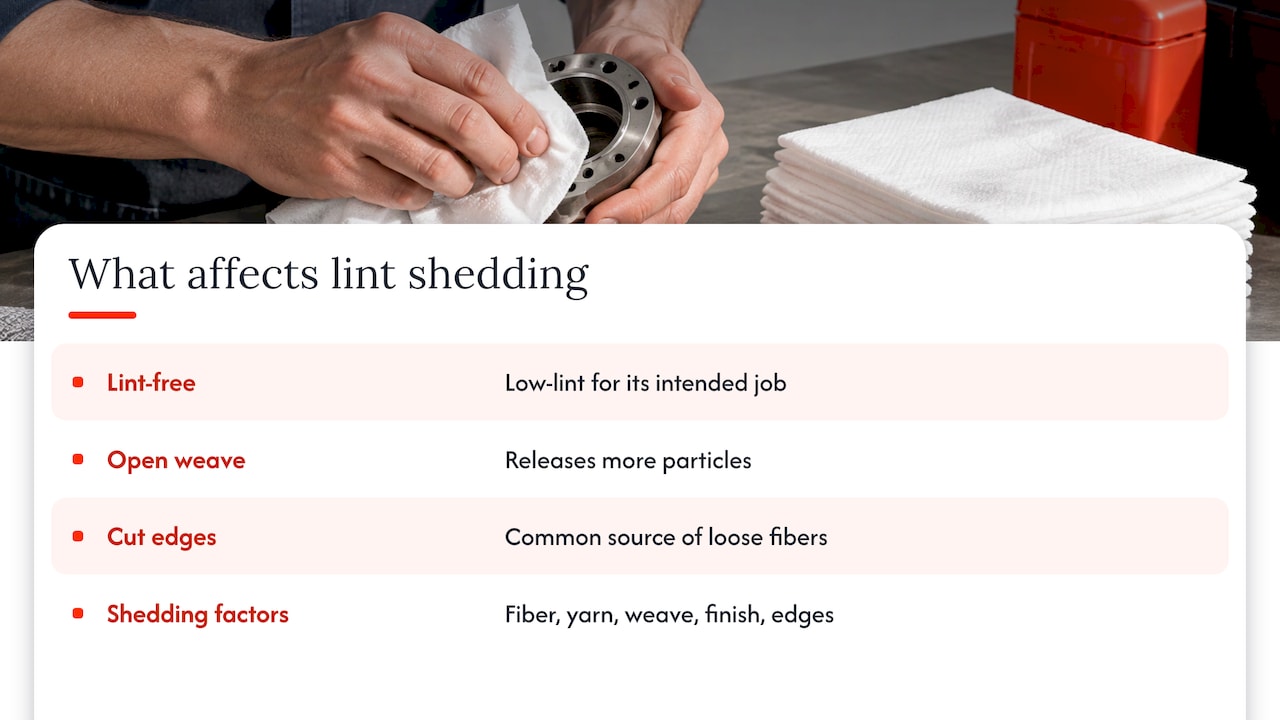
Lint is loose fiber that separates from the surface of a material. According to Conro’s guide to low-lint materials, the more open the weave, the more particles a cloth releases. So “lint-free” on a product page is shorthand for “low-lint for its intended job”.
That matters because the same word covers very different products. A cleanroom polyester wiper, a pack of white knit cotton rags and a microfiber towel are all sold as lint-free. They do not shed the same amount, they do not absorb the same way and they do not cost the same.
What decides shedding, according to Loom and Fiber’s fabric selection guide (2026), is a short list: fiber type, yarn construction, weave, finishing and the edges. Cut edges are a common source of loose fibers, which is why sealed or hemmed edges appear in many specifications.
Which materials shed least, and which shed most
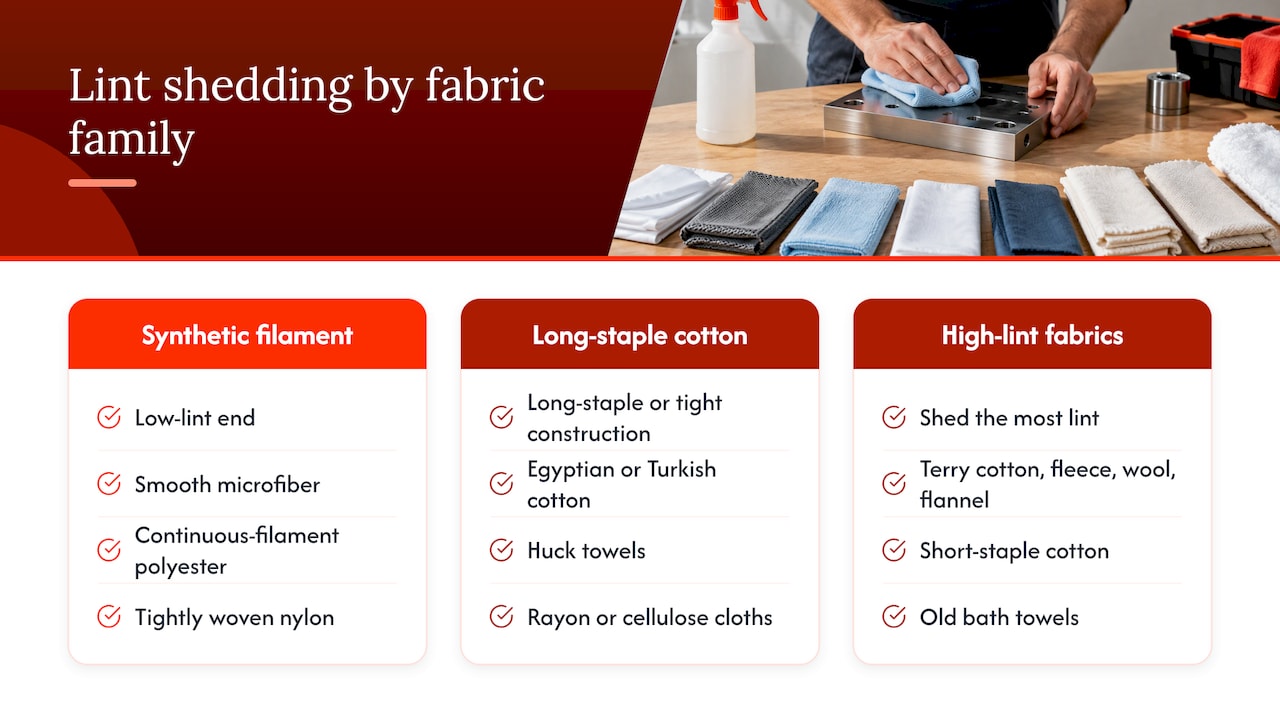
The materials people usually reach for fall into three families.
Synthetic filament fabrics. Smooth microfiber, continuous-filament polyester, tightly woven nylon and cleanroom-grade polyester wipes sit at the low-lint end, along with specific nonwovens and laundered linen, per Loom and Fiber. All Textile describes a wiper made from continuous-filament polyester with heat-sealed edges, which is the kind of construction that keeps loose ends down.
Long-staple and tightly constructed cotton. All Textile lists long-staple cotton cloths such as Egyptian or Turkish cotton towels and huck towels, along with cellulosic cloths made from rayon or cellulose. Longer fibers are held more firmly in the yarn, so fewer break loose.
High-lint fabrics. Terry cotton, fleece, wool, flannel and short-staple cotton produce the most lint, according to Loom and Fiber. Old bath towels and fleece are the classic examples. They absorb well and shed heavily, which is fine under an engine and a problem under a clear coat.
So, do microfiber rags have lint? Smooth microfiber is among the lowest-shedding common options, but a worn, snagged or poorly finished cloth can still release fibers. Construction and condition count as much as the fiber name.
Match the rag to the job
What counts as acceptable lint depends on what happens next on the surface. A simple way to plan an order is to sort your customers’ tasks into three groups.
| Task | Lint tolerance | What to specify |
|---|---|---|
| Wiping oil, grease and machinery | High | Absorbent cotton wipers, consistent size, clean and sorted |
| Cleaning tools, benches, general shop use | Medium | Soft knit cotton, no heavy pile, no hard trim or fasteners |
| Painting, staining, finishing, final surface prep | Low | Smooth knit or tightly woven material, hemmed or sealed edges, no terry or fleece |
Most shop and workshop demand sits in the first two rows. That is where a graded, recycled cotton wiper earns its place: it is absorbent, it is made from material that already exists, and the cost per wipe is low. Our guide to oil absorbent rags, their uses and safe disposal covers that end of the market, including how to handle soiled rags safely.
Lint-free rags for painting and staining
The painters and woodworkers who search for this are usually wiping on stain, removing sanding dust or doing a final wipe before a finish goes on. Loose fibers stuck in a wet coat show up as specks.
For your buyers, the checks are practical:
- Fabric. Smooth knit cotton or synthetic filament cloth, never terry, fleece or flannel.
- Edges. Hemmed, folded or sealed edges release fewer fibers than raw-cut edges.
- Condition. Washed, dry and free of hard trim, buttons, zips and elastic that can scratch a surface.
- Size. A consistent piece size, so the user can fold it into a pad that does not fray at the corners.
- Solvent compatibility. Conro lists this as a buying check. A rag that works dry may break down in a solvent.
A quick floor test helps any buyer: wipe a dark, clean surface with a rag and look at it under a bright side light. Visible fibers mean the cloth is wrong for finishing work, whatever the label says.
What is a substitute for lint-free wipes?
When a task does not need a certified wiper, a smooth, well-washed knit cotton rag cut from a plain T-shirt fabric is the usual stand-in. The key is to avoid anything with a pile or a brushed surface. Washing a rag several times also removes much of the loose fiber it started with, which is why washed, graded rags are common in shops.
For industrial buyers the lesson is the reverse: if your customers keep improvising, they are telling you their task needs a defined grade. That is a reason to sell by specification.
How to assess a bulk lot
Conro’s guidance for buyers is to check material type (polyester or nylon for precision work, cellulose for general tasks), construction (non-woven for particle control, knit microfiber for delicate surfaces), edge finish (heat-sealed or laser-cut), solvent compatibility and electrostatic discharge requirements. Those apply to cleanroom and precision wipers. For general industrial rags, turn them into an order checklist:
- Material and blend. Cotton, cotton-blend or synthetic. State what you accept and what you reject.
- Color and sorting. White, light and mixed colors priced and shipped separately.
- Trim. Zero tolerance for buttons, zips, hooks and heavy seams.
- Size range. A minimum and maximum piece size.
- Moisture and cleanliness. A stated limit and a clean-bale requirement.
- Bale weight and packing. Consistent weight and strapping, so every bale lands and sells the same way.
- Test method. Absorbency and linting measured by a named standard rather than a supplier’s adjective.
That last point is where many orders go wrong. A grade letter such as A or B tells you very little by itself. Our articles on why buyers need ISO tests beyond A/B grades and on tying wiper rag grades to ISO 9073 results walk through how to write a grade into a purchase order so it can be checked on arrival.
Industrial rag prices in 2026: what moves the number
Rag prices are quoted per kilogram, per pound or per bale, and no single figure applies across suppliers, so a published price from one listing tells you little about yours. These are the factors that move it:
- Material. Soft cotton knit costs more than blended or heavy fabrics. Synthetic filament wipers are priced as a technical product.
- Color and cleanliness. White and light rags generally command more than mixed colors.
- Trim and sorting. Rags with hard trim removed cost more to prepare.
- Size and cut. Uniform cut pieces take more processing than mixed sizes.
- Packaging. Compressed, strapped bales reduce freight volume and handling damage.
- Order size and destination. Container-load volumes, freight lanes and port costs change the landed price more than the ex-works number.
Because freight and duty are a large part of the real cost, classify the product correctly before you order. Our guide for importers on HS 6310 for wiping rags explains how the code affects port holds and duty. Rag prices also move with the cotton and textile waste markets, so ask for a current quote rather than relying on any posted figure.
Perspective
We ship used textiles to buyers in more than 40 countries, and the pattern in rag orders is consistent: disputes start with an adjective, not a defect. “Clean”, “soft” and “lint free” mean one thing to the seller and another to the person holding the cloth.
Our answer is to write the task into the order. A workshop wiping oil and a painter doing a final wipe need different cloths, and recycled cotton wiping rags suit the large share of work where absorbency and cost per wipe come first. That is the work our recycled industrial wiping rags are made for.
What we can offer on the logistics side is what we state: advanced machinery that speeds up bale packaging and turnaround, a 133,000 square foot warehouse that keeps a broad range in supply, and shipments that are documented for import requirements. When a buyer brings a grade, a size range and a test method, a rag order becomes simple to fulfill and simple to check.
rodrigues
Our wiping rags for resellers and distributors
If you supply workshops, garages, print shops or cleaning contractors, you need rags that arrive consistent and baled for easy handling and freight. Our recycled industrial wiping rags are sold wholesale in bulk bales from Poland to business buyers, and we pack them using advanced machinery that shortens turnaround.
Send us the application, the size range, the color mix and the destination country, and we will quote against that. If you also move used clothing or shoes, the same shipment can carry other categories from our range; start with used clothing or used shoes.
A buyer’s routine from inquiry to delivery
- Define the end use. Oil and grease, general shop cleaning, or surface prep. Write it down.
- Set the grade in measurable terms. Material, color, trim, size, moisture and the test standard you will use.
- Request a quote on those terms. Ask for bale weight, bale count per container and packaging details.
- Check the paperwork. Confirm the HS classification and the documents your port requires before the cargo ships.
- Inspect on arrival. Open a sample of bales, compare against the written grade and record the result with the bale marks.
- Repeat the same spec. Reordering against the same written grade is what makes supply reliable over time.
FAQ
What do you use lint-free cloths for?
They are used wherever loose fibers would spoil the result: wiping on stain, final surface prep before painting, cleaning glass and optics, and precision or cleanroom work. Heavier shop jobs such as wiping oil off machinery rarely need them.
Do microfiber rags have lint?
Smooth microfiber is among the lowest-shedding common materials, but no cloth is entirely lint-free. Fiber type, construction, edge finish and wear all change how much a cloth releases.
What are examples of lint-free cloths?
Common examples include microfiber, continuous-filament polyester wipers with sealed edges, long-staple cotton such as huck towels, and cellulose or rayon cloths. Terry, fleece, flannel and short-staple cotton shed the most.
How should I buy lint-free shop rags in bulk?
Specify material, construction, edge finish, size, moisture and a test method, then compare each delivery against that written grade. Our guide to industrial wiping rag grades shows how.
Sources
- What Does “Lint-Free” Mean, Conro
- What Fabric Is Lint Free? A Practical Selection Guide, Loom and Fiber
- What Is a Lint-Free Cloth? All Textile