
Industrial vacuum-compression packaging compacts bulk second-hand clothing into dense, single-category bales wrapped in transparent, waterproof film, typically run through hydraulic baling presses rather than small consumer sealers. Before accepting a shipment, we always expect legible bale labels showing mass, category, supplier and consignee details, and country of origin, along with fumigation evidence, a Certificate of Conformity or PVoC, and a packing list that matches the physical load. Some suppliers publish bale specs and run advanced baling machinery as examples of what this standard looks like in practice.
TL;DR:
- Green list treatment depends on clean sorting, low contamination, and reuse; shipments also need an Annex VII movement document and a written reuse contract.
- Match the shipment’s Certificate of Conformity or PVoC, treatment certificate, and packing list to the physical load, including bale count and treatment date.
- Put single category guarantees, written mass tolerances, arrival inspection rights, and certificate delivery before payment into the contract, with a remedy for mixed bales.
- At arrival, compare bale labels and certificates, photograph discrepancies, and quarantine affected bales instead of releasing them into inventory until they are resolved.
- Confirm garments are dry before wrapping and ask whether press settings change by category, since moisture and excess pressure can cause mildew or fabric damage.
Table of Contents
- How industrial baling presses compress bulk clothing
- Bale specifications buyers must insist on
- Classifying waste versus non-waste textiles for customs
- Checking fumigation evidence and packaging on arrival
- Vetting suppliers and writing contract clauses that hold up
- The step-by-step compression process from sorting to sealed bale
- Protecting garment quality through the compression process
- Vacuum compression versus other storage and shipping methods
- Folding and loading techniques that maximize bale density
- Handling vacuum-compressed bales safely in the warehouse
- What happens to the wrapping and strapping materials afterward
- Why documented packing protects your margins
- How we package, document, and ship compliant bales
- FAQ
- Sources
How industrial baling presses compress bulk clothing
A hydraulic baling press is the workhorse behind every export-ready bale. Sorted clothing is fed into a chamber where a vertical or horizontal ram compresses the material under high pressure, then the compacted block is strapped and wrapped before it ever leaves the press. Vertical presses tend to suit smaller operations with slower throughput, while horizontal continuous presses handle higher volumes for exporters moving large daily tonnage.
The machinery matters because poorly maintained or incorrectly rated presses create two problems: inconsistent bale density and higher injury risk for warehouse staff. Safety and design requirements for this equipment are addressed in standards such as SNZ AS/NZS 4024.3703, which covers guarding, feeding systems, and hazard controls for compacting machinery, and in baling press standards summarized on GlobalSpec. Asking a supplier which standard their equipment follows is a fair question, not an unusual one.
What this means for a buyer opening a bale at the destination warehouse:
- Garments should spring back somewhat once unwrapped, not arrive crushed flat or torn from overcompression.
- Density should be consistent bale to bale from the same supplier, since inconsistent compression often signals mixed or poorly sorted inputs.
- A correctly baled shipment should sample easily, letting an inspector pull a cross-section without the whole bale collapsing.
Bale specifications buyers must insist on
Specs are the easiest part of a contract to get wrong because they look generic until a shipment gets held at port over a labeling gap or a mixed category. Industry practice built around protocols such as Kenya’s second-hand clothing import rules gives buyers a workable template even outside that market.
- Bale mass: a common target is around the typical industry bale mass, with a stated tolerance agreed in writing rather than left implied.
- Single-category rule: each bale contains one garment type or grade, never a mix of categories, since mixed bales complicate both customs review and resale sorting.
- Labeling: every bale carries legible markings for mass, category, supplier, consignee, and country of origin, printed clearly enough to survive handling and stacking.
- Bagging material: transparent, moisture-resistant film or specified bagging fabric, consistent with bagging and marking requirements such as the JCIBPC bale specifications, which set minimum fabric weights and require a Certificate of Analysis for approved bagging materials.
Pro Tip: Ask for the Certificate of Analysis on the bagging film itself, not just on the garments, since polyethylene wrap can tear under repeated handling without the right fabric weight.
Classifying waste versus non-waste textiles for customs
This is the step that determines whether a shipment moves on standard commercial terms or gets pulled into waste-shipment notification controls, and it is worth getting right before goods ever leave the warehouse. Gov explains that exporters must determine whether a load counts as waste or non-waste, because the two categories face different controls. Textile waste commonly falls under Basel code B3030, and misclassifying a load can trigger documentation requirements buyers never anticipated.
Shipments correctly classified as green-list goods move under Article 18 controls, which require less paperwork than shipments subject to full prior notification and consent. The distinction hinges on sorting quality, contamination levels, and whether the goods are destined for reuse rather than disposal.
Key documentary steps buyers should verify before goods ship:
- A written contract with the exporter that specifies the goods are destined for reuse, not disposal.
- An Annex VII movement document for green-list shipments, following the format described in the UK’s movement document for transboundary waste shipments, which lists packaging types and operation codes.
- A Certificate of Conformity or PVoC covering the specific consignment, not a generic supplier certificate.
- Fumigation or treatment certificates issued by a competent authority, matched to the shipment date and bale count.
- Retained copies of all the above, since regulators in several markets expect records to be available on request well after the goods clear customs.
Sorted, low-contamination, single-category bales are the easiest lever a buyer has to keep a shipment on the simpler notification path.
Checking fumigation evidence and packaging on arrival
Document review and physical inspection should happen together, not one before the other, because a clean-looking certificate attached to a damaged or mixed bale tells you the paperwork was not matched to the actual load.
What to check on the certificate itself:
- Issuing authority name and credentials, matched against the country of origin.
- Treatment date close to the shipment date, not months earlier.
- Bale count and reference numbers that match the physical consignment.
What to check on the bales:
- Transparent wrapping intact, with no tears exposing garments to moisture or pests.
- No visible mixing of categories within a single bale.
- Sampling holes, if present, patched correctly rather than left open.
Fumigation and PVoC certificates are commonly required before used clothing can clear customs in several import markets, according to Kenya’s import protocol documentation, which ties clearance directly to certificate validity. When something looks wrong, the right sequence is to record the discrepancy with photos, quarantine the affected bales rather than release them into inventory, and notify the supplier and, where the contract requires it, the relevant customs or standards authority before deciding on acceptance or return.
Vetting suppliers and writing contract clauses that hold up
A supplier evaluation should happen before the first purchase order, not after a disputed shipment. Confirm warehouse capacity, ask what press type they run, request published bale specs in writing, and request a sample bale before committing to volume. Long-term partner references are worth asking for directly, since a supplier confident in their process will usually have them ready.
- Confirm warehouse capacity and machinery type match the volume you intend to order.
- Request published bale specifications, including mass tolerance and labeling format, in writing.
- Request a sample bale and inspect it against the same checklist you would apply at arrival.
- Write a single-category guarantee into the purchase contract, with a defined remedy if it is breached.
- Require COA/PVoC and fumigation certificates as a condition of payment release, not an afterthought.
- Include a right-to-inspect clause covering arrival inspection before final acceptance.
- Set a record-retention period, often three years, matching what regulators in your market expect.
Pro Tip: Build your packing-list clause around a CTU-aligned packing specification so the paperwork and the physical load describe the same thing in the same terms.
A buyer-facing bale-spec checklist can serve as a starting template for drafting these clauses before they go into a formal contract.
The step-by-step compression process from sorting to sealed bale
The process starts well before anything touches the press. Sorted clothing arrives by category, grading staff pull out contaminated or unsellable items, and the remaining garments are stacked loosely to feed the chamber.
Loading comes next. Operators layer garments evenly across the press bed so the ram compresses the load uniformly rather than crushing one corner while leaving another loose. Uneven loading is one of the most common causes of lopsided or unstable bales.
The ram then applies hydraulic pressure in stages rather than a single crushing motion, letting air escape gradually so the compacted block holds its shape once strapping is applied. Steel strapping or heavy-duty cord secures the block at this stage, usually in two or three bands depending on bale size.
Once strapped, the bale moves to wrapping, where transparent waterproof film is applied around the entire block, sealing out moisture and pests while keeping the contents visible for inspection without unwrapping. Labeling is applied last, printed or tagged directly onto the film or an attached card, listing mass, category, supplier, and origin.
Final steps include weighing each bale to confirm it meets the agreed tolerance, logging the bale number against the shipment’s packing list, and staging it for loading in a way that keeps categories separated in the container.

Protecting garment quality through the compression process
Compression is not free of risk to the goods themselves, and the biggest quality threats come from overpressure, poor sorting, and moisture trapped inside the wrap before sealing.
Overpressure flattens structured items like jackets or shoes beyond what they can recover from, so operators running mixed-category loads by grade rather than garment type tend to see fewer complaints about shape loss. Garments should be dry before they reach the press, since any residual moisture sealed inside waterproof film has nowhere to go and can lead to mildew by the time a bale reaches its destination.
Sharp items such as buckles, zippers, or metal hardware left unprotected inside a bale can puncture neighboring garments under pressure, which is why some operations separate accessory-heavy categories into their own bales rather than mixing them with plain textiles. Consistent press settings matched to garment type, lighter settings for delicate categories and firmer settings for denim or workwear, reduce the rate of torn seams and stretched fabric that shows up during destination inspection.
Buyers who want fewer quality disputes should ask suppliers directly whether press settings vary by category, since a one-setting-fits-all approach is a reasonable warning sign.
Vacuum compression versus other storage and shipping methods
Loose bulk shipping, where garments move in cartons or loose sacks without compression, takes up significantly more container space and leaves goods exposed to moisture and pests during transit. It is rarely used for large-volume export because the shipping cost per garment climbs fast once volume is the goal.
Baling without a waterproof wrap, common in smaller or less equipped operations, compresses the load but skips the moisture barrier, leaving garments vulnerable to the same contamination risk loose shipping carries. Palletized cartons offer good protection and easy handling but cannot match the density of a properly compressed bale, meaning fewer garments per container and a higher landed cost per unit.
Industrial vacuum-compression baling, by contrast, combines density with protection: garments are compacted tightly, then sealed against moisture in one continuous process. The tradeoff is that compression needs to be managed carefully for delicate categories, which is why grading before baling matters more here than it does for loose or carton shipping. For a wholesale buyer comparing supplier quotes, the method behind the price difference is worth asking about directly, since a cheaper bale price sometimes reflects a cheaper wrap material rather than a cheaper process.
Folding and loading techniques that maximize bale density
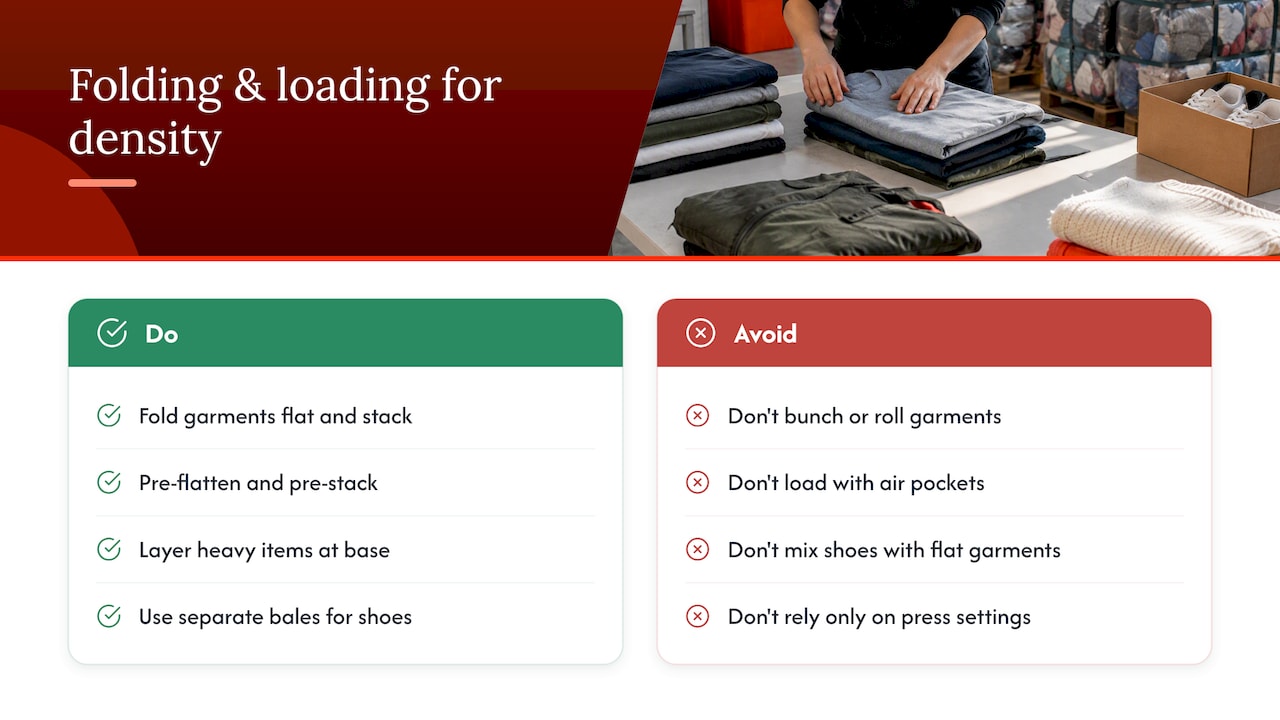
Density is mostly decided before anything reaches the press. Garments folded flat and stacked in consistent layers compress more evenly than garments bunched or rolled, because a flat stack has fewer air pockets for the ram to push out.
Heavier items like jeans and jackets generally belong at the base of the load, with lighter items layered above, since this ordering keeps the press from having to compress a dense bottom layer through loose material sitting on top. Shoes and bagged accessories typically need their own bale rather than mixing with flat garments, since rigid shapes create uneven pressure points that reduce overall density and risk damaging nearby fabric.
Trapped air is the enemy of density. Garments loaded loosely with pockets of air between layers compress less efficiently than tightly stacked ones, since the ram spends part of its stroke pushing out air rather than reducing fabric volume. Operators who pre-flatten and pre-stack before loading consistently get denser bales from the same press settings than those who load straight from a sorting bin.
For buyers evaluating suppliers, a consistent bale weight across a shipment is a reasonable proxy for how carefully the loading step was handled, since inconsistent folding tends to produce inconsistent density even from the same machine.
Handling vacuum-compressed bales safely in the warehouse
Compressed bales are heavy, dense, and under tension from strapping, which changes how they need to be handled compared to loose cartons. Strapping that has shifted or loosened during transit can snap under load if a bale is moved incorrectly, so warehouse staff should inspect strapping before lifting rather than after.
Forklifts or pallet jacks rated for the bale’s weight should be used rather than manual lifting for anything near or above standard bale mass, since a 45 kg bale moved by hand repeatedly is a reasonable source of workplace strain injuries. Stacking height matters too: bales stacked too high can become unstable, particularly if lower bales have settled or lost some rigidity after storage.
Opening a bale for inspection calls for a safe cutting tool rather than a blade swung toward the body, since tightly wound strapping can release suddenly once cut. Staff should stand to the side rather than directly in front of the strapping when cutting it.
Storage conditions matter beyond handling. Bales kept in dry, ventilated space hold their condition far better than bales stacked in humid or poorly ventilated storage, where trapped moisture inside the wrap has nowhere to escape.
What happens to the wrapping and strapping materials afterward
The transparent film and strapping that protect a bale in transit become waste the moment the bale is opened, and what happens to that material afterward is worth building into a sourcing decision.
Polyethylene film, the most common wrapping material referenced in bagging guidance such as the JCIBPC specifications, is recyclable in facilities that accept flexible plastic film, though not every municipal recycling stream takes it curbside. Steel strapping is widely recyclable through standard scrap metal channels, making it one of the easier materials to divert from landfill after a bale is opened.
Buyers receiving high volumes of bales regularly accumulate a meaningful amount of film and strapping waste, and some warehouses set up a dedicated collection point for both materials rather than treating them as general trash. Where local recycling access is limited, baling the film itself for resale to plastics recyclers is an option some operations pursue once volume justifies the equipment.
Choosing a supplier that uses recyclable-grade film rather than mixed-material wrap makes downstream disposal simpler on the receiving end, and it is a fair question to raise during supplier vetting alongside bale specs and certification requirements.
Why documented packing protects your margins
A bale that arrives without matching paperwork does not just risk delay, it risks extra duty, a failed inspection, or a shipment returned at your cost. We have seen that suppliers willing to show their machinery, bale specs, and certificates upfront are consistently the ones whose shipments clear without surprises.
Transparency about process is not a courtesy, it is a cost control. Use the checklist in this guide when you negotiate terms, and treat any hesitation to share specs or certificates as the warning sign it usually is.
— rodrigues
How we package, document, and ship compliant bales
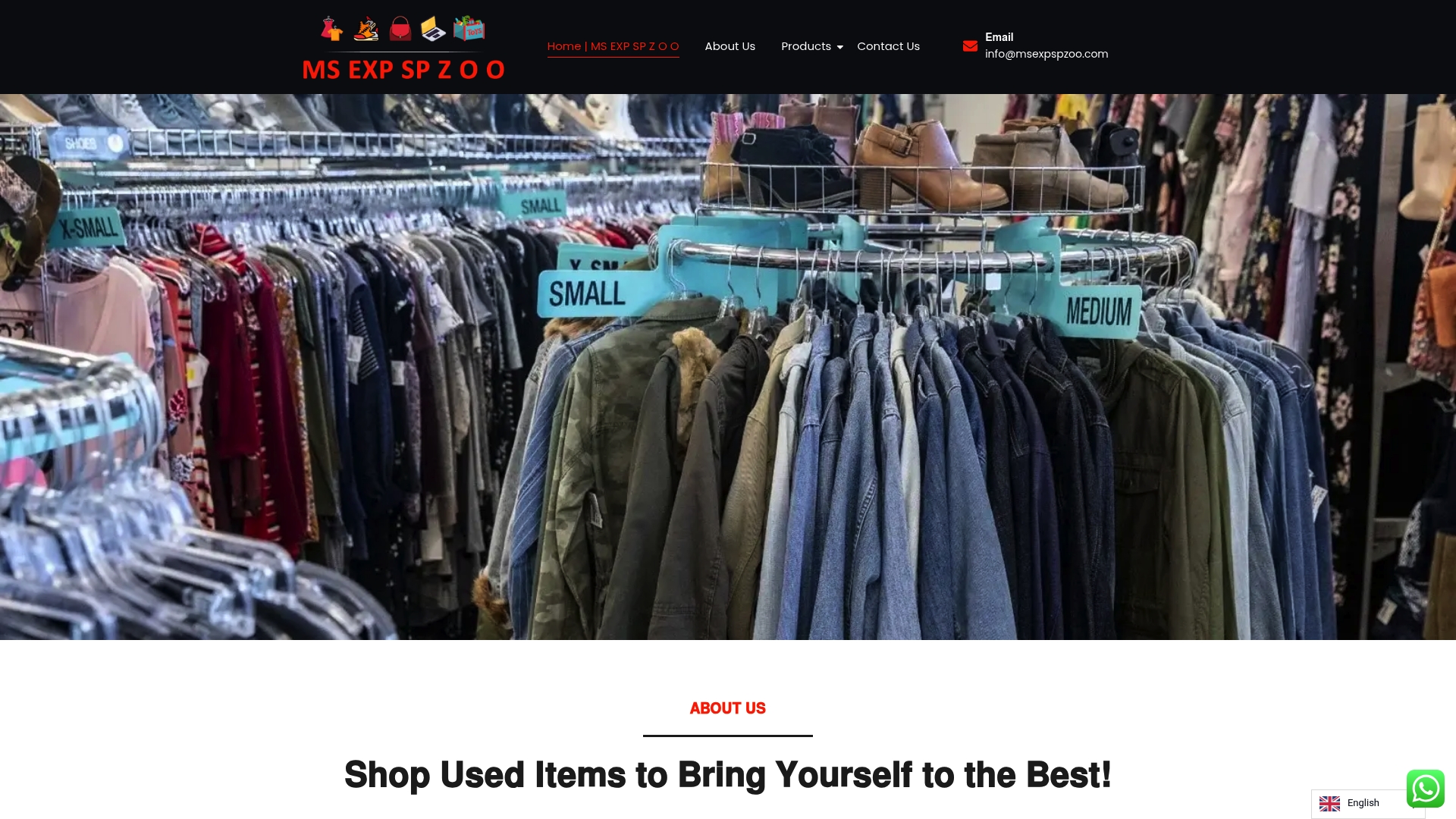
Some suppliers run advanced baling machinery built for faster turnaround, store inventory in large warehouse spaces, and ship internationally, which gives buyers access to consistent bale specs without waiting weeks for a custom run.
Before placing an order, you can request:
- A sample bale matched to your target category and mass tolerance.
- Published bale specifications covering labeling, wrapping, and weight.
- Fumigation certificates and Certificate of Conformity or PVoC documentation tied to your specific shipment.
- CTU-aligned packing details for customs clearance on your end.
If compliant, well-documented used-clothing bales are what your sourcing plan needs, our Used Clothing page has current categories, specs, and contact details to request a quote.
FAQ
What is industrial vacuum-compression baling for used clothing?
It is the process of compacting sorted, single-category used clothing into dense bales using hydraulic baling presses, then wrapping the compressed block in transparent, moisture-resistant film. Buyers should expect legible labeling and supporting certificates to accompany each bale, as outlined in Kenya’s import protocol.
How much does a standard used-clothing bale weigh?
A common industry target is a bale mass in the typical range, though exact tolerances should be confirmed in the purchase contract. This figure comes from widely referenced bale specification guidance used across the used-clothing export trade.
Do used-clothing bales count as waste under customs rules?
Classification depends on sorting quality and contamination levels, and GOV.UK guidance explains that textiles can fall under waste codes such as B3030 if they are not clearly destined for reuse. Clean, well-sorted, single-category bales are more likely to qualify for simpler green-list treatment than mixed or contaminated loads.
What certificates should accompany a bulk clothing shipment?
Buyers should expect a fumigation or treatment certificate, a Certificate of Conformity or PVoC, and a packing list matching the physical bale count, consistent with requirements described in Kenya’s import protocols. Missing or mismatched documentation is one of the most common causes of port holds.
What countries does MS EXP SP Z O O ship used-clothing bales to?
We ship bulk used-clothing and accessory bales to more than 40 countries worldwide from our Poland-based warehouse. Buyers can request sample bales, published specs, and compliance documentation through our Used Clothing page before placing an order.
Sources
- Gov
- Protocols on importation of second hand clothes in Kenya — Infotrade Kenya
- Cotton
- Movement document for transboundary movements and shipments of waste (UK)