
Bale wrapping film is the polyethylene or woven polypropylene outer layer that holds a compressed bale together and keeps moisture, dust and dirt out. For used clothing and shoes, choose film by three things: how well it blocks water vapor, how well it resists punctures and tearing during handling, and whether it is clear enough to meet the labeling and inspection rules of your destination market. The rest of this guide shows how to make that choice, what to put in a purchase specification, and what to do with the film afterward.
Most pages that rank for this phrase are written for farmers wrapping hay and silage. A wholesaler of second-hand textiles has a different problem: a tightly compressed bale of garments or shoes that must survive warehousing, strapping, container loading, weeks at sea, and a customs inspection at the other end. That is the problem we cover here.
TL;DR
- Bale wrap protects compressed textile and footwear bales from moisture, dust and loose fibers during storage and international shipment.
- Water vapor transmission rate (WVTR) is the number to check: published guidance for textile sea freight points to film at 5 to 8 g/m²/24h.
- Puncture and tear resistance matter as much as barrier performance, because a split film lets moisture in at the first rough handling.
- Some markets set packing rules. Kenya, for example, requires clear, waterproof packing and set label details on every bale.
- Used film can often be recycled if kept clean and baled, so ask your supplier how packaging waste is handled at origin and at destination.
Table of Contents
- What bale wrapping film does for a used clothing bale
- The film properties that matter most
- How to match film to bale contents
- Packing rules in destination markets
- How wrapping affects handling and shipping losses
- A buyer’s specification checklist
- Our perspective
- Reusing and recycling bale wrap
- Selling what comes out of the bale
- Order wrapped bales from us
- FAQ
- Sources
What bale wrapping film does for a used clothing bale
A bale of used clothing is a block of loose textiles squeezed under pressure. Without a skin, garments at the edges snag, shed fibers, pick up dust and absorb humidity. The wrap does four jobs:
- Contains the contents. Textile balers compress material and then wrap it in plastic film or other packing material, then seal and secure it, according to a manufacturer’s description of how textile balers work. The same page notes this equipment is common in second-hand clothing, wool and cotton recycling plants, and is used for clothes, quilts and shoes.
- Blocks moisture and dust. This is the job that protects resale value. A damp bale grows mildew, and a mildewed bale is a downgraded bale.
- Carries the label. A clear skin lets inspectors and buyers read the bale category and see the contents without cutting it open.
- Protects strapping and handling points. Film spread across the corners reduces abrasion where straps, forks and clamps touch the bale.
Film is not the only option. Woven polypropylene bale wraps are also used, and one US supplier states they suit storage and shipment of bulk materials such as bundles of used clothing and rags. The choice between film and woven wrap comes down to visibility, tear behavior and what the destination market asks for.
The film properties that matter most
Moisture barrier (WVTR)
WVTR, the water vapor transmission rate, is measured in grams of water vapor passing through a square meter of film in 24 hours. According to a film manufacturer’s technical page, the test conditions are 40°C and 90% relative humidity, and the typical ranges look like this:
| Film type | Typical WVTR (g/m²/24h) |
|---|---|
| Standard LDPE film | 15 to 25 |
| Good moisture-proof PE film | 5 to 10 |
| Recommended for textile and garment sea freight | 5 to 8 |
The same source says moisture-proof PE film in the 5 to 8 range helps prevent mildew, musty smells and discoloration on sea freight. For containers crossing the equator it recommends a WVTR below 8, and below 5 for sensitive goods. For outdoor storage it calls for UV-stabilized, moisture-proof film.
That page is a manufacturer’s own guidance, so treat the numbers as a starting point for your specification and confirm them against the test report your film supplier provides.
Puncture, tear and weather resistance
A good barrier number means nothing if the film splits at a corner. Shoes are the hard case: heels, buckles and soles push against the film from inside. One manufacturer’s product sheet describes a cross-laminated polyethylene bale wrap as very strong and stiff, with high puncture resistance on round or square bales and excellent weathering resistance. The sheet adds that this film does not peel or shred the way woven polypropylene can, and that it is engineered for automatic and manual fiber packing machines.
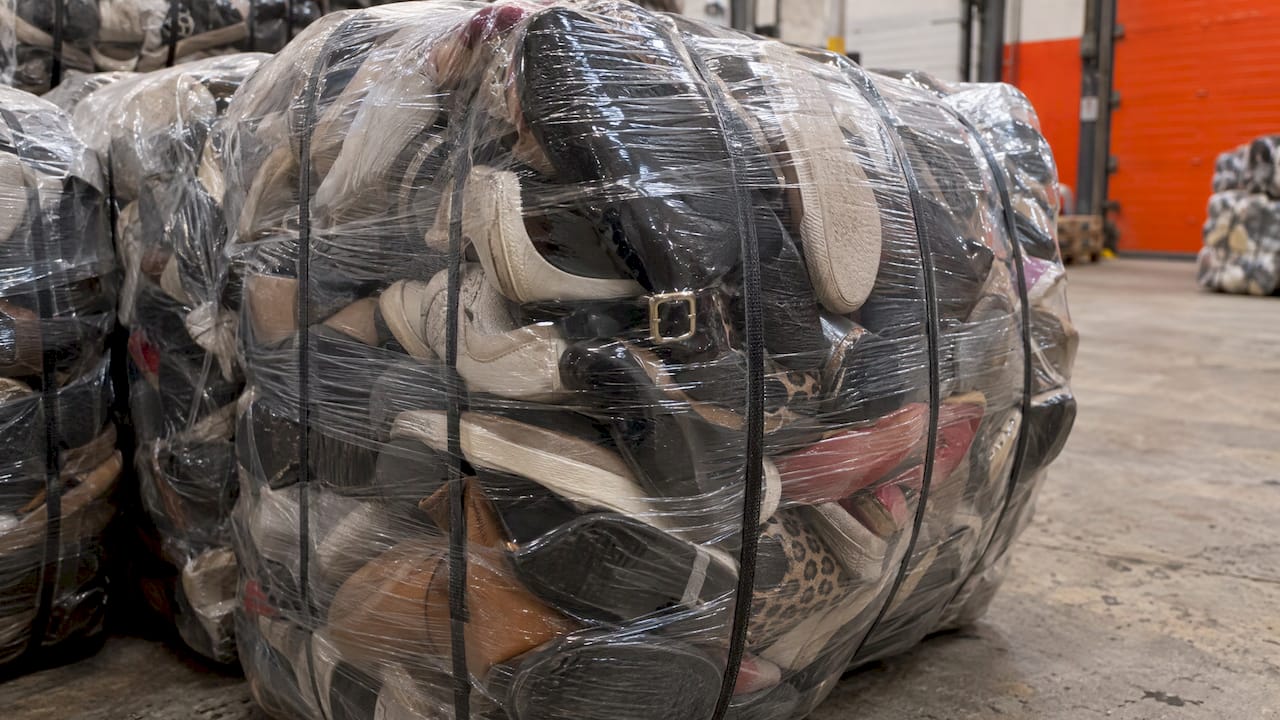
That last point is practical. Film that suits one packing line can misfeed or tear on another, so match the film to the machine and not only to the bale.
Clarity
Clear film lets everyone see what is inside. That helps buyers, port inspectors and warehouse staff. It also helps with compliance in markets that ask for transparent packing, which we cover below.
Thickness and number of layers
Thicker film is not automatically better. Gauge, layer construction and stretch behavior all change how the film holds a bale. Ask for the full data sheet: gauge, WVTR, puncture resistance, UV stabilization and the packing-machine compatibility the maker states.
How to match film to bale contents
Different goods tolerate different humidity. The same film manufacturer advises matching film to product sensitivity: textiles can accept WVTR up to 12 g/m²/24h, while leather goods need a WVTR below 8 (source). Used shoes often include leather, so a shoe bale deserves the tighter barrier.
| Bale content | What to prioritize in the film | Why |
|---|---|---|
| Used clothing, mixed grades | Low WVTR, clear, good tear strength | Mildew risk on long sea routes; label visibility |
| Used shoes | Puncture resistance plus low WVTR | Hard edges push against the film; leather is moisture-sensitive |
| Purses and bags | Puncture resistance, clear | Hardware and straps catch on thin film |
| Soft toys | Clear, dust barrier | Fabric and filling absorb humidity |
| Industrial wiping rags | Dust containment, durable skin | Loose fibers shed easily during handling |
These are our working priorities for specification, built on the published guidance above. They are not a standard, so write the final film choice into your contract with figures from your supplier’s data sheet.
Bale size and the transport route
Three route questions change the specification:
- Does the container cross the equator or sit in a hot port? Heat and humidity swings push you toward the lower WVTR range and a UV-stabilized film.
- Will bales wait outside at a port, yard or market? Choose weather-resistant film and plan for covers or pallets. The film is a barrier, not a roof.
- How many times will each bale be handled? More handling points call for higher puncture and tear resistance, and for strapping that spreads load. Our guide to bale breakage prevention goes through the failure points one by one.
Packing rules in destination markets
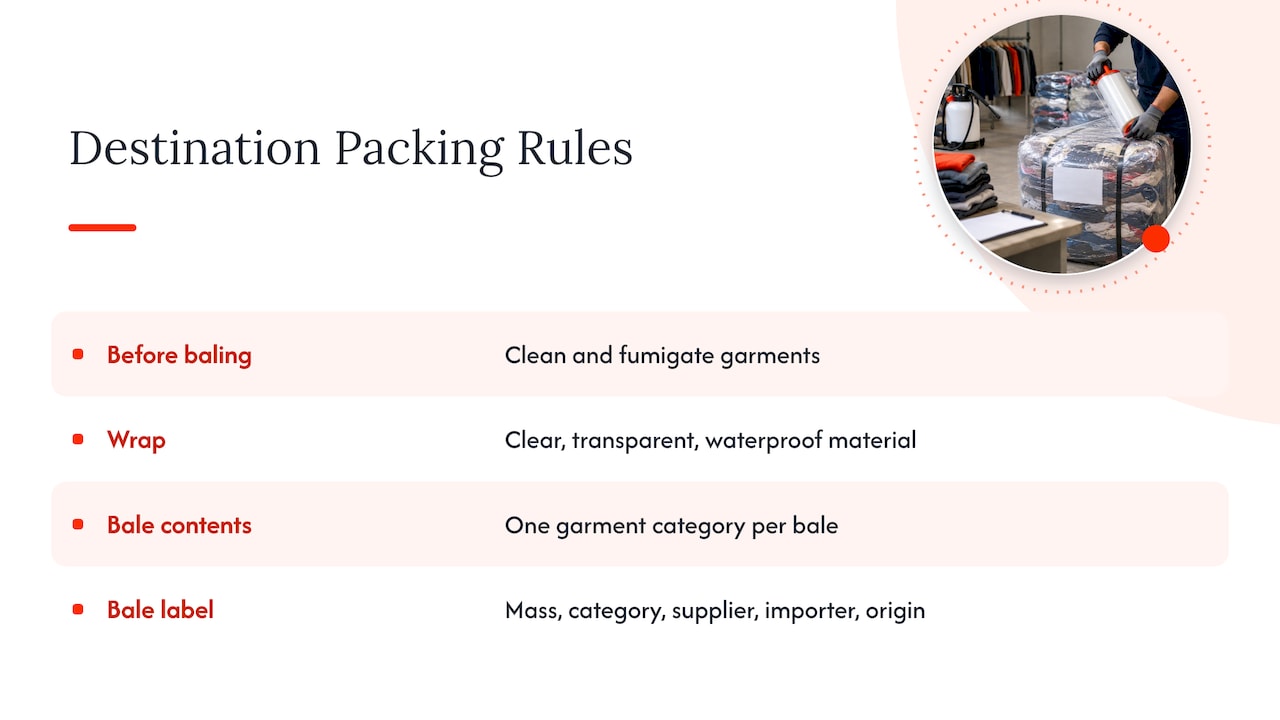
Some importing countries write packing conditions into their protocols. Kenya’s standards body sets out that used clothing and shoes must be cleaned and fumigated before baling. It also says each consignment must be packed in clear, transparent and waterproof materials, and each bale must hold a single category of garments. Every bale must be legibly and indelibly labeled with its mass in kilograms, the category of garments, supplier and importer details, and the country of origin (KEBS protocols, 2020).
Two lessons carry over to other destinations. First, clear and waterproof wrap is not just a preference: in at least one major importing market it is a stated condition. Second, the film has to leave the label readable, so check how your film, label and strapping sit together before a full run.
Rules differ by country and change over time. Confirm the current requirement with the importer’s customs broker or the destination standards body before you finalize packing. For the paperwork side, see our notes on bale labeling standards, what belongs on a packing list and supplier certificates importers need.
How wrapping affects handling and shipping losses
Wrapped bales behave differently from loose or strapped-only bales. A film skin keeps the bale’s outer layer from fraying and gives straps a surface to bite into without cutting into garments. It keeps dust from settling into the fabric during warehousing, and it slows moisture uptake in humid ports.
What film cannot do is fix a bale that was packed damp. Textiles loaded with moisture and then sealed stay damp inside. This is why the Kenya protocol puts cleaning and fumigation ahead of baling, and why moisture control starts in the sorting hall. Our piece on bale contamination control covers that stage.
Film also works alongside other packing methods. Vacuum packing, for example, changes how the bale is compressed and sealed, and brings its own port-inspection questions, which we cover in our vacuum packing guide. For container loading and machine strapping, see our packing methods guide.
A buyer’s specification checklist
When you order bales, put the wrapping in writing. A short list is enough:
- Film type and gauge, with the supplier’s data sheet attached.
- WVTR value, stated against test conditions (40°C, 90% RH is the common reference).
- Clarity: the film must leave the label and contents visible.
- Puncture and tear performance, especially for shoe and bag bales.
- UV stabilization, if bales will wait outdoors.
- Single category per bale, labeled with weight, category, supplier, importer and origin.
- Strapping plan, and how it sits over the film.
- Photographs of a sample bale before shipment and on loading.
The weight and contract details belong in the same document. Our 45 kg bale checklist for contracts and warehousing specifications give you wording to adapt. For tracking what was packed and where it went, use the per-bale traceability record.
Our perspective
We pack and ship used clothing, shoes, bags, toys, bric-a-brac and wiping rags in bulk to buyers in more than 40 countries. From that work, we treat the wrap as part of the product, not as an afterthought.
Our approach starts with speed and consistency. We use advanced machinery on our packaging line, which is designed to turn bales around quickly and keep each one uniform. A uniform bale is easier to wrap well, easier to strap, easier to stack in a container and easier for your receiving team to count and check.
The second part is documentation. We aim to ship every consignment with clear records, so that bale category, weight and origin are traceable and the paperwork matches what is on the pallet. Buyers who import into markets with packing and labeling protocols need exactly that match, and we offer compliance support for global import requirements.
The third part is capacity. Our warehouse covers 133,000 square feet, which lets us hold a broad range of goods and fill mixed orders without long waits. When a wrapped bale arrives in the condition you expected, you can sell it faster and argue less about grades.
Our advice to any wholesaler is simple: write the wrapping into your order, ask for the data, and work with a supplier who answers questions quickly and fixes issues as soon as they are raised. That is how we try to work with every long-term partner.
rodrigues
Reusing and recycling bale wrap
After the bale is opened, the film becomes waste, and a good share of it can be recovered if you handle it properly.
An Australian state environmental agency notes that plastic film is thin, normally clear and used for a short time to protect items from moisture and dust. It states that reusing old plastic saves 80 to 90 percent of the energy needed to make the same item from virgin material, and that most plastics are not biodegradable and can take many years to break down in landfill (NSW EPA fact sheet, 2012). It recommends recycling clean, separated film.
A US pollution prevention document gives the practical rules for stretch wrap and similar film:
- Film is usually made from HDPE, LDPE, LLDPE or polypropylene resins, and most recyclers accept only two to five percent contamination.
- To cut storage and transport costs, bale the film. Most markets accept it only in bale form.
- Store film bales indoors on pallets or concrete pads. If outside, keep them on concrete pads under tarpaulins to protect against UV degradation and moisture.
For a reseller opening dozens of bales a week, this means a clean-film collection point at the receiving dock, kept apart from straps, labels and garment scraps.
Producers are also moving toward recycled content. Trioworld, working with Nordic agricultural cooperatives, announced a bale wrap range containing at least 30% post-consumer recycled material, with an approximately 30% lower carbon footprint than the same 25µ film made from fossil raw material (press release, 2022). That is an agricultural product, but it shows the direction of the film market. If your customers care about eco-friendly supply chains, ask your film supplier whether recycled-content grades meet your barrier and clarity requirements.
The bigger sustainability story is the garments themselves. Reusing clothing keeps it in circulation, which is the idea behind our textile waste reduction approach.
Selling what comes out of the bale
A well-wrapped bale protects what you sell next. Resellers who build small curated bundles for shoppers, such as women’s clothing bundles, depend on garments arriving clean and dry from the original bale. If you are building a vintage or sustainable fashion line, start from bales whose contents and packing you can trust. Our used clothing buying guide walks through grades and how to read them, and the shoe bale grading guide does the same for footwear.
Order wrapped bales from us
We supply used clothing, used shoes, used purses and bags, industrial wiping rags, bric-a-brac, hard and soft toys, and used tyres in bulk bales, packed on our machinery and shipped worldwide. We sell to businesses only: retailers, resellers, wholesalers, importers and market traders. Prices are quoted per order, so contact us with your product, volume and destination.
Start with the category you buy most: used clothing or used shoes. For other lines, or to ask about packing and destination requirements, begin at msexpspzoo.com.
FAQ
What is bale wrapping film?
It is a plastic film, usually polyethylene, wrapped around a compressed bale to hold it together and shield it from moisture, dust and handling damage. In used clothing, it is applied after the textiles are compressed in a baler, and it often carries the bale label. Some suppliers use woven polypropylene wraps instead.
What WVTR should I ask for on garment bales?
One manufacturer’s guidance gives 5 to 8 g/m²/24h for textile and garment sea freight, and below 5 for sensitive goods on routes crossing the equator (source). Ask your film supplier for the test report at 40°C and 90% relative humidity and write the figure into your order.
Does the film have to be clear?
In some markets, yes. Kenya’s protocol requires used clothing and shoes to be packed in clear, transparent and waterproof materials, with each bale labeled by weight, category, supplier, importer and country of origin. Check the current rules of your destination before you pack.
Can I recycle used bale wrap?
Often you can, if it is clean and separated from other waste. Recyclers typically tolerate only a small share of contamination, and most markets want film in baled form, kept dry and covered. Speak with a local recycler about their specific requirements.
Sources
- Woven Polypropylene (PP) Bale Wraps and Covers, Gulf Coast Bag
- Characteristics and Uses of Textile Baler, Jiangsu Xutian
- Transparent Moisture Proof Film, PE Barrier Film
- XF BW Film product sheet, Inteplast
- Protocols for Importation of Used Textiles and Used Footwear, KEBS
- Reducing business waste materials fact sheet: Plastic film, NSW EPA
- Stretch Wrap Alternatives, P2 Infohouse
- Trioworld and Nordic agricultural cooperatives bale wrap press release