
Warehouse cross docking is a logistics method in which goods arrive from suppliers and move straight to outbound vehicles, with little or no long-term storage in between. Maersk describes it as bypassing storage so goods reach customers faster. Below you will find how the process runs dock door by dock door, the main types, what it saves, where it breaks down, and how the same thinking applies to bulk shipments of second-hand goods.
TL;DR
- Cross docking transfers freight from inbound to outbound transport without putting it into storage. Temporary staging on the floor is normal.
- The academic literature usually treats storage of about 24 hours or less as the limit. Beyond that, you are running a conventional warehouse.
- It cuts handling, storage and lead time, but it punishes late trucks, unstable demand and poor labeling.
- It works best with predictable volumes, pre-labeled goods and tight scheduling.
- For bale exporters and importers, the same discipline shows up as fast packing, clear documentation and short dwell time at the dock.
Table of Contents
- What warehouse cross docking means in plain terms
- How the cross docking process works
- Types of cross docking
- Benefits of cross docking
- Limits and risks to plan for
- What you need to run a cross dock
- Cross docking for used clothing, shoes and other second-hand goods
- Perspective
- Supply bulk second-hand goods with fewer handling steps
- FAQ
- Sources
What warehouse cross docking means in plain terms
A normal warehouse receives goods, puts them away on shelves or racks, stores them, then picks and ships them when an order arrives. A cross dock skips the middle. Trucks unload at one side of the building, the freight is sorted by destination, and it is loaded onto outbound trucks on the other side.
The 2020 systematic literature review by Mavi and colleagues defines it as moving merchandise from receiving to shipping without first placing it into storage. The same review notes that stock does not stay beyond 24 hours at the cross-dock station. An earlier state-of-the-art review from KU Leuven says many authors describe temporary storage in the same way, at no more than about 24 hours.
That 24-hour rule is a useful test. If freight sits for days waiting for an order, or if staff pick individual items from stock, the building is acting as a warehouse, not a cross dock.
Why perfect synchronization rarely happens
In theory, an inbound truck pulls up and its freight rolls directly onto an outbound truck. In practice, trucks do not arrive at the same minute. The KU Leuven review explains that perfect synchronization is hard, so real operations use short-term floor staging while freight is sorted, consolidated or waiting for the outbound load to be completed. Longer storage or order-picking turns the operation back into conventional warehousing.
How the cross docking process works
The flow has three core phases, as VPD’s knowledge base lays them out: receipt, sorting by destination, and loading onto outbound vehicles. Here is what happens at the dock.
- Scheduled arrival. The inbound carrier books a dock appointment. Controlled arrivals matter because there is no storage to absorb a bunching of trucks.
- Unloading at the strip door. According to the KU Leuven review, goods arrive at an assigned strip door and are unloaded and identified, for example by barcode scanning.
- Sorting and consolidation. Workers using forklifts or conveyor belts move freight toward its destination. Sorting can be manual, by conveyor, or both.
- Staging. Freight waits briefly on the floor in the lane for its outbound destination until the load is complete.
- Loading at the stack door. The freight is loaded onto the outbound truck and the shipment is confirmed in the system.
The systems behind this are often a warehouse management system, electronic data interchange, bar-coding and scanning, plus material-handling equipment, according to the same review. The scanner is the most important piece. If a pallet cannot be identified at the strip door, it cannot be routed to the right stack door.
Types of cross docking
The main difference between types is where and when the destination is decided. Maersk lists pre-distribution, post-distribution, continuous, consolidation, deconsolidation, retail, manufacturing and e-commerce cross docking.
| Type | How it works | Where sorting happens |
|---|---|---|
| Pre-distribution | Each product’s destination is assigned before shipping | At the supplier, before arrival |
| Post-distribution | Destinations are decided after arrival, based on demand | At the terminal |
| Consolidation | Small lots from several suppliers are combined into full outbound loads | At the cross dock |
| Deconsolidation | A bulk shipment is broken into smaller lots for different destinations | At the cross dock |
The pre- and post-distribution split is described clearly by NetSuite: in pre-distribution, goods are unloaded, sorted and placed on outbound trucks according to instructions set before shipping. In post-distribution, destinations are determined after arrival and goods are held until then, based on demand. The same page notes that cross docking can consolidate products from multiple suppliers, break bulk shipments into smaller lots, and reorganize items for delivery to retail stores, fulfillment centers and customers.
Where the sorting happens decides who carries the labor. Pre-distribution pushes work upstream to the supplier, which is why it rewards suppliers with good labeling and packing. If you are weighing the retail side of this, inventory management best practices are a useful companion, because a cross dock only works when stock data is accurate at the store end too.
Benefits of cross docking
The Mavi review lists the benefits the research most often reports:
- Lower warehousing, inventory-holding, handling, labor and transportation costs
- Shorter lead times from supplier to customer
- Less storage space needed
- Reduced risk of damage, obsolescence and overstock
- Better shipment consolidation and resource use
- Improved delivery control and service levels
Maersk adds that time-sensitive goods such as perishable food, fashion apparel and electronics benefit most, because delivery times drop. Notice that fashion is on that list. Apparel loses value as trends move, so each day in a building is a cost.
A worked example
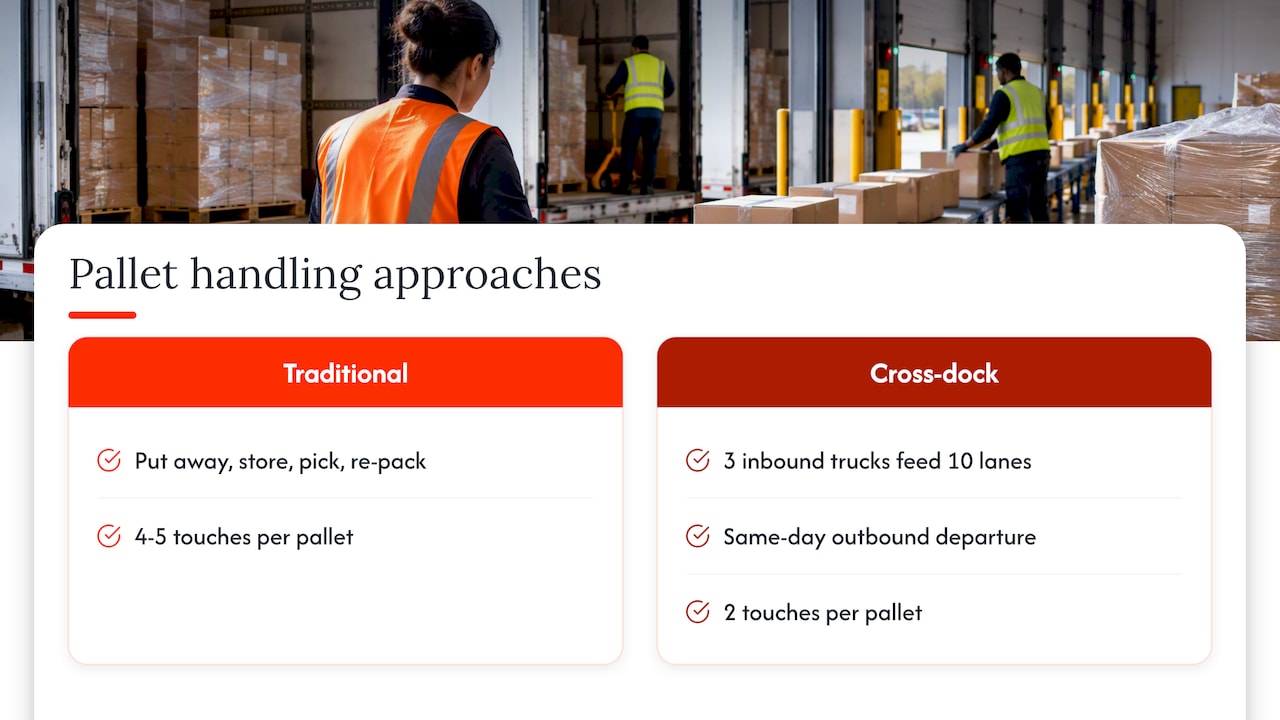
Imagine a distributor receiving full trucks of mixed goods from three suppliers and serving ten customers. In a traditional setup, every pallet is put away, stored, picked and re-packed. In a cross dock, the three inbound trucks are scanned, the pallets are routed to ten outbound lanes, and the trucks leave the same day. The touches per pallet fall from four or five to two. Those saved touches are where labor and damage savings come from. Your own numbers will differ, so measure touches per pallet before and after.
Limits and risks to plan for
Cross docking is not a free upgrade. Maersk points out that it is sensitive to scheduling and demand changes, requires coordination among stakeholders, and can carry substantial setup and operating costs. A comparison on one of the ranking pages makes the same point: traditional warehousing absorbs disruption better, while cross docking is less forgiving of upstream supply or transport delays.
The IEOM study on implementing a cross-docking system names the factors that reduce effectiveness: limited space, workforce or equipment, poor design, and stockouts. Trace Consultants, a professional logistics advisory, stresses that success relies on actively managing inbound variability and making sure the sorting method matches outbound requirements exactly.
A quick fit check helps:
- Good fit: steady demand, predictable inbound schedules, standard packaging, pre-labeled freight.
- Poor fit: very irregular demand, slow-moving stock, or goods needing extensive special conditioning before they ship.
What you need to run a cross dock
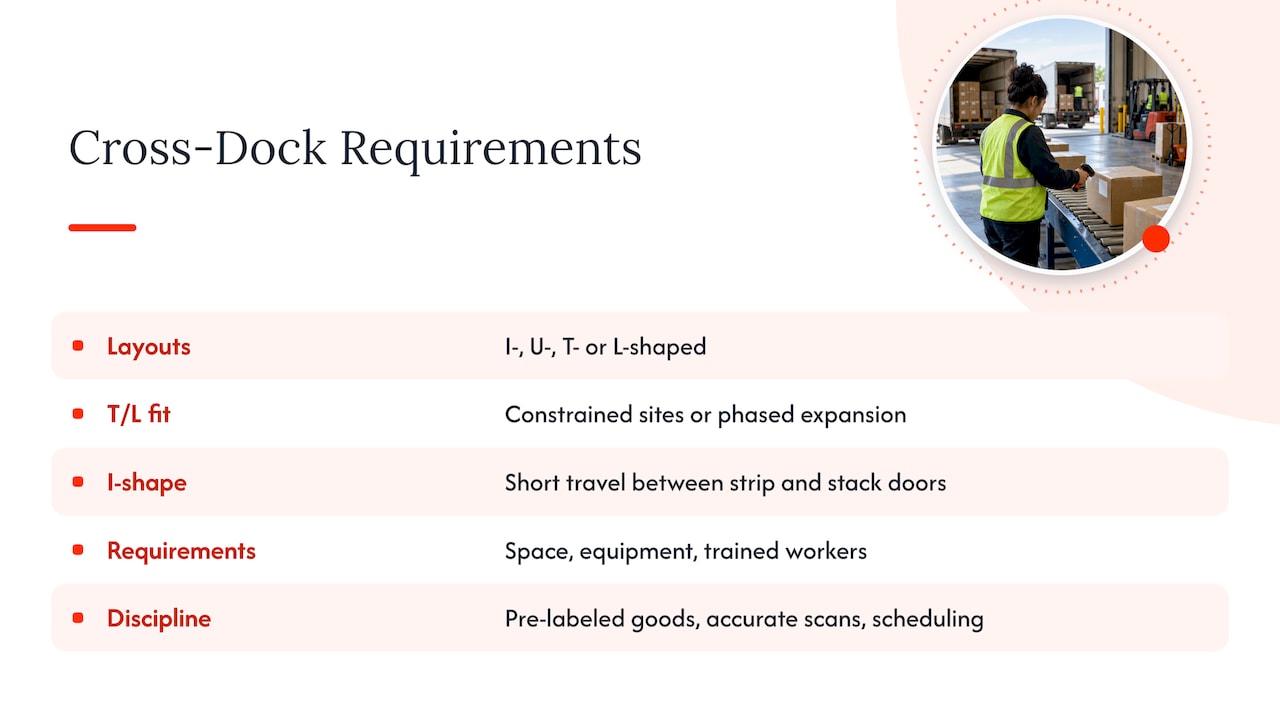
Layout. Trace notes that facilities use I-, U-, T- or L-shaped layouts. T- and L-shapes suit constrained sites or phased expansion. A narrow I-shape keeps travel distance short between strip and stack doors.
Space, equipment and people. The IEOM paper lists adequate space, equipment and trained workers, plus accurate information, forecasts and good information flow, as key requirements. Teams need training in consolidation, deconsolidation and time-sensitive workflows, and one design-build contractor notes that labor shortages can make hiring harder.
Discipline. The same source says operations benefit from pre-labeled goods, accurate scans, disciplined scheduling and reliable transport coordination.
Scale and simulation. At very large scale, planning gets mathematical. A 2025 case study presented at the Winter Simulation Conference describes how Amazon uses Inbound Cross Dock facilities to distribute inventory across its fulfillment network, and how simulation supports design validation and capacity planning. Most businesses will not need a simulation model, but the lesson holds: as complexity rises, guessing stops working.
Physical condition counts as well. Dock floors, lanes and staging areas must stay clear for fast movement, and the future of warehousing increasingly includes keeping these floors clean and safe with automated equipment.
Cross docking for used clothing, shoes and other second-hand goods
Second-hand goods do not fit the textbook cross dock neatly, because the freight is not uniform. Each bale has a grade, a content mix and a destination market. But the principle of reducing dwell time still applies.
An academic study of used-clothing supply chains describes them as complex, globally dispersed and multi-tiered. Retailers and charities are among the main collectors in Western economies, while commercial sorters, resellers and recyclers dominate in developing nations. The study identifies better logistics and supply-chain infrastructure, and collaboration across the ecosystem, as resources for easing sustainability concerns. Researchers from Sweden also found that used-garment collection is often organized by separating the core business from the heavy, costly sorting work and outsourcing that work to external partners.
Put those together and a practical model emerges for bulk buyers:
- Sort once, upstream. Pre-distribution logic applies. When bales are graded, weighed and labeled at the source, nobody downstream needs to open them. Our guide on clothing sorting automation shows when the throughput justifies it.
- Consolidate by destination. Mixed lots from different categories, such as clothing, shoes and bags, are combined into full containers for one port.
- Keep the paper moving with the freight. Each bale needs a record of what it contains and where it came from. See what to record in used clothing traceability.
- Plan the container. A truck that waits for a container that is not there is a cost. Our piece on container shortages covers the levers.
One caution on scope: reverse logistics, meaning the flow of used goods back from consumers, is still underdeveloped compared with forward logistics. An Indian study on apparel e-commerce returns proposes optimizing that network to cut cost and environmental impact. Fast, scheduled transfer points are part of the answer.
Perspective
From where we sit as a Poland-based exporter of used clothing, shoes and other second-hand goods, the cross-dock mindset is familiar, even if our buyers never use the term. A bale that sits in a warehouse is a bale that is not earning money for anyone.
That is why we invest in packaging machinery designed to speed up how fast bales are pressed, wrapped and ready to ship. Our 133,000 square feet of warehouse space is there to hold a broad range of goods, so a buyer can combine categories in one order instead of chasing several suppliers. We see the value in short dwell time, documented shipments and clear paperwork, because those are the things that keep an order moving through ports in the 40-plus countries we serve.
Our view is simple. The best logistics are the ones you do not notice. If the goods arrive in the grade you ordered, with documents that match, your team can get on with selling.
rodrigues
Supply bulk second-hand goods with fewer handling steps
If you buy bales for resale, you benefit from the same principles: fewer touches, faster turnaround, accurate documents. We supply used clothing, shoes, bags, toys, bric-a-brac, wiping rags and more in bulk, packed for export. Start with our used clothing wholesale range or browse everything on our main site.
Before ordering, our used clothing buying guide for resellers and importers walks through grades and what to ask a supplier.
FAQ
Which companies use cross docking?
Large retailers, parcel networks and e-commerce operators use it widely. A 2025 conference case study documents Amazon’s Inbound Cross Dock facilities, which distribute inventory across its fulfillment network. Manufacturers, grocers and fashion distributors use variations of the same method.
What is cross docking in simple terms?
It means unloading goods from an incoming truck and loading them directly onto outgoing trucks, with little or no storage in between. Sorting by destination happens in the middle. If freight stays longer than about a day, it is generally treated as warehousing instead.
What is received at a cross dock?
Pallets, cartons or full truckloads from one or many suppliers. They are identified on arrival, often by barcode, then sorted manually or by conveyor and loaded for retail stores, fulfillment centers or customers. Sorting may happen before arrival or at the dock itself.
When is cross docking a poor choice?
It struggles with very irregular demand, slow-moving stock, and goods that need extensive special conditioning. It also depends on reliable inbound schedules, because there is no inventory buffer. In those cases a traditional warehouse gives you more room to absorb disruption.
Sources
- Cross-Docking: Definition, benefits and best practices (Maersk)
- Cross-docking: State of the art (KU Leuven)
- Cross-Docking: A Systematic Literature Review
- What is cross-docking? (VPD)
- What Is Cross-Docking? Definition, Types and Advantages (NetSuite)
- Implementing a Cross-Docking System in a Warehouse (IEOM)
- Warehouse, Cross Dock and Loading Dock Design (Trace Consultants)
- Logistics Cross-Dock Facility Builder: Design Strategy (EB3 Construction)
- Case Study: Simulation of Amazon Inbound Cross Dock (INFORMS)
- Used-clothing supply chain study (International Journal of Logistics Management)
- Organizing Means-Ends Decoupling: Core-Compartment (University of Gothenburg)
- Multi-Objective Optimization for Economic and Environmental Apparel Reverse Logistics (IJMEMS)
- Inventory management best practices for retail and hospitality
- The Future of Warehousing