
Vintage wholesale sourcing comes down to three decisions: who you buy from, how the goods are sold (by the piece, by the pound or by the sealed bale), and what the lot really costs once it lands at your door. Get those three right and a first order becomes a controlled test. Get them wrong and you own a pallet of goods you cannot sell. This guide walks through each decision in the order a buyer faces it.
TL;DR
- Choose the sale unit first: per piece gives control and costs more per item, per pound or per bale gives margin and carries sorting risk.
- Vet the supplier before you pay: verify its legal identity, ask what each grade means and test with a sample, not a promise.
- Budget landed cost, not the bale price: add freight, duties where they apply, storage and sorting labor.
- Check import rules for your own country and keep the paperwork consistent from invoice to customs entry.
- Start small, record exceptions in writing and scale only when the second lot matches the first.
Table of Contents
- The three ways vintage stock is sold
- Where retailers and resellers source vintage and second-hand stock
- Vet the supplier before you send money
- What to put in the order terms
- Calculate landed cost, not bale price
- Import rules and paperwork
- Be careful with sustainability claims
- Our perspective
- Work with a bale exporter
- A starting checklist for new vintage entrepreneurs
- FAQ
- Sources
The three ways vintage stock is sold
Before you compare suppliers, understand the unit they sell in. The same jacket can arrive in your shop through three very different routes.
By the piece. A supplier hand-picks and prices each garment. You see what you buy, so quality risk is low and styling is consistent. The price per item is the highest of the three, and the selection is whatever the supplier has already curated. This suits boutiques that need a tight look and cannot afford dead stock.
By the pound or kilogram. Goods are sorted by category and sold on weight. It is faster and cheaper per item, but weight rewards heavy items (denim, coats) and does not guarantee the count of saleable pieces. Ask for a typical piece count per unit of weight in the category you want.
By the sealed bale. Goods are compressed and wrapped, usually in a set weight, and sold by grade and category. This is the lowest cost per piece and the most common route for exporters and market traders. The tradeoff is that you cannot see every item, so grading and sampling matter more than anything else.
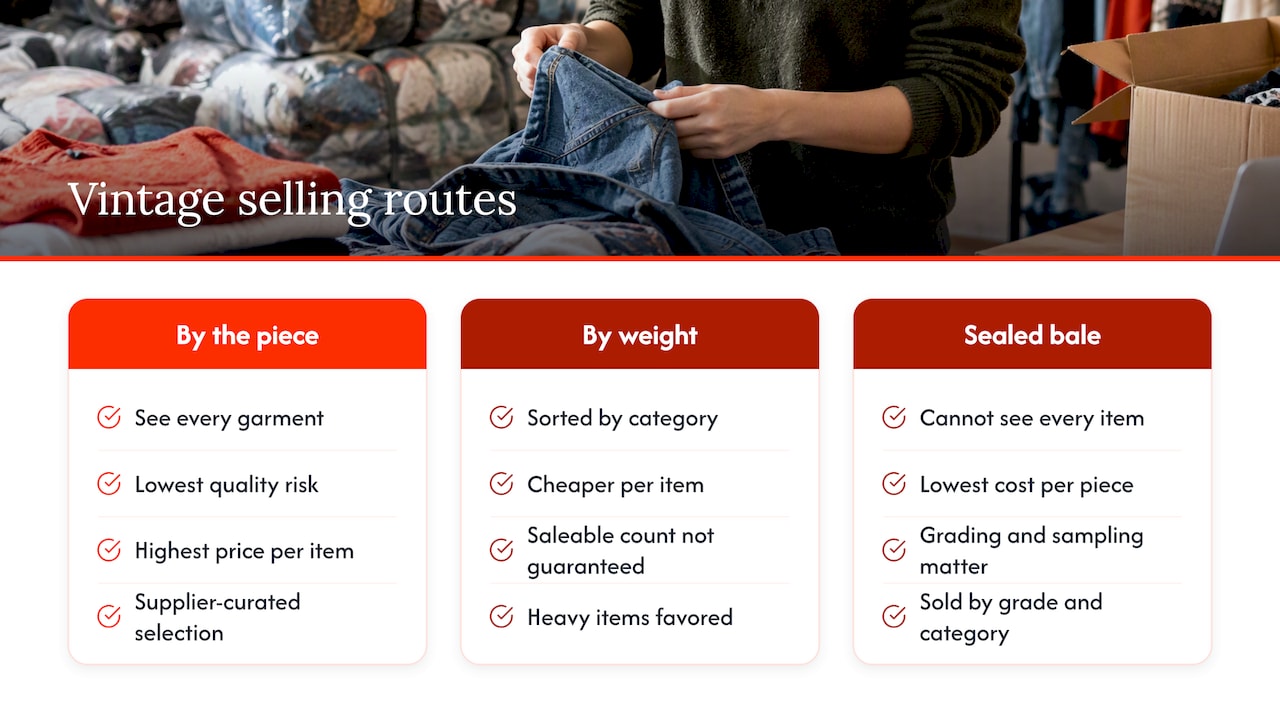
Many buyers use two routes at once: a small curated by-the-piece order for the front of the store and bales for volume. Neither is better in general. The right one depends on your resale channel, your sorting capacity and how much unknown you can absorb.
Where retailers and resellers source vintage and second-hand stock
There is no single marketplace for vintage wholesale. Stock reaches buyers through a handful of supplier types, and each has a different profile.
- Curated vintage wholesalers pick and sort for style, era or brand. Expect higher prices and smaller quantities, with strong consistency.
- Sorting and grading exporters buy collected used clothing in volume, sort it into grades and categories, and ship bales or containers. This is where volume buyers, importers and market distributors usually shop.
- Textile recyclers and collectors sell what remains after sorting. Quality is variable and the material is often better suited to rags or upcycling.
- Estate, auction and liquidation sellers offer one-off lots. Prices can be sharp, but each lot is a new gamble and repeat supply is rare.
- Online wholesale marketplaces list many sellers at once. They make comparison easy, but verification of each seller is still your job.
If you want regular volume with documented shipments, the sorting-and-grading exporter is the practical core of a sourcing plan. We work in that part of the chain: used clothing, shoes, bags, vintage items and other categories packed in bales and shipped from Poland to buyers in more than 40 countries. Our own used clothing and used shoes pages show the categories we pack.
Vet the supplier before you send money
The costliest mistakes in this trade happen before the goods ship. A short vetting routine catches most of them.
- Confirm who you are paying. Get the full legal name, company registration number and address, and check them against an independent business register in the supplier’s country. The payment recipient should match the contracting company.
- Ask for documents from past shipments. Anonymized invoices, packing lists and photos of loaded containers show how the supplier actually operates.
- Request a dated inventory. A stock list without a date or version tells you little. You want to know what is available now.
- Ask what each grade means. “Grade A” and “premium” have no universal definition. Get the criteria in writing: condition, brand mix, seasonality, acceptable defects.
- Check whether photos show your goods. Photos of the exact bales are evidence. Photos of an example are marketing.
- See the goods live. A video call showing current bales and the weighing is a reasonable request from a serious buyer.
We go deeper on this in vetting a used clothing supplier before you wire a dime, and on how grades are read in vintage bale grading.
Test with a sample, then read it correctly
A sample is the cheapest insurance you can buy. Many resellers start with a paid sample of roughly 5 to 10 percent of the intended volume, and we describe the method in sample 5–10% first and in our guide to a paid sample of vintage bales.
Keep one limit in mind: a sample shows the quality level, not that every item in a mixed lot is identical. So record what you expect from the full order in writing against an identifiable inventory, and list any material exceptions the same way after delivery. Footwear needs its own checks, since the wear that decides a grade sits in specific places; see three zones that decide vintage footwear grades.
What to put in the order terms
A clear order document is the difference between a disagreement and a claim you can win. At minimum, state:
| Term | What to specify |
|---|---|
| Sale unit | Bale, pound, kilogram or piece, and the nominal weight or count |
| Settlement weight | How the weight is measured and which weight governs the invoice |
| Grade and category | The written definition of each grade, plus the mix you expect |
| Packaging | Bale type, wrapping, labeling and whether goods are vacuum packed |
| Delivery terms | The Incoterm, who pays freight and who clears import |
| Payment | Deposit, balance, method and the exact beneficiary |
| Claims | What counts as nonconformity, the deadline to report it and the evidence required |
A 45 kg bale is a common standard for exported used clothing, and our bale checklist for used clothing contracts walks through each clause. If traceability matters to your customers, see what to record and verify per bale.
Calculate landed cost, not bale price
The bale price is only the first line. A realistic budget adds freight, import duties where they apply, storage, and the labor to inspect, sort or mend the goods. Forthclear’s wholesale logistics checklist lists these same components, and adding them together gives the landed cost you should compare between suppliers.
Here is the logic with made-up round numbers, purely to show the method. Suppose a bale costs 100 in your currency and freight, duties and handling add 35 per bale. If sorting leaves 80 percent of the pieces sellable, you are paying for 20 percent that earn little or nothing. Your real cost per saleable piece is the landed cost divided by the sellable count, not by the nominal count. Comparing suppliers on that figure, not on headline price, is how resellers avoid a cheap bale that costs more.
For pricing your resale, many professional resellers use a “3x rule”: estimate a realistic resale value and divide by three to get a maximum buy price, leaving room for margin, marketplace fees and unsold items, as the same checklist describes. If you sell through large marketplaces, run your fee math before you buy; this breakdown of Walmart fulfillment fee calculations shows how per-unit fees can reshape margin on low-priced goods. For handbags specifically, see how to calculate landed cost on 45 kg handbag bales.
Import rules and paperwork
Rules for used clothing differ sharply by country. Some markets restrict or ban imports, some require fumigation or disinfection certificates, and some allow entry with ordinary customs documentation. One trade article notes that India and several other countries require fumigation certificates for used clothing, and that clothing in visibly poor condition may enter the U.S. duty-free under HTS 6309; the piece dates from 2013, so confirm current treatment with your customs broker and the official tariff schedule (Fibre2Fashion).
Because rules change, treat your own country’s customs authority as the final word, and use these pages from us as orientation:
- Can you legally import used clothing for resale in 2026?
- Supplier certificates U.S. importers need for used clothing
- Keeping used clothing tariffs low with HTS 6309
- Used clothing import bans in nine countries
- Six buyer checks to avoid customs rejection on door-to-door shipments
Shipping terms and documents
Decide early who handles delivery and import clearance. Incoterms such as DAP or DDP allocate those responsibilities between seller and buyer. For shipments outside the EU, DHL’s customs brochure says a waybill and a detailed commercial or pro-forma invoice are generally needed (DHL Express customs brochure). The goods description on the invoice should match the packing list and the physical bale labels. Mismatches are a common reason shipments get held. Vacuum packing also affects inspection and port handling; see preventing port holds on vacuum packed used clothing.
Be careful with sustainability claims
Used clothing has a real environmental case: it extends the life of garments that would otherwise become waste. But that case needs to be stated carefully. Policy experts at the European Environmental Bureau describe the EU’s direction of travel as mandatory third-party verification of green claims, with the burden of proof placed on the trader (EEB circular textiles policy review). Even where you sell outside the EU, that is a good standard to adopt.
In practice: describe what you can document (reuse, sorted and graded bales, traceable shipments) and avoid vague words such as “eco” or “green” that you cannot back up. Ask suppliers for the records behind any sustainability statement they give you. Our view on reuse is set out in reuse first textile waste reduction.
Our perspective
Most sourcing problems we see are not about bad goods. They are about unclear expectations: a grade that meant one thing to the seller and another to the buyer, a weight measured two different ways, a document that did not match the load.
That is why we built our process around speed and paperwork together. Our machinery lets us pack and turn around bales quickly from our 133,000 square foot warehouse in Poland, and our shipments are documented so that buyers can see what they are receiving and give their customs agent consistent paperwork. We aim to support buyers on import requirements and to resolve issues early, because long-term partners are what a wholesale business runs on.
Our advice to a new buyer is simple: start with a sample, write down the grade definitions, and judge us on the second order as much as the first. We would rather earn a repeat customer than win a single big one.
rodrigues
Work with a bale exporter
If you are ready to move from research to a trial order, we supply wholesale bales of used clothing, shoes, purses and bags, vintage items, toys, bric-a-brac, industrial wiping rags and more, shipped to importers, resellers and market traders worldwide. We sell to businesses, not individual shoppers.
Browse the used clothing range, or contact us through our main site with your target categories, volumes and destination country, and we will discuss a sample order.
A starting checklist for new vintage entrepreneurs
If you are entering the market, work through these in order:
- Write a specification. Categories, eras, sizes, gender split, season and the grades you accept.
- Verify the seller and the payment recipient. Same legal entity, same country, same account holder.
- Calculate landed cost. Include freight, duty, storage and sorting labor, and apply your resale margin rules.
- Agree payment and claims terms in writing. Include a deadline for reporting nonconformity.
- Plan the post-delivery check. Weigh, count and photograph a defined portion on arrival, and log exceptions against the inventory.
- Scale gradually. Repeat the same order once before you increase the volume.
If your focus is footwear, our guides to how used shoe grades work and disinfecting used shoes for resale cover the extra checks. If you serve African markets, the market data and supplier checklist for used shoes in Africa is a useful starting point. Buyers of cleaning materials can read how to tie wiper rag grades to ISO 9073 results.
FAQ
Is it better to buy vintage wholesale by the piece or by the bale?
Buy by the piece when you need a consistent, curated look and cannot tolerate unsold stock. Buy by the bale when you want the lowest cost per item and can sort and price the goods yourself. Many resellers combine the two, using curated pieces for display and bales for volume.
How much should I order the first time?
Start with a paid sample rather than a full order. A sample of roughly 5 to 10 percent of your planned volume is a common approach. It lets you check grading, packaging and documents before committing more money, and you can scale up once the second lot matches the first.
What costs come on top of the bale price?
Budget for freight, import duties where they apply, storage, and the labor to inspect, sort or mend goods. Add them to the bale price to get landed cost, then divide by the number of pieces you can actually sell. That figure, not the headline price, tells you whether a supplier is competitive.
Can anyone import used clothing for resale?
Not everywhere. Some countries restrict or ban used clothing, and others require certificates such as fumigation or disinfection. Check your national customs authority and ask your broker before ordering. Our guides on import bans and legal import of used clothing give a starting point.
Sources
- Fibre2Fashion: Import norms of second-hand clothing
- Forthclear: Wholesale product logistics checklist
- DHL Express: customs brochure
- European Environmental Bureau: Circular textiles policy review
- Nectar: Walmart fulfillment fee calculations