
Vintage bale grading is the sorting of used garments into tiers by condition, era, brand and style, so a buyer knows roughly what share of a bale can be resold at vintage prices. No single authority sets these tiers. Each supplier defines its own, so the same word can mean different things on two invoices. This guide shows what the grades usually cover, where they differ, and how to test a grade before you commit to a full bale.
TL;DR
- Grades are supplier-specific. “Cream,” “Grade A” and “premium” have no universal definition, so ask for the written criteria behind each one.
- Graders judge mainly by appearance and condition, then fashion currency, function (zippers, buttons) and likely durability.
- Vintage is a thin slice of any ordinary bale. Unless you pay for a higher grade, expect only a minority of pieces to be true vintage.
- Order a paid sample first and check 5 to 10% of it against the stated grade.
- If you ship from or through the EU, sorting and documentation rules for used textiles tightened in 2025.
Table of Contents
- What a vintage bale grade actually tells you
- The criteria graders use
- Common grade names and what they usually mean
- How much of a bale is really vintage?
- Grading differs by garment type
- Our perspective: grade the process, not just the label
- How to verify a grade before paying for a full bale
- Compliance: grading now touches export rules
- Sourcing graded vintage and used stock from us
- FAQ
- Sources
What a vintage bale grade actually tells you
A bale grade is a promise about distribution, not about every garment. When a supplier says a bale is Grade A, it is telling you that most pieces are wearable, modern and free of major flaws. It does not say that every piece is vintage, and it does not say that every piece will sell.
For vintage specifically, the grade usually answers three questions:
- Condition. Is the garment faultless, lightly worn, or visibly worn, stained or repaired?
- Era and style. Does it belong to a period or look buyers pay extra for, or is it simply old?
- Brand and fabric. Are there recognizable labels, natural fibers, or construction details that resellers can point to in a listing?
The reason grading matters so much is simple. Two bales can weigh the same and cost very different amounts, and the difference is the grade. A buyer who ignores it can end up holding stock they cannot sell.
The criteria graders use
A UNCTAD brief on second-hand clothes in Uganda and Tanzania describes quality assessment as resting on five main criteria: appearance (color vibrance, stains), condition (physical wear, damage), fashion (trend currency), functionality (zippers, buttons, integrity) and perceived durability. Appearance and condition usually carry the most weight. The same brief notes that some specialized graders use weighted scoring so that different people sorting the same pile reach the same result.
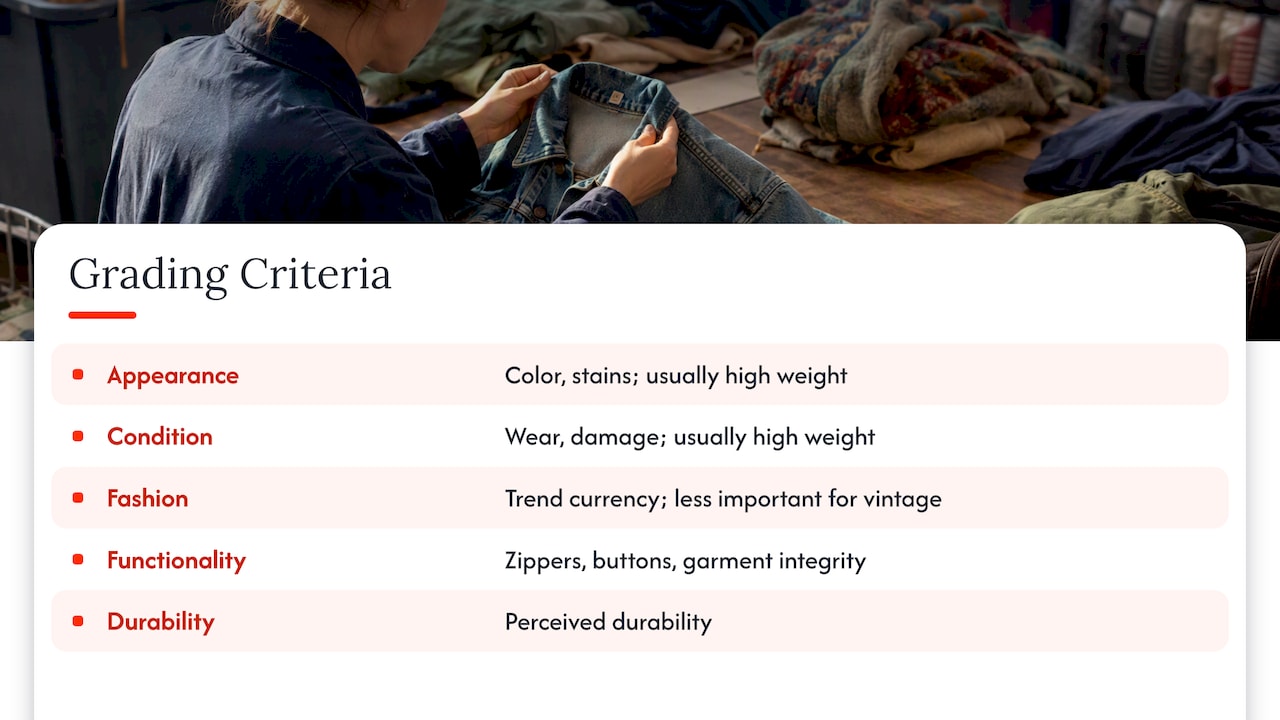
For vintage, the order changes a little. Trend currency matters less, because a 1990s windbreaker is not supposed to look current. What replaces it is authenticity and desirability: is this piece from an era and a maker that vintage buyers search for?
Why grading is visual
Graders cannot test every garment for seam strength or colorfastness, because those tests destroy the item. Industry stakeholders therefore rely on visual inspection protocols, as the ECOS and EEB position paper on reuse textiles explains. The same paper argues the industry needs harmonized, category-specific quality grades in place of today’s fragmented, supplier-specific system.
For you, that means two things. A grade is only as good as the sorter’s eye and the supplier’s written standard. And a buyer’s own sample check is not optional; it is the only way to calibrate someone else’s grading against your customers.
Common grade names and what they usually mean
Terms vary, but most wholesale vintage and used clothing trade uses a ladder like this. Treat the table as a starting point for questions, not as a standard.
| Typical label | What it usually signals | Who it suits |
|---|---|---|
| Cream / premium / hand-picked | Best pieces pulled out for condition, brand or vintage appeal | Vintage boutiques, online sellers with strong photography |
| Grade A / first quality | Wearable, few or no visible flaws, mostly recent or classic styles | Resale shops, online resellers, retail-floor stock |
| Grade B / second quality | Wearable basics with some wear, minor flaws, lower brand content | Market traders, volume sellers, price-led customers |
| Lower grades / rewear and recycle | Heavily worn or damaged pieces | Recycling, wiping rags, repair-and-upcycle projects |
Two cautions. First, “vintage” is a style claim, and some suppliers use it loosely for anything older than the current season. Ask what age or era range the label covers. Second, a few sellers describe condition on a 1 to 10 scale instead of letters. Condition-scale guides such as GradeThread’s 1 to 10 system map a numeric score to named tiers from new with tags downward. A numeric scale and a letter grade measure different things, so do not assume “Grade A” equals any particular number.
Our own guide to how bale grades work for buyers goes deeper on the general ladder for everyday used clothing.
How much of a bale is really vintage?
This is the question that decides profit, and the honest answer is: less than the listing suggests, unless you buy a curated grade. Public reseller discussion often puts the usable vintage share of a standard bale at around 10 to 15%, with higher figures only when you pay for a higher grade. Treat any such figure as an anecdote, not a guarantee, because it depends on the sorting source and the grade you buy.
A practical way to plan is to work backward from your sales channel:
- Online vintage shop: you need photographable pieces with a clear era or brand story. Pay for the top grade and expect to discard little.
- Physical resale store: you need volume of wearable, current-looking stock with a small vintage rack on top. A Grade A mix with a hand-picked vintage add-on can fit.
- Market stall or wholesale trading: you need sellable volume at a price your customers accept. Grade B can work, provided the unsellable share is known and priced in.
Whatever your channel, do the arithmetic per sellable piece, not per kilogram. A cheaper bale where a third is unsellable can cost more per usable garment than a dearer one with a lower reject rate. Our used clothing price bands and landed cost guide walks through that math.
Grading differs by garment type
Vintage buyers rarely buy only one category, and each has its own checkpoints:
- Footwear: soles, uppers and interior wear decide the grade. See our breakdown of the three zones that decide vintage footwear grades.
- Denim: fit, fading, hardware and repairs matter. Our list of six denim bale specs to verify first covers them.
- Sportswear: brand and condition split bales widely, with sellable shares running from 80 to 95% down to under 30% depending on grade.
- Kids’ clothing: wear patterns and safety details differ; see how to verify a 45 kg kids’ bale grade.
- Mixed bales: grades can vary inside one bale, so check four grades before you pay.
Our perspective: grade the process, not just the label
We export used clothing, shoes, bags and other second-hand goods from Poland to buyers in more than 40 countries, and the pattern we see is consistent. Disputes rarely start with a bad bale. They start with a vague grade name that the buyer and the seller read differently.
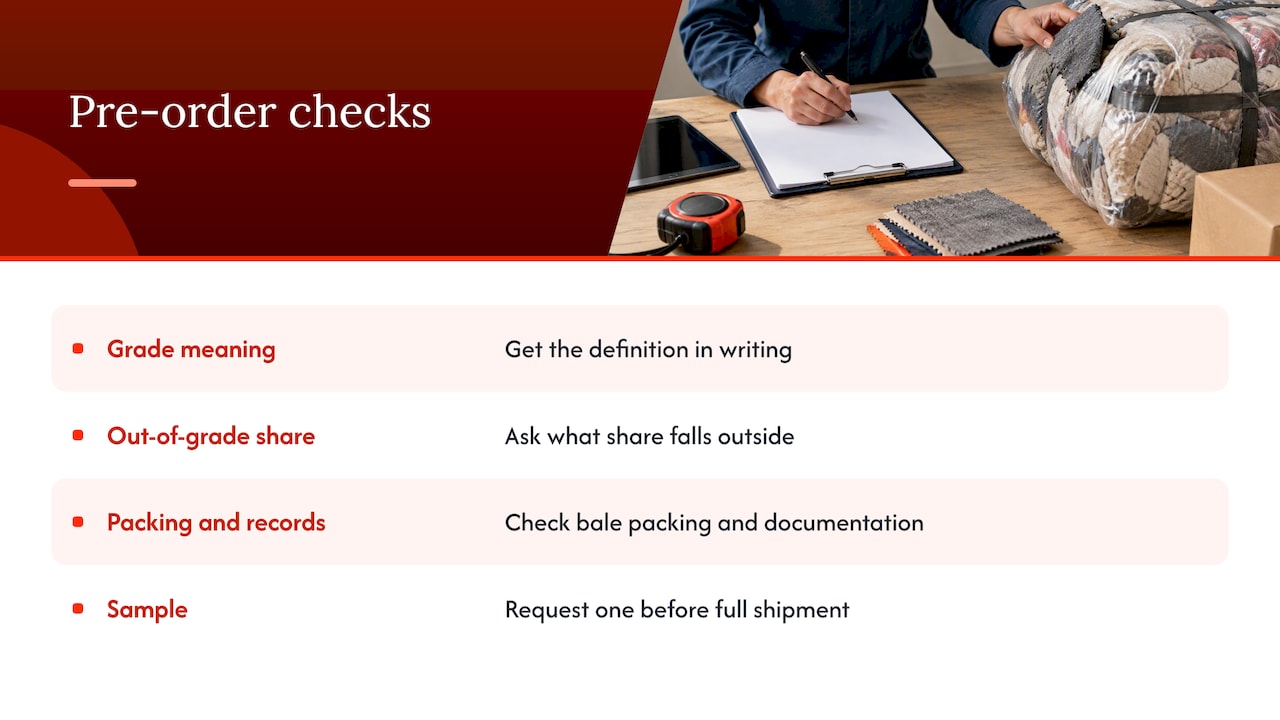
So we encourage buyers to push on four points before any order. Ask what the grade means in writing. Ask what share of a bale falls outside it. Ask how the bale is packed and documented, because a well-pressed, clearly labeled bale is easier to inspect and clear through customs. And ask for a sample, because it costs little compared with a full shipment.
Our warehouse of 133,000 square feet and our packaging machinery exist to make that process quick and repeatable: faster baling means shorter turnaround, and consistent documentation means fewer surprises at the port. We would rather you test us on a small order and judge our grading against your own customers than take our word for it.
— rodrigues
How to verify a grade before paying for a full bale
A short routine protects your margin on any supplier, including us.
- Get the grade criteria in writing. Ask for the condition standard, the era range for “vintage” and the permitted share of lower-grade pieces.
- Order a paid sample. A sample of around 100 lb, as outlined in our vintage bales sourcing guide, is large enough to show real distribution without risking a full order.
- Check 5 to 10% against the grade. Pull pieces at random rather than the nicest on top. Our guide on verifying original and graded clothing explains the method.
- Sort into three piles. Sellable at vintage price, sellable at regular price, and unsellable. Count each and compute your real cost per sellable piece.
- Photograph everything. If the sample does not match the stated grade, you have evidence for a conversation with the supplier.
- Agree payment terms that match the risk. Splitting payment protects both sides; see our note on payment terms that protect you.
Compliance: grading now touches export rules
Grading is no longer only a commercial matter. In October 2025 the European Commission announced that the revised Waste Framework Directive entered into force, and Member States must ensure separately collected textiles are sorted before any shipment, so waste is not falsely labeled as reusable and exported. For exporters and importers handling EU-origin goods, this makes documented sorting more valuable than ever.
There is also a destination-market side. UNCTAD’s survey of 54 importers in Uganda and Tanzania found that they source from global sorting facilities operating to quality and compliance standards set by local regulations. The same brief warns that in some regions imports exceed what local retailers can absorb, leading to waste. Sustainable sourcing therefore means matching volume to what your market can actually sell, not just buying good grades.
Three practical checks follow:
- Confirm the destination country allows used clothing at all; our overview of import bans in nine countries lists the rules and reasons.
- If you import into the United States, classification matters for duty; see our note on HTS 6309 and used clothing tariffs.
- Check packing: vacuum-packed bales can cause port holds if documentation does not match, and our packing specs for used clothing cover strapping and container loading.
Sourcing graded vintage and used stock from us
If you resell vintage or used apparel and want a supplier that documents its shipments, our used clothing range is the place to start. We sell in bulk bales to retailers, resellers, wholesalers and importers, and we also supply used shoes and used purses and bags. Prices are quoted per order, so tell us your market, your channel and the grade you need, and ask for a sample first. We do not sell to individual shoppers.
FAQ
Is there an official standard for vintage bale grades?
No. Grades such as Cream, A and B are set by each supplier, which is why industry bodies have called for harmonized, category-specific grades. Always ask for the supplier’s written definition and compare it with your own sample.
What is the difference between Grade A and Grade B?
Grade A generally means wearable pieces with few or no visible flaws, while Grade B accepts more wear and lower brand content. Where the line falls depends on the supplier, so check a sample against your customers’ expectations rather than the label.
How big a sample should I inspect?
We suggest checking 5 to 10% of a paid sample, chosen at random from different parts of the bale. Sort what you pull into vintage-price, regular-price and unsellable groups, then calculate cost per sellable piece.
Can I buy only the vintage pieces from a bale?
Sometimes, but you pay for it. Hand-picked or higher grades concentrate the desirable pieces and cost more per kilogram. Ask your supplier whether a curated vintage selection is available for your order size.
Do EU sorting rules affect buyers outside Europe?
They can. The revised directive requires sorting before textiles leave the EU, and documentation may be asked for at export and import. Ask your supplier what paperwork travels with each shipment.
Sources
- UNCTAD: SMEP brief on second-hand clothes in Uganda and Tanzania (2024)
- ECOS and EEB: Redefining used textiles and textile waste
- European Commission: Revised Waste Framework Directive enters into force (16 October 2025)
- GradeThread: How to grade used clothing condition, 1 to 10