
Used clothing grading is the sorting of collected garments into quality tiers, so a wholesale buyer knows roughly what share of a bale will sell and at what price. There is no single global standard. A grade is a seller’s description of condition, style and marketability, and buyers in Nairobi, Accra and Karachi read it differently. This guide explains what the grades usually mean, what drives them, and how to check a grade before you commit to a container.
We are a Poland-based exporter of used clothing, shoes and other second-hand goods, so we look at grading from the sorting floor and from the buyer’s side of the table.
TL;DR
- Grading means sorting used garments by condition, season, style and resale potential. Common labels are Cream (or Premium), Grade A, B and C, but the labels are not standardized, and each supplier defines them in its own way.
- Buyers judge a bale by how it looks and sells in their own market, not only by mechanical defects. A garment that simply looks old is often discarded.
- Regulation now pushes sorting upstream: the EU treats separately collected textiles as waste until they are sorted and assessed as fit for reuse, and importers such as Kenya require labeled bales and ban certain items.
- Do not rely on a declared grade alone. Ask for a written spec, sample a small share first, and check the packing list against what you open.
Table of Contents
- What used clothing grading actually means
- The usual grade labels, and why they are only a starting point
- Why grading is a perception, not a measurement
- Grading is also a legal step now
- What importing countries ask of a graded bale
- How to verify a grade before you pay
- Grading beyond clothing
- Perspective: what we see on the sorting floor
- Choosing bales from us
- FAQ
- Sources
What used clothing grading actually means
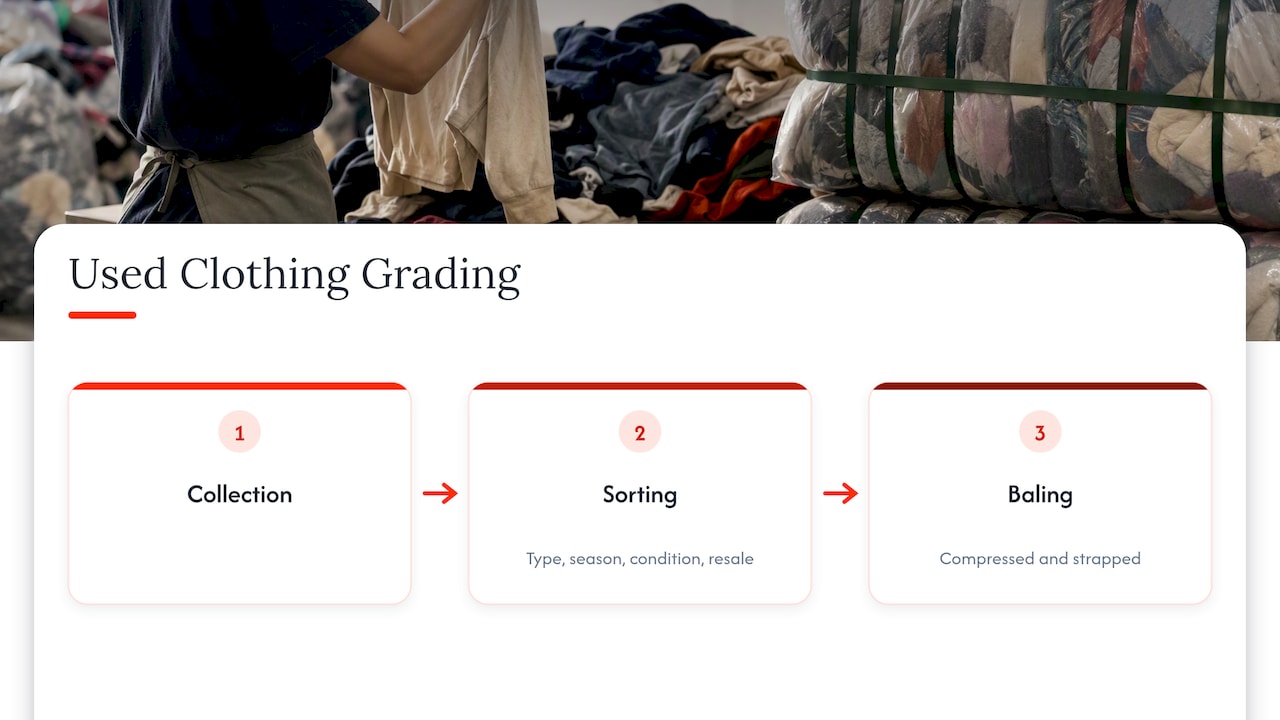
Two meanings of the word “grading” compete in search results. In garment manufacturing, pattern grading is scaling a sample pattern into other sizes. That has nothing to do with this article. In the second-hand trade, grading is the quality sort that happens after collection: items are separated by type, season, condition and expected resale value, then compressed and strapped into bales.
The United Nations trade body UNECE uses the customs code HS 6309, worn textiles and clothing, for textiles fit for reuse, and calls this trade second-hand clothing. That code is the legal frame. The grade is the commercial layer on top of it, and it is what determines your margin.
The usual grade labels, and why they are only a starting point
Most exporters use a ladder like this. Treat it as a typical convention, not a rule. Every seller sets its own thresholds.
| Label | Typical meaning | Who it suits |
|---|---|---|
| Cream / Premium | Best of the sort: very good condition, current styles, no visible defects | Buyers who resell to quality-conscious shoppers or sell by the piece at higher prices |
| Grade A | Good condition, free of significant defects | Mainstream retailers and market stalls |
| Grade B | Fair condition, minor wear, small blemishes | Lower price points, high-volume markets |
| Grade C | Visible wear or faults, limited resale value | Repair, reprocessing, or very low-cost trade |
| Rework / rags | Needs major repair or no longer wearable as clothing | Reprocessing, recycling, wiping cloths |
One published example from a charity-sector trade body shows how specific a written grade can get. The Textile Recycling Association’s specification for charity shop grade clothing defines a collection grade in writing, which is exactly the kind of document a buyer should ask any supplier for.
The point: Grade A from one supplier can be Grade B from another. The label tells you where on the supplier’s own scale a bale sits, nothing more.
Why grading is a perception, not a measurement
Researchers who interviewed sorters, importers, distributors, retailers and vendors in Uganda and Tanzania found that grades are perceived differently across the supply chain, with several characteristics shaping how quality is understood. Work on Kenyan imports reaches a similar conclusion: grading is a market-specific snapshot, and many importers travel to suppliers to pick and inspect bales at random before authorizing a shipment, because they want to see the quality against their own market’s demand.
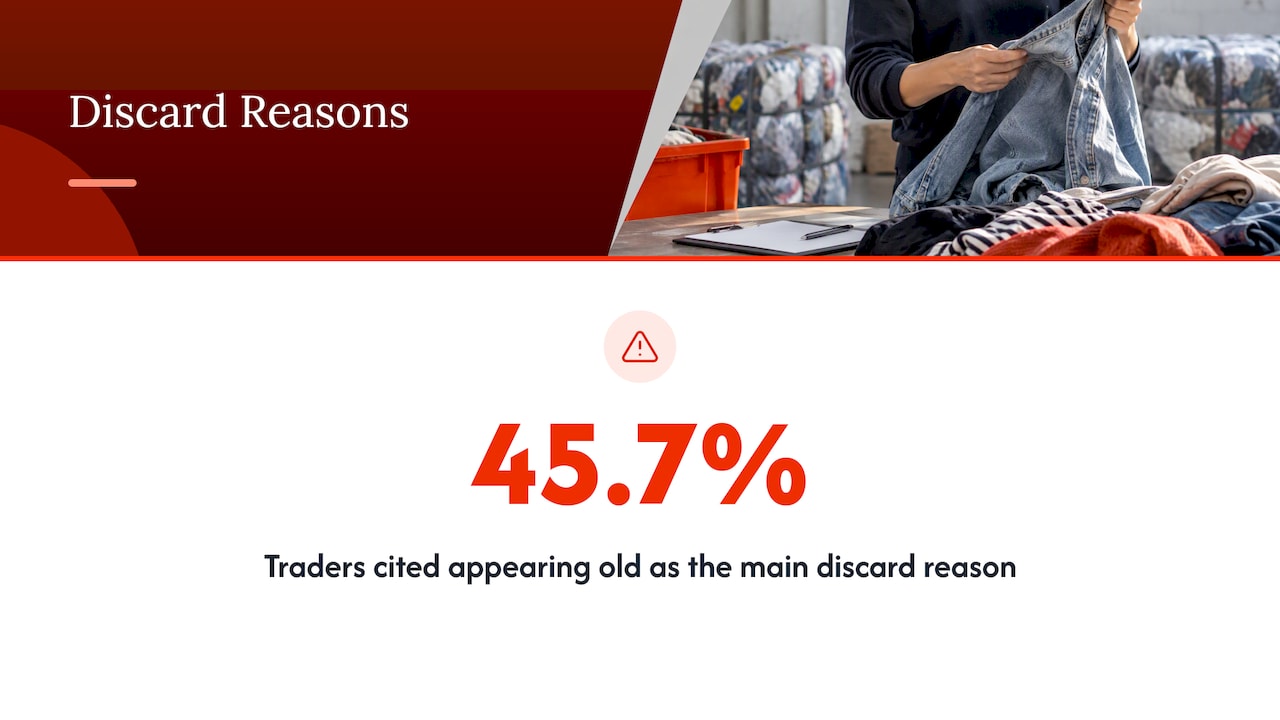
A 2024 study of traders in Ghana’s second-hand market found that 45.7% of traders named “appearing old” as the main reason to discard an item. That label blends wear, fading and an outdated style. So value is not only about stains and tears. It depends on how the garment looks and whether your customer will buy it.
What graders look at
On the sorting line, a trained sorter typically checks:
- Garment type and fabric. Jeans, T-shirts, dresses, children’s wear and outerwear sell at very different speeds.
- Season. Tropical markets want light cotton and summer clothing. Heavy winter items in a tropical order tie up capital.
- Condition. Stains, tears, missing buttons, broken zips, pilling, fading.
- Style and brand appeal. Outdated cuts lose value even when the fabric is sound.
- Cleanliness and odor. Damp or musty goods fail at once.
The same logic applies to footwear, where grade depends on the condition of specific zones of the shoe. We cover that in three zones that decide vintage footwear grades.
Grading is also a legal step now
Sorting is no longer only a commercial choice. Under the revised EU Waste Framework Directive, which entered into force on 16 October 2025, all separately collected textiles are considered waste until they are sorted and assessed as fit for reuse. Member States have 20 months to transpose it. The legal text, Directive (EU) 2025/1892, explains how used textiles are defined. For an exporter in Poland, that makes professional sorting by trained staff the gate between a lawful reuse shipment and a restricted waste shipment.
The Basel Convention adds a second layer. Under HS 6309 these items are clothing for reuse, but under Basel code B3030 similar items can be classed as waste when they are not suitable for reuse. A documented grade, produced by a real sort, is part of showing which side of that line a shipment falls on.
Policy groups are pushing further. A position paper from ECOS and the European Environmental Bureau argues for harmonised sorting guidelines and quality criteria per product category, because the lack of common grading leaves buyers uncertain. That is a proposal, not a current rule, but it shows where the trade is heading.
What importing countries ask of a graded bale
Destination rules decide what you may bring in, whatever the grade says. Kenya is a clear example. Its protocol for used textiles draws on standard KS EAS 356:2019 and requires bales to carry labels with gross mass, garment categories, supplier or importer details and origin. It also prohibits items such as used undergarments, nightwear and hospital wear. A bale of Grade A goods that contains banned categories is still a bad purchase.
Other markets differ, and some ban used clothing outright. Before you place an order, read our overview of used clothing import bans in nine countries and the plain-language guide on whether you can legally import used clothing for resale. For label content, see bale labeling standards for wholesalers.
How to verify a grade before you pay
Research from Kenya suggests that for a high-volume supplier, intentionally shipping unsellable goods rarely pays, since manual sorting and export are labor-intensive. Most disputes come from two sides reading the same standard differently. So the fix is to make the standard explicit before money moves.
A five-step check
- Get the grade definition in writing. Ask for the percentage of items allowed with defects, the seasons included, and the item categories excluded.
- Specify your market. Tell the supplier the country, the climate and the customer type. A grade built for one market can fail in another.
- Order a sample first. Start with a small share of the volume. Our guide to sampling 5 to 10 percent first shows how resellers compare original and graded clothing.
- Open bales at random. Do not inspect only the bale the seller offers. Pick from different pallets, and compare piece counts and categories with the packing list.
- Put the spec in the contract. Bale weight, grade, tolerance and remedy for a miss should be in writing. See our 45 kg bale checklist for used clothing contracts and payment terms that protect you.
If you are in the United States, supplier paperwork matters as well. See which supplier certificates U.S. importers need.
Red flags in a grade offer
- A grade name with no written definition.
- A single grade quoted for every season and every market.
- No piece count or weight tolerance.
- Refusal of a pre-shipment sample or photos of opened bales.
- A packing list with only a generic description such as “mixed clothing”.
Grading beyond clothing
The same discipline applies to other categories. Sportswear bales have their own sellable-share ranges, which we break down in sportswear bale grades. Handbag bales hinge on landed cost per piece, covered in calculating landed cost on 45 kg handbag bales. Items too worn to wear can be reprocessed: grades for wiping cloths are best tied to test results, as in industrial wiping rag grades beyond A and B.
Grading also connects to a wider idea: a garment sorted well gets a second life instead of becoming waste. Retail guides on cost per wear and slow fashion make the same case from the consumer side, and a careful sort is where that principle is applied at scale in the used trade.
Perspective: what we see on the sorting floor
We pack and ship from a warehouse of 133,000 square feet in Poland to buyers in more than 40 countries. Our view, from that work, is simple: a grade is only worth the document behind it.
We do not think buyers should accept a label on trust, and we do not ask them to. The importers we respect most inspect, sample and write the spec down. Machine packaging speeds up how fast bales leave us, but speed means nothing if the content is not what the packing list says. So we focus on consistent documentation of every shipment, because that is what keeps customs, ports and buyers aligned.
Where a dispute arises, it usually turns on interpretation, not bad faith. We prefer to settle the interpretation in advance: which items count as defects, which seasons are in, which categories are out. That is slower for the first order and much faster for every order after it.
— rodrigues
Choosing bales from us
If you buy for resale, start with the category that matches your market and ask us for the spec. Our used clothing and used shoes pages list what we supply, and we also export purses and bags, soft and hard toys and industrial wiping rags. Prices are quoted per order, so contact us with your destination country, volume and target grade, and we will respond with the details. You can also read how we package bales in our guide to CTU code packing and machine strapping.
FAQ
What does Grade B mean in used clothing?
Grade B generally means garments in fair condition with minor wear or small blemishes, below the standard of Grade A. The exact limits are set by each supplier, so ask for the written definition and a sample. One seller’s Grade B can resemble another’s Grade A.
Is there an official standard for used clothing grades?
No single global standard exists. Some bodies publish specifications for particular collections, and policy groups are calling for harmonised sorting guidelines. Until that happens, the contract is your standard.
How do I know what used clothes are worth?
Value depends on the grade, the season, the garment type and, above all, your local market. Test a small lot, track how much sells and at what price, then compare it with the price you paid per kilogram. That sell-through figure is more reliable than any label.
Can I ship any graded bale to any country?
No. Importing countries set their own rules. Kenya, for example, requires labeled bales and bans certain items, and some countries prohibit used clothing altogether. Check the destination rules with your customs broker before you order.
Sources
- UNECE: second-hand clothing trade report
- Textile Recycling Association: charity shop grade specification
- UNCTAD: brief on second-hand clothes in Uganda and Tanzania
- The quality of second-hand clothes imported to Kenya
- Humana Italia: second-hand clothes trade study
- European Commission: revised Waste Framework Directive enters into force
- EUR-Lex: Directive (EU) 2025/1892
- Mitumba Association: trade in secondhand clothing
- ECOS and EEB: redefining used textiles and textile waste
- Kenya protocols for importation of used textiles and footwear