
Used clothing door to door refers to sorted bulk bales of second-hand garments and related goods delivered to a buyer’s named business location, purchased by retailers, importers and market traders for resale. Before you commit to an order, verify the bale grade and the shipping Incoterm the supplier is quoting, since both determine what you actually receive and who pays for problems along the way. You should also confirm the supplier can document that the goods qualify as reusable merchandise, not textile waste, a distinction regulators increasingly enforce.
TL;DR:
- Verifying bale grades and documentation proving goods are reusable reduces risks of misgraded or waste textiles, especially in heavily scrutinized markets like Europe and Africa.
- Choosing DAP or DPU Incoterms shifts most shipping risk to the seller, offering more safety for first-time buyers but at a typically higher cost.
- Shipping costs depend heavily on packaging and container efficiency, with palletized, sorted bales offering predictable rates and reduced damage risk during transit.
- Building inspection rights, sample orders, and clear sorting logs from suppliers help ensure consistent quality and prevent costly disposal or recycling fees.
- Full landed costs vary based on freight, customs duties, taxes, and inland fees, so buyers should create comprehensive comparisons rather than relying solely on price per kilogram.
Table of Contents
- Quick buyer checklist for door to door bulk orders
- Shipping, Incoterms and logistics: who pays what and when
- Quality, sorting standards and compliance: proving used versus textile waste
- How to choose a reliable door to door supplier and order workflow
- Complete cost breakdown: shipping, customs fees, taxes and extras
- End to end process timeline for purchasing used clothing door to door
- Typical costs and pricing shapes: per kilogram versus per bale
- Publisher perspective: what buyers should expect from a serious wholesaler
- Ready to place a trial order
- Sources
- FAQ
Quick buyer checklist for door to door bulk orders
A short list of checks before payment saves far more money than any discount a supplier offers upfront.
- Verify the bale grade and whether contents are sorted or unsorted, since mixed unsorted bales carry unpredictable resale value.
- Confirm bale weight, packaging method, palletization and how the supplier stuffs the container.
- Confirm the Incoterm being quoted and who handles export and import formalities on each side.
- Request sample photos, or better, a sample bale, before sending payment.
- Confirm minimum order quantity, lead time, payment terms and your right to inspect before final acceptance.
- Request documentation proving the goods meet used goods standards rather than waste classification, since this affects customs clearance in many markets.
Skipping any one of these items shifts risk onto you after the container has already left the warehouse, when your options for recourse are limited.
Shipping, Incoterms and logistics: who pays what and when
Three Incoterm families dominate used clothing exports, and each shifts cost and risk at a different point. Under FCA, the seller delivers goods to a carrier named by the buyer, and risk transfers there, meaning the buyer arranges and pays for the main freight. Under CFR or CIF, the seller pays freight to the destination port, but risk still passes to the buyer once goods are loaded, so a damaged container mid-voyage is the buyer’s problem even though the seller paid for shipping. Under DAP or DPU, the seller carries risk and cost all the way to the buyer’s named place or unloading point, which is the safest arrangement for a first-time buyer but usually the most expensive quote, as explained in the ICC’s Incoterms rules.
Packaging shapes your landed cost as much as the Incoterm does. Sorted clothing is commonly packed into 45 kg (100 lb) bales and loaded onto pallets for container stuffing, a practice that keeps cost-per-kilogram predictable and reduces damage in transit, according to research on the international secondhand clothing trade. Unsorted bales sometimes arrive heavier or lighter than stated and stuff a container less efficiently, cutting into your per-kilogram economics before you have sold a single item.
- Ask whether the supplier offers a through-carriage contract, since a single carrier managing the full route reduces handoff delays.
- Build in buffer time for port congestion and customs holds, both common delay points alongside sorting and packing at origin.
- Confirm who is liable for demurrage charges if your customs clearance runs long.
- Request container-loading photos so you can verify pallet arrangement before the doors close.
Pro Tip: Ask for the container loading plan in advance. A supplier who can show you how pallets will be arranged is usually the same supplier who packs consistently, order after order.
Quality, sorting standards and compliance: proving used versus textile waste
Grading determines both price and resale speed. A supplier who can describe grades precisely, cream, grade A, grade B, mixed rags, and back that up with sorting logs, is selling you a known quantity. A supplier who describes a bale only as “used clothing mix” is asking you to buy blind.
Regulatory pressure on this distinction is rising. The European Environment Agency notes that EU rules increasingly require exporters to distinguish reusable goods from textile waste and to provide proof that shipments meet quality standards for export, a shift that follows the reality that Asia and Africa together receive the large majority of globally traded used textiles. Separately, the United Nations Economic Commission for Europe is studying the global second-hand clothing trade with an eye toward technical regulations that would restrict exports to good-quality clothing and support extended producer responsibility schemes.
A large proportion of global used textile imports went to Asia in 2025, with Africa also receiving a similarly significant share, according to the EEA. That concentration means customs authorities in those regions are the ones most likely to scrutinize your paperwork on arrival.
Ask suppliers for:
- Sorting logs showing how bales were graded and by whom.
- Inspection certificates or bale-condition photos taken before shipment.
- Fiber-content notes, especially for mixed-material bales.
- Chain-of-custody records tracing the goods from collection to export.
Unsellable or misgraded stock does not just cost you the purchase price. It costs disposal or recycling fees on top of lost resale margin, which is why pre-shipment inspection rights and a documented corrective-action process matter more than a low quoted price per kilogram.
How to choose a reliable door to door supplier and order workflow
Evaluate suppliers on documented sorting standards, warehouse capacity, packaging machinery and a track record of shipment records rather than on price alone. A supplier who can show you an auditable sorting process and consistent bale-grade paperwork is lower risk than one who simply quotes a cheaper rate per kilogram.
- Ask directly about minimum order quantities and whether smaller trial orders are available.
- Ask whether they offer sample bales or high-resolution photos before you commit to a full container.
- Ask which Incoterms they routinely work under and whether they can accommodate DAP if you need door delivery.
- Ask for proof of export compliance documentation tied to the goods you are considering.
Decline offers that show clear red flags: no samples available, vague bale descriptions with no grade specified, or paperwork that does not match the shipment being offered. These are the signs of a supplier managing surprises after the sale rather than preventing them before it.
Pro Tip: Start every new supplier relationship with a trial container, even if it costs slightly more per kilogram than a full order. A single trial run tells you more about consistency than any reference call.
A workable order sequence looks like this: request bale photos, order a paid sample bale, run a trial container with full inspection rights, then move to ongoing replenishment terms once quality proves consistent.
Complete cost breakdown: shipping, customs fees, taxes and extras
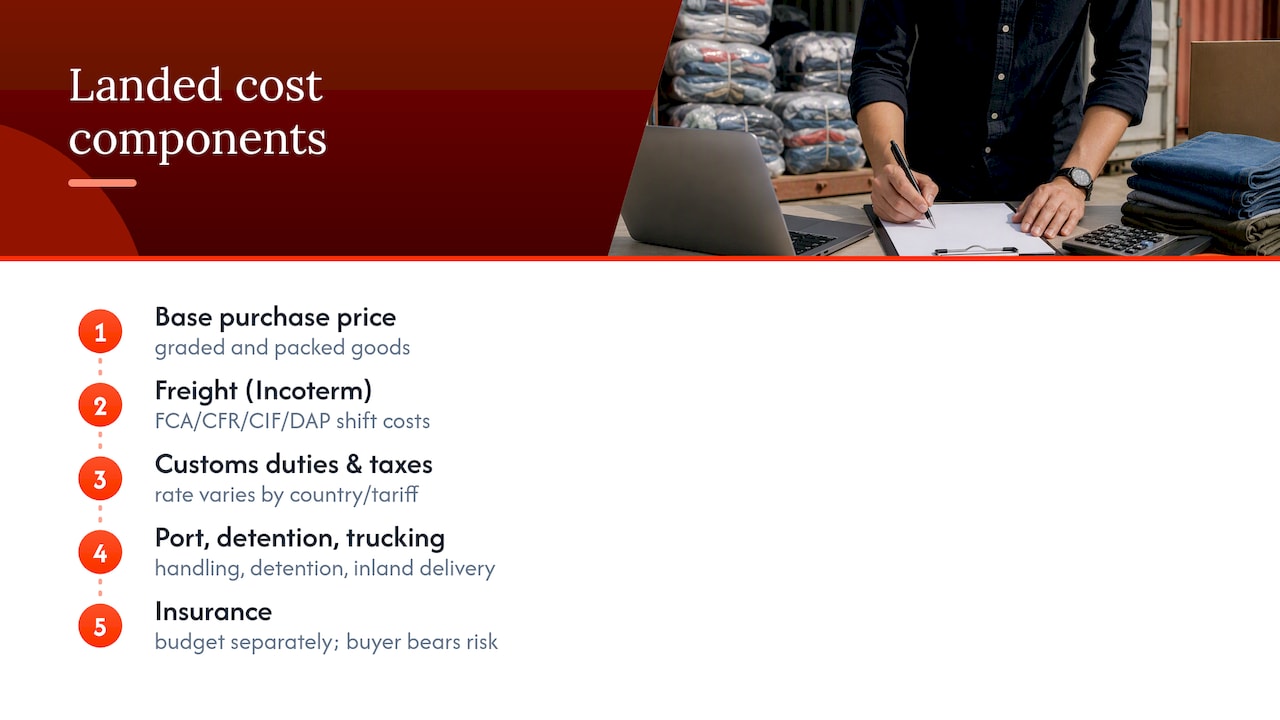
Landed cost for a container of used clothing bales is built from several layers, not just the quoted price per kilogram or per bale. The base purchase price covers the goods themselves, graded and packed. On top of that sits freight, which varies heavily depending on whether you negotiated FCA, CFR/CIF or DAP terms, since each shifts a different share of the freight bill onto you.
Customs duties and import taxes apply at the destination and vary by country and tariff classification, so you should confirm the applicable rate with your own customs broker or a government source rather than relying on a supplier’s estimate. Port and terminal handling charges, container detention fees if clearance runs long, and inland trucking to your warehouse are additional layers that rarely appear on the initial quote.
Insurance is worth budgeting separately, particularly on CFR or CIF terms where the seller pays freight but you carry the risk once goods are loaded. A buyer who skips insurance to save a small percentage on a full container is exposed to the entire cargo value if something goes wrong at sea.
Because these layers shift with the Incoterm chosen, the only reliable way to compare two supplier quotes is to build out the full landed cost for each, not just the headline price per kilogram.
End to end process timeline for purchasing used clothing door to door
A typical order moves through five stages, though timing varies by supplier and destination. First, you request bale photos and grade specifications, usually turned around within a few business days. Second, you order a sample bale or small trial shipment, which adds transit time on top of the supplier’s own packing schedule. Third, once the sample checks out, you place a full container order, at which point sorting and packing at origin becomes the first potential delay point.
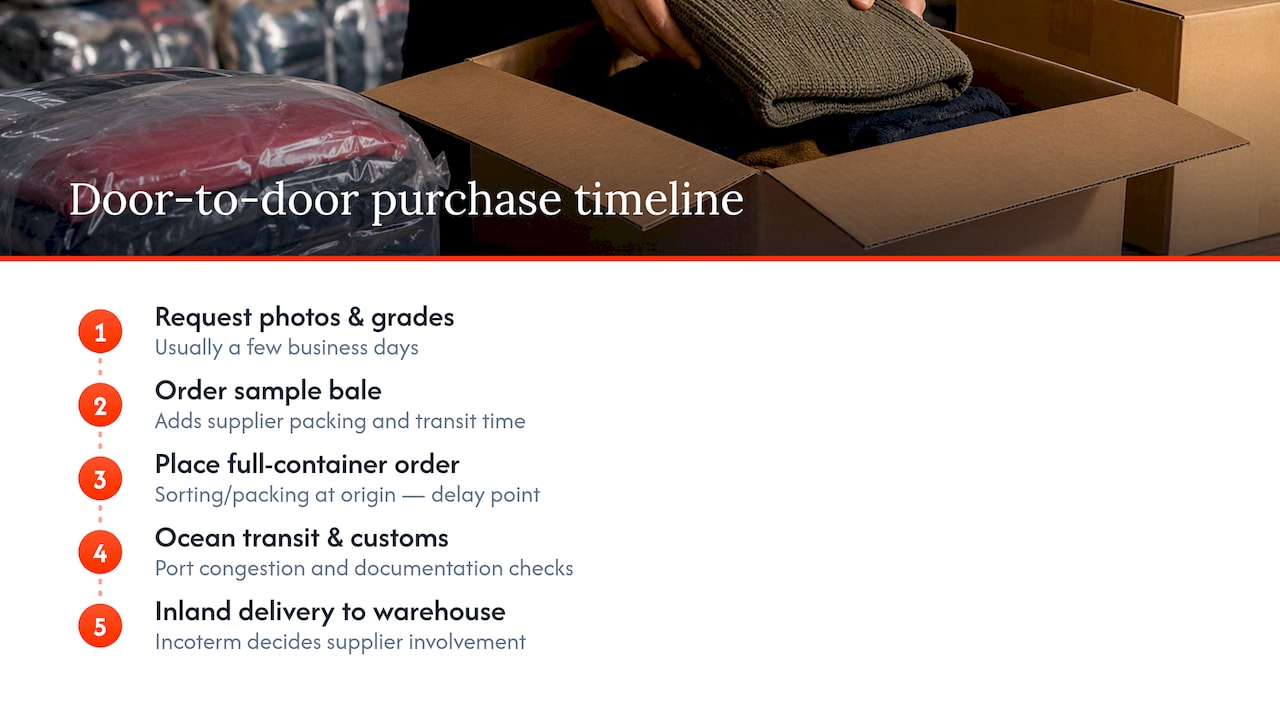
Fourth comes transit, where port congestion is the most common source of schedule slippage, followed by customs clearance at destination, which can stretch out further if your documentation proving used-goods status is incomplete. Fifth, inland delivery to your warehouse closes out the order, and this is where your chosen Incoterm determines whether the supplier is still involved or the shipment is entirely in your hands.
Buyers who build in buffer time at the customs-clearance stage, rather than assuming the fastest-case timeline, avoid the worst surprises. A supplier with rapid packaging turnaround shortens the front end of this timeline, but it does not shorten port or customs delays, which are outside any single supplier’s control.
Typical costs and pricing shapes: per kilogram versus per bale
Pricing in this trade is usually quoted one of two ways: per kilogram or per bale, and the shape of the quote tells you something about what you are buying. A per-kilogram quote is easier to compare across suppliers offering the same grade, since it normalizes for bale-weight variation. A per-bale quote assumes a standard bale weight, commonly cited around 45 kg (100 lb), and can hide inconsistency if actual bale weights vary shipment to shipment.
Higher grades, cream and grade A stock, command a premium per kilogram because resale value and turnover speed are both higher. Mixed or unsorted bales price lower per kilogram, but that lower entry price is precisely what carries the higher liquidation and disposal risk described earlier. A buyer comparing two quotes side by side needs to know the grade before the price means anything at all.
Freight cost per kilogram also shifts with how efficiently a container is packed. Palletized, uniformly sized bales stuff a container more predictably than loose or irregular ones, which is one more reason packaging discipline at origin translates directly into your bottom line at destination.
Publisher perspective: what buyers should expect from a serious wholesaler
Working with a wholesale buyer’s priorities in mind means documentation has to be as reliable as the goods themselves. A supplier with extensive warehouse space and advanced packaging machinery enabling rapid bale turnaround can benefit buyers trying to meet replenishment schedules without holding excess inventory. Compliance documentation and sample access should never be an afterthought bolted onto a shipment after the fact. Buyers who want a tailored quote or a trial order are better served asking for both upfront than discovering gaps once a container has already left the port.
— rodrigues
Ready to place a trial order
Bulk sourcing works best when you start small and scale once quality proves consistent, and that path starts with a sample rather than a full container. 
MS EXP SP Z O O ships used clothing bales sorted to documented grades, backed by the same warehouse capacity and packaging machinery covered above, so a trial order arrives on the same footing as a repeat one. Buyers sourcing mixed cargo can add used shoes to the same container, and manufacturers or workshops sourcing separately can request recycled industrial wiping rags as a standalone line.
- Request bale photos and grade specifications for the category you need.
- Order a sample bale before committing to a full container.
- Move to a trial container with inspection rights once the sample checks out.
- Set ongoing replenishment terms once quality proves consistent order to order.
| Step | What it covers |
|---|---|
| Sample photos | Grade, condition and packaging shown before any payment |
| Sample bale | A small paid order to verify quality firsthand |
| Trial container | Full order with inspection rights before acceptance |
| Replenishment | Standing terms once quality is proven |
Reach out through MS EXP SP Z O O to request a quote and start with a sample.
Sources
For deeper reading, consult the EEA on used textile exports, UNECE’s trade study, the ICC’s Incoterms reference, and MDPI’s trade research. Retailers refreshing store presentation alongside sourcing may also find this guide to second-hand shopfittings useful, and buyers positioning stock for resale can review this piece on sustainable urban fashion.
- EU export of used textiles — EEA
- United Nations will launch a study on global second-hand clothing trade and disposal in Chile — UNECE
- Incoterms® 2020 — ICC
- The International Second-Hand Clothing Trade: Contributions to Sustainability and the Circular Economy — MDPI Sustainability
FAQ
What does used clothing door to door actually mean for a reseller?
It refers to sorted bulk bales of second-hand clothing and related goods delivered to a buyer’s named business location, sold wholesale rather than as individual garments. Buyers are typically retailers, importers or market traders purchasing for resale rather than personal use.
How do I know if a bale is graded or unsorted?
Ask the supplier for a specific grade name, such as cream or grade A, along with sorting logs or inspection photos taken before shipment. A vague description like “used clothing mix” with no grade specified is a sign the bale has not been properly sorted.
Which Incoterm is safest for a first-time buyer?
DAP or DPU places the most cost and risk on the seller, since the seller delivers to your named place or unloading point before risk transfers to you, as defined in the ICC Incoterms rules. FCA and CFR/CIF shift more responsibility to the buyer earlier in the shipping process.
How can I prove imported clothing is used goods, not textile waste?
Request documentation from your supplier, including sorting logs, inspection certificates and chain-of-custody records, since regulators are increasingly requiring proof that exports are reusable rather than waste, per EEA guidance. Keep this paperwork with your shipment to support customs clearance at destination.
What is a typical bale weight in this trade?
Sorted clothing bales are commonly packed at around 45 kilograms (100 lb), a standard cited in industry and academic trade research. Actual weights can vary by supplier, so confirm the figure on your specific order before comparing per-kilogram pricing.