Used clothing is regulated at three levels: whether the goods count as reusable products or textile waste, how customs classifies them, and what the destination country demands before a bale can enter. Get any one of these wrong and a container can sit at the port, be reclassified at a higher duty, or be refused. This guide walks through each level for businesses that buy second-hand clothing and shoes in bulk for resale.
TL;DR
- Goods only count as used clothing, not waste, when they are suitable for direct reuse. Mixed, unusable or visibly damaged textiles are treated as waste in England, and that triggers a different set of rules.
- Customs heading 6309 needs two things together: appreciable wear and bulk packing such as bales or sacks. Calling goods “used” on an invoice is not enough.
- Import rules differ sharply by country. Some ban used clothing or footwear outright, others allow it with certificates, fumigation or licenses.
- Always check the destination authority’s current rules before ordering, and ask your supplier for documents per shipment.
Table of Contents
- Used goods or textile waste: the first test
- How customs classifies used clothing: heading 6309
- Country rules: who bans, who restricts, who allows
- Permits, certificates and documents
- Mixed bales, damaged textiles and shoes
- Our perspective
- Buy bulk used goods with compliance in mind
- How to verify current rules for your market
- FAQ
- Sources
Used goods or textile waste: the first test
The most important line in used clothing law is the one between a reusable product and waste. It decides which permits apply, whether the Basel Convention comes into play, and how a border officer reads your paperwork.
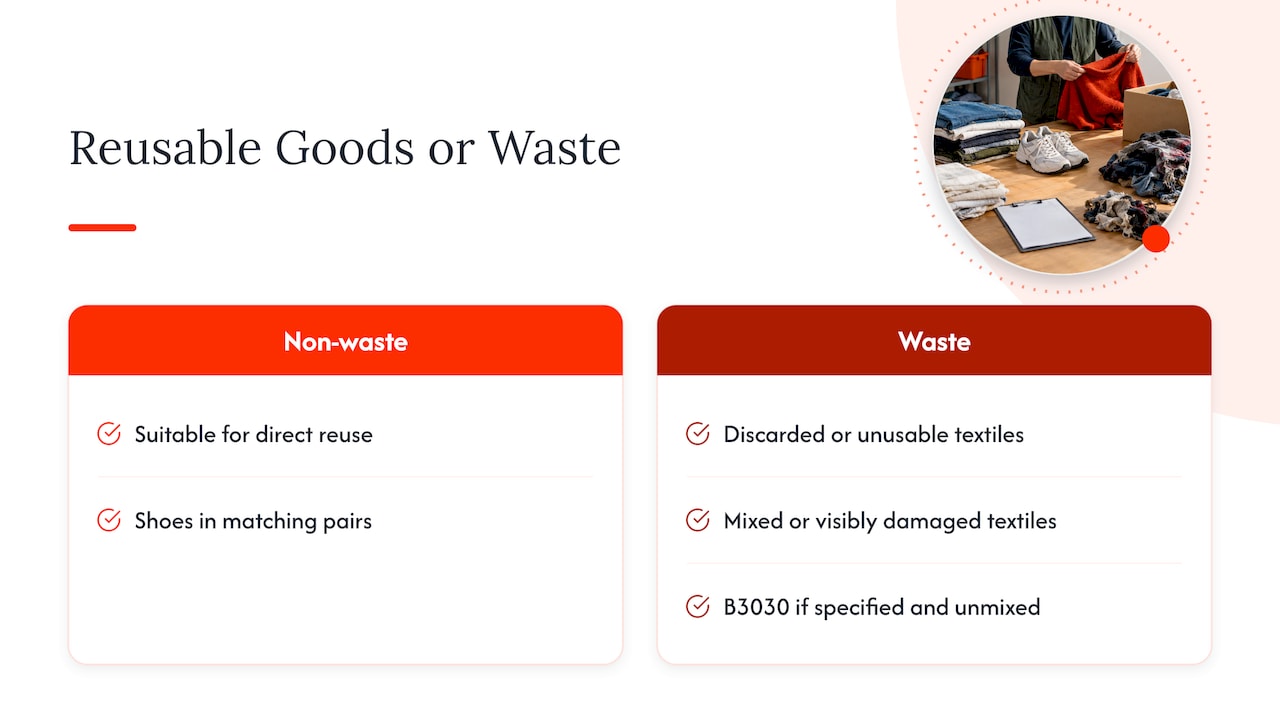
UK government guidance shows the logic clearly. In England, textiles are non-waste only if they are suitable for direct reuse. Discarded, unusable, mixed or visibly damaged textiles are waste. Where waste shipments are allowed, they usually travel under the Basel code B3030, provided the textiles are prepared to a consistent specification and are not mixed with other waste. The same guidance says non-waste shoes must be in matching pairs, which is a practical point for anyone buying footwear bales.
This is not only a UK concern. In January 2026 the World Customs Organization reported that many customs administrations lack clear national criteria separating used textiles from textile waste. The gap is especially visible where second-hand clothing is in high demand and imported bales vary in quality. For a buyer, that means inspectors may use their own judgment about what is wearable. A bale full of stained, torn or odd-sized items invites that judgment.
The practical takeaway: buy graded, wearable stock, and keep records proving what is in each bale. Our guide on how used clothing bale grades work explains how grading connects to what you can defend at the border.
How customs classifies used clothing: heading 6309
Under the World Customs Organization’s Harmonized System, worn clothing and other worn textile articles sit in Chapter 63, heading 6309. Used or new textile rags and worn-out twine, cordage, rope and cables are covered separately by heading 6310. Countries add their own digits beyond the international six, so the exact national subheading and duty can differ.
The two-part test
The UK trade tariff entry for this heading explains that it covers clothing, clothing accessories and parts, blankets, household linen and certain furnishings, plus footwear and headgear of any material other than asbestos. Classification requires both appreciable wear and presentation in bulk, bales, sacks or similar packing. Canada’s 2026 tariff reproduces the same two-part test, though its duty rate comes from the national tariff line and origin treatment rather than from the heading alone.
For Northern Ireland, the same tariff page lists code 6309000000 with a 5.30% third-country duty, preferential rates including 0.00% and 4.20%, no excise duty, and displayed VAT rates of 20.00% and 0.00% (page dated 31 March 2026). Treat that as an example of how a heading turns into a duty, not as a rate that applies in your country.
What a U.S. ruling adds
U.S. Customs rulings show how the test works in practice. In ruling NY L87070, new faulty or shop-soiled articles, and garments merely described as antique or vintage, were not automatically treated as worn clothing. Goods that failed the appreciable-wear test had to be classified as apparel in Chapter 61 or 62. Commingled goods that cannot be separated may be assessed under the highest applicable rate. The same ruling states that heading 6309 includes footwear and clothing accessories, but not purses or stuffed animals, and that residue sold as wiping material may fall under heading 6310 depending on fiber content and sorting.
Two lessons follow. First, a vintage label does not protect you: if the pieces show little wear, the lower used-goods heading may not apply. Second, mixing product types in one bale can cost you. If you import for the U.S. market, our article on keeping tariffs low with HTS 6309 goes deeper, and the HS 6309 classification guide covers the export side.
A separate 2025 U.S. Customs ruling dealt with origin. It found that grading, checking, scrubbing, washing, repairing, overdyeing and re-grading donated clothing did not make a Canadian warehouse the manufacturer for origin purposes. In other words, sorting and cleaning do not change where the garments originally came from, so do not assume a processing country becomes the origin on your entry.
Country rules: who bans, who restricts, who allows
There is no single global rulebook. Each importing country sets its own. The table below summarizes what official sources say for several markets our buyers ask about. Rules change, so confirm them with the authority named before you commit to an order.
| Country | What the official source says | Source |
|---|---|---|
| Kenya | Used clothing and footwear allowed if they meet PVoC standards (KS EAS 356:2019 and KS 1533:1999). Used nightwear, hospital wear, bath towels, undergarments, sandals and slippers are banned. | Kenya 2020 protocols |
| Ghana | Commercial imports of second-hand handkerchiefs, men’s, women’s and children’s underpants, mattresses and sanitary ware are prohibited under L.I. 1586. | Ghana Standards Authority |
| India | Worn clothing is a restricted item needing a government license, with imports primarily permitted only in the Kandla Special Economic Zone. | Law Library of Congress, 2024 |
| Costa Rica | Used footwear and intimate clothing banned. Other used clothing allowed if sanitation precautions are taken before importation. | Law Library of Congress, 2024 |
| Peru | Commercial imports of used clothing and footwear prohibited, with exceptions for donations and for personal luggage and household goods. | Law Library of Congress, 2024 |
| Nicaragua | Used clothing allowed with a certified sanitation certificate issued by authorities in the country of origin. | Law Library of Congress, 2024 |
Notice the pattern. Bans tend to target intimate items, footwear or commercial trade as a whole, while “allowed” markets attach conditions: a standard, a certificate, a treatment. Our overview of used clothing import bans in nine countries lays out the reasons behind these rules, and the legal-to-import guide helps you frame the first question: can you bring this product in at all?
Permits, certificates and documents
Where used clothing is allowed, paperwork is what moves a shipment from the port to your warehouse.
Kenya
The 2020 Kenyan protocols set out a clear chain. Importers register with KEBS. Shipments need PVoC examination before export and a Certificate of Conformity (COC) issued by a PVoC service provider. Used clothing and shoes must be cleaned and fumigated before baling and arrive with a fumigation or treatment certificate. Bales must come in transparent, waterproof packaging. Every one of those items is something your supplier has to do before the goods leave, not something you can fix on arrival.
Ghana
The Ghana Standards Authority says high-risk goods, including second-hand clothing, should be accompanied by a Certificate of Analysis or Certificate of Conformity that references applicable standards. It should be issued by a competent laboratory, preferably in the exporting country.
Sanitation and fumigation
Nicaragua’s sanitation certificate and Costa Rica’s sanitation precautions point the same way as Kenya’s fumigation requirement: authorities want proof that the goods were treated. Our guide to fumigation certificates for clothing explains the three situations in which one is typically needed, and the shoe disinfection compliance guide covers footwear. For a wider look at supplier paperwork, see supplier certificates U.S. importers need.
A document checklist
Whatever the destination, ask your supplier for these per shipment:
- Commercial invoice and packing list that describe the goods the same way (type, grade, bale weight, piece count where relevant).
- The HS code used, with a plain statement that the goods are worn and baled.
- Treatment or fumigation certificate, where your country requires one.
- Pre-shipment inspection or conformity certificate, where required (for example a PVoC COC for Kenya).
- Bale-level identification so each bale can be traced to its packing record. Our note on what to record and verify per bale shows how.
Mixed bales, damaged textiles and shoes
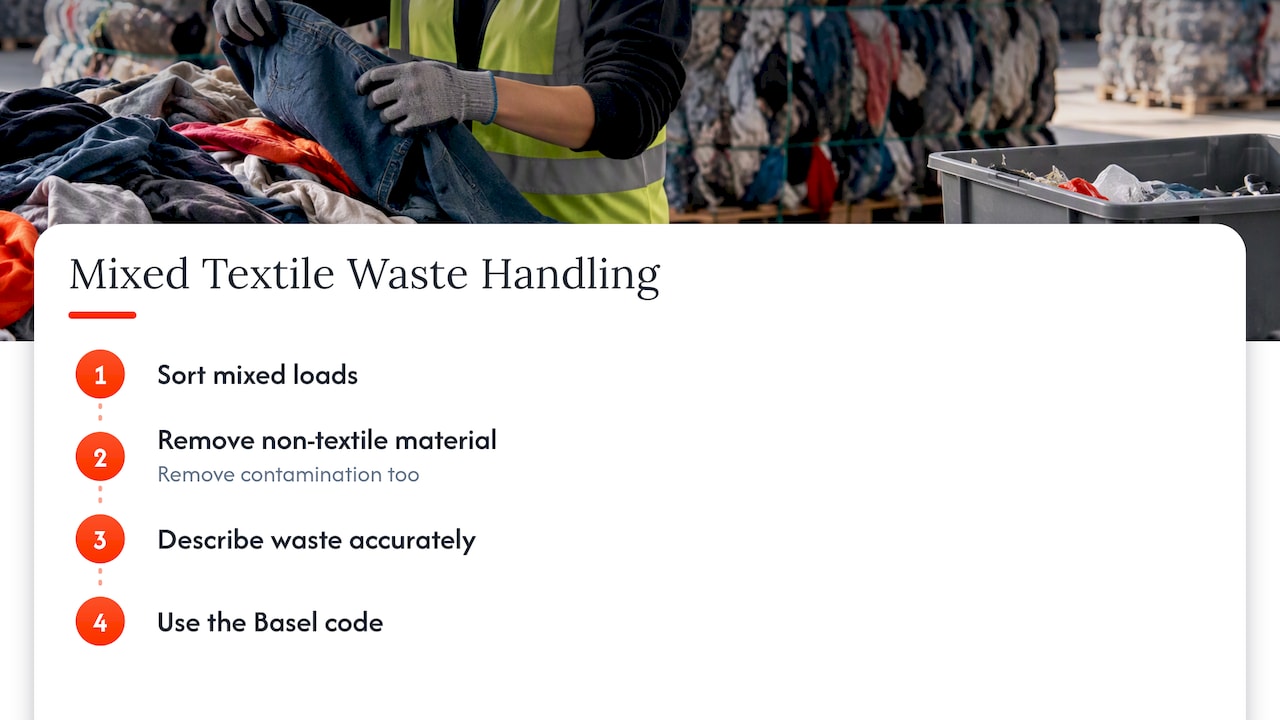
Mixed shipments are where most disputes start. The England guidance says mixed loads and visibly damaged textiles are treated as waste: they must be sorted, non-textile material and contamination removed, the waste accurately described and its Basel code used. If you buy mixed bales for resale, you need the supplier to describe the contents honestly and keep unusable pieces out.
Shoes need their own care. Pairs must match for the non-waste route in England, and Kenya and Costa Rica restrict some footwear types or require treatment. Nigeria, Uganda, Tanzania and other markets may apply their own rules, so shoe bales should never be assumed to follow the clothing rules. Our shoe bale grading guide and market and supplier checklist for used shoes in Africa help you set specifications before ordering.
Other categories sit under different headings. Handbags and soft toys are not part of heading 6309 under the U.S. ruling above, and wiping rags may fall under 6310. If you buy those lines, read how HS 6310 applies to wiping rags so your declaration matches the goods.
Our perspective
In our experience, most problems with used clothing shipments are decided before the container is loaded. The buyer who asks for a clear grade, a consistent bale specification and the right certificates for the destination rarely meets the surprises that cost money at the port.
That is why we pack with advanced machinery and keep shipments documented. Faster packaging means a bale can be sealed, labeled and recorded quickly, and consistent documentation is what customs officers and standards bodies ask to see. We serve buyers in more than 40 countries from a 133,000 square foot warehouse in Poland, and we see how different each market’s expectations are. A document set that works for one destination may be incomplete for another.
Our approach is to treat compliance as part of the product. We aim to give importers the information they need to meet their country’s import requirements, and when an issue comes up, we work to resolve it with the buyer rather than leave them to guess. Wearable, graded goods packed in sound bales are what the rules reward, and that is what we want every buyer to receive.
rodrigues
Buy bulk used goods with compliance in mind
We supply businesses, not individual shoppers: importers, wholesalers, resellers and market traders who buy bulk bales. Our range covers used clothing and used shoes, plus bags, toys, bric-a-brac and wiping rags, shipped in bales packed for international delivery. Tell us your destination country and product line, and we will talk through the documents your shipment is likely to need.
To start a conversation about a bulk order, visit msexpspzoo.com.
How to verify current rules for your market
Rules for used clothing change, and our research found official sources for some countries but not all of those our buyers ask about, including Nigeria, Tanzania, Uganda, Cameroon, Côte d’Ivoire, Senegal, Benin, Togo, Pakistan and the UAE. Use this routine for any market:
- Find the competent authority. It is usually the national standards body, the customs service or the trade ministry. Kenya’s protocols and Ghana’s standards page above show where such rules are published.
- Ask for the current document, not a summary. A circular, protocol or tariff schedule with a date beats a forwarder’s email.
- Confirm the HS subheading. Ask a licensed customs broker in the destination country which national tariff line applies to your goods and what duty and tax follow.
- Check restricted items. Underwear, nightwear, sandals and similar items are the ones most often singled out.
- Send the supplier the requirements in writing. Certificates such as fumigation or pre-shipment conformity must be arranged before export.
- Re-check before every new contract. A rule that held last year may have changed.
If you are importing into the EU, our EU used clothing compliance guide covers that market specifically. For border-to-door shipments, see the six buyer checks to avoid customs rejection. And for how reuse fits the wider waste picture, read our piece on reuse-first textile waste reduction.
FAQ
Is used clothing treated as waste or as a product?
It depends on condition. In England, textiles are non-waste only when suitable for direct reuse, while discarded, mixed, unusable or visibly damaged textiles are waste. Other countries draw the line differently, and customs bodies report that many lack clear criteria. Graded, wearable stock with records is your best protection.
What customs code applies to used clothing?
The international Harmonized System places worn clothing in heading 6309, and used textile rags fall under 6310. The goods must show appreciable wear and be presented in bulk, bales or sacks. Your country adds its own digits and sets its own duty, so confirm the national subheading with a customs broker.
Which countries ban used clothing imports?
Peru prohibits commercial imports of used clothing and footwear, with exceptions for donations and personal luggage. Costa Rica bans used footwear and intimate clothing. Kenya allows used clothing under conditions but bans items such as undergarments, sandals and slippers. Always verify with the importing country’s authority.
Do I need a fumigation certificate?
Only where the destination requires it. Kenya’s protocols require used clothing and shoes to be cleaned and fumigated before baling, with a treatment certificate. Nicaragua requires a sanitation certificate from the country of origin. Ask your supplier to confirm before shipping.
Sources
- Importing and exporting waste and non-waste textiles, GOV.UK
- World Customs Organization, Operation Demeter XI report
- World Customs Organization, HS Nomenclature 2022 edition
- UK Trade Tariff, commodity code 6309000000
- Canada Border Services Agency, Chapter 63, Customs Tariff 2026
- U.S. Customs ruling NY L87070
- U.S. Customs ruling H329916 (2025)
- Kenya protocols for importation of used textiles and footwear
- Ghana Standards Authority, Import Inspection
- Law Library of Congress, Textile Waste Bans in Selected Countries (2024)