
Buying used clothing well comes down to five checks: the quality of the garments, the grade the supplier assigns, the true price per kilogram, the proof the supplier gives you before you pay, and the paperwork that gets the shipment through customs. This guide walks through each one for buyers who purchase in bulk and resell, whether you run a shop, a market stall, an online store or an import business.
TL;DR
- Judge quality by fabric, seams, buttons and stains, then confirm what the supplier’s grade means in writing, because grade names are not standardized across sellers.
- Compare offers by price per kg of sellable goods, not by headline bale price. Add freight, duty and your own sorting losses.
- Order a small sample (5 to 10% of the planned volume) before the first full order, and check it against the grade promised.
- Ask for packing, document and certificate details before you pay, and split payment terms so you are protected.
- Store bales dry and off the floor, and match what you buy to what your customers actually sell.
Table of Contents
- What you are really buying when you buy a bale
- Know the quality signals before you talk to a supplier
- Sizing: do not trust the label alone
- How grading works, and why you must get it in writing
- Price per kg: the number that actually compares offers
- Always sample before you commit
- Paperwork, packing and customs
- Match the lot to your customers
- Our perspective
- Why reuse is a sound base for a business
- Buy bulk used clothing from us
- Mistakes that cost buyers money
- FAQ
- Sources
What you are really buying when you buy a bale
A bale of used clothing is a compressed, strapped lot of garments sorted to a described standard. You are not buying individual pieces you can inspect. You are buying a promise about the average quality of the contents, so everything in this guide is about turning that promise into something you can measure.
Consumer guides to second-hand shopping tell people to touch, inspect and try on every item. A bulk buyer cannot do that for each garment, but the same signals still apply. You apply them to a sample, to photos and to the supplier’s description, then you check them again when the lot arrives.
The difference between a good and a bad purchase is rarely the supplier’s headline price. It is the share of the bale that you can actually sell at a margin, and how fast.
Know the quality signals before you talk to a supplier
The same inspection points that help a thrift shopper help a reseller assess a sample bale. Use them on the first lot you receive and on every sample.
Fabric
Natural fibers such as cotton, wool, linen and silk are often a sign of quality, while cheaper synthetic materials are often linked with lower quality, according to Love Your Clothes. The same guide warns that a high price does not always mean high quality, which is a useful reminder when you see a famous label in a mixed lot. Hold fabric up to the light: a dense weave suggests better construction.
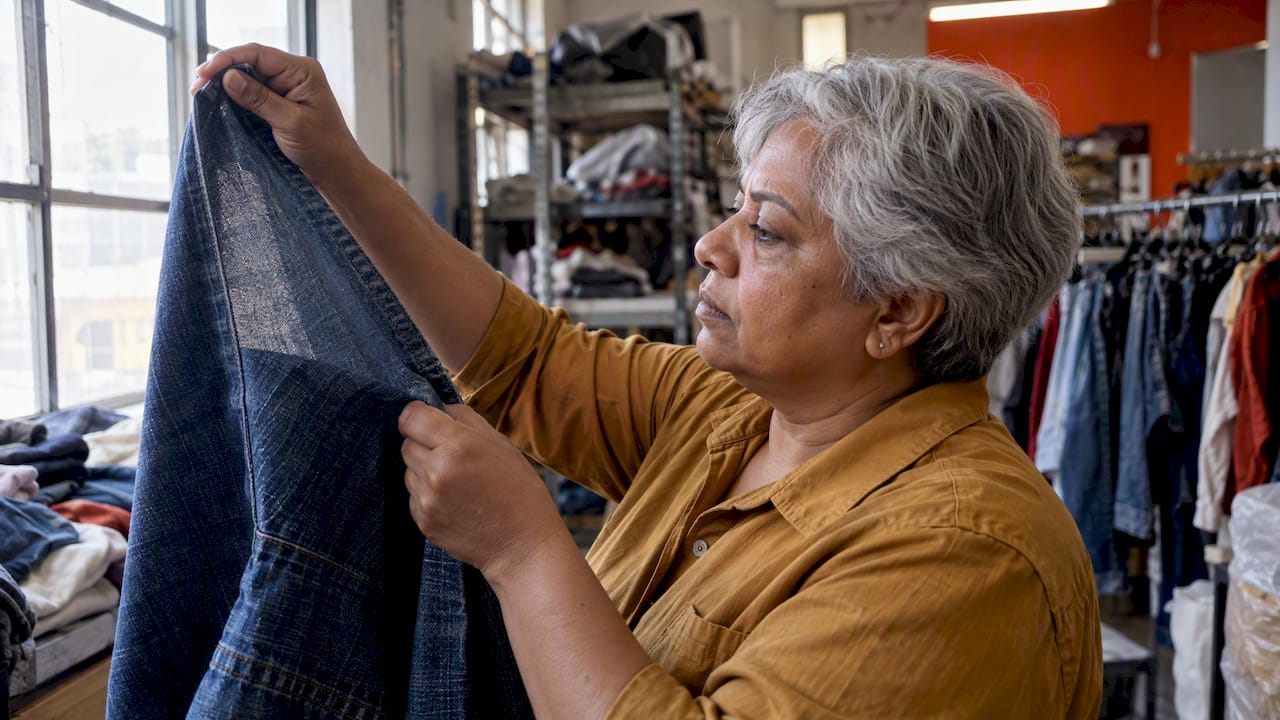
Fiber matters commercially too. Cotton tees and denim sell steadily in many warm-climate markets, while a lot heavy in thin synthetics may sit longer. Your own sales history is the best guide to which blend you can move.
Seams, buttons and hems
The University of Georgia Cooperative Extension notes that puckered or raveling seams, ragged buttonholes and uneven hems point to construction shortcuts. It also says many flaws can be repaired, and that they show how much of a bargain you are getting. For a reseller, that translates into a simple rule: repairable flaws on good garments are fine if you have a repair option and the price reflects them. Flaws on weak garments are not.
Re-Fashion’s consumer guide lists even stitching, straight seams, secure buttons, lining, hemming and topstitching as quality indicators. Love Your Clothes adds buttons that are not flimsy and buttonholes without fraying.
The inside-out check
Ethical Consumer’s guidance recommends turning garments inside out and pulling at every piece of string, since shabby seams or unraveling are reasons not to buy. When you open a sample bale, pull 20 to 30 pieces at random and do exactly this. It takes ten minutes and tells you more than any description.
Stains, holes and stretch
The Good Trade advises looking for large stains, holes and overly stretched fabric and asking whether tailoring or mending is practical. For resale, count these separately from minor wear. A bale with 3% stained pieces and one with 15% are different products even if the grade label is the same.
Sizing: do not trust the label alone
Label sizes drift between brands, decades and countries. Ethical Consumer advises asking for measurements, comparing with a similar item you own, and checking whether a brand runs true to size. For a reseller, that means measuring a sample of garments flat (chest, length, waist) and recording the spread. If you sell online, list measurements, not just the tag size, and your returns will fall.
Shoes need the same discipline. A step-by-step combat boot fit check shows how to confirm length, width and ankle fit rather than trusting the printed size, and the same habit applies to any pair you list for resale.
How grading works, and why you must get it in writing
Grading is the supplier’s sorting of garments into quality tiers. Names such as “cream,” “A grade,” “B grade” or “original” are common in the trade, but no single standard binds every seller, so the same word can mean different things from different suppliers. Before you compare any two offers, ask each supplier to define their grades in writing: what share of the lot is first-quality, how stains and damage are handled, what seasons are included and which garment types are in the mix.
Our breakdown of how bale grades work for buyers goes through the typical tiers in detail. If you are weighing ungraded lots against sorted ones, how resellers verify original and graded clothing covers what to test in each. For footwear, the logic differs; see how used shoe grades work.
Price per kg: the number that actually compares offers
Many buyers search for a used clothing price per kg, and it is the right unit for comparing lots, but a single market-wide figure would mislead you. Prices move with grade, garment type, season, origin, packing method and the destination. Any quoted number is a snapshot, so ask each supplier for a current written quote and compare on a consistent basis.
This is the method we recommend for pricing bales of used clothing:
- Get the net weight and the price. Ask for the bale weight, whether it is gross or net, and the price per bale or per kg.
- Convert to price per kg delivered. Add freight, insurance, port charges, duty and clearance fees, then divide by net weight.
- Estimate your sellable yield. After sorting, some pieces go to a discount rail, some to rags or recycling, and some are discarded. Use the result from your sample, not a guess.
- Compute cost per sellable piece. Divide total landed cost by the number of pieces you can sell at your target price.
- Compare against your realistic resale price, not the best-case one.
Here is an illustration with made-up numbers, only to show the arithmetic. Say a lot costs 1,000 units of currency for 500 kg, so 2.00 per kg. Freight and duty add 300, bringing the total to 1,300, or 2.60 per kg. If your sorting yields 80% sellable goods, you are really paying 3.25 per sellable kg. A rival lot at 2.30 per kg that yields only 60% sellable costs far more per sellable kg than it first appears. Run your own figures through the same steps.
For specific categories, our guide to landed cost on handbag bales shows the same calculation applied to a different product.
Always sample before you commit
The cheapest way to find a bad supplier is a small order. We recommend a trial of 5 to 10% of your planned volume before the first full purchase. When it arrives, do these checks:
- Open the bale and photograph the contents layer by layer.
- Pull a random 30 pieces and run the seam, stain and fiber checks above.
- Measure a handful of garments against their size labels.
- Count pieces per kg and compare with what you were told.
- Check the bale marking, weight and packing against the quote.
If the sample matches the written grade, scale up. If it does not, you have lost a small amount rather than a container. A supplier vetting checklist helps you ask the right questions before any money moves.
Paperwork, packing and customs
A good garment lot can still become a bad purchase if the shipment is held at the port. Used clothing rules differ by country: some markets restrict or ban imports, and others require specific certificates. Check your own country’s rules before you order. Our overview of used clothing import bans in nine countries explains the reasoning behind the strictest policies.
If you import into the United States, see the supplier certificates U.S. importers need and how HTS 6309 classification affects tariffs. For door-to-door delivery, six buyer checks to avoid customs rejection are a useful pre-order list.
Packing affects both cost and clearance. Compare how a supplier compresses and straps bales, and whether they follow container packing rules; our notes on packing specs and machine strapping and vacuum-packed used clothing explain what to ask for.
Payment terms
Avoid paying everything up front to a supplier you have not tested. A split between a deposit and a balance tied to shipping documents or inspection is common practice; see payment terms that protect you for structures worth proposing.
Match the lot to your customers
The best bale is the one your customers want. Before choosing, answer three questions:
| Question | Why it matters |
|---|---|
| Who buys from you, and in what climate? | Summer and winter mixes sell on different calendars, and heavy knitwear is a poor fit for hot markets. |
| What price points do your shoppers accept? | A premium lot only pays if your channel can charge for it. |
| How will you sell: stall, shop, online? | Online sales need photo-ready pieces and measurements, so you need higher-grade lots. |
| Can you sort and store? | Unsorted lots need labor and space; sorted lots cost more per kg. |
Once bales arrive, dry storage matters. Damp compressed textiles can develop odor and mildew, so see our practical notes on storing used clothing. Vintage and footwear buyers have their own grading logic, covered in the three zones that decide vintage footwear grades.
Our perspective
We ship used clothing, shoes, bags, toys and other second-hand goods from Poland to buyers in more than 40 countries, and the pattern we see is consistent: buyers who do well ask hard questions early.
Our approach is built around what we say are the two things that cause most buyer pain: slow turnaround and unclear documentation. We pack with advanced machinery designed to make bale preparation faster and more uniform, and we work from a warehouse of 133,000 square feet so that we can hold a broad range of goods. We document shipments so that you know what you are importing, and we help with the compliance questions that come with global import requirements.
Our advice is to treat the first order as a test, ask for the grade definition in writing, and judge a supplier on how they respond when something is not right. We aim to resolve issues proactively, because long-term partners matter more to us than a single sale.
Reuse also has a real environmental case when it replaces new production. The European lifecycle assessment of used textiles found that new garments caused almost 70 times the overall impact of reused crème and B-grade T-shirts. We think that is a strong reason to build your stock on quality second-hand goods.
rodrigues
Why reuse is a sound base for a business
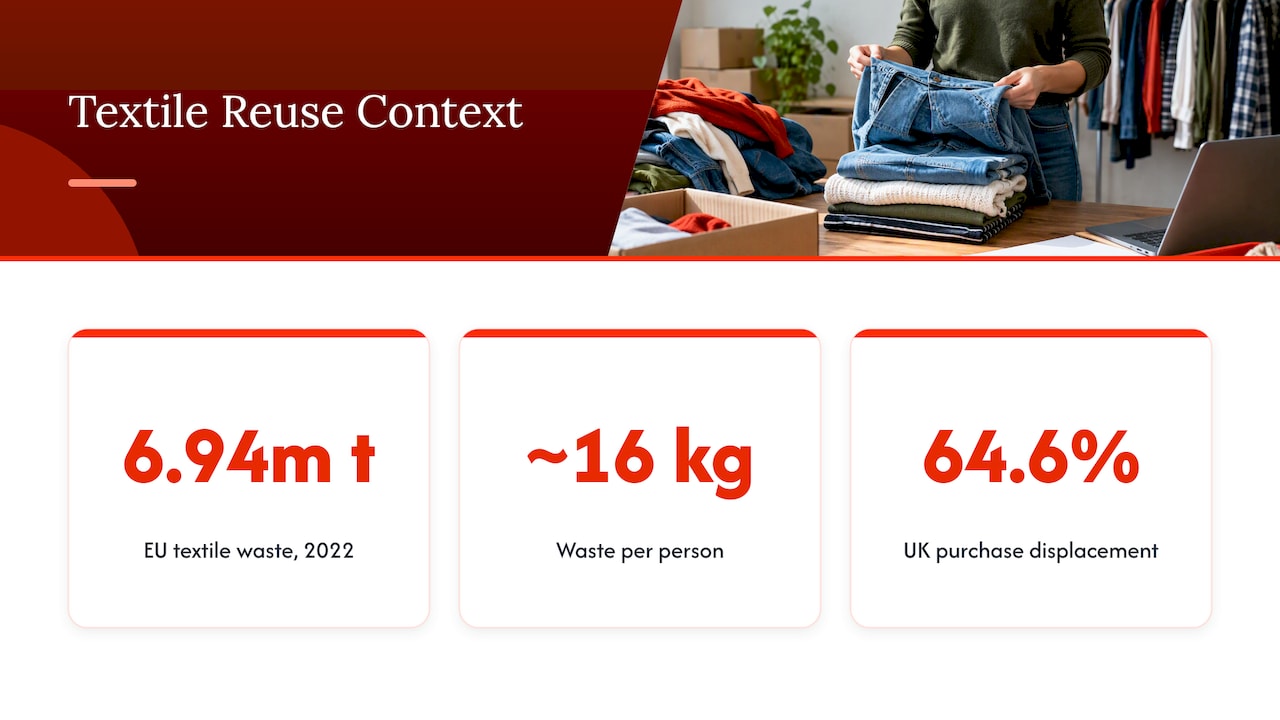
The supply of used textiles is large. The European Environment Agency estimates that EU Member States generated about 6.94 million tonnes of textile waste in 2022, around 16 kg per person, so sorted second-hand goods are a steady raw material for resellers rather than a niche.
The environmental benefit depends on one condition, which the European lifecycle study states plainly: reuse helps most when it replaces the production of new garments. For a UK peer-to-peer context, WRAP measured a 64.6% displacement rate, meaning more than three in five second-hand purchases replaced a new one. That figure is specific to the UK and is not a global rate, but it shows why selling clothes people genuinely wear, instead of dumping low-grade stock, is both the ethical and the commercial choice. Our piece on reuse-first textile waste reduction covers this from a reseller’s point of view.
Buy bulk used clothing from us
We supply bulk used clothing in sorted, strapped bales to importers, wholesalers, market traders and resellers. Our team can walk you through grades, packing and shipping documents before you place an order, and you can start with a sample lot.
See the range on our used clothing page, or if you also resell footwear, visit our used shoes page. Prices are quoted per order, so contact us with your destination, volume and preferred grade for a current quote.
Mistakes that cost buyers money
- Comparing bale prices instead of cost per sellable kg. The cheap lot with a low yield is the expensive one.
- Accepting a grade name without a definition. Ask for photos and a written description.
- Skipping the sample. The first order is the cheapest time to learn.
- Ignoring import rules. A held container adds storage and demurrage costs, and some products are restricted outright.
- Buying for the wrong season. Time your orders to your selling calendar.
- Poor storage. Moisture ruins good stock.
FAQ
What is a fair price per kg for used clothing bales?
There is no single figure, because grade, garment mix, season, packing and destination all change it. Request written quotes from several suppliers for the same grade, add freight and duty, and compare the landed cost per sellable kg. Contact us for a current quote on your volume.
How do I check the quality of a bale before buying?
Order a sample of 5 to 10% of your planned volume and inspect it. Pull random pieces, turn them inside out, check seams, buttons, stains and fiber content, and compare the result with the grade definition in your quote.
Should I buy graded or original (ungraded) clothing?
Graded lots cost more per kg but need less sorting and give more predictable results. Original lots can pay off if you have the labor and an eye for what sells. Test either type with a sample first.
What documents should I ask for?
Ask for an invoice, packing list, weight details and any certificates your destination requires. Rules differ by country, so check with your customs broker or the national authority before ordering.
Sources
- Management of used and waste textiles in Europe’s circular economy, European Environment Agency
- Circularity of the EU textiles value chain in numbers, European Environment Agency
- LCA-based assessment of the management of European used textiles
- Displacement Rates Untangled, WRAP
- Quality and Selection, University of Georgia Cooperative Extension
- Upcycling, repairing and second-hand clothing, Ethical Consumer
- Re-Fashion consumer guide
- Shopping New and Second-Hand, Love Your Clothes
- How To Properly Clean And Care For Secondhand Clothing, The Good Trade
- Combat boot fit check