
Bale mix planning is the work you do before you place an order: deciding which categories, grades and sizes should be in the bales you buy, in what proportions, and how you will check that the sealed bale matches the spec. The mix should follow what your customers actually buy, not what a supplier happens to have on the floor. A buyer who writes the mix down, asks for a sample and tests it against sales gets steadier margins than one who orders “mixed” and hopes.
This guide is for wholesalers, market traders and importers who buy used clothing, shoes and accessories by the bale. It shows how to build a mix, how to adapt ratios to your channel and climate, which terms to confirm with a supplier, and which import rules shape what a bale may contain.
TL;DR
- A bale mix is a written spec: category, gender and age split, season, grade and bale weight. If it is not written down, it cannot be enforced.
- Start from your sell-through data by category and customer, then set ratios. Change one variable per order so you can see what moved the result.
- Single-category bales are safer than blended ones in some markets. Kenya, for example, requires each bale to hold one category of garments or one type of shoe.
- Sealed bales carry risk. Order a small sample first, inspect 5 to 10% of a lot, and keep records by batch.
- Keep dutiable goods separate in your documents: commingled goods with different duty rates can be charged the highest rate in the U.S.
Table of Contents
- What bale mix planning actually covers
- Start from your channel, not the supplier’s list
- Building the ratios: a worked example
- Terms to confirm before you order
- Rules that shape what a bale may hold
- Checking what is really in the bale
- Our perspective on bale mix planning
- Order a bale mix that matches your spec
- FAQ
- Sources
What bale mix planning actually covers
A used-clothing bale is a compressed, strapped block of sorted garments or shoes. “Sorted” is the key word. Before baling, a sorting house splits donated and collected clothing into fractions by type, quality and sometimes season. Your mix plan decides which fractions you want and how much of each.
Five decisions make up the plan:
- Category: tops, trousers, dresses, outerwear, kidswear, denim, sportswear, footwear, bags.
- Grade: the quality tier, from premium or “cream” down to lower resale grades. Grade names differ between suppliers, so get the definition in writing. Our guide to how bale grades work for buyers explains the common tiers.
- Demographic split: men, women, children, unisex.
- Season and climate fit: summer, winter, or all-season.
- Packing format: bale weight, strapping, labels and whether the bale is single-category or mixed.
The last point matters more than it looks. A mixed bale gives you range; a single-category bale gives you predictability. Many experienced buyers use both: single-category bales for the fast movers, mixed bales for stalls that need variety.
Start from your channel, not the supplier’s list
The contents of a bale should answer one question: who will buy this, and where? A channel is the way the goods reach a customer, and it changes the ideal mix a great deal.
Open-air market stalls
Market traders sell by the piece or by the heap, and customers browse. Variety helps, and so does a visible top layer of strong items. These buyers usually want a spread of everyday categories, with a smaller share of premium pieces to anchor the stall.
Shops and boutiques
A shop sells a curated range, so it needs consistency: tighter grade bands, cleaner condition, and fewer unsellable pieces. A shop owner accepts a lower category spread in exchange for a higher share of top grades.
Wholesale sub-distribution
If you resell sealed bales onward, your customers are trusting your labels. You want a mix that is boringly repeatable: the same spec, the same weight, the same category each time. Repeatability is your product.
Climate and local demand
Climate decides how much of the bale is useful. A hot, humid coastal market has little use for heavy coats; a highland or northern market can sell them for months. Local dress norms, school uniform seasons, religious festivals and the local currency’s strength against the dollar all shift demand. Look at your own sales ledger by category over twelve months before you set any ratio. If you do not have a ledger yet, your first orders are the ledger: keep them small, and record what sells in the first two weeks.
Building the ratios: a worked example
The ratios below are a planning illustration, not an industry standard and not a published specification of ours. Real mixes depend on your data. The method is what you should copy.
Imagine a trader with a mid-market shop in a warm climate who sells to working adults and families. Her last year of sales shows that women’s tops and dresses move fastest, children’s clothing is steady, and outerwear barely sells outside two months. She plans a 100-piece sample of mixed stock like this:
| Category | Share of bale (illustrative) | Reason |
|---|---|---|
| Women’s tops and blouses | 30% | Fastest sell-through in her ledger |
| Women’s dresses and skirts | 15% | Strong in festival months |
| Men’s shirts and T-shirts | 20% | Steady everyday demand |
| Men’s and women’s trousers, jeans | 15% | Good margin, slower turn |
| Children’s clothing | 15% | Steady, price-sensitive |
| Outerwear and knitwear | 5% | Seasonal, kept low |
She then applies a grade rule on top: for example, she asks for the highest grade in tops and dresses, where customers inspect closely, and accepts a middle grade in trousers and children’s wear, where price matters more than perfection.
How to adapt the ratios
- Raise a category’s share by a small step, such as five percentage points, and keep everything else equal for the next two orders.
- Track sell-through by category after two weeks and after six. A category that sells out in days is under-ordered; one that sits for a month is over-ordered.
- Watch your reject rate: pieces you cannot sell at any price. If it climbs, the issue is usually grade, not category.
- Separate seasonal stock from the base mix so you can order it once or twice a year instead of every time.
For footwear, apply the same approach but expect narrower control. Size runs, pairs matching and sole wear drive value more than category. Our guides to how used shoe grades work and the three zones that decide vintage footwear grades set out what to ask a supplier to define. For bags, see how to calculate landed cost on 45 kg handbag bales before you fix the mix.
Terms to confirm before you order
Most disputes about a bale come from a word that meant two things. Before you pay, get each of these in writing:
| Term | What to ask |
|---|---|
| Bale weight | The nominal weight per bale and the tolerance. Bales come in different weights, so never assume. |
| Grade definition | What separates each tier: condition, stains, wear, brands, fabric. |
| Category content | Is the bale single-category or mixed, and which categories in what range? |
| Gender and age split | Men, women, children, unisex, as a range. |
| Season | Summer, winter, all-season. |
| Label | What is printed: mass, category, supplier, consignee, origin. |
| Packing | Strapping, wrapping, container loading method. |
| Contamination | Limits on odor, damp, mold, non-textile items. |
| Sample policy | How samples are drawn and what happens to disputed bales. |
Our seven bale specs buyers should demand goes deeper on warehousing and storage, and our guide on bale contamination control covers what should not be in a bale at all. For how bales are strapped and loaded, read about CTU Code packing specs and machine strapping.
Rules that shape what a bale may hold
A mix that is perfect commercially can still be refused at the port. Check the rules of your destination before you finalize a spec.
Kenya: single category per bale
Kenya’s published protocol for imported used textiles and shoes requires that each bale contain only a single category of garments or a single type of shoes, and that each bale be legibly labeled with mass, category or type, supplier details, importer or consignee details and country of origin. The same document lists PVoC inspection and certification, a fumigation or treatment certificate, a Certificate of Conformity and importer registration among the checks. If you sell into Kenya, this rules out the “mixed bale” idea for that route: your planning happens across bales, not inside them.
United States: wear and bulk, and commingling
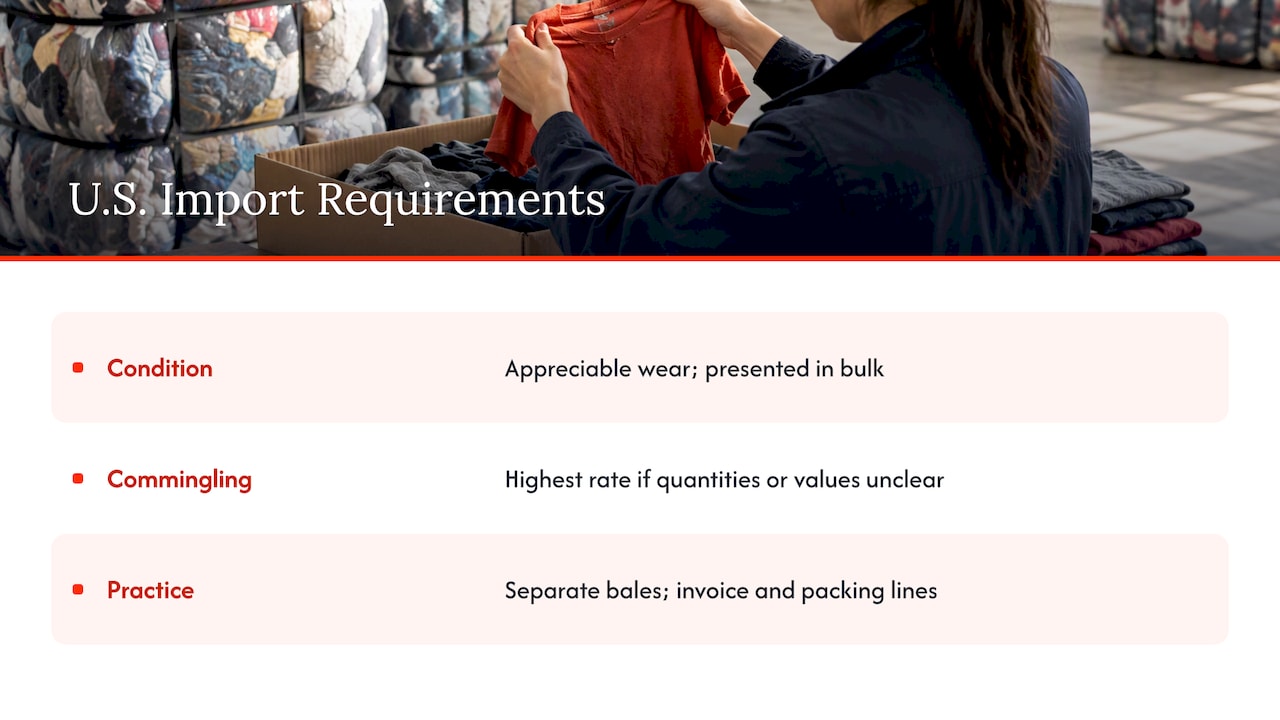
For U.S. imports, a customs ruling on heading 6309 states that goods must show appreciable wear and be presented in bulk. The same ruling notes that if goods subject to different duty rates are commingled so that their quantities or values cannot readily be ascertained, they may be charged the highest applicable rate unless segregated. In practice: if a shipment includes categories that classify differently, keep them in separately labeled bales with separate lines on the invoice and packing list. We cover this in HS Code 6309 classification rules and how U.S. importers keep used clothing tariffs low.
Other markets
Import bans, certificates and documentary requirements differ by country and change. Check our overview of used clothing import bans in nine countries, the guide on whether you can legally import used clothing for resale, and the list of supplier certificates U.S. importers need. Confirm the current text on the official customs or standards page of your country before each shipment.
Checking what is really in the bale
You cannot see inside a sealed bale. Researchers studying secondhand clothing trade in Ghana describe an “uncertainty tax”: traders often buy sealed bales without being able to inspect them, and unsellable items become a financial risk they carry. Your mix plan is only as good as your ability to verify it.
What good suppliers do
Quality control at a sorting house is typically a sampling exercise. One professional report describes chief sorters checking about 15% of daily production to confirm sorted qualities meet the defined requirements. Ask your supplier how they check, how often and who signs off. A specification only works when it is checked at the source, in the same way a clothing brand fixes a product on paper before it goes to the factory, as this tech pack to production workflow shows for new garments.
What you should do
- Order a sample first. Take a small trial before a container. Our guide, sample 5 to 10% first, explains how resellers verify original and graded clothing.
- Open bales at random. Choose them yourself, not the supplier’s top row. Open bales from different pallets or positions.
- Sort and count. Put every piece into your own categories and grades, count them, and compare with the spec as percentages.
- Record everything by batch. Keep the bale label, batch, date, photos and your count. A dispute without records is an opinion.
- Check labels and ties before dispatch. A packing guide from a baling-equipment maker advises confirming that bale labels match the fraction, ties are in the expected condition and dispatch records support traceability. Ask your supplier for the same records.
- Agree a tolerance. Decide in advance what deviation, for example in category share or reject rate, triggers a credit or replacement.
Reading the results
If the category split is off but the grade is right, you have a sorting problem: raise it with the supplier and tighten the category range in your spec. If the category split is right but sell-through is poor, your plan was wrong: revisit your channel assumptions. Keeping those two diagnoses apart is the entire value of writing the mix down.
Our perspective on bale mix planning
We ship used clothing, shoes, bags, toys and other goods to buyers in more than 40 countries from our warehouse in Poland, which covers 133,000 square feet. That range of customers has taught us that no single mix is right. A market trader in one country and a shop owner in another can buy the same category and need very different grades.
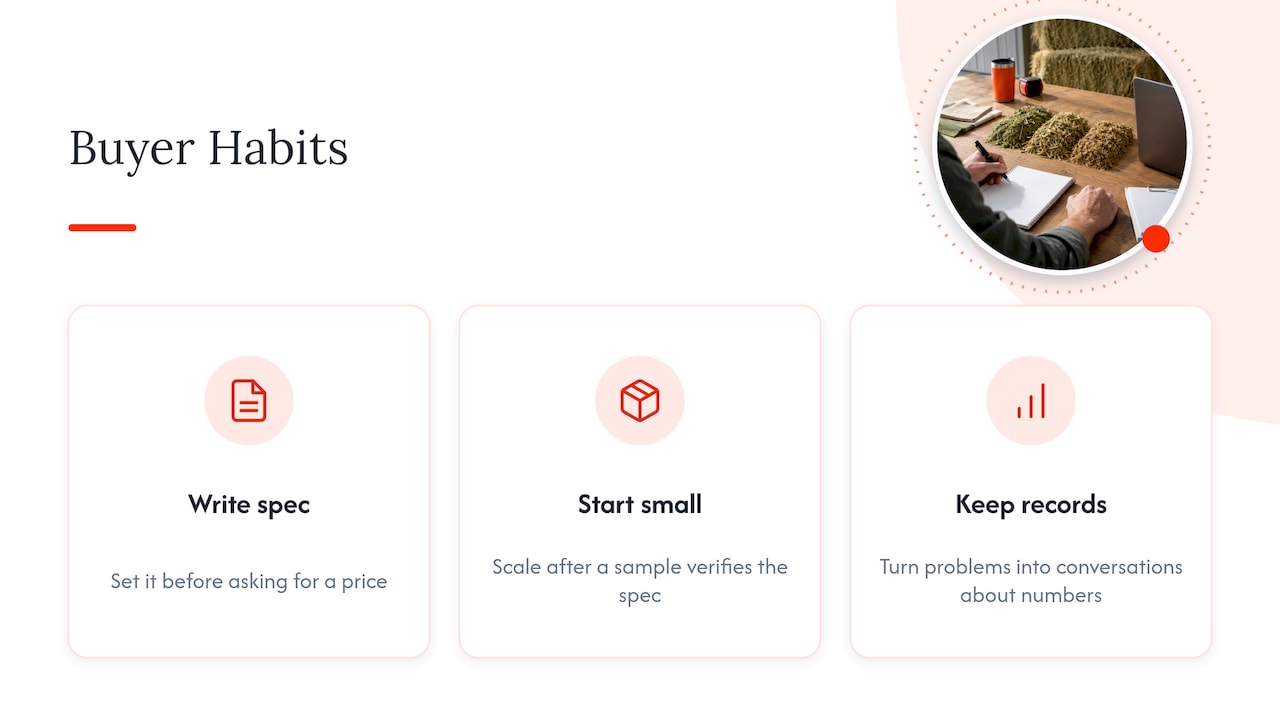
Three habits separate the buyers who come back from those who do not. They write the spec before they ask for a price. They start small and scale only after a sample verified the spec. And they keep their records, so a problem becomes a conversation about numbers instead of an argument. We use machinery for packaging so bales are uniform and can be turned around quickly, and we document shipments so that your customs broker has what they need. Our view is simple: the supplier’s job is to make the spec easy to meet and easy to check.
— rodrigues
Order a bale mix that matches your spec
If you are ready to test a mix, start with the category that moves fastest in your ledger. Our used clothing range is packed in bales for wholesale buyers, and our used shoes range follows the same approach. Send us your destination country, channel, target categories and the grades you want, and we will talk through what a first sample order could look like.
For payment structures that reduce your risk on a first order, see our guide to payment terms for used clothing.
FAQ
What is a good mix ratio for a used clothing bale?
There is no universal ratio. A good mix is the one that matches your own sales by category, grade and season. Build it from your ledger, test it with a small order and change one variable at a time.
Should I buy mixed bales or single-category bales?
It depends on your market and your customers. Some countries, such as Kenya, require each bale to contain only one category of garments or one type of shoes. Where mixed bales are allowed, they give a stall more variety, while single-category bales give you more predictable resale.
How do I know the bale matches the stated mix?
You verify it. Order a sample, open bales you choose at random, sort and count the contents, and compare your percentages with the written spec. Keep photos and batch records so you can claim if the bale deviates.
Do import rules affect how I plan a bale mix?
Yes. Some markets restrict what a bale may contain and require labels and certificates. In the U.S., goods with different duty rates that are commingled can be charged the highest applicable rate unless they are segregated, so keep them in separate labeled bales.
Sources
- Protocols for importation of used textiles and used shoes, Kenya
- U.S. Customs ruling NY N340317, heading 6309
- Waste and Quality Uncertainty in Imported Secondhand Clothing Markets
- Sorting and sales of second-hand clothing
- Textile Baling Preparation and Sorting, THE BALER
- Men’s Swimwear Workflow: From Tech Pack to Production