
Used clothing traceability means being able to show where a bale came from, who sorted and graded it, what is inside, and who has held it since. You can’t trace a single garment the way you can trace a new one, so the bale becomes the unit of record. This guide covers what to record, how to handle mixed bales, how to check a supplier’s paperwork, and where the rules differ by country.
TL;DR
- For used clothing, the bale is the traceable unit. A record covers its content, quality grade, assessor, date and every handover to resale.
- Traceability has to run beyond manufacture: collection, sorting, grading, baling, export, customs, import and resale all count, because a garment’s owner, condition and legal status change along the way.
- Buyers can verify a supplier by asking for sorting records, site details, a per-bale evidence trail and the paperwork the destination country requires.
- Rules and definitions of “fit for reuse” differ by country, so ask for the documents your own market demands before you order.
- Good records protect you from customs holds, disputed grades and weak sustainability claims.
Table of Contents
- What traceability means for used clothing
- What to record from sorting to resale
- How to trace mixed bales
- How to verify a supplier’s records
- Tools and data formats that connect the records
- What good records do for quality, logistics and claims
- Costs, barriers and rules that vary by country
- Our perspective: the bale is the promise
- Sourcing bales with documented shipments
- FAQ
- Sources
What traceability means for used clothing
Traceability for new apparel follows a product backwards: raw material, yarn, fabric, garment assembly, retail. A European Parliament study on digital product passports describes that chain and notes that simple identification such as a barcode can’t tell apart similar products made through different processes.
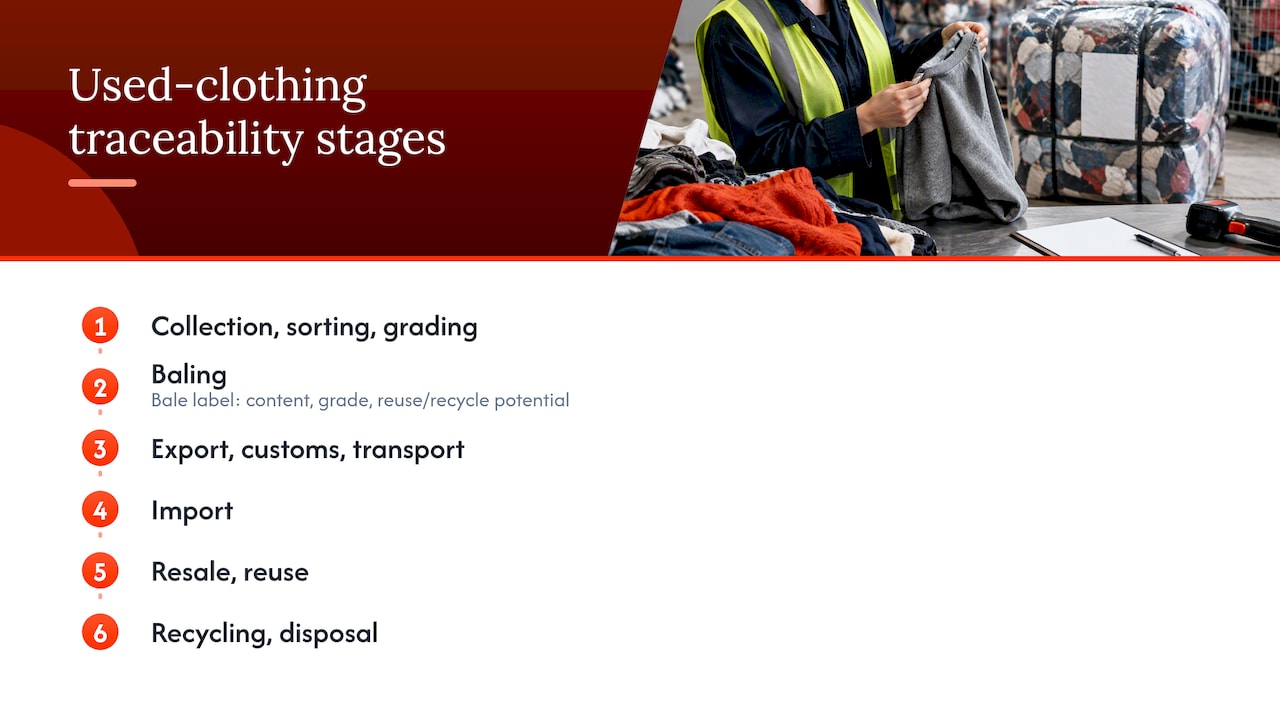
Used clothing adds a second life to that story. A 2026 ECLAC/UNECE study on trade and circularity argues that traceability must extend to collection, sorting, grading, baling, export, customs, transport, import, resale, reuse, recycling and disposal. Garments can change owner, condition and intended status after their first sale. The same study recommends bale-level digital labelling that states content, quality grade and reuse or recycling potential, together with customs supervision.
The status question is the heart of it. A 2025 peer-reviewed study of imported used textiles in Chile separates used textiles, which are expected to be reused or recycled, from textile waste, which no longer provides value. It names weak traceability and the misclassification of waste as used clothing as sources of uncertainty. For a buyer, traceability is largely proof that what arrives is a sellable product and not a disposal problem.
One more distinction is worth keeping. Traceability is the ability to follow a product through the chain. Transparency is what you tell customers about it. An academic review of traceability and transparency describes traceability as the internal tool for managing value chains and verifying claims, and transparency as the outward information that lets consumers make informed choices.
What to record from sorting to resale
The practical answer is to record at every stage what you would need to defend the bale later. A 2021 EuRIC specification for handling and sorting lists the data points for sorted textiles: clothing type, size, colour, gender and material composition, the reuse decision, condition and defects, bale assignment and date, the assessor, and the version of the sorting criteria. Grouped records paired with the facility’s name and address form a compliance pack.
The same specification asks that collection bins identify the responsible operator, and that incoming and outgoing material at sorting sites be weighed on calibrated scales with clear, permanent records.
| Stage | What to record | Why it matters |
|---|---|---|
| Collection | Responsible operator, source, weight | Establishes origin and who is accountable |
| Sorting | Item type, size, colour, gender, material, condition, reuse decision, assessor | Proves the goods are fit for reuse |
| Grading and baling | Grade, bale ID, bale date, criteria version | Lets a buyer match a bale to the grade they bought |
| Export | Invoice, contract, evidence of assessment per bale, signed declaration | Supports the “reuse, not waste” status at the border |
| Import and customs | Commodity code, certificates, importer and supplier details | Avoids holds and disputes on classification |
| Resale | Which bale each lot came from, returns and quality notes | Closes the loop for claims and complaints |
For exports from the European Union, a 2026 industry analysis says shipments declared for reuse should be accompanied by an invoice, a contract, evidence of prior assessment per bale, and a signed declaration that the items are fit for reuse and not waste. It also says the burden of proof sits with the exporter. Treat that as a guide to what a careful supplier keeps on file, and confirm the current requirement with the authorities involved.
How to trace mixed bales
Mixed bales are the hard case, because you can’t scan a shirt that has no tag left. The answer is to make the bale itself homogenous and well labelled, then record at bale level.
A 2025 ECOS and EEB position paper suggests bales should be homogenous by user category, product category, season, quality grade, size and style. The tighter the definition, the easier it is to check a bale against its label.
Grading is also how the market sorts value once bales open. A WasteAid study of Owino Market in Kampala found bales graded A, B or C, then sub-categorized as First, Second, Fagi or Rags when opened to determine economic value. A trader who keeps a record of which bale produced which share of each category learns quickly which suppliers deliver what they claim. Our guide to how bale grades work for buyers explains the grade vocabulary, and how resellers verify original and graded clothing shows how to test a sample before committing.
If you want to see a fully digital version, one Italian reuse platform describes a model in which each bale receives a QR identity. Scans connect bales to containers, seals, transport and receipts, ownership changes stay recorded, and quality verdicts with notes and photographs flow back to the sorting source. Few traders need that level of software on day one. The principle is what you can copy: one ID per bale, and every handover logged against it.
A simple bale record you can start with
- Give each bale a unique ID and attach it to the bale itself, not only to the invoice.
- Record grade, category, season, weight and the date it was packed.
- Photograph the bale sealed, and photograph a sample opened.
- Log the container number and seal number at loading.
- On receipt, note the condition and any grade disputes against the same ID.
How to verify a supplier’s records
Asking a supplier for “traceability” is too vague to be useful. Ask for specific evidence instead.
- Where the work happens. Which sites receive, aggregate, sort or handle the clothing, with names and addresses.
- Sorting evidence. Records showing who assessed the goods, when, and against which criteria.
- Grade definitions in writing. What an A, B or C means for that supplier, and how it maps to your market.
- Per-bale documentation. Bale ID, content description and packing date.
- Downstream details. Who the goods go to after you, if you resell, so claims can be backed.
- Site visits. The chance to see sorting and baling, or a recent third-party audit.
Some schemes already formalize this. The Charitable Reuse Australia export accreditation handbook requires participants to identify the main sites where clothing is received, aggregated, sorted or handled, and builds in site visits, audits and supporting records, including downstream provider details. It is an Australian scheme, but the checklist logic carries over to any buyer evaluating a supplier.
The EEB also advocates standardized quality grades per product category so that “fit for reuse” means the same thing everywhere and waste can’t be shipped as reusable goods. Until such standards exist, written grade definitions from your supplier are your best protection.
Tools and data formats that connect the records
Traceability breaks where records stop talking to each other: sorter to warehouse, warehouse to carrier, carrier to customs. The ECLAC/UNECE study recommends UN/CEFACT Recommendations 46 and 49 for classification procedures, data models, digital certificates and interoperable exchange protocols, alongside bale-level digital labels and digital documentation for customs supervision.
Fashion for Good’s textile-waste tracing pilot found that a standardized material-data format could be completed manually or through a digital platform. It recommended linking that format with transaction certificates and traceability systems so certified material volumes can be reconciled.
For most importers and resellers, the sensible starting point is a spreadsheet with a fixed set of columns shared with your supplier, one row per bale, and scanned copies of every certificate. Software can come later. A consistent format is what matters.
What good records do for quality, logistics and claims
The research on traceability points to the same benefits: companies manage value chains better, respond to disruptions, protect product quality and safety, and reduce financial, operational and reputational risk.
In practice for a reseller:
- Quality control. When a bale underperforms, the record tells you which supplier, grade and packing date to question.
- Sourcing. Months of bale-level data show which categories and grades sell in your market.
- Logistics. Matching bale IDs to container and seal numbers shortens any dispute over missing or damaged goods.
- Credibility. Shoppers increasingly want proof behind secondhand and sustainability claims. A piece on sustainability in ecommerce and brand trust makes the case for why that evidence matters to buyers, and bale records are what let you provide it. For context on the scale of the issue in the United States, see these U.S. textile waste statistics.
Sorting quality matters here too. EuRIC stresses that sorting should be done by trained personnel in dry, covered areas to prevent cross-contamination and weather damage, which protects the reusability of the stock before a single record is written.
Costs, barriers and rules that vary by country
The main cost of traceability is time: weighing, labelling, photographing and filing. The main barrier is that definitions and paperwork are not uniform.
Definitions of reuse. The same 2026 analysis notes that a garment judged reusable in one country may be unsellable in another, with Poland and Ghana as its example. It also describes heavier paperwork for shipments declared fit for reuse and for waste, including an Annex VII document or notification and consent for some mixed loads.
Customs codes. A 2024 University of Cambridge challenge note highlights that the HS and Basel Convention codes for second-hand clothing and textile waste are poorly specified and offer little guidance for customs officers. Our articles on HS codes for B2B used clothing imports and HTS 6309 for U.S. importers cover the classification side.
Waste shipment rules. The Flemish waste agency’s guide to textile regulation says the Waste Shipment Regulation sets general information requirements or a prior notification and consent procedure for shipping waste across borders. The European Commission’s Waste Framework Directive page describes a proposal under which all separately collected used textiles must be sorted by a trained operator before shipment to count as reusable rather than waste.
United Kingdom. Reporting on 2026 UK government guidance says donated textiles should not be classed as waste until a formal determination of suitability for sale, reuse or repair is made, and that the Environment Agency may ask for proof of how waste was assessed and sorted.
Kenya. The 2020 Kenyan protocols for imported used textiles require a Certificate of Conformity from a contracted service provider, fumigation certification, and a notification with supplier and importer details. Check the current version with the Kenyan authorities before shipping.
If you import into the United States, start with the supplier certificates U.S. importers need and whether you can legally import used clothing for resale. For other destinations, our overview of used clothing import bans in nine countries shows how quickly the rules change. Buyers sourcing in Europe can also read about EU used clothing compliance.
Our perspective: the bale is the promise
We export used clothing, shoes and other second-hand goods from Poland to buyers in over 40 countries, so we see the same failure again and again. A buyer receives a bale, the contents don’t match expectations, and nobody can show what was agreed or checked. Most of those disputes are record problems before they are quality problems.
That’s why we put our effort into the things that make a bale easy to account for. Advanced packaging machinery lets us turn bales around quickly, and a warehouse of 133,000 square feet gives us the room to keep categories separate instead of mixing stock. We document shipments and help buyers with the import paperwork their market asks for.
Our advice to any reseller is to decide what evidence you need before you place the order, not after the container arrives. Ask for it in writing, match it to your destination’s rules, and keep it filed by bale. Suppliers who welcome those questions are the ones worth building a long relationship with.
— rodrigues
Sourcing bales with documented shipments
If you are building a resale business on used apparel, start with our used clothing range. We supply bales to importers, wholesalers and market traders, and we can talk through the documents and grade details your market needs. Footwear buyers can see used shoes too.
To discuss a first order, start from msexpspzoo.com and tell us your destination country, categories and volumes.
FAQ
Can you trace an individual used garment?
Usually not. Secondhand garments lose labels and change hands, so the practical unit is the bale. Record its content, grade, assessor and packing date, and log each handover against the bale ID.
What is the difference between used clothing and textile waste?
Used textiles are expected to be reused or recycled, while waste no longer provides value, as a peer-reviewed study of imported used textiles explains. Which side of the line a shipment falls on depends on sorting evidence and on the rules of the countries involved, so keep assessment records for every bale.
What should I ask a supplier for before ordering?
Ask for the sorting site’s name and address, written grade definitions, per-bale content descriptions, and the certificates your destination requires. Request a sample inspection or a site visit where possible, and compare what you receive with the bale record.
Do traceability rules differ between countries?
Yes. Importing countries set their own documents, such as Kenya’s certificate and fumigation requirements, and exporting regions apply their own waste rules. Check with the customs authority of your destination for the current version before you ship.
Sources
- Digital product passport for the textile sector, European Parliament
- Making trade work for circularity, ECLAC/UNECE
- The Journey of a Discarded T-shirt, Springer
- Traceability and transparency: enhancing sustainability and circularity
- EuRIC handling and sorting specifications, 2021
- Ghana, Kenya, the UAE: closed. Unless you can prove your clothes aren’t waste
- ECOS and EEB position on end-of-waste criteria for reuse textiles
- A study of textile waste at Owino Market, Kampala, WasteAid
- ReWeR reuse supply chain traceability, CircularWare
- Charitable Reuse Australia export accreditation handbook, 2024
- Tracing Textile Waste, Fashion for Good
- Textile trade codes challenge note, University of Cambridge
- From Rags to Regulations, OVAM
- Waste Framework Directive, European Commission
- UK textiles export standards guidance, MRW
- Protocols for importation of used textiles, Kenya
- Sustainability in ecommerce: why it matters for brands
- U.S. textile waste: 17 million tons and less than 15% recycled