
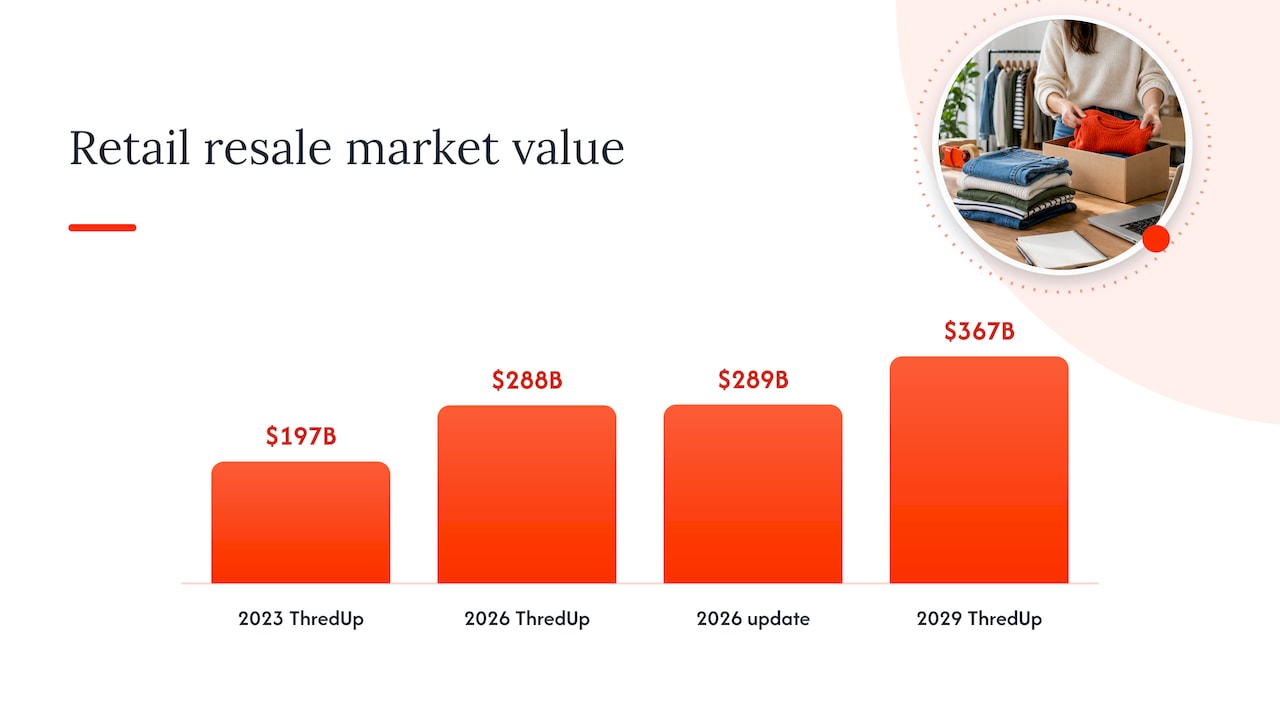
Demand for used clothing is growing on both sides of the trade. Shoppers in rich countries are buying more secondhand, and importers in Africa, South Asia and the Gulf keep buying graded bales for their markets. The global secondhand apparel market was estimated at $197 billion in 2023 and is forecast to reach $288 billion in 2026, according to the ThredUp Resale Report 2025. For a wholesale buyer, the useful question is what that growth means for the bales you source.
TL;DR
- The global secondhand apparel market is forecast to reach $288 billion in 2026 and $367 billion by 2029, growing about 2.7 times faster than the overall apparel market.
- Demand comes from two directions: consumers in the US and Europe who want value, brands and sustainability, and importers in low- and middle-income countries who resell bales in local markets.
- Bale quality is not standardized. Grade names, waste rates and buyer expectations differ by market, so verify grading with samples before you commit.
- The strongest buying decisions combine market data with a clear grade specification, a documented shipment and a compliance check for the destination country.
Table of Contents
- How big the market is and where the forecasts point
- What is driving demand
- What wholesale buyers actually look for
- The limits of the numbers: waste and sustainability
- Our view: demand is strong, but trust decides who captures it
- Turning demand into an order
- Practical checks before you buy
- FAQ
- Sources
How big the market is and where the forecasts point
The headline numbers come from resale reports, so read them as estimates. The ThredUp report puts the global secondhand apparel market at $197 billion in 2023, rising to $288 billion in 2026 and $367 billion by 2029, and expects it to grow 2.7 times faster than apparel overall (ThredUp Resale Report 2025). A 2026 update from ThredUp and GlobalData, covered by The Guardian, forecasts $289 billion for 2026 with growth averaging 9% a year over the next five years.
Those figures measure retail resale value, mostly consumer-facing. The wholesale trade is a different measure: it counts what exporters and importers move across borders. The UN Comtrade trade statistics used in the UNCTAD and SMEP study on trade in secondhand clothing identify HS code 6309 as covering worn clothing and other used textile articles intended for reuse. An academic review in MDPI finds that, by those statistics, the global market value of the trade quadrupled from 1.37 billion USD to 5.68 billion USD between 2002 and 2022.
When you compare reports, check three things:
- What is counted. Retail resale value and customs trade value are not the same number.
- Which products. Some reports include luxury and online consignment, which a bale buyer does not sell.
- Which geography. A US forecast says little about demand in Kampala or Karachi.
What is driving demand
Consumers in developed markets
The ThredUp report lists the reasons shoppers give: better deals, the thrill of the hunt, access to higher-end brands, sustainability and one-of-a-kind looks. It also reports that 48% of younger generations say secondhand is the first place they look when shopping for apparel. US online resale is projected to grow at a compound annual rate of 13% to reach $40 billion by 2029 (both from the ThredUp report).
An academic review in the International Journal of Retail & Distribution Management describes fashion re-commerce as shaped by consumer motivations (convenience, sustainability, economic value), retailer sustainability commitments and enabling technology. For a wholesaler, this matters because it keeps vintage, branded and good-condition garments in demand with resellers who sell to those consumers.
Importers in low- and middle-income markets
The export side runs on affordability. Bales feed informal markets and small shops where a graded garment costs far less than new clothing. Trade data shows how large some of these markets are:
- Kenya. In 2023, the top exporters of used clothing to Kenya included China (89.9 million USD), Pakistan (53.2 million USD) and the European Union (13.3 million USD), per World Bank WITS.
- Pakistan. The country imported $511 million worth of used clothing in fiscal 2024–2025, up from $434 million the year before, according to Pakistan TV.
Two things stand out. Established importers also buy from other emerging suppliers, so competition on price and reliability is real. And demand is not limited to one region: East Africa, West Africa, South Asia and the Gulf each have their own buying patterns.
What wholesale buyers actually look for
Demand is not for “used clothing” in general. Buyers want a defined grade, a predictable mix and a known sellable share.
The UNCTAD brief on secondhand clothes in Uganda and Tanzania shows how traders in those markets sort goods. In Uganda they use first, second, fagi, rags and textile waste. In the surveyed Tanzanian markets they use first, second, third, ronya, rags and textile waste. First has the highest market value, and ronya is the last wearable subcategory.

The same brief reports that traders judge quality by appearance, condition, fashion, functionality and perceived durability. These criteria are not universally standardized and vary by market. In practice, a bale called “Grade A” by one supplier may not match what your customers call first-grade.
Bale types that follow demand
Different product lines serve different customers. Our guides cover the most requested ones:
- General garments: how bale grades work for buyers
- Premium and retro stock: reading vintage bale grades before you buy
- Active categories: sportswear bale grades and denim bale specs
- Children’s stock: checking 45kg kids bales
- Footwear: market data and a supplier checklist for used shoes in Africa
The limits of the numbers: waste and sustainability
Growth figures do not tell you how much of a bale you can sell. The European Environmental Bureau and ECOS report that stakeholders disagree on the share of waste in imported secondhand bales, with estimates ranging from near zero to 50% (ECOS and EEB, 2025). They also recommend harmonizing global quality grading systems so traders know what they are buying and imports match local expectations.
That gap is the practical risk for a buyer. A supplier’s grade label means little until you have tested it. Our article on verifying original versus graded clothing with a 5–10% sample shows how resellers check this before a full order.
Sustainability claims need the same care. Reuse extends the life of garments, and UNCTAD advises that improving upcycling and waste management of textile residues does more for local livelihoods than broad restrictions on imports. On the other side, a survey of 1,009 US consumers published in Scientific Reports found secondhand consumption positively correlated with new clothing purchases, and the authors suggest it may enable continued overconsumption. Reuse is a real benefit, but it does not remove the need for responsible handling of what cannot be sold. Our piece on textile waste reduction for brands and resellers covers that side.
Our view: demand is strong, but trust decides who captures it
We ship from Poland to buyers in more than 40 countries, and what we hear from importers is consistent. They are not short of suppliers. They are short of suppliers whose bales match the description on the order.
Three things follow from that:
- Grade clarity beats headline price. A bale priced slightly higher with a documented grade and a sellable share you can check usually earns more at the market stall than a cheaper bale with surprises inside.
- Speed matters when stock turns. Resellers who run weekly or monthly restocks cannot wait on slow packing. We invested in packaging machinery so bales can be packed and turned around quickly from a 133,000 square foot warehouse.
- Paperwork is part of the product. Documented shipments, correct tariff codes and compliance support for the destination country prevent port holds that cost more than any price difference.
The market will keep growing, but growth rewards buyers who treat sourcing as a process: define the grade, test a sample, document the shipment, and keep the supplier relationship long term.
— rodrigues
Turning demand into an order
If you are ready to source, start with the product line that matches your customers. We supply used clothing and used shoes in bulk bales, plus purses and bags, toys, bric-a-brac and industrial wiping rags. Prices are quoted per order, so contact us through the Msexpspzoo website with your destination country, product, and target grade.
We sell to businesses only: retailers, resellers, wholesalers, importers and market traders, not individual shoppers.
Practical checks before you buy
Use the demand data to choose a market, then use this list to choose a supplier.
- Grade definition in writing. Ask what each grade means in garment condition, and what share is sellable.
- Sample before volume. Inspect a sample from the actual lot, not a showroom set.
- Warehousing and packing. Look at the bale specs to demand for used clothing warehousing.
- Customs classification. US importers can read about keeping tariffs low with HTS 6309, and wiping rags fall under a different code, covered in HS 6310 for wiping rags.
- Import rules. Some countries restrict or ban used clothing, so review import bans in nine countries before shipping.
- Payment structure. Staged payments protect both sides; see payment terms for used clothing.
FAQ
How big is the secondhand clothing market?
The global secondhand apparel market was estimated at $197 billion in 2023 and is forecast to reach $288 billion in 2026 and $367 billion by 2029, according to the ThredUp Resale Report 2025. These are retail resale estimates. Cross-border bale trade is measured separately in customs data.
Which countries import the most used clothing?
It depends on the year and the data source. Pakistan imported $511 million of used clothing in fiscal 2024–2025, and Kenya sources from several exporters including China, Pakistan and the European Union. Check the latest customs statistics for your target market before you plan volumes.
What do bale grades like First, Second and Ronya mean?
In the Ugandan and Tanzanian markets surveyed by UNCTAD, First is the highest-value grade and ronya is the last wearable one, followed by rags and textile waste. The criteria vary by market, so get each supplier’s grade definition in writing.
Does buying used clothing help the environment?
Reuse keeps garments in use longer, but research is mixed. A US survey of 1,009 consumers found secondhand buying correlated with new clothing purchases, so the benefit depends on whether it replaces new buying. Responsible handling of unsellable material also matters.
Can individuals buy from you?
No. We sell wholesale bales to businesses such as importers, resellers and market traders. Single items for personal use are outside what we offer.
Sources
- ThredUp Resale Report 2025
- The Guardian: secondhand clothes sales forecast to hit $289bn
- UNCTAD and SMEP: Trade in secondhand clothing, full study
- MDPI: Secondhand clothing in global commerce
- International Journal of Retail & Distribution Management: Fashion re-commerce review
- World Bank WITS: worn clothing exports to Kenya, 2023
- Pakistan TV: winter thrifting in Lahore’s Landa Bazaar
- UNCTAD brief on second-hand clothes in Uganda and Tanzania
- ECOS and EEB: Redefining used textiles and textile waste
- Scientific Reports: secondhand fashion consumers and fast fashion behaviors