
General average is an ocean shipping rule that makes everyone on a voyage share the cost of an emergency sacrifice. If a carrier declares it, your cargo can be held until you post security, even if your own boxes arrived undamaged. Insured cargo is normally released against a guarantee from your insurer. Uninsured cargo usually needs a cash deposit. Here is how it works, what it costs, and what an importer should do before the ship sails.
TL;DR
- General average applies when a ship or cargo is deliberately sacrificed, or extraordinary expense is incurred, to save the whole voyage from a real danger. Ship and cargo owners then share the loss in proportion to value.
- Your cargo can be undamaged and still be held until you sign a General Average Bond and provide security.
- Your share is calculated from the commercial invoice value of your goods, compared with the total value of everything saved.
- Marine cargo insurance normally covers general average contributions, and your insurer can issue the guarantee that releases the goods. Without insurance, you may face a cash deposit.
- Check your policy wording and your freight contract before you book, not after a declaration.
Table of Contents
- What general average means in shipping
- When a carrier can declare general average
- General average versus particular average
- Who has to contribute
- How your share is calculated
- What happens after a declaration
- Does cargo insurance cover general average?
- Practical steps for importers of bale goods
- Our perspective
- Buy bales from an exporter that documents every shipment
- FAQ
- Sources
What general average means in shipping
The principle is old and simple. According to the CMI short-form guide, it dates back to the earliest days of maritime trade and rests on equity. The word “average” is an ancient term for loss, and “general” means that all the interests in the voyage are involved. The Legal Information Institute at Cornell notes that some sources trace the doctrine to about 900 B.C., though the Rhodians practiced a form of it as early as 300 B.C.
The classic case: a captain throws one merchant’s containers overboard to keep the ship from sinking. That merchant should not carry the whole loss alone. The CMI Guidelines explain that the shipowner and the other cargo interests contribute to make good the value of what was jettisoned.
TT Club, a transport insurer, describes the group of stakeholders on a voyage as the “maritime adventure”. Everyone in that group proportionally shares losses or expenses that come from a voluntary, intentional act made to save the remainder in an emergency.
Where the rules come from
The York-Antwerp Rules are the standard set of general average rules. The Legal Information Institute records that the International Law Association adopted them in 1890. They are not an international convention. According to the CMI Guidelines, they apply only when a contract of carriage incorporates them, which most bills of lading do. The Comité Maritime International updates them periodically.
When a carrier can declare general average
Rule A of the York-Antwerp Rules sets the test. A general average act exists only when an extraordinary sacrifice or expenditure is intentionally and reasonably made or incurred for the common safety, to preserve the property in the voyage from peril. Each word matters:
- Extraordinary. Normal running costs and ordinary wear do not qualify.
- Intentional and reasonable. The act is a deliberate decision, not an accident.
- For the common safety. The aim is to save the ship and cargo together, not one party’s interest.
- Real peril. There must be an actual danger to the property involved.
Typical events
The CMI Guidelines give several examples:
- Grounding: damage from efforts to refloat, cargo jettisoned or lightened, and port of refuge expenses.
- Fire: the cost of extinguishing it, plus damage to ship or cargo caused by the firefighting.
- Cargo shifting in heavy weather: jettison and port of refuge expenses.
- Collision, machinery breakdown or other accidents that damage the ship and force it into a port or hold it there.
Sacrifice versus expenditure
The One Line FAQ separates two kinds of general average cost. A sacrifice is something lost on purpose, such as cargo jettisoned to stop a sinking. An expenditure is money spent, such as the shipowner paying for a tug in a time of peril. A fire often produces both: water damage to cargo from extinguishing is a sacrifice, and the cost of fighting the fire is an expenditure.
General average versus particular average
Not every loss at sea is shared. The ITIC publication on security collections distinguishes accidental damage, called particular average, from damage that results from a deliberate sacrifice for the common safety, which is general average.
| Situation | Type | Who bears it |
|---|---|---|
| Cargo damaged by a fire | Particular average | The owner of the damaged cargo (and their insurer) |
| Cargo lost overboard in heavy weather | Particular average | The owner of that cargo |
| Cargo wetted in a hold flooded after grounding | Particular average | The owner of that cargo |
| Cargo jettisoned to help refloat a grounded ship | General average | Shared by all interests |
| Cargo damaged by water while putting out a fire | General average | Shared by all interests |
The line is intent. If someone chose the loss to save the voyage, everyone shares it. If the loss just happened, the owner carries it.
Who has to contribute
All property that was part of the voyage and at risk when the act took place contributes. The CMI Guidelines say the split is pro rata, by value at the port where the voyage ends. According to TT Club, typical contributors are the shipowner, the beneficial owner of the cargo, the owners of bunkers and stores on board, and the owner of containers and carrying equipment, each in proportion to value.
That means a small importer with one container can be asked to pay toward a loss that involved a ship worth far more. It also means your cargo does not need to be the cargo that was damaged.
One US-specific point from the Legal Information Institute: under traditional principles, a carrier may be unable to recover contribution when the vessel was unseaworthy at the start of the voyage and that unseaworthiness caused the general average act. The case it cites is Deutsche Shell Tanker Gesellschaft v. Placid Refining Co., 993 F.2d 466 (1993). Disputes like this are for a maritime lawyer, but they show that a declaration is not always the end of the discussion.
How your share is calculated
An independent average adjuster prepares the numbers. Per the CMI Guidelines, the adjuster divides the total general average amount pro rata by contributory values. For cargo, that value is based on commercial invoices. Under Rule XVII of the York-Antwerp Rules 2004, cargo is valued at the time of discharge, taken from the commercial invoice to the receiver. If there is no such invoice, the shipped value is used, including the cost of insurance and freight.
A simple worked example
The One Line FAQ gives a clean illustration. Suppose the ship is worth 100, the cargo is worth 50, and the general average is 15. Total contributory values are 150, so the general average is 10% of that. The cargo contribution is 10% of 50, or 5.
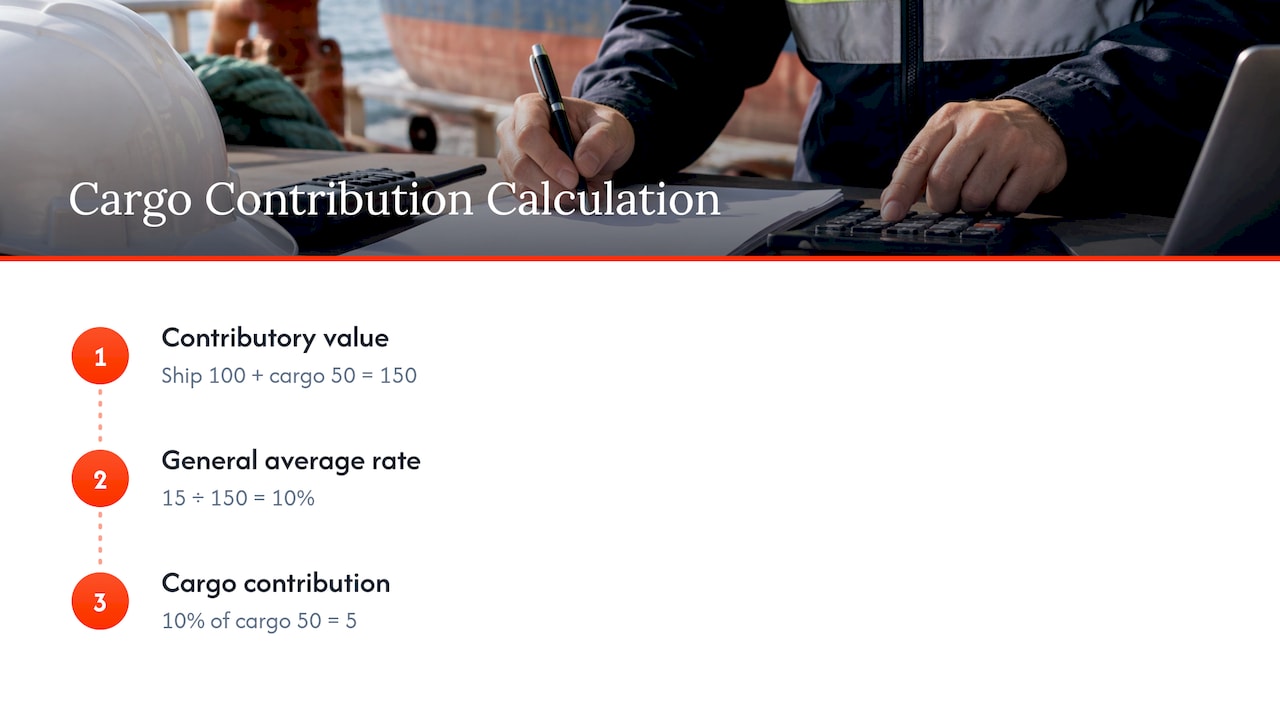
Apply it to a shipment. If your invoice value is a tenth of everything that was saved, you pay a tenth of the total general average. Your share follows the value of your goods, not their condition.
A larger example
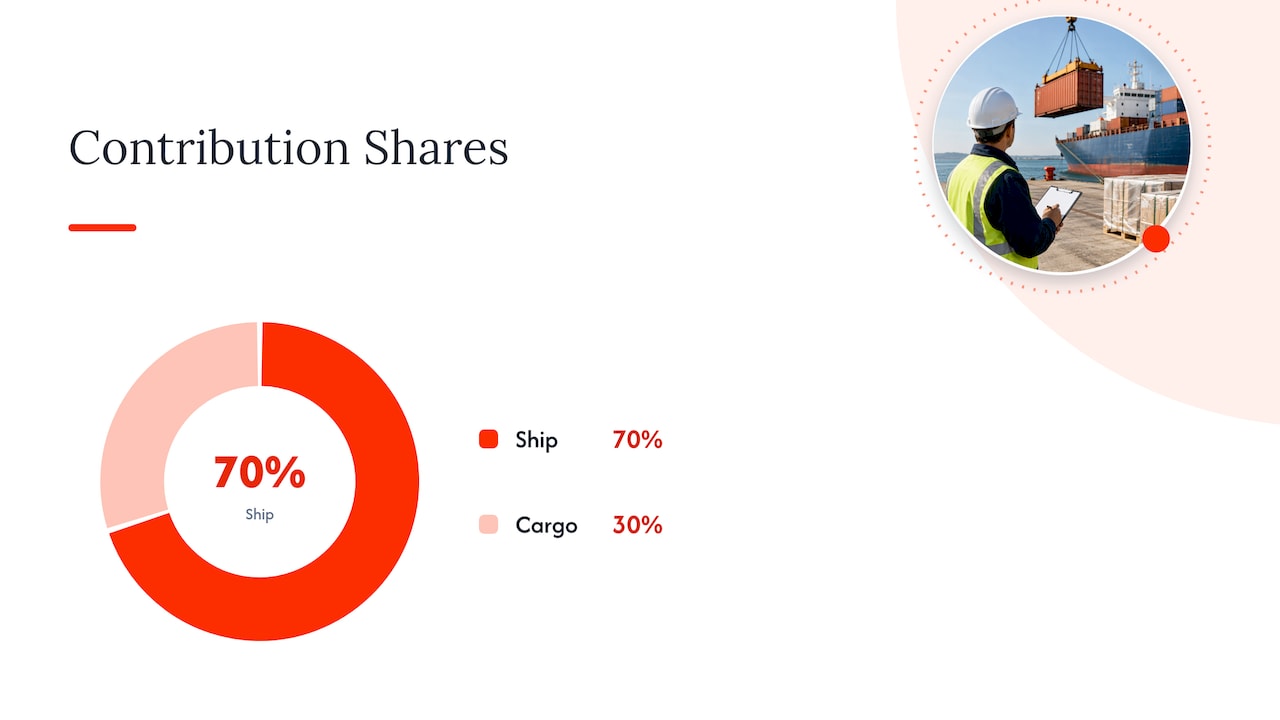
A CEFOR 2024 seminar on the York-Antwerp Rules walks through a case where the ship’s sound value is USD 10 million. Deducting USD 3 million of repair costs gives a contributory value of USD 7 million. With cargo invoiced at USD 3 million, the ship pays 70% and cargo pays 30%.
The same seminar covers interest on allowed losses. The old LIBOR-based formula no longer works because LIBOR was discontinued, so interest is now calculated at the US Prime Rate plus 2%, which was 10.5% in 2024. Because long adjustments can run for years, interest can add up.
What happens after a declaration
A declaration usually arrives as a notice from the carrier or its agent while the cargo is still on the water or in port. Expect these steps.
- The carrier declares general average and appoints an average adjuster.
- Cargo is held. The One Line FAQ explains that the shipowner has a possessory lien on cargo and may withhold delivery until the contribution is paid, or until security is given.
- You sign a General Average Bond and attach the commercial invoice, as described in the CMI Guidelines.
- Security is provided. If the cargo is insured, your insurer completes a General Average Guarantee in place of a cash deposit. If it is uninsured, you provide a cash deposit estimated by the adjuster, usually a percentage of invoice value.
- Cargo is released. The security is an undertaking to pay whatever contribution turns out to be legally and properly due.
- The adjustment is issued, often long after delivery, and the final share is settled.
The ITIC publication stresses that security must be obtained before delivery, and that a promise to sign is not enough. The documents must actually be signed before cargo leaves.
While you wait, your stock is not moving. Retailers and resellers who plan seasonal inventory should build slack into delivery schedules, and a forwarder with strong ocean freight and customs clearance support can help you re-plan when a carrier announces a hold.
Does cargo insurance cover general average?
Yes, normally. The One Line FAQ states that general average contributions are normally covered by policies on the ship and cargo interests. Several standard wordings say so directly:
- The American Institute Cargo Clauses (WA), 2004 cover general average contribution and salvage charges due from or in respect of insured property, payable under US laws and usage, a foreign statement, or the York-Antwerp Rules where the contract of affreightment provides.
- The Institute Cargo Clauses (B), 2009 cover general average and salvage charges incurred to avoid loss from any cause not excluded.
Maersk adds a practical point: general average expenses fall under the Marine Cargo Policy, and a Letter of Guarantee from the insurer may be needed to release the cargo. A cargo owner without cover has to arrange their own letter, which can be expensive and may need to stay in place for several years in complex losses.
What to confirm with your broker
For US importers, a broker who handles transportation and logistics insurance can walk through the policy. Ask these questions before the booking is confirmed:
- Does the policy explicitly cover general average contributions and salvage charges?
- Is the insured value at least your full invoice value plus freight? Underinsurance can reduce what you recover. Under the Canadian Marine Insurance Act, for example, a partly insured shipment recovers only a proportion of the contribution.
- Can the insurer issue a guarantee quickly, and who is the contact after hours?
- Which rules govern the adjustment: US law and practice, or the York-Antwerp Rules in the bill of lading?
On the exporter side, we cover where claims go wrong in container insurance for used goods.
Practical steps for importers of bale goods
Second-hand clothing, shoes and bags ship in dense, high-volume containers, and your invoice drives your share. These habits make a declaration far easier to handle.
- Keep your commercial invoice accurate. Contributory value comes from it. Match it to the packing list; our guide to what belongs on a packing list shows the fields that matter.
- Insure every shipment, not only the large ones. A single guarantee is far cheaper than a cash deposit.
- Budget for the full landed cost, including insurance. Our walkthrough on calculating used clothing shipping costs shows where each line fits.
- Know your contacts. Save your forwarder’s, broker’s and carrier’s emergency numbers with the bill of lading.
- Respond fast to notices. Signed bonds and guarantees are what free the container.
- Watch the claim windows. Under Rule E of the York-Antwerp Rules 2004, parties claiming in general average must give written notice to the adjuster within 12 months of the end of the voyage. The CEFOR seminar notes that Rule XXIII extinguishes contribution rights unless an action is brought within one year of the adjustment, and in no case after six years from the end of the voyage.
Our perspective
At MS EXP SP Z O O we ship used clothing, shoes, bags and other goods in bulk bales to buyers in more than 40 countries, so we see the same pattern in every shipment: the buyers who sleep well are the ones who treated documents and insurance as part of the product.
We believe general average is best understood as a paperwork problem you can solve in advance. Our baling process is designed to produce consistent, clearly marked bales, and we aim to give buyers shipment documents that line up: invoice, packing list and bale counts. When the value on your invoice sets your share of a contribution, a clean invoice is not a formality. It is the number the adjuster will use.
We also think a fast, organized exporter shortens the time cargo spends in uncertainty. Quick turnaround at our warehouse means a container is ready for the booked sailing, and complete paperwork means you can answer a carrier’s request for a bond without hunting for documents.
Our advice to every importer is simple. Insure the full invoice value, confirm that general average is in the wording, and keep a copy of every shipment file where your team can find it. That small routine turns a scary notice into an administrative task.
rodrigues
Buy bales from an exporter that documents every shipment
If you resell used goods, a smooth import starts with a supplier whose paperwork is complete. We supply wholesale bales of used clothing, shoes, bags, toys and wiping rags, packed for container shipping and delivered worldwide.
Tell us the product, volume and destination port, and we will help you plan the shipment and the documents that go with it. Start from our home page or go straight to the category you buy.
FAQ
What is meant by general average?
It is a maritime law principle under which all parties in a voyage share the cost of a deliberate sacrifice or extraordinary expense made to save the ship and cargo from a common danger. The shares are proportional to the value each party has in the voyage.
Do I have to pay if my cargo was not damaged?
Yes, you may be asked to contribute. Contribution is based on the value of your goods at the end of the voyage, not their condition. Your insurer normally covers it, and the carrier can hold the cargo until security is provided.
How is the amount I owe worked out?
An average adjuster divides the total general average by the contributory values of ship, cargo and other property. Cargo is valued from the commercial invoice at discharge. If your cargo is worth a tenth of the total, you bear a tenth of the loss.
What documents will the carrier ask me for?
You will normally sign a General Average Bond and supply the commercial invoice. Insured cargo needs a guarantee from your insurer. Uninsured cargo needs a cash deposit set by the adjuster as a percentage of invoice value.
Sources
- CMI Guidelines Relating to General Average
- CMI: What is General Average?
- York-Antwerp Rules 2004
- TT Club: Demystifying General Average
- One Line: General Average and Salvage FAQ
- ITIC: Security Collections under General Average
- CEFOR: York-Antwerp Rules in Focus 2024
- Cornell LII: Law of General Average
- Maersk: What is a general average?
- American Institute Cargo Clauses (WA), 2004
- Institute Cargo Clauses (B), 2009
- Canada Marine Insurance Act