
A U.S. customs broker usually charges somewhere between $90 and $400 for a single used-clothing entry, depending on who you ask and how complex the entry is. Published ranges differ because brokers bundle fees differently. The number on your invoice also includes duties and government fees that the broker passes through and does not keep. This guide separates the two, shows what pushes a bale shipment toward the high end, and explains when a broker is worth it.
TL;DR
- Published U.S. broker fees for a standard entry run from about $90 to $250 to $150 to $400+ all-in, depending on add-on charges.
- Duties, the merchandise processing fee and harbor fees are pass-through costs, not broker income.
- Extra tariff lines, agency filings, an ISF filing, a bond and storage delays are what inflate a quote.
- A customs broker files your entry. A freight forwarder moves the cargo. Most bale importers need both functions.
- Compare complete fee schedules, not headline entry fees, and ask your supplier for clean documents so the broker has less to fix.
Table of Contents
- What a customs broker actually charges for
- How much brokers charge: the ranges
- Broker fees versus duties, taxes and other charges
- What pushes the fee up on used clothing
- Customs broker vs. freight forwarder
- Is a customs broker worth it?
- How to choose a customs broker
- Direct supplier versus broker: not an either-or
- Buying bales that clear cleanly
- A simple way to budget
- FAQ
- Sources
What a customs broker actually charges for
A customs broker is a licensed specialist who prepares and lodges your customs entry and manages compliance. The broker’s own fee covers that work. Everything else on the invoice falls into a second bucket: government duties, taxes and fees the broker pays on your behalf. Good invoices show the two separately.
For used clothing, the broker’s fee is built from a handful of parts:
- Base entry fee. One filing per shipment. Rogers & Brown describes pricing as an entry fee, an ISF submission charge and a security surcharge, with add-ons on top.
- Extra line items. Each additional tariff line costs more. One published 2025 rate sheet charges $3 per additional line after the first five.
- ISF filing. The importer security filing for ocean cargo. The same rate sheet lists $40, while another 2026 schedule gives $35 to $75.
- Partner government agency filings. Needed when another agency has an interest in the goods. Ranges quoted: $35 per agency on one rate sheet and $50 to $150 on another.
- Continuous bond. If you import regularly, a continuous bond is quoted at $400 to $650 a year in one 2026 schedule and $550 a year on the 2025 rate sheet above.
- Duty advance fee. If the broker fronts your duties, expect a charge on top. One rate sheet charges 1.5% of duties and taxes paid, and another source puts it at 2% to 5% of the duty bill.
How much brokers charge: the ranges
The published figures do not agree, and that is useful information in itself. They describe different service levels.
| Source (year) | Standard entry | Complex entry or all-in |
|---|---|---|
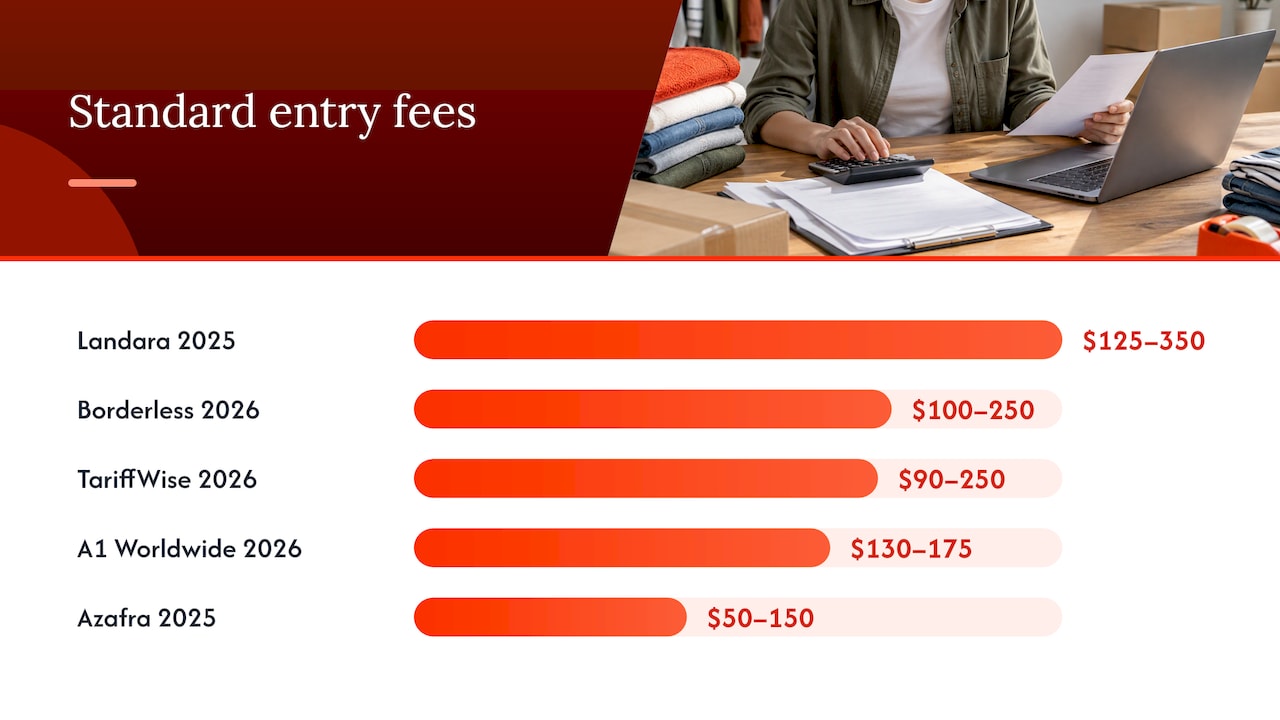
| Landara (2025) | $125 to $350 per entry | Higher with multiple tariff codes or agency rules |
| Borderless (2026) | $100 to $250 base | $150 to $400+ once ISF, lines and filings are added |
| TariffWise (2026) | $90 to $250 | $180 to $450 for high complexity |
| A1 Worldwide Logistics (2026) | About $130 to $175 advertised basic air and ocean entry | Add-ons extra |
| Azafra International (2025) | $50 to $150 per shipment | Plus 0.3% to 0.5% of value on some high-volume imports |
A practical reading: budget roughly $150 to $400 per container-sized used-clothing entry in the U.S., and treat anything much lower as a headline price that will grow once extra lines and filings are added. These are third-party figures, not quotes. Your broker’s own schedule is the number that counts.
The search term most people type, how much brokers charge, has one honest answer: it depends on lines, agencies, bonds and whether they advance your duties.
Broker fees versus duties, taxes and other charges
New importers often blame the broker for charges the broker never keeps. Here is how an invoice for a bale shipment usually splits.
What the broker keeps
Entry preparation, ISF filing, extra-line fees, agency filing fees, exam coordination, bond arrangement, and any disbursement or duty advance fee. These are the “professional service” lines.
What passes through
- Duty. The ad valorem rate for your tariff classification. For worn clothing, correct classification matters. Our guide on keeping used clothing tariffs low with HTS 6309 explains how the code is chosen.
- Merchandise processing fee (MPF). For formal entries it is 0.3464% of entered value, with a minimum of $33.58 and a maximum of $651.50 for October 1, 2025 to September 30, 2026. The figure resets each fiscal year, so check the current one.
- Harbor maintenance fee. 0.125% of value on ocean cargo, billed at cost.
- Carrier and port charges. Ocean freight, terminal handling and similar items belong to the carrier or forwarder, not the broker. Maersk’s overview lists import duties, taxes, brokerage and ancillary charges such as inspection and port security as separate categories.
If an invoice lumps these into a single “customs fee,” ask for a breakdown. Transparency is the best predictor of a fair broker: Rogers & Brown notes that importers should compare complete rate structures, since a low entry fee can be offset by charges for extra lines, agency filings or handling.
What pushes the fee up on used clothing
Used apparel is not complicated cargo, but a few habits make it expensive to clear.
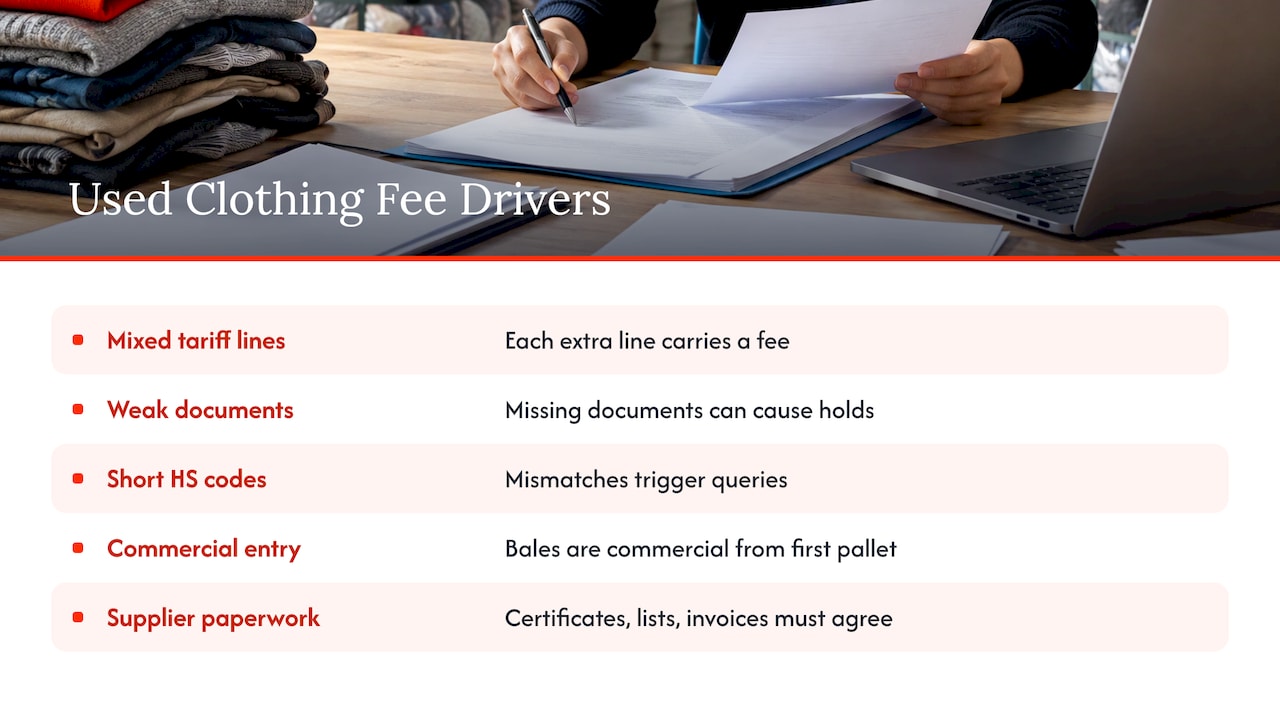
Mixed lots with many tariff lines. A container of clothing, shoes, bags and toys is several classifications. Each additional line carries a fee. If you can sensibly consolidate by product type per container, the entry gets simpler.
Weak documentation. Missing certificates or vague descriptions lead to holds. Storage can accrue daily after free time expires, and a delay from one missing document can become a five-figure storage bill. For a deeper look at how port delays compound costs for apparel, see these notes on BMSB clearance delays.
Codes that are too short. Descriptions and codes that do not match the goods lead to queries. We cover this in 8 to 10 digit HS codes that prevent port holds.
Commercial versus personal confusion. Trade consultants note that once volume passes a threshold, customs treats the import as commercial whatever the importer intended. Bale quantities are commercial from the first pallet, so file them that way.
Supplier paperwork that does not match. Certificates, packing lists and invoices must agree. Our list of supplier certificates U.S. importers need shows what to request before the cargo sails.
Customs broker vs. freight forwarder
These roles are often mixed up, and the confusion causes people to pay twice or miss a service entirely.
| Customs broker | Freight forwarder | |
|---|---|---|
| Main job | Files the entry and manages regulatory compliance | Arranges transport from origin to destination |
| Typical charges | Entry, ISF, line, agency and bond fees | Freight, handling, documentation and routing fees |
| Needed when | Cargo is being imported and must clear customs | Cargo has to move by sea, air or road |
That division is described by Greenwich Mercantile: the broker handles entry filing and compliance, the forwarder handles logistics. Many companies offer both under one roof, which can simplify things. Others specialize, and professional guidance for importers says to decide which services you need first, since some brokers also handle transportation and financing and others do not.
For used clothing in bales, a common setup is a forwarder booking the container and a broker clearing it at the U.S. port. Our shipping cost calculator walkthrough shows how to put forwarder, broker and duty lines into one landed-cost number.
Is a customs broker worth it?
For most bale importers, yes. Informal entry is generally allowed only for shipments valued at $2,500 or less, and formal entry is required above that. A container of used clothing is far above that figure, so you are in formal entry territory, with bonds, ISF and classification all in play.
You can file yourself if you hold the right bond and software and know the process. Most small resellers find that a broker fee of a few hundred dollars is small against the cost of a misclassified line, a held container or daily storage. Frequency matters too: an importer bringing in one container a month gains more from a broker with a continuous bond and a consistent process than one doing a single trial run.
A broker is worth most when:
- you ship regularly and want repeatable, predictable entries;
- your lots include several product types;
- you are new to the tariff code for worn clothing;
- you cannot afford a hold, because your stock supplies a retail calendar.
How to choose a customs broker
- Verify the license. Licensed status is the baseline. Ask for the license details and confirm them.
- Look for apparel experience. Guidance for apparel importers says to request references from other apparel importers and to understand the fee structure, including hidden fees.
- Get a full schedule in writing. Entry, ISF, extra lines, agency filings, bond, disbursement fee, exam coordination, amendment fee.
- Expect a credit check. Importers complete a credit application and can expect a background check, and a broker advancing duties must be able to pay them.
- Compare like with like. A $90 entry with $35 per agency and $3 per line may cost more than a $175 entry with those included.
- Test responsiveness. Ask how they handle a hold or an exam, and who answers when it happens.
Direct supplier versus broker: not an either-or
Buyers sometimes frame the choice as buying direct from a supplier or going through a middleman. The two questions are different. A supplier sells the goods. A broker clears them. Buying direct from the exporter removes a trading intermediary, and you still need someone to file the import entry.
What a direct supplier can do is reduce what the broker has to fix. When bales arrive with consistent descriptions, correct codes and matching paperwork, the broker’s job is shorter, and extra-line and amendment fees do not appear. Our buying guide for resellers and importers walks through what to ask a supplier before you commit, and our traceability checklist shows what to record per bale.
Our perspective on broker costs
We export used clothing, shoes, bags, toys and wiping rags in bulk bales from Poland to buyers in more than 40 countries, so we see the same pattern in importer complaints. The broker is rarely the problem. The expensive part is a shipment that arrives without clean paperwork.
That is why we put effort into packaging and documentation. Our machinery is designed to speed up bale packing and turnaround, and we aim to provide documented shipments so that your broker spends less time chasing details. A shorter broker job means fewer add-on lines and less exposure to storage charges.
Our advice to a new buyer: pick one clear product type per container where you can, ask us for the documents your broker will need before the cargo leaves, and share your broker’s checklist with us early. We would rather answer a question in week one than fix a hold in week six.
rodrigues
Buying bales that clear cleanly
If you are planning your first or next order, start with the category that matches your resale channel: used clothing bales, used shoes or used purses and bags. We supply from a 133,000 square foot warehouse and support importers with documentation for global import requirements.
Tell us your destination port, product mix and volume, and we will help you plan the shipment so your broker can quote a simple entry. You can reach us through our main site.
A simple way to budget
Build one line per cost category, and keep broker and pass-through costs apart:
- Goods cost for the bales.
- Ocean or air freight from the forwarder.
- Broker entry fee, plus ISF, extra lines, agency filings and bond share.
- Duty at your classification rate.
- MPF and harbor maintenance fee.
- Inland haulage and a storage buffer.
Evaluate the broker’s slice against the full landed cost. On a full container, a few hundred dollars of brokerage is usually a small share. The larger risk to margin is a hold, so spend your attention on paperwork and classification. Before you finalize anything, read the rules for where you sell: our overview of whether you can legally import used clothing for resale is a good starting point.
FAQ
Do I pay the broker fee or the supplier?
You pay the broker directly for U.S. clearance, as the importer. Your supplier invoices the goods, and the forwarder invoices the freight. Keep the three invoices separate so you can see where the money goes.
Are duties part of the broker fee?
No. Duties, the merchandise processing fee and harbor maintenance fee are government charges the broker pays for you and bills at cost. Some brokers add a disbursement or duty advance fee for fronting the money, which is their own charge.
Can I clear used clothing without a broker?
Yes, if you can handle the filing yourself. Formal entry is required above $2,500 in value, so bale shipments need a bond and correct classification. Most importers find a broker faster and safer than learning the process on a live container.
What is the cheapest way to lower broker costs?
Send your broker clean, consistent documents and keep each entry to as few tariff lines as practical. Fewer lines and fewer agency filings mean fewer add-on fees. Importing regularly under a continuous bond also spreads the bond cost across shipments.
Sources
- How Much Do Customs Brokers Charge? (Landara)
- How Much Does a Customs Broker Cost in 2026? (Borderless)
- Customs Broker: What They Do & How Much They Cost in 2026 (TariffWise)
- How much does a customs broker charge in different countries (Azafra International)
- U.S. Customs Brokerage Rate Sheet
- Customs Clearance Costs & Customs Broker Fees in the USA (A1 Worldwide Logistics)
- Calculating and Understanding Customs Clearance Service Charges (Rogers & Brown)
- Beyond the border: Understanding customs clearance charges (Maersk)
- Reading a customs broker quote (Fernable)
- Used Clothing (Commercial) Customs Rules (Goods Across Borders)
- Customs Broker vs. Freight Forwarder (Greenwich Mercantile)
- Choosing a Customs Broker for Apparel
- E-Commerce Frequently Asked Questions (U.S. Customs and Border Protection)
- Avoid a Five Week BMSB Delay: What Importers Must Do Before Sailing