
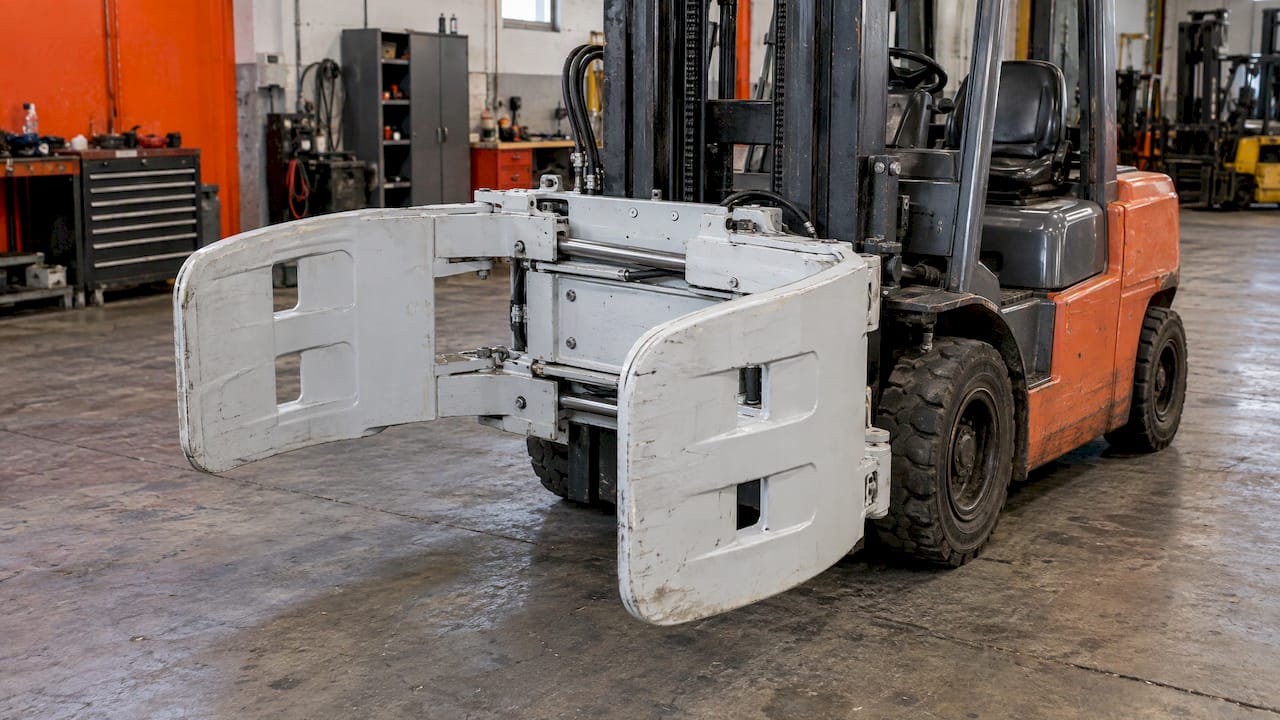
A forklift bale clamp is a hydraulic attachment that replaces the forks. Two broad arms squeeze a compressed bale from the sides, so you can lift, stack and load it without a pallet. For used clothing, shoes, rags and similar baled goods, the right clamp speeds up loading and cuts handling time. It only works safely when the clamp, the truck and the bale are matched. This guide covers how clamps work, the main types, how to check compatibility and rated capacity, and how to operate and inspect one.
TL;DR
- A bale clamp grips bales between two arms, so palletless handling and stacking become possible. OSHA lists cotton and pulp bale clamps among standard forklift attachments.
- The main designs are basic, sideshifting and revolving 360-degree clamps, with different arm sizes and arm facings.
- Before buying, give the supplier your load type, dimensions, weight and the truck’s mounting type. The forklift maker must approve the combined capacity.
- Every attachment lowers the truck’s usable capacity, so train operators and never exceed the rated figure.
- Close the arms gently, keep people clear and put the clamp on your inspection schedule.
Table of Contents
- What a bale clamp does and why it suits baled textiles
- Types of forklift bale clamps
- How to choose a clamp for clothing, shoe and textile bales
- Checking compatibility with your forklift
- Operating a bale clamp safely
- Inspection and maintenance
- Why bale handling matters when you buy used clothing in bulk
- Source consistent bales from us
- FAQ
- Sources
What a bale clamp does and why it suits baled textiles
Standard forks need a pallet or a strapped base under the load. A clamp skips that. Its arm faces are broad, so the force spreads across the side of the bale. According to one attachment manufacturer’s product guide, compressed product can be lifted, stacked several high and loaded into a trailer without a frame or cradle underneath.
That matters in the textile trade for three reasons:
- No pallet cost or weight. Bales go straight into a container or trailer, which leaves more room for product.
- Fewer touches. One pick moves one bale or a column of bales, depending on the clamp’s opening.
- Tighter stacking. Clamps place bales side by side without the gaps that forks leave.
Cascade lists cotton, flax, wool, synthetic textile fibres, hay, rags and recycled clothing as bale-clamp applications. Used clothing, mixed shoes, rags and soft toys all travel as compressed, strapped or wrapped bales, so the same attachment family applies.
Types of forklift bale clamps
Cascade’s range shows the main choices: basic, sideshifting and revolving 360-degree models, with different arm dimensions and round-bar, serrated-rib or button arm facings.
| Type | What it does | Where it fits |
|---|---|---|
| Basic (non-sideshifting) | Opens and closes the arms only | Straightforward loading and unloading with the truck lined up square to the stack |
| Sideshifting | Moves the clamp sideways on the carriage | Tight container loading and exact placement without repositioning the truck |
| Revolving (360 degrees) | Rotates the bale to reorient or invert it | Turning bales to fit a stack pattern or feed a processing line |
Arm facings
The surface that touches the bale changes how it grips:
- Round-bar arms are a common general choice for soft, compressed textiles.
- Serrated-rib arms add bite for bales with slick wrapping.
- Button arms spread contact across many points.
If your bales are wrapped in film, ask the supplier which facing suits that surface. Our guide on choosing bale wrapping film for clothing and shoes explains how film choice affects handling.
Capacity ranges
Capacity depends on the model. Bolzoni reports its Silver Line LC-G bale clamp at 1,400 to 3,200 kg for heavy-duty recycling work with textile, paper, plastic and metal bales. A typical clothing bale of 45 to 100 kg sits far below that, but clamps are often used to move several bales at once, so the combined load is what counts. Our bale weight conversion guide shows how bale weights relate to piece counts.
How to choose a clamp for clothing, shoe and textile bales
Start with the information any attachment supplier will ask for. The Australian Forklift and Industrial Truck Association advises providing the load type, dimensions, weight and required mounting type when selecting an attachment. Hangcha’s guide says the same about material type, size and weight.
A selection checklist
- Bale dimensions. Measure length, width and height of your usual bale, and the largest you handle. The arm opening must clear the widest bale with room to spare.
- Bale weight. Note the heaviest single bale and the heaviest multi-bale pick you plan.
- Bale firmness. Tightly compressed, strapped bales tolerate more clamp force than loosely wrapped ones.
- Handling pattern. Straight in and out of containers points to a basic or sideshifting model. Rotating bales points to a revolving one.
- Environment. Textile yards are dusty and sometimes abrasive. Bolzoni’s recycling-sector view is that textile and waste environments justify protected hydraulic components, reinforced structures and wear-resistant materials, because abrasive and cutting contaminants speed up wear and downtime.
Gentle closing matters
The clamp should hold, not crush. One manufacturer advises a light touch when closing the arms to avoid squeezing and damaging the load. For used clothing and shoes, over-clamping can split film, distort bale shape and loosen straps, which leads to damage in transit. See our notes on bale breakage prevention for the packing side of that problem.
Checking compatibility with your forklift
A clamp that fits the carriage is not automatically safe on your truck. Work through these checks in order.
1. Mounting interface
Confirm the carriage class (ITA class) or fork-pocket dimensions, the minimum carriage width or fork spread, and whether the clamp hangs on the carriage or slides onto the forks. AFITA’s guidance is to confirm the mounting interface and carriage class before ordering.
2. Hydraulics
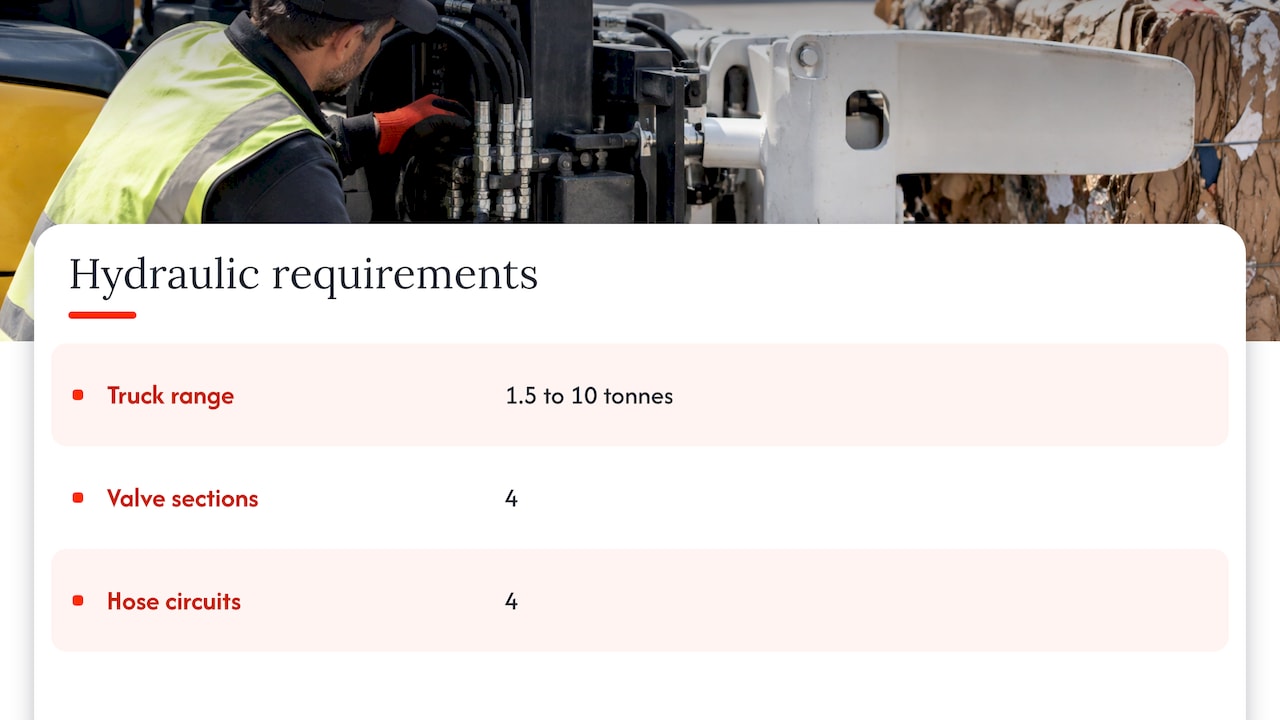
Bale clamps need hydraulic functions beyond tilt and lift. Hangcha describes its bale-clamp option for 1.5 to 10 tonne forklifts as needing four hydraulic valve sections and four hose circuits. Many trucks leave the factory with fewer, so adding valve sections and hoses may be part of the job. Check required pressure and flow against what your truck delivers. Anyone planning valve sections and circuits for the first time can read about hydraulic circuits and truck compatibility in a related guide on dock equipment.
3. Rated capacity of the combined truck and attachment
OSHA explains that attachments change a forklift’s centre of gravity, visibility and capacity. The attachment’s weight reduces lifting capacity, and it can push the load centre farther from the fulcrum, which reduces it further.
So collect these figures from the attachment supplier:
- Attachment mass
- Rated capacity
- Load centre
- Lost-load distance (how far the attachment moves the load forward)
- Centres of gravity
Then ask the forklift manufacturer or its authorised representative to recalculate and approve the combined capacity and update the capacity plate. That is the AFITA-recommended process. A worked example in plain terms: a truck rated for a given load at its standard load centre loses some of that rating once a heavy clamp sits ahead of the carriage. The new plate figure is the only number operators should work from.
Lifting limits apply across the whole yard, not only the truck. Safe working loads for other lifting equipment follow the same principle: know the rated figure and stay under it.
Operating a bale clamp safely
Training
OSHA requires operators to be trained in the adaptation, operation and limitations of the attachment. They must be retrained when a new attachment is added and instructed never to exceed the rated capacity of the truck and attachment combination. This is a United States rule. Outside the US, follow your national requirements.
Handling rules from a manufacturer’s manual
Bolzoni’s use and maintenance manual sets out practices worth building into your site procedure, summarised in the manual:
- Train personnel to use and maintain the attachment.
- Do not carry unstable, uncentred, oversized or over-capacity loads.
- Do not use an attachment with structural deformation or operating anomalies.
- Keep people outside the truck’s radius of action.
- Adjust speed to the road surface and obstacles.
- Do not park with a raised load.
The same manual says loads should be stable, arranged with crossed layers or straps, and gripped carefully so adjacent bales are not damaged. It also states that the truck manufacturer determines the effective capacity of the truck and attachment together.
Practical habits for bale yards
- Approach the bale square on, centre the clamp on its height and length, then close the arms.
- Lift just clear of the floor and check the bale is stable before travelling.
- Travel with the load low and tilted back as the truck manual allows.
- Stack in crossed layers, as described above, and respect the stack height your site rules permit.
- Keep walkways marked so pedestrians never cross the truck’s path.
Our article on warehouse safety for bales covers stacking, handling and fire rules in more depth.
Inspection and maintenance
The clamp belongs in your scheduled maintenance, not an afterthought. OSHA’s guidance is to include the attachment in scheduled maintenance and inspection, check load-bearing components for deformation and load-bearing welds for cracks, and maintain mechanical and hydraulic components according to the manufacturer’s instructions.
A simple routine:
| When | Check |
|---|---|
| Start of each shift | Arms for visible bends, hoses and fittings for leaks, arm facings for wear, smooth opening and closing |
| Weekly | Mounting hooks and pins, grease points, hose condition along their full run |
| Per manufacturer schedule | Welds, hydraulic cylinders, seals, structural wear |
Take a clamp out of service if you find deformation, cracks or odd behaviour. Abrasive dust in textile yards wears seals and facings faster, so shorter intervals pay off in busy yards.
Why bale handling matters when you buy used clothing in bulk
If you import used clothing, shoes or bags, the clamp is the last link in a chain that starts with how the bale was packed. A bale that is firm, evenly shaped and clearly labelled is easy to grip, stack and count. A loose or misshapen one is not.
When you assess a supplier, look at:
- Bale shape and firmness. See what to ask for in our guide to bale specs for used clothing warehousing.
- Strapping and packing method. Our guide to CTU code packing and machine strapping explains how well-strapped bales hold up under clamp handling.
- Labelling. Clear bale marks speed up receiving. See bale labeling standards.
- Packing choice. If you are weighing formats, read baling versus box packing for the shipping cost picture.
Our view on bale handling
We pack used clothing, shoes and other goods into bales for export to buyers in more than 40 countries, so we think about what happens to a bale after it leaves our line. Our packaging machinery is designed to give bales a consistent shape, which is what makes them easier to grip with a clamp and to stack in a container.
From our side, the best handling outcome starts at the baling stage. A firm bale with sound strapping or film, clearly labelled, loads faster and arrives in better condition. We run a warehouse of 133,000 square feet, and we keep documented shipments so receiving teams know what is in every bale before it comes off the truck.
Our advice to importers: tell us how you unload. If you use clamps, say so, and give us your bale size preferences. We will work with you on packaging that suits your equipment.
rodrigues
Source consistent bales from us
We supply used clothing, shoes, bags, toys, rags and more in bulk bales, built for efficient handling and worldwide delivery. If you plan to unload with a clamp, start with our used clothing range, then tell us your handling setup.
Our team can also support the paperwork side, from used clothing regulations to bale traceability. Visit our main site to request a quote for your next order.
FAQ
What is a forklift bale clamp used for?
It grips compressed bales between two hydraulic arms so a forklift can lift, move and stack them without pallets. It is common with cotton, wool, textiles, rags and recycled clothing, according to Cascade’s product page.
Can any forklift use a bale clamp?
Not automatically. The truck needs a compatible carriage or fork pockets and enough hydraulic functions, and its capacity must be recalculated with the attachment fitted. The forklift manufacturer or its authorised representative should approve the combined capacity and update the plate.
Which clamp type is best for container loading?
A sideshifting clamp helps with precise placement in tight spaces, because the clamp moves sideways without repositioning the truck. A revolving model suits sites that need to rotate bales. A basic clamp covers straightforward lifting and stacking.
How do I avoid damaging clothing bales with a clamp?
Close the arms with a light touch, centre the clamp on the bale and pick facings that suit the wrapping. Stack in crossed layers or with straps as Bolzoni’s manual advises, and grip carefully so neighbouring bales are not damaged.
Sources
- OSHA Powered Industrial Trucks eTool: attachments
- Cascade J-Series bale clamps
- Bolzoni Group news on recycling clamps
- Bolzoni use and maintenance manual
- AFITA attachment information, 2022
- Hangcha forklift attachment guide
- Bale clamp product guide