
The maximum weight of a container is set by its rated gross weight, but the load you can actually ship is usually lower. A standard 20-foot or 40-foot container is typically rated at 30,480 kg or 32,500 kg gross, according to the carrier container specification. On US highways the whole rig (tractor, chassis, box and cargo) is capped at 80,000 lbs. For bale shippers, the road limit and the verified weight you declare before loading decide the real payload, not the number on the box. At MS EXP SP Z O O we export used clothing, shoes and other bulk goods from Poland, so we plan every load against these limits before the first bale goes in.
TL;DR
- Tare is the empty box, gross is box plus cargo, and payload is the cargo you can add. Payload equals rated gross minus tare, minus any bracing and dunnage.
- Typical ratings are 30,480 kg or 32,500 kg gross, with payloads of roughly 26,700 to 30,250 kg depending on size and unit.
- In the US the combined truck, chassis, container and cargo weight is capped at 80,000 lbs on the Interstate System, and axle and bridge limits can bind sooner.
- For ocean shipments, the shipper must provide a verified gross mass (VGM) before loading onto the vessel.
- Dense bales can hit the weight limit before the container is full, so weight is planned at the warehouse, not at the port.
Table of Contents
- What container weight limits actually mean
- Maximum weight in a 20-foot and 40-foot container
- The US road limit is lower than the box rating
- Verified gross mass: the ocean shipping rule
- What happens when a container is overweight
- Planning bale loads for used clothing, shoes and mixed goods
- Customs and documents that depend on weight
- Order a container planned to the limit
- FAQ
- Sources
What container weight limits actually mean
Three terms appear on every booking and every plate, and mixing them up is the most common source of mistakes.
- Tare weight: the mass of the empty container.
- Maximum gross weight (rating): the total allowable weight of the container and its cargo, as specified on the CSC safety approval plate, as explained in this container weight guide.
- Payload: the cargo the container can hold, which is what you pay freight on and what your buyer receives.
The BIC Boxtech overview of container weight measurements uses the same split: tare is empty mass, gross is container plus maximum payload, and payload is the cargo. Accurate declarations matter commercially too. Mixing up tare, net and gross weight can lead to customs delays, rejections or extra fees, as Maersk’s documentation guide notes.
The key point: the rating belongs to the container, but several other limits sit on top of it. Whichever is lowest wins.
Maximum weight in a 20-foot and 40-foot container
The carrier’s container specification lists the ranges below. Individual units differ, so these are guides, not promises.
| Container | Typical max gross | Typical payload |
|---|---|---|
| 20-foot standard | 30,480 kg or 32,500 kg | About 28,180 to 30,250 kg |
| 40-foot or 40-foot High Cube | 30,480 kg or 32,500 kg | About 26,700 to 28,800 kg |
In pounds, 30,480 kg is roughly 67,200 lbs, and 32,500 kg is roughly 71,650 lbs. The 40-foot box has more volume but, because it weighs more empty, often carries a similar or lower payload than the 20-foot. That surprises many first-time buyers. For dense goods, a 20-foot container can be the smarter choice.
How to find the exact number for your box
Do not rely on a table. The CSC plate and the unit-specific documentation are the leading sources for a container’s rated gross weight, and the tare is marked on the door. The payload is then simple arithmetic: according to the IMO informative material on cargo transport units, you subtract the container’s tare and the mass of securing and bracing materials from its rated gross mass.
A worked illustration, with round numbers: a unit rated at 32,500 kg gross with a tare of 3,700 kg leaves 28,800 kg. Subtract 150 kg of strapping, dunnage and pallets and you have 28,650 kg of true cargo capacity. If that cargo is packed in 45 kg bales, the box could in theory take 636 of them by weight. Whether they fit by volume is a separate question, and for compressed bales weight is often the tighter constraint.
The US road limit is lower than the box rating
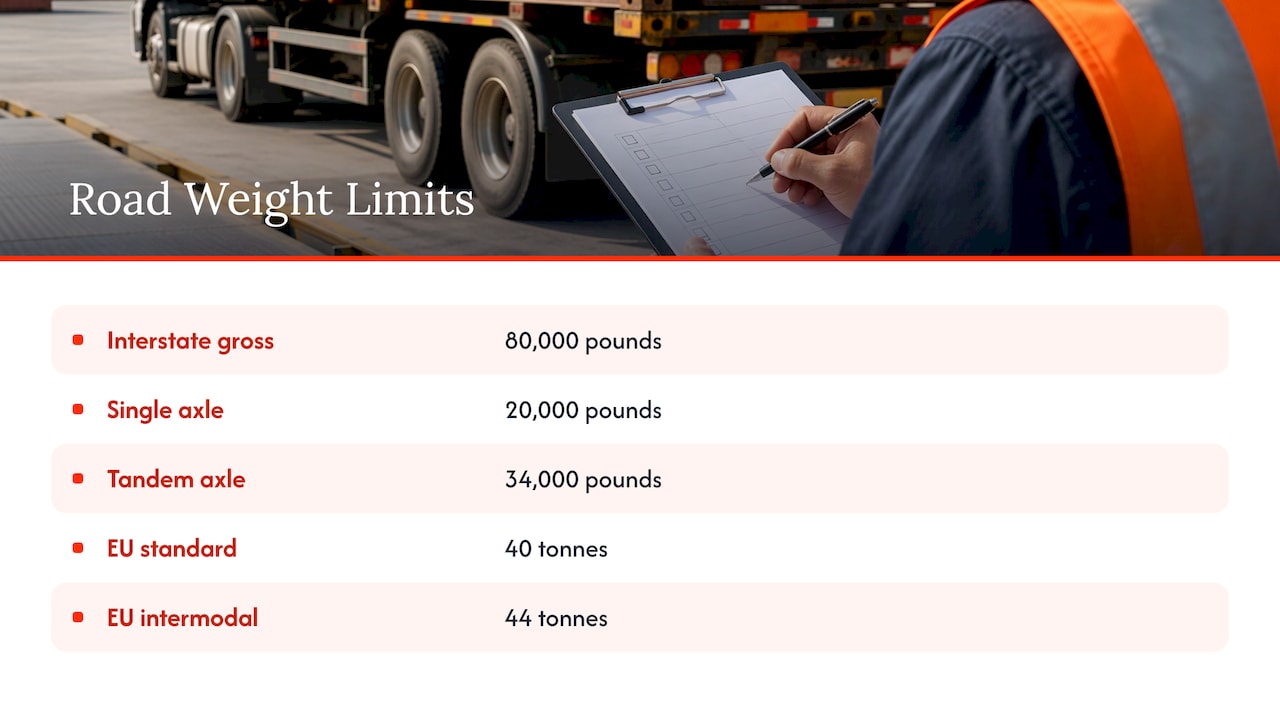
A container rated at 32,500 kg gross does not mean you can truck 32,500 kg of cargo on US roads. The Federal Highway Administration states that the federal gross weight limit on the Interstate System is 80,000 pounds unless the Bridge Formula dictates a lower weight. That figure covers everything on the road: tractor, chassis, container and cargo.
The same FHWA publication gives two more figures that matter for containers: single axles are limited to 20,000 pounds and tandem axles to 34,000 pounds. States set their own rules for non-Interstate roads and can apply permits and exceptions, so the limit for your delivery route depends on the states you cross. Check the state rules for your destination before you fix the load.
Outside the US, the logic is the same but the numbers change. The European Union generally caps standard road combinations at 40 tonnes, with 44 tonnes often allowed for road-to-rail intermodal operations, per this European weight limits overview. Road and rail limits often set a lower practical load than the container’s structural ISO rating. If your buyers are in Africa, South Asia or the Gulf, ask them for the inland haulage limits on their side of the port as well.
Why the chassis matters
Because the chassis and tractor eat into the 80,000 lbs, the practical US payload often ends up below the box rating. Axle weights also depend on where the cargo sits inside. Weight distribution has to be planned at the warehouse: once a sealed container is on a truck chassis, the option to redistribute weight to comply with axle load laws is severely limited, as this weight distribution guide points out. Load heavy items evenly along the floor, not all at the door end or the nose.
Verified gross mass: the ocean shipping rule
For sea freight, the weight on the booking is a legal declaration. Under the SOLAS amendment, the container’s gross mass must be verified before it is stowed on board. The OIML bulletin on VGM describes this as the requirement that the packed container’s gross mass is verified prior to stowage. The shipper provides it before the container is loaded onto the vessel, according to BIC.
There are two accepted methods, set out in the South African Maritime Safety Authority guidance:
- Method 1: weigh the fully packed and sealed container.
- Method 2: add up the mass of all cargo items, packing and securing materials, then add the container’s certified tare mass.
Method 2 only works when every bale has a known, recorded weight. This is one reason we keep bale weights consistent and documented per shipment. Our packaging uses advanced machinery, so bales come off the line in uniform sizes that make the sum straightforward to check.
The reason for the rule is safety: the IMO amended SOLAS to improve safety in container loading and handling, and incorrect weights can cause stack collapses, cargo loss and risk of injury or death, BIC notes.
What happens when a container is overweight
The cost of getting it wrong falls on the shipper, and it arrives in layers:
- The terminal can refuse the container, so it is not moved.
- You can face extra drayage, unloading, repacking and storage costs, as one freight guide describes.
- On US roads, fines can range from hundreds to thousands of dollars, plus chassis swap charges and transloading costs, according to this overweight guide.
For a buyer, the worst result is not the fine but the delay. A held container means missed market days, demurrage and a stalled stock plan. It is far cheaper to catch the problem at the origin warehouse than at a weigh station. For the related paperwork and claims side, see our guide on avoiding claim denials in container insurance.
Planning bale loads for used clothing, shoes and mixed goods
Bulk second-hand goods behave differently from retail cartons. Compressed clothing bales are dense, shoes are heavy for their volume, and mixed bales vary. Here is a routine that works for any bale buyer.
- Start from the lowest limit. Take the container’s rated payload, then the road limit for your delivery route, then any limit at the destination port or on inland haulage. Plan to the smallest of the three.
- Subtract the non-cargo weight. Pallets, strapping, dunnage and any liners count toward the gross mass.
- Divide by bale weight. Use real, recorded bale weights, not nominal ones. Allow a margin for natural variation between bales.
- Check volume as well. A load can be full before it is heavy, or heavy before it is full. Shoes and tyres tend toward weight, light garments toward volume.
- Plan the floor. Spread heavy bales evenly so axle loads stay balanced on the chassis.
- Record everything. Keep the bale count, bale weights, tare and total in the shipping file so the VGM can be produced and defended.
Our container stuffing plan guide walks through the layout, and our article on avoiding rejections when loading used clothing containers covers what receiving terminals check. If you want to see how bales are strapped and specified, read about CTU Code packing specs and machine strapping. Compressed formats change the weight per cubic meter, so vacuum packed used clothing is worth understanding before you set a bale count.
Goods that move on to retail or online channels face their own weight-sensitive handling downstream, where warehouse services optimization depends on accurate per-unit data, which starts with accurate weights at origin.
Weight by product type
The same container carries a different number of units depending on the category. We ship used clothing, used shoes, used purses and bags, toys, bric-a-brac and wiping rags, among others. A rag or shoe load will usually reach the weight ceiling sooner than a load of lightweight garments, so the bale count you were quoted for one category should not be copied to another. Landed cost per bale also moves with weight, which is why our handbag bale landed cost guide starts from the real bale weight.
Customs and documents that depend on weight
The weight you declare appears on the bill of lading, the packing list and the customs entry. If these disagree, goods can be held. Weight and classification travel together, so it helps to read our guide to 8 to 10 digit HS codes that prevent port holds and the overview of supplier certificates US importers need for used clothing. For rules on the buyer’s side of the border, see used clothing regulations importers must know.
Our view on weight planning
We pack used goods for buyers in more than 40 countries, and the pattern we care about is simple: a weight problem is cheapest to fix in the warehouse. Once the doors are sealed, every option costs money.
That is why we built our process around fast, machine-assisted bale packaging and documented shipments. Uniform bales make a bale count reliable, and documented shipments give you the records a VGM needs. Our warehouse space of 133,000 square feet lets us stage and check loads before they are stuffed, instead of improvising at the dock.
Our advice to any importer: ask for the planned bale count and the weight basis before you confirm a container, and match it to the limit on your own inland route. A good load plan is one where nobody at the port has a surprise.
rodrigues
Order a container planned to the limit
If you are an importer, wholesaler or market trader buying used clothing, shoes, bags, toys, wiping rags or other bulk goods, we pack and document the shipment to a stated plan so you know what is in the box and how it was loaded. Start with the used clothing range, or contact us through our main site and tell us your destination and inland route.

We can then work out a bale count that fits both the container and your haulage limit.
FAQ
What is the maximum weight allowed in a 40-foot container?
A 40-foot or High Cube container is typically rated at 30,480 kg or 32,500 kg gross, with listed payloads of roughly 26,700 to 28,800 kg, according to the carrier specification. The exact figure is on the CSC plate of your unit. On US roads the whole combination must also stay within 80,000 lbs.
How much weight can I put in a 20-foot container?
Standard 20-foot dry containers are typically rated at 30,480 kg or 32,500 kg gross, which gives payloads from about 28,000 to 30,250 kg depending on the unit’s tare. Subtract pallets and bracing to get your true cargo capacity. Then check the road limit for your route, which may be lower.
What is the difference between tare, gross and payload?
Tare is the empty container’s weight. Gross is the container plus everything in it, and the rated maximum is printed on the CSC plate. Payload is what is left for cargo once tare and securing materials are taken from the rated gross.
Do I have to declare the container weight for ocean shipping?
Yes. Under the SOLAS amendment, the shipper must provide the verified gross mass before the container is loaded on the ship. You can weigh the packed container or add up cargo, packing and securing materials plus the certified tare.
What is the US highway weight limit for a loaded container truck?
The federal limit on the Interstate System is 80,000 pounds gross, unless the Bridge Formula sets a lower figure, says the FHWA. That includes tractor, chassis, container and cargo. Single axles are limited to 20,000 pounds and tandem axles to 34,000 pounds.
Sources
- Bridge Formula Weights, FHWA Freight Management and Operations
- Container Specification, Hapag-Lloyd
- Container Weight Measurements, BIC Boxtech
- Informative Material 3, Cargo Transport Unit types, IMO
- Weights and measures implementation framework for VGM guidelines, OIML
- SOLAS VGM guidance, South African Maritime Safety Authority
- Weight of a shipping container, tare and max cargo
- Understanding Tare, Net, and Gross Weight in Logistics, Maersk
- HGV Weight Limits Across Europe
- Container Weight Distribution and Axle Load Rules
- Sea Freight container guide
- Overweight Containers: Limits, Fines, and Liability