
The EU Waste Shipment Regulation is Regulation (EU) 2024/1157, which has applied since 21 May 2026. For a used clothing or shoe buyer, it comes down to one question: is the bale a reuse product or waste? A bale that has been professionally sorted, documented and shown to be fit for reuse moves as a product. A bale that cannot show this risks being treated as waste, with notification, consent and export limits. This guide explains the test, the paperwork and the checks to run with your supplier before you order.
TL;DR
- Regulation (EU) 2024/1157 covers shipments of waste between EU states, exports to non-EU countries and transit through the EU.
- Used textiles count as products when they are sorted and assessed as fit for direct reuse. Discarded or unsorted material is waste.
- Authorities can ask for proof of origin, destination, sorting and condition. Packaging that protects the goods is part of that proof.
- Since 21 May 2026, waste notifications and related documents run through the EU’s electronic system, DIWASS.
- Your destination country has its own import rules on top of EU rules. Check both before every order.
Table of Contents
- Why this regulation matters to a bale buyer
- What the regulation covers
- Used textile or textile waste: the test
- What inspectors can ask for
- When the shipment is classed as waste
- What changed on 21 May 2026
- Sorting, sustainability and your own market position
- Destination rules you still check separately
- A buyer’s checklist before you order
- Our perspective
- Used clothing, shoes and more, ready for export
- FAQ
- Sources
Why this regulation matters to a bale buyer
The regulation is written for waste, not for clothing you plan to sell in a market in Accra or Nairobi. It still affects you, because customs and environmental inspectors in the EU decide case by case whether a container of used clothing is a product or a disguised waste shipment. The European Parliament’s legislative summary describes the policy driver as reducing illegal shipments disguised as reuse, by requiring sorting before shipment and clarifying that reuse-suitable used textiles should not be treated as waste.
For an importer, that has two practical consequences. A supplier who sorts and documents properly clears faster. A supplier who ships unsorted or poorly described material exposes your container to holds, inspection costs and possible return.
What the regulation covers
The regulation applies to waste shipments between Member States, with or without transit through third countries, to exports from the EU to third countries, and to transit through the EU. It sets different control regimes depending on origin, destination, route, type of waste and planned treatment.
Three points follow for readers in Africa, South America, the Gulf and South Asia:
- The rules apply on the EU side of the shipment. Your country’s rules apply on arrival. Both must be satisfied.
- Waste destined for recovery can need prior written consent, in particular hazardous waste and waste not listed in the regulation’s green-list annexes (III, IIIA, IIIB).
- The EU generally limits waste exports to non-EU countries and requires environmentally sound management guarantees where exceptions apply, as an ECOS and EEB position paper sets out.
This is why classification is the whole game. A correctly classified reuse product does not enter the waste procedure at all.
Used textile or textile waste: the test
The EU waste framework amendments draw the line this way, as legal analysis of the changes explains. Used textiles are products handed over directly by end users and professionally assessed as fit for reuse at the collection point, by a reuse operator or a social economy entity. Waste textiles are substances or objects that the holder discards, intends to discard or is required to discard.
In plain terms:
| Question | Points to reuse product | Points to waste |
|---|---|---|
| Was it assessed by a professional? | Yes, per bale, with a record | No assessment, or only a bulk guess |
| Is it fit to be worn or used again? | Yes | Soiled, damaged, contaminated |
| Is there a buyer and a destination? | Contract and invoice naming reuse | No clear buyer or use |
| How is it packed? | Stacked and baled to avoid damage | Loose, crushed, mixed with refuse |
What inspectors can ask for
To tell non-waste used goods from waste, Regulation 2024/1157 allows authorities to require documentary evidence of origin and destination, and evidence that the item is not waste, including functionality where appropriate. They must also consider whether packaging and stacking protect the goods against damage in transport and handling.
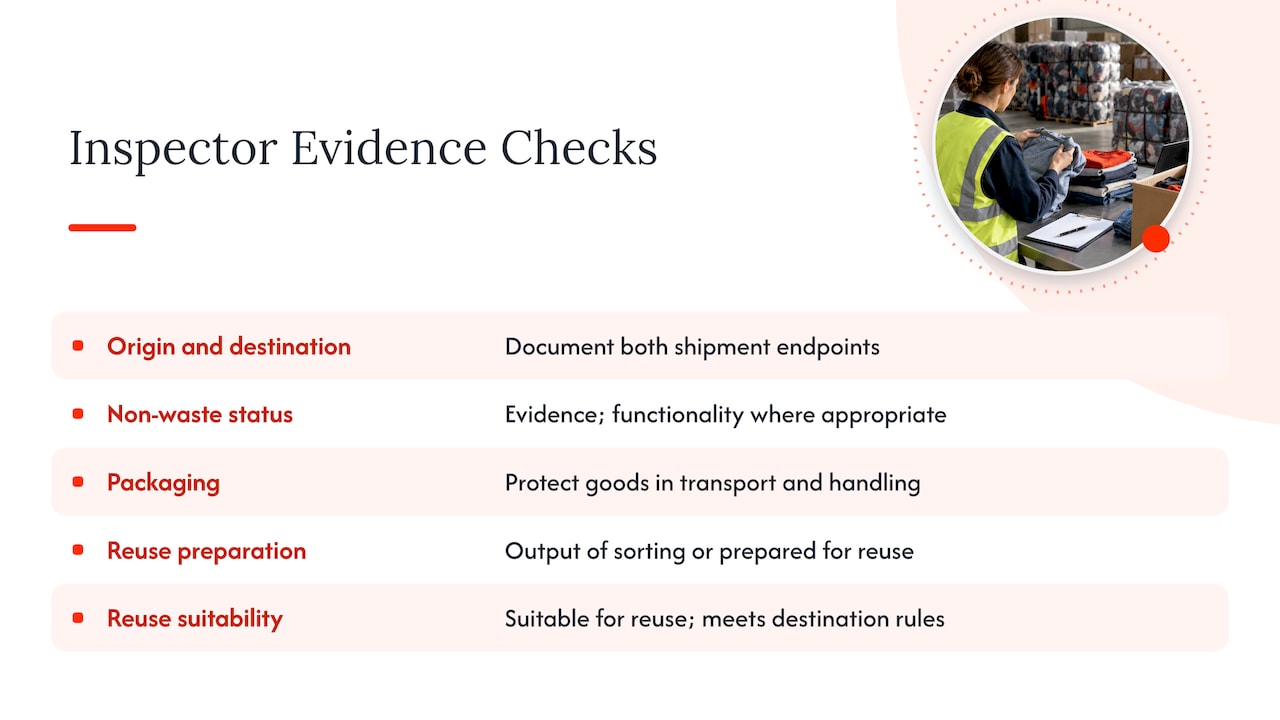
A sector note from the University of Cambridge adds that shipments of used textiles and footwear will need to show they are the output of a sorting operation or are being prepared for reuse, that they are suitable for reuse, and that they comply with the national rules of the destination country.
The minimum paperwork for a reuse shipment
Legal analysis of the framework amendments lists the minimum documents for exports of used textiles assessed as fit for reuse:
- an invoice and a contract stating the textiles are destined for, and fit for, direct reuse;
- evidence of prior sorting or direct professional assessment for each bale;
- a protocol on recordkeeping requirements;
- a declaration by the person in possession that none of the material in the shipment is waste.
As a buyer, you can ask for these before you pay a deposit. Our guides on what belongs on a packing list for used clothing exports and what to record and verify per bale go through the fields in detail.
When the shipment is classed as waste
If a consignment is treated as waste, a different procedure applies. Recovery shipments need prior written consent in the cases described above. For exports under the OECD decision, the regulation also requires documentary evidence that the recovery facility in the destination country has been audited against the criteria in its Annex X, as the regulation’s text describes. A French government information page on used textiles also notes that waste textiles fall under the EU transfer and export rules, and refers to Regulation (EC) 1013/2006 and Regulation (EC) 1418/2007 for certain wastes going to countries outside the OECD decision, per the GISTRID information site.
For a reseller, the lesson is simple. This procedure is slow, consent-based and built for waste operators. A resale business should not be on it. Buy from a source that keeps reuse goods firmly outside it.
What changed on 21 May 2026
Regulation (EU) 2024/1157 was adopted on 11 April 2024, and its application date is 21 May 2026, replacing the previous regulation in its essential parts.
The visible change is digital. From that date, EU operators and authorities must use the central electronic system, DIWASS, to submit and exchange notifications, consents, movement documents and other required information, for both the notification procedure and the general-information procedure, according to Bavarian authorities’ guidance for businesses. The same guidance notes that electronic transmission requirements apply immediately for shipments under the general information obligations.
For buyers outside the EU, you do not log in to DIWASS yourself. You see the effect: cleaner, more consistent paperwork from suppliers who have adapted, and less tolerance from inspectors for vague descriptions.
Sorting, sustainability and your own market position
The regulation rewards a business model that was already the better one: sort first, grade honestly, document each bale, sell to a named buyer for reuse. That model also serves retailers and entrepreneurs who want a credible sustainable sourcing story. Reuse keeps garments in circulation and out of the waste stream, and a documented chain lets you say so to your own customers. If you are weighing how to present that story, this overview of fast versus slow fashion shows how consumers think about the cost of a garment over its life. Our own piece on reuse-first textile waste reduction covers the sourcing side.
Destination rules you still check separately
EU compliance gets the bale out of Europe. It does not get it into your country. Each destination has its own import regime, and they differ.
Kenya is a clear example. According to Kenya’s trade information portal, importers must register with the Kenya Bureau of Standards (KEBS) before importing and selling secondhand clothes (mitumba), and KEBS issues a registration certificate. The same page explains that a Certificate of Conformity shows the consignment was inspected in the country of origin, and a consignment arriving without one needs a local inspection.
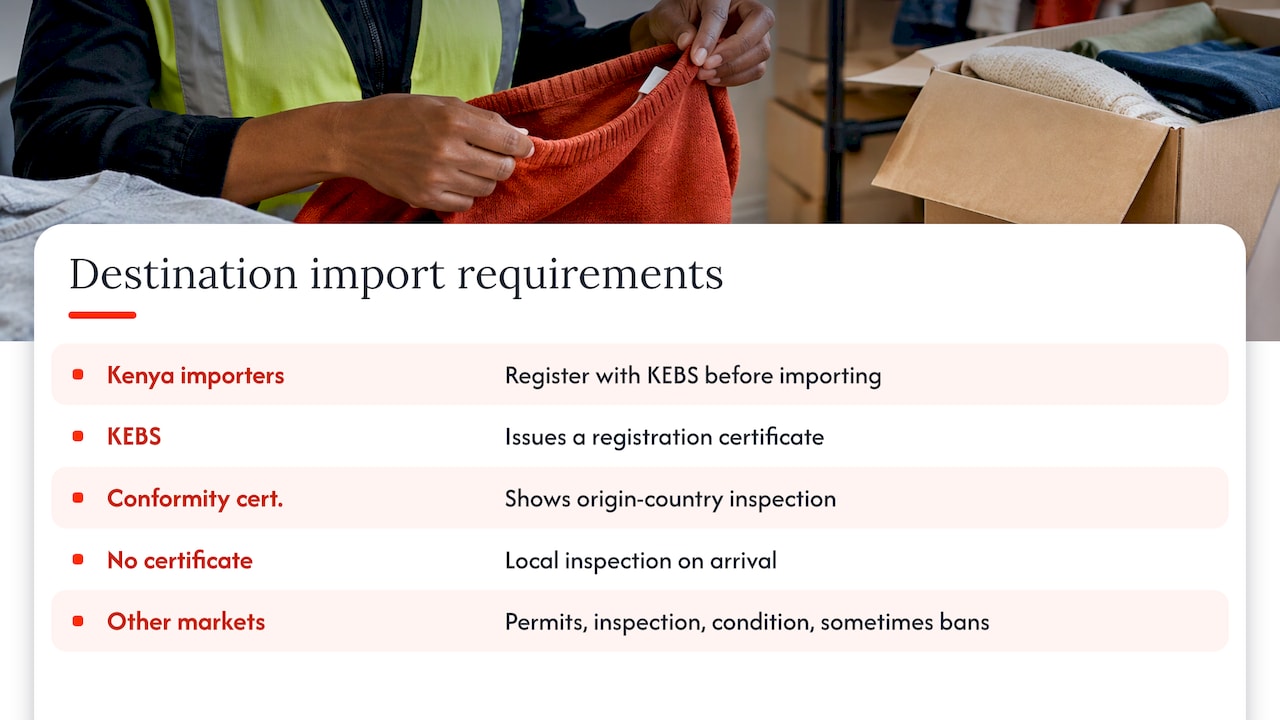
Other markets on your list, including Ghana, Nigeria, Cameroon, Côte d’Ivoire, Senegal, Pakistan, the UAE and India, each have their own rules on permits, inspection, product condition and sometimes outright bans. Read the current rules from your customs authority or standards body, and see our guides to used clothing import bans in nine countries and what importers must know about used clothing regulations. Classification also matters at the border: see HS code 6309 for worn clothing.
A buyer’s checklist before you order
- Ask how the goods are sorted. You want per-bale assessment, not a bulk label.
- Ask for the document set. Invoice, contract naming reuse, sorting evidence and the declaration that nothing in the shipment is waste.
- Check bale identification. Each bale should map to the packing list and grade. Our guide to shoe bale grading shows how grades work for footwear.
- Check packing quality. Inspectors look at packaging and stacking. Strong strapping and sound bales matter; see CTU code packing specs and bale breakage prevention.
- Confirm your own import file. Registration, certificates, HS code and any pre-shipment inspection your country requires. For a longer walkthrough of border checks, read our six buyer checks for door-to-door shipments.
- Plan for the EU compliance guide. Our note on EU used clothing compliance for 2025 to 2027 gives the wider picture.
Our perspective
We ship from Poland, so this regulation is part of our daily work, not a headline. Our view is that the new rules reward exporters who sort, pack and document properly, and that is the kind of exporter we aim to be.
Our positioning is built on three things: advanced machinery that speeds up bale packaging and turnaround, a warehouse of 133,000 square feet that gives buyers a broad range to choose from, and consistently documented shipments. We designed our process so that the paperwork a buyer needs for clearance is prepared with the goods, and we support clients with compliance questions on global import requirements.
For a wholesaler in Lagos, a market trader in Douala or an importer in Dubai, the practical benefit is a supplier who treats documentation as part of the product. We work with long-term partners who value that trust, and we resolve issues proactively when they arise.
rodrigues
Used clothing, shoes and more, ready for export
We supply businesses, not individual shoppers, with bulk bales of used clothing and used shoes, as well as purses and bags, wiping rags, vintage items, toys and bric-a-brac, packed on advanced machinery and shipped worldwide. If you are planning an order for a market covered above, tell us the destination and we will work from your country’s import requirements. Start at msexpspzoo.com.
FAQ
Does the EU Waste Shipment Regulation ban exporting used clothes?
No. It controls waste, and used textiles that are sorted and professionally assessed as fit for reuse are products, not waste. What it does is require evidence, such as origin, destination and sorting records, so inspectors can tell the difference. Textiles that are waste face the notification, consent and export limits described above.
What is DIWASS?
DIWASS is the EU’s central electronic system for waste shipments. Since 21 May 2026, EU operators and authorities use it to submit and exchange notifications, consents and movement documents, according to Bavarian business guidance. Importers outside the EU do not use it directly.
Which documents prove a bale is fit for reuse?
The core set is an invoice and contract stating the textiles are destined for direct reuse, evidence of sorting or professional assessment per bale, a recordkeeping protocol and a declaration that none of the material is waste. Ask your supplier for these with each order.
Do EU rules replace my country’s import rules?
No. EU rules govern the export side. Your country’s registration, certificate and inspection rules apply on arrival, as Kenya’s KEBS registration requirement shows. Check both sides before you commit to a shipment.
Sources
- Regulation (EU) 2024/1157, EUR-Lex
- Regulation (EU) 2024/1157, application date, EUR-Lex
- European Parliament Legislative Observatory summary
- EU textile waste and Waste Framework Directive amendments
- Textile trade codes challenge note, University of Cambridge
- ECOS and EEB position on reuse textiles
- Used textiles: waste or not, GISTRID
- Information for businesses on cross-border waste shipment, Bavaria
- Import of secondhand clothes, Kenya trade information portal