
A compression ratio tells you how much smaller a pile of loose material becomes once it is pressed: 5:1 means the bale takes one-fifth of the original volume. For a used-clothing buyer, though, the ratio is only a starting point. The figures that decide freight cost, handling and resale condition are bale density (kilograms per cubic meter), bale weight and bale dimensions, and these belong in your purchase specification, not just in a machine brochure. Below, we show how to calculate each one and compare high, low and double compression. We also list what to fix in writing before you order.
TL;DR
- Compression ratio = initial volume divided by final bale volume. Ten cubic feet pressed to two cubic feet is 5:1.
- Ratio describes the press, not the shipment. Ask for bale weight, dimensions and density (kg/m³) instead of a ratio alone.
- Higher compression packs more clothing into a container, but a container usually reaches its weight limit before it runs out of space.
- “Double press” has no single standard meaning, so define the bale size, weight and strapping in the contract.
- Pressure that is too high can crease fabric and break fibers, which hurts resale value, especially on vintage pieces.
Table of Contents
- What a compression ratio actually measures
- Why density is the number that matters
- High compression versus low compression
- Double compression and double-press bales
- Container math: you usually weigh out before you cube out
- Is higher compression a quality risk?
- What to put in your bale specification
- Matching compression to your market
- Where we fit
- Our view on compression
- FAQ
- Sources
What a compression ratio actually measures
The ratio compares two volumes. Divide the volume of the loose material by the volume of the finished bale. One baler guide gives the example of 10 cubic feet compressed to 2 cubic feet, a 5:1 ratio, meaning the material ends up at one-fifth of its original volume.
Some suppliers measure it by weight per volume instead. In this method you weigh one cubic yard of loose material and compare it with the weight of the same material baled into one cubic yard. A 25 lb loose versus 500 lb baled example works out at about 20:1, and the same guide gives bale volume as length × width × height in inches divided by 46,656, which converts to cubic yards.
Two things follow for a buyer:
- The same word can mean two calculations. A ratio quoted for “waste” in general is not a ratio for clothing.
- Manufacturers’ ratios describe what a machine can do. One clothing-baler spec sheet lists a compaction ratio of up to 5:1 and a 50 to 80% volume reduction. That is a capability range, not a promise about the bale in your container.
Why density is the number that matters
Loose clothing is mostly air. Engineering notes on textile presses explain that the early part of the press stroke costs little, but once fibers touch on all sides, required pressure climbs roughly with the cube of packing density. That is why density, not volume, drives the choice of press for export bales.
For you, density is simple to compute and to verify:
Density (kg/m³) = bale weight (kg) ÷ (length × width × height in meters)
A worked example. A bale measures 1.15 m × 0.75 m × 0.80 m and weighs 300 kg.
- Volume: 1.15 × 0.75 × 0.80 = 0.69 m³
- Density: 300 ÷ 0.69 ≈ 435 kg/m³
That is in line with a published case study for used-clothing bales of this size, which expects a final density of about 430 to 450 kg/m³ at roughly 290 to 310 kg per bale.
One caution on measuring. Bales are not perfect blocks. They bulge between the straps and relax in height after the press opens, so density worked out from nominal dimensions looks better than the real figure. Measure the finished bale after it has settled, and apply the same method to every supplier you compare.
High compression versus low compression
Buyers searching for “high compression vs low compression” are really asking which trade-off suits their market and their handling. Here is how the two compare on the points that matter to a reseller.
| Criterion | Higher compression | Lower compression |
|---|---|---|
| Freight per kg | Lower, because more clothing fits in the same space | Higher, because the bales take more room |
| Container loading | Often limited by weight before space | Often limited by space |
| Garment condition | Needs controlled pressure to avoid creasing and fiber damage | Gentler on fabric |
| Opening and sorting | Bales must be untangled carefully | Easier to open |
| Handling | Dense, heavy units suit forklifts | Lighter, easier for manual handling |
| Best for | Long sea routes where freight dominates cost | Shorter routes, delicate or vintage stock |
The logic behind the freight row is straightforward. After compression, rectangular bales stack with fewer empty gaps, so more clothing fits per container and transport cost per kilogram falls. The logic behind the condition row is that pressure has to be monitored so that textiles stay compact enough for economic transport without structural damage. Excessive density can leave permanent creasing and broken fibers, which matters most for vintage items sold on appearance.
So the right answer is rarely “as high as possible”. It is the highest density at which the garments still sort, hang and sell well on your market. A trader selling mixed everyday clothing in a high-volume market and a vintage reseller selling curated pieces will set different targets.
Double compression and double-press bales
You will see “double compression” and “double press” in supplier listings. There is no universal definition. In the trade the words usually point to a smaller, denser bale produced with a heavier or two-stage pressing, but the label alone does not tell you weight, size or pressure. Treat it as a description to be replaced by numbers.
What the equipment makers publish gives you a useful frame of reference:
- Large export bales. One press brochure lists a single-box press with 75 or 120 tons of pressing force producing 400 to 550 kg bales at 1150 × 730 × 1300 mm, at 4 to 5 bales an hour.
- Small bales. The same brochure lists presses for 45 to 100 kg bales at 765 × 465 × 250 to 600 mm. These are sized for easy handling and for fitting maritime containers.
- Machine pressing force differs from bale density. A 40-ton press for small bales and a 120-ton press for large bales are different tools, so tonnage alone does not rank bale quality.
If a seller offers “double-pressed” bales, ask for the bale weight band, the finished dimensions and the strapping method, and write them into the order. Our guides on 45 kg bale checklists for wholesale contracts and on converting bale weights from 45 to 100 kg into pieces show how those numbers turn into a count of garments you can actually resell.
Container math: you usually weigh out before you cube out
More compression does not automatically mean more bales per container. Two limits apply: the internal volume and the maximum payload your carrier or route allows.
The simple formulas are:
- Bales per container by volume = container volume ÷ bale volume (rounded down)
- Bales per container by weight = payload limit ÷ bale weight (rounded down)
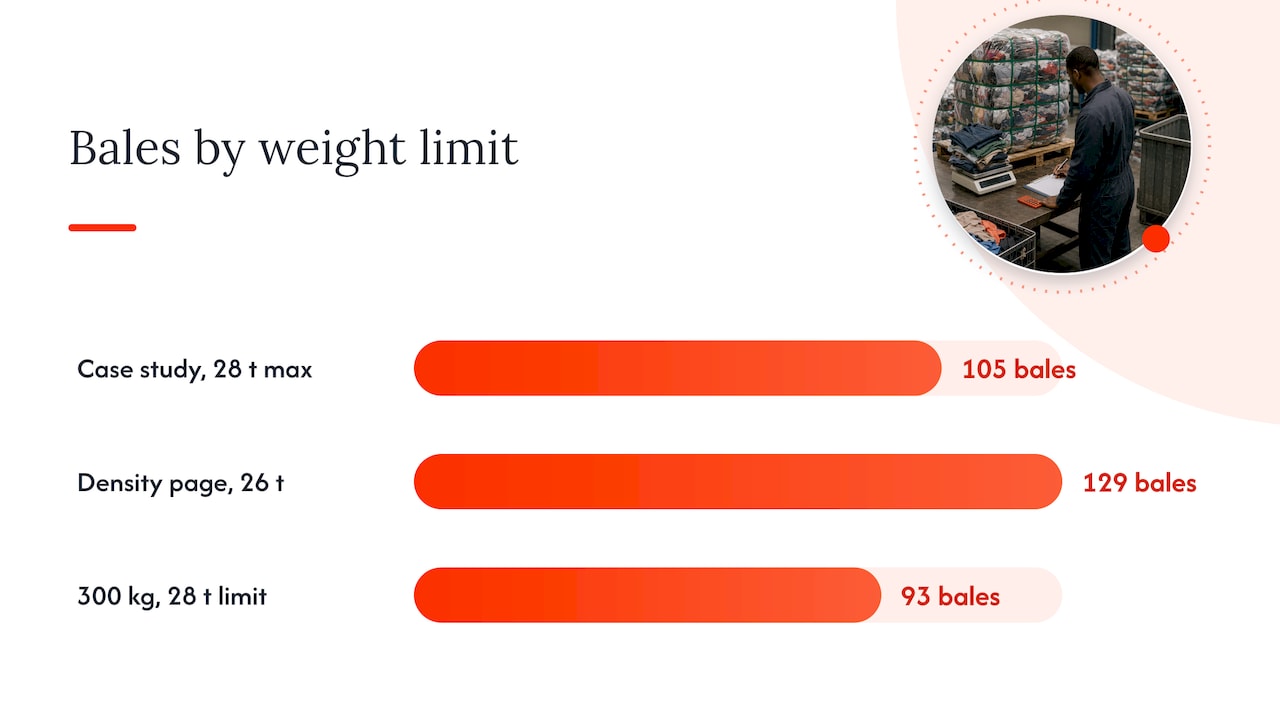
You take the smaller number. Two published examples show why this matters:
- In the used-clothing case study above, 105 bales of about 290 to 310 kg would total 30.5 to 32.6 tonnes, above the customer’s 28-tonne loading maximum. Heavier bales did not mean better use of the container.
- A density calculator page notes that 129 bales at 227 kg come to 29.3 tonnes against a 26-tonne limit, so the box is full by weight before it is full by volume.
In our 300 kg example with a 28-tonne limit, 28,000 ÷ 300 gives 93 bales by weight. If the same container could physically hold more, the extra density buys you nothing. The same source adds that real loads run a few percent below the pure volume ratio because bales do not tessellate perfectly, so use these calculations to compare options, not to book a final load plan.
For the cost side of the same decision, see how to calculate used clothing shipping costs in 10 minutes.
Is higher compression a quality risk?
It is a quality factor you control through specification. Three effects are worth knowing about:
- Creasing and fiber stress. Too much pressure on delicate or natural-fiber items shows up as hard creases that do not hang out.
- Opening speed. Dense bales must be untangled by hand or by machine before sorting, which slows a sorting line.
- Moisture. Tight bales trap whatever humidity was inside when they were pressed, so storage and packing conditions matter as much as pressure. Our notes on desiccants for clothing bales and vacuum packing used clothes cover that side.
A European Environment Agency-linked technical report on used-textile exports also observes that falling per-kilogram prices alongside rising export volumes may reflect declining quality or market saturation. Judge a bale on its grade and contents, not on a low price per kilogram or a high ratio.
What to put in your bale specification
A ratio on its own cannot be audited. These items can. Put them in the purchase order:
- Bale weight band (for example 45 to 100 kg for small bales, or the larger export weights your route uses), with an accepted tolerance.
- Finished dimensions after relaxation, in millimeters.
- Target density in kg/m³, calculated with the formula above.
- Strapping and wrapping method, so bales survive stacking and handling. See our guide to CTU Code packing specs and machine strapping.
- Container plan: bales per container by weight and by volume, and the payload limit you work to.
- Grade and content description, since compression affects condition but grade decides what is inside.
- Per-bale records for traceability. Our page on what to record and verify per bale lists the fields.
- Quality acceptance rule, for example a sampling method for rejects, as described in our article on cutting bale rejects with AQL checks.
Once these are fixed, the compression ratio becomes a footnote: if weight, dimensions and density match, the ratio is whatever it needs to be.
Matching compression to your market
Your sales channel should set your target before any supplier talks about tonnage.
- High-volume open markets with long sea freight: denser, standardized bales cut cost per kilogram and make forklift handling, storage and stock counting simpler. Standard sizes help with inventory control.
- Reseller shops and online sellers who sort piece by piece: moderate density and smaller 45 kg-class bales are easier to open, and each bale is a lower-risk commitment.
- Vintage and premium stock: lighter pressing protects fabric and shape, which is where resale value sits.
- Mixed loads (clothing with shoes, bags and toys): check that the heavier categories do not push you over the weight limit before the container is full.
Before a first order, work out landed cost per bale and per sellable piece with the same formulas. Our used clothing buying guide for resellers and importers walks through that sequence, and the page on breakage prevention covers handling losses in transit.
Where we fit
If you buy used clothing, shoes, bags or other second-hand goods in bulk, we are an exporter based in Poland, serving buyers in over 40 countries. Our packaging runs on advanced machinery designed to speed up the packing of bales and shorten turnaround, and we work from a warehouse of 133,000 square feet, so a broad range of stock is available for one order. We also document shipments and support buyers with the compliance requirements of global imports. You can see the range on our used clothing page, and the same approach applies to used shoes and used purses and bags.

When you request a quote, send us your target bale weight, finished dimensions, container payload limit and destination. With those four figures a supplier can answer in numbers rather than in a ratio. You can start from the msexpspzoo.com landing page.
Our view on compression
We think buyers should stop asking “what is your compression ratio?” and start asking “what is the weight, size and density of each bale, and what condition is the stock in when it is opened?”
Compression is a means to a dependable shipment. A bale that is pressed consistently, strapped properly and recorded per shipment is easier to stack, easier to count and easier to clear through a port. That is why we invest in packing machinery and in keeping our shipments documented, and why we think of packaging speed and consistency as part of the product, not an add-on.
For wholesalers and importers who move volume, a steady bale specification is what lets you plan freight and pricing. For resellers who sort by hand, it protects the garments you will actually sell. Our warehouse capacity lets us supply a wide range of categories to the same standard, so the specification you set for clothing can carry across to shoes, bags and other goods.
rodrigues
FAQ
What is a good compression ratio for used clothing bales?
There is no single good ratio. Clothing-baler specifications quote figures up to about 5:1, but the better measure is bale density in kg/m³ together with weight and dimensions. A density near 430 to 450 kg/m³ appears in a published case study for roughly 300 kg bales, which gives you a reference point, not a rule.
How do I calculate the compression ratio of a bale?
Divide the volume of the loose material by the volume of the finished bale. Ten cubic feet pressed to two cubic feet is 5:1. Bale volume is length × width × height, so measure the bale after it has relaxed, because bulging between straps makes nominal dimensions look smaller than the real volume.
What are double-compression or double-press clothing bales?
The term usually means a bale pressed harder or in two stages to make it smaller and denser, but there is no industry standard. Ask for the bale weight band, finished dimensions, density and strapping method in writing so that the label is backed by numbers.
Does higher compression always lower my shipping cost?
Not always. Denser bales cut freight per kilogram until the container reaches its weight limit. After that, extra density adds no bales to the load. Work out bales per container by volume and by weight and use the smaller figure.
Sources
- How to measure the compression ratio of a baler
- Clothing baler specification sheet
- Balers and recycling: compaction ratio guide
- Textile baler engineering overview
- Used clothing baler for 300 to 500 kg textile bales
- Bale density, press duty and container fill
- Used clothes baling and shipping costs
- Bale compression management
- Sorting and baling systems for used clothing (brochure)
- EU exports of used textiles in Europe’s circular economy (ETC report)