
In used clothing wholesale, MOQ (minimum order quantity) is the smallest order a supplier will accept, and for bales it is usually set in whole bales, in a mixed or single-category lot, or in a container load, not in individual garments. Lead time is the span from confirmed order to goods in your warehouse, and most of it is decided before the bale leaves the supplier: how fast it is packed, how clean the paperwork is and how the cargo is consolidated. We export used clothing, shoes, bags, wiping rags, toys and more from Poland to buyers in over 40 countries, and this guide covers what an importer, reseller or market trader needs to settle on both points before the first purchase.
TL;DR
- MOQ for used clothing is counted in bales or container loads. Confirm what one bale holds (category, grade, weight) before you compare MOQs between suppliers.
- Lead time has three parts: preparation and packing, documents and export clearance, then transit and import clearance. The last two cause most surprises.
- Mismatched HS codes and missing certificates are among the most common reasons cargo is held at a port, so settle them before loading.
- Start with a smaller first order in one category to test sell-through, then scale to a full container.
- Tell us your destination, category and target volume and we will confirm the order structure for you.
Table of Contents
- What MOQ means when you buy used clothing
- Why suppliers set a minimum at all
- What affects the order size you should choose
- Lead time: the three stages
- The paperwork mismatch that costs the most days
- How to reduce lead time on your imports
- Questions to ask any used clothing supplier before you order
- Different categories, different order logic
- Perspective
- Plan your first order with us
- FAQ
- Sources
What MOQ means when you buy used clothing
MOQ is the minimum a supplier will sell in a single order. In new-garment manufacturing it is counted in pieces per style, color and size, because each production run has setup costs. Used clothing works differently. Nothing is manufactured. The goods are collected, sorted, graded and compressed into bales, so the natural unit of sale is the bale, and the natural shipping unit is the pallet or the container.
That changes what you should ask. A garment count is meaningless when a bale holds a mix of items that vary in weight. Ask instead:
- What is the minimum number of bales per order? This is the real MOQ.
- What is in a bale? Category (mixed clothing, shoes, bags, toys, wiping rags), grade, and approximate weight. Our guide on calculating landed cost on 45 kg handbag bales shows how bale weight drives your cost per piece.
- Does the MOQ apply per category or per order? A single-category order and a mixed order can carry different minimums.
- Does the MOQ change by destination? Shipping a part load is not the same as filling a container.
There is no universal MOQ in this trade. Any figure quoted in a blog is a general range, so ask each supplier for its own and get it in writing with the bale specification attached.
Why suppliers set a minimum at all
A minimum protects the supplier’s handling cost. Every order means picking from the warehouse, packing on a baling line, strapping, labeling, building the documents and booking transport. Those steps cost nearly the same for a small order as for a large one, so a minimum keeps the per-bale cost workable.
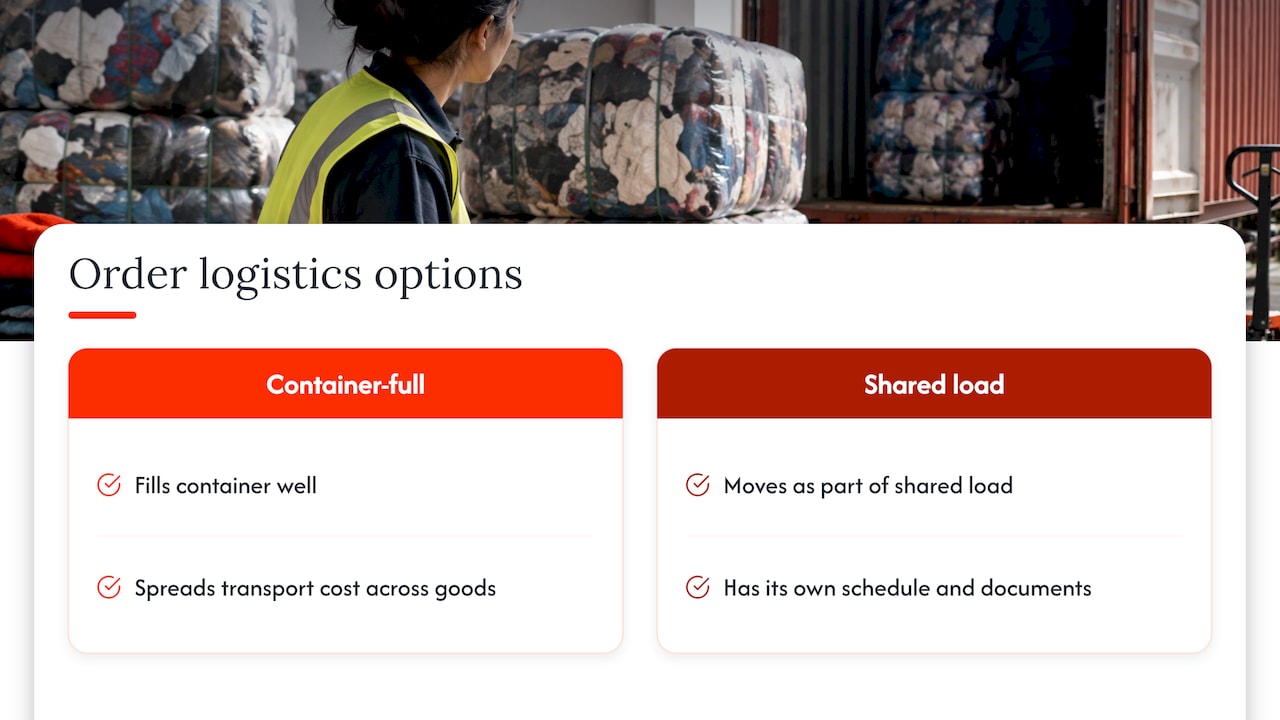
For you, the minimum is also a logistics decision. Freight is the biggest variable in your landed cost, and freight is priced by container or by consolidated volume. An order that fills a container well usually spreads the transport cost across more goods. An order that is too small for a container can still move, but it travels as part of a shared load, which has its own schedule and its own documents.
What affects the order size you should choose
The supplier’s minimum is a floor, not a recommendation. Your own order size should come from four things.
Your sell-through speed
Used clothing is a volume business, but stock that sits is cash that sits. If you run a market stall or a small shop, a first order that you can sell through in a few weeks tells you more than a large order that takes months. Seasonal mix matters too: a bale of summer items bought for a rainy season is a slow bale.
Your cash and your landed cost
The price on the invoice is not what a bale costs you. Add freight, duty, port charges, inland transport and your own handling. Before you decide how many bales to order, work out the landed cost per kilo or per piece. Our used clothing buying guide for resellers and importers walks through that arithmetic.
Your storage
Bales are dense, but a container is a lot of volume. Stock stored damp or hot loses value. Our guide to storing used clothing covers what a reseller needs in the warehouse before the container arrives.
Your testing plan
Buyers who are new to a category, or to a supplier, often get better results by running a small pilot order before committing, since order size changes both unit pricing and how much risk you carry. Treat the first order as a trial of the whole chain: quality against the description, packing, paperwork and delivery time.
Lead time: the three stages
Supplier websites often promise a lead time without saying what it covers. Break it into stages and ask about each one.
| Stage | What happens | What you can influence |
|---|---|---|
| 1. Preparation | Stock is picked, baled, strapped, labeled and loaded | Choose in-stock categories, confirm bale specification early |
| 2. Documents and export clearance | Invoice, packing list, certificates, export declaration, booking | Send consignee details and import permits at order confirmation |
| 3. Transit and import clearance | Sea or road transport, port handling, customs at destination | Correct HS code, complete paperwork, pre-arranged clearing agent |
Stage 1: preparation and packing
This is where a supplier’s equipment matters. Our packing runs on advanced baling machinery, which is designed to speed up how quickly bales of second-hand goods are packed and turned around. We also hold 133,000 square feet of warehouse space, so a broad range of categories can be held ready rather than collected after you order. How strongly the bales hold their shape in transit also depends on strapping and compression. See our notes on CTU code packing and machine strapping and on preventing bale breakage.
Stage 2: documents and export clearance
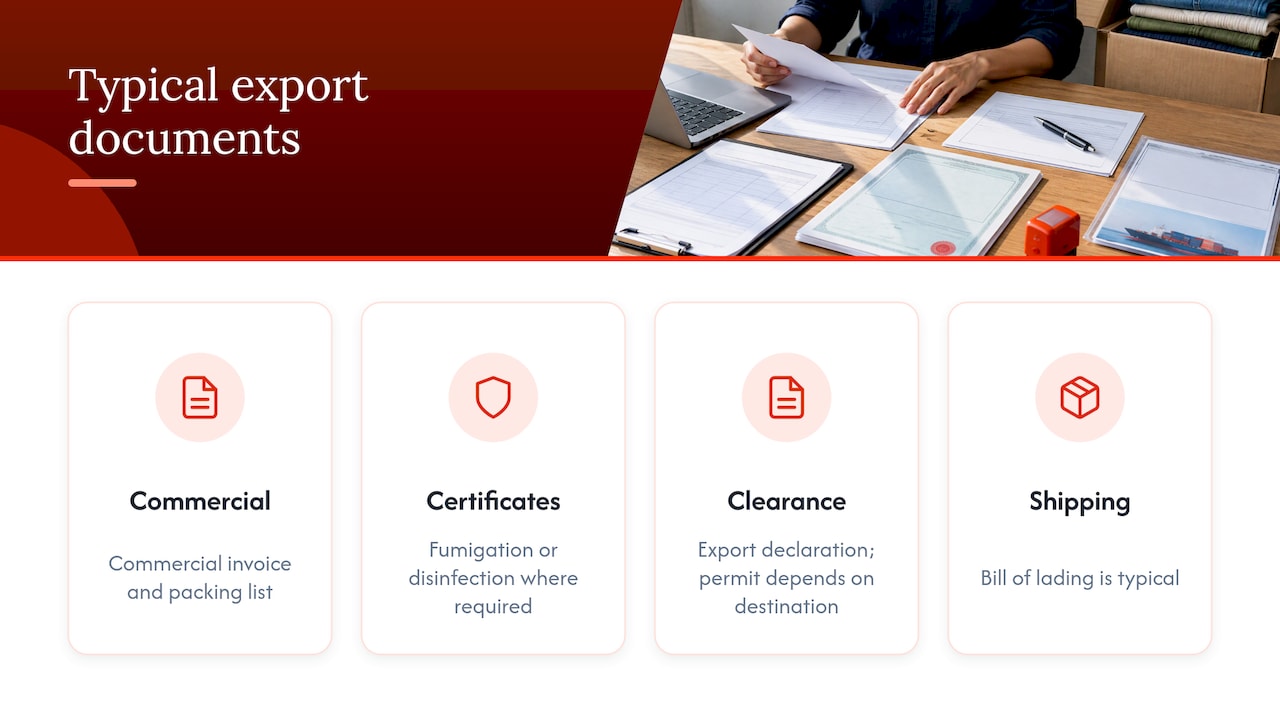
This stage is where good orders stall. For used clothing under HS code 6309, a freight forwarder that ships used clothing from Miami to Central America lists the typical documents: commercial invoice, packing list, a fumigation or disinfection certificate where required, the export declaration, an import permit or sanitary authorization depending on the destination, and the bill of lading. The exact set depends on the exporting and importing country, so confirm it for your lane.
Our article on what belongs on a packing list explains what each document should show, and the one on supplier certificates U.S. importers need covers the certificate side.
Stage 3: transit and import clearance
Transit time depends on the lane, the carrier and the port. As one reference point, the Miami forwarder above says weekly consolidated LCL (less-than-container-load) containers to Central America take 5 to 12 days in transit depending on destination. That is a figure for one lane from the United States. Shipping from Poland to West Africa, East Africa, the Gulf or South Asia will be different, so ask for a quoted schedule for your specific port.
Customs clearance at the destination is the least predictable part. It is shorter when the paperwork matches the goods and longer when it does not.
The paperwork mismatch that costs the most days
The single most avoidable delay is a document set that does not agree with itself. A customs brokerage explains that for used clothing the HS code must match exactly across the commercial invoice, packing list, bill of lading and export declaration, because any mismatch is a red flag that can pause clearance until an amendment is filed. The same article notes that the HS code also determines whether the cargo needs fumigation certificates or special permits.
A practical routine before every shipment:
- Agree the HS code with your clearing agent before the supplier issues documents.
- Check that the goods description on the invoice and packing list uses the same wording and the same code.
- Check that bale counts, gross weight and net weight agree on every document.
- Confirm which certificates your destination requires, and ask for them before loading, not after.
We have written the detail up in separate guides: HS code 6309 classification rules, 8 to 10 digit HS codes and port holds, and, for buyers shipping into the U.S., keeping tariffs low with HTS 6309. If you want to confirm your market allows these goods at all, start with whether you can legally import used clothing for resale and what importers must know about used clothing regulations.
How to reduce lead time on your imports
Lead time is shortened mostly by removing waiting, not by speeding up the ship. These are the steps that matter, in order.
- Choose in-stock categories and grades. The faster the goods can be picked and baled, the shorter stage 1. Tell the supplier your category and target volume early so stock can be reserved.
- Fix the bale specification before you pay. Changes to category, grade or weight after confirmation restart the packing work.
- Send consignee and permit details at order confirmation. Import permits and sanitary authorizations belong at the start, not when the container is already booked.
- Agree the HS code and document wording first. One amendment can hold a container for days.
- Ask for traceability per bale. Clear bale records make it easier to answer any customs query quickly. See what to record and verify per bale.
- Use consolidation where your volume does not fill a container. Regular consolidated departures can lower shipping cost and speed clearance when documents are reviewed before loading, as the Miami forwarder describes for its Central America service.
- Book a clearing agent at the destination before the ship sails. Idle containers collect storage charges.
- Place repeat orders on a rhythm. A regular schedule lets the supplier plan stock and packing slots for you.
Questions to ask any used clothing supplier before you order
Use this list to compare suppliers on equal terms.
- What is the minimum order in bales, per category and per shipment?
- What is the weight and grade specification of each bale type?
- How long from confirmed payment to cargo ready for loading?
- Which documents come with every shipment, and who prepares them?
- Which destination certificates or fumigation steps are handled before loading?
- How are problems with a delivered bale handled?
The answers show you more than any price list. A supplier that answers in writing, with numbers, is a supplier whose lead time you can plan around.
Different categories, different order logic
The minimum and the lead time change with what you buy.
- Used clothing: the largest range. Bales are sorted by category and grade, and mix matters. See our used clothing range.
- Used shoes: pairing, grading and disinfection add steps. Read our guides on how shoe bale grading works and disinfecting used shoes for resale.
- Bags and accessories: weight per bale is lower in value per kilo than clothing, so landed cost needs its own calculation.
- Wiping rags: sold by material type and absorbency, with a different HS code. See the HS code for wiping rags.
- Toys and bric-a-brac: mixed in size and shape, so packing method and breakage prevention matter more.
Perspective
From where we sit in Poland, the buyers who run into trouble are rarely the ones with the wrong minimum. They are the ones who never wrote down what the minimum buys: how many bales, which category, which grade, which documents.
We built our operation around that problem. Our packing line uses advanced machinery so that bales of clothing, shoes and other second-hand goods can be turned around quickly. Our warehouse of 133,000 square feet lets us hold a broad range of categories, so a mixed order does not have to wait while stock is collected from several places.
The second half of lead time is paperwork, and we treat it as part of the product. We document shipments consistently and help buyers with the compliance requirements of their destination, because a container that clears on the first attempt is the fastest container.
Our advice to a new importer is simple: start with the category you know you can sell, agree the bale specification and documents in writing, and let the first shipment show you how the whole chain performs. Then scale.
rodrigues
Plan your first order with us
We sell used clothing, shoes, purses and bags, recycled industrial wiping rags, bric-a-brac, hard and soft toys and used tyres in bulk bales to retailers, resellers, wholesalers and importers. Orders ship worldwide with documentation prepared for each shipment, and our team supports you on compliance for your destination. Send us your market, category and target volume through our used clothing page and we will come back with the order structure that fits.
If shoes are your focus, go to used shoes. For other goods, start from our main site.
FAQ
What does MOQ mean for used clothing bales?
MOQ is the smallest order a supplier will accept. For used clothing it is normally set in bales or container loads rather than individual garments. Ask for the figure per category and get the bale weight and grade in writing.
How long is the lead time for used clothing bales?
It depends on three stages: packing, documents and export clearance, and transit with import clearance. One U.S. forwarder quotes 5 to 12 days of transit on its Central America lane, but each route is different. Ask your supplier for a schedule to your specific port.
Why do used clothing shipments get delayed at customs?
The most common cause is documents that disagree, especially the HS code across invoice, packing list, bill of lading and export declaration. Missing certificates or permits are the other usual cause. Confirm both before loading.
Can I order less than a full container?
Often yes, through consolidated shipping, where your goods share a container with other cargo. Consolidated loads run on set departures, so confirm the schedule and the documents needed. Tell us your volume and destination and we will advise on the order structure.
How do I reduce lead time on repeat orders?
Fix the bale specification, keep the same document templates and HS code, send permits at confirmation and book your clearing agent early. A regular ordering rhythm also lets the supplier plan stock and packing time.
Sources
- Used Clothes Consolidation USA to Central America
- Why HS Codes Matter in Used Clothing Exports
- Run a 100 to 500 Order Pilot: Plastic-Free Packaging for Apparel Brands