
HS code 6309 applies only when worn textile goods meet two conditions at once: they must show appreciable wear, and they must be presented in bulk rather than individually packaged or retail-ready. Meet both and the shipment typically qualifies for duty-free treatment under most tariff schedules, though the entry still has to clear destination-country import controls. Miss either one, and customs will reclassify the goods into higher-duty apparel headings.
TL;DR:
- Shipment qualifies for duty-free treatment only if the worn textile goods show visible, physical signs of prior use and are presented in bulk packaging.
- Goods that are individually bagged or folded for retail like size or brand sorting do not meet the bulk presentation requirement, risking reclassification into higher-duty headings.
- Proper classification depends on physical evidence of wear, such as fading, patching, or thinning fabric, rather than self-declarations or purchase history.
- Packaging decisions made at the origin, like baling and sorting, have a direct impact on classification success and should prioritize bulk presentation standards.
- Verifying import restrictions, licensing, and duty rates for each destination market before shipping helps avoid non-tariff border restrictions and detention.
Table of Contents
- What Heading 6309 Covers and Where the Legal Text Lives
- What Counts as “Appreciable Wear” and “Bulk” in Practice
- Rulings and Precedent Shaping 6309 Enforcement
- Duty Treatment and Statistical Reporting Under 6309
- Import Controls That Commonly Restrict Used Clothing
- Building the Paper Trail That Supports a 6309 Claim
- Common Pitfalls in 6309 Classification Disputes
- Why Packaging Discipline Beats Legal Argument Every Time
- Sourcing Compliant Bulk Bales for Your Next 6309 Shipment
- Primary Sources for Verifying 6309 Classification and Duty
- Sources
What Heading 6309 Covers and Where the Legal Text Lives
Heading 6309 covers worn clothing and other worn textile articles, a category built around condition and packaging rather than fabric type or garment style. That means a used cotton shirt, a stack of worn wool blankets, and a bundle of secondhand curtains can all sit under the same heading, provided they clear the wear and bulk tests. The Harmonized Tariff Schedule maintained by the USITC sets out the controlling language, and that entry is the first document any classification memo should cite.
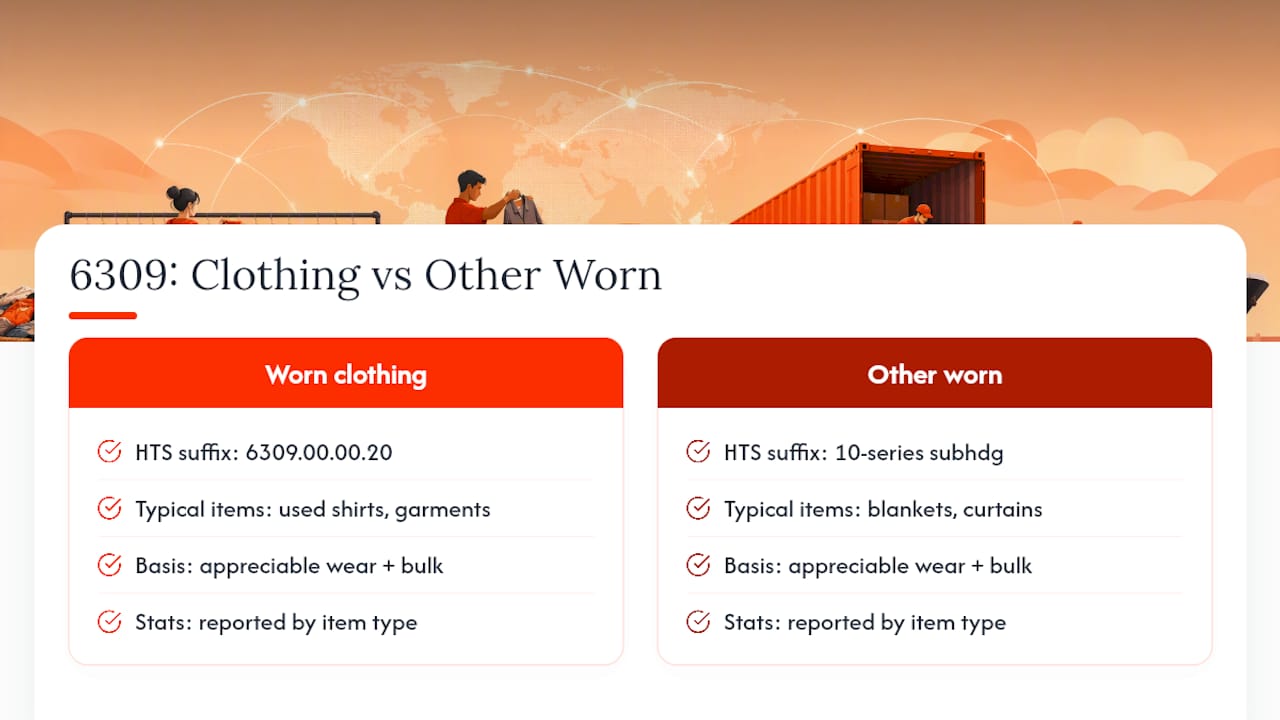
Statistical reporting under 6309 typically splits by item type rather than fiber content. In the US schedule, subheading 6309.00.00.20 covers other worn clothing, while a parallel 10 series subheading applies to other worn articles like blankets or curtains. Brokers filing entries need to match the physical goods to the correct 10-digit statistical suffix, not just the six-digit heading, because customs uses that suffix for trade statistics and enforcement targeting alike.
The World Customs Organization’s Explanatory Notes to Chapter 63 provide the interpretive backbone for “appreciable wear” and “bulk,” and most CBP rulings quote that language directly before applying it to the facts at hand. When drafting a classification opinion or responding to a request for information, cite the HTS entry first, then the Explanatory Notes for the qualifying language, then any relevant ruling. Trade-intel platforms like Flexport’s HS code reference are useful for a quick orientation, but they are secondary sources. Never cite them in place of the HTS text or an actual ruling when the classification is contested.
One detail trips up newer filers constantly: 6309 is a residual heading. If a specific chapter 61 or 62 provision more precisely describes the item and the item does not show appreciable wear, that more specific heading wins under General Rule of Interpretation 3(a). Wear and bulk aren’t optional flavor text. They are the entire legal basis for the heading’s existence.
What Counts as “Appreciable Wear” and “Bulk” in Practice
Customs officers and CBP rulings look for physical, visible evidence of use, not a self-declared age or purchase history. The practical markers that show up in actual rulings include:
- Fading or discoloration consistent with repeated washing or sun exposure
- Wear at stress points: collar edges, cuffs, knees, seat seams, shoe soles
- Visible mending, patching, or replaced buttons and zippers
- Pilling, thinning fabric, or stretched-out elastic
- Odor or staining consistent with prior use rather than storage
What does not count as appreciable wear: shop-soiling, minor manufacturing defects, factory seconds, or overstock that simply looks slightly used from handling. Customs has repeatedly distinguished between goods that were actually worn by a consumer and goods that merely look imperfect. That distinction alone accounts for a large share of adverse rulings.
“Presentation in bulk” is a packaging and handling test, separate from condition. Genuine bulk presentation looks like compressed bales wrapped in strapping or plastic sheeting, large woven sacks, or rough wooden crates holding hundreds of mixed garments with no individual packaging, tagging, or size sorting. Retail packaging, by contrast, looks like individually bagged items, garments folded and tagged by size, or cartons organized the way a store would receive inventory for shelving.
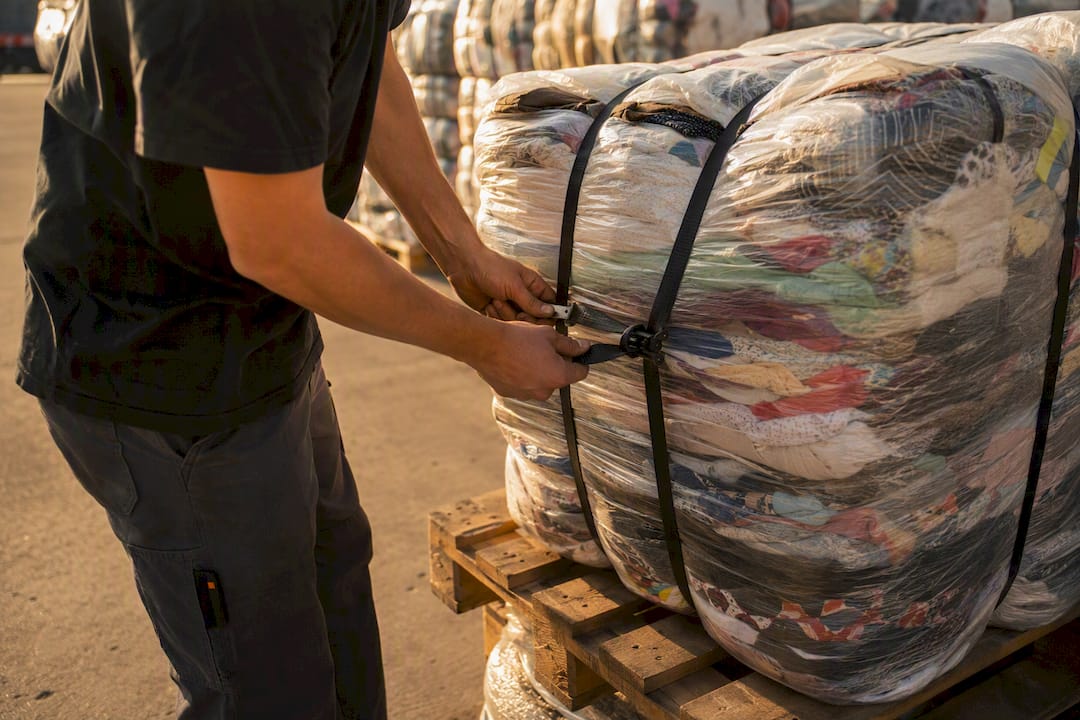
Borderline cases show up most often in small-lot e-commerce shipments, where a seller bags each used garment individually for hygiene or shipping convenience. CBP rulings have found that individual bagging, even of genuinely worn items, undercuts the bulk requirement and pushes the goods back into chapter 61 or 62.
Pro Tip: Photograph an open bale before it’s compressed and strapped, showing loose, mixed, ungraded garments inside. That single image does more to support a 6309 claim during an inspection than a page of invoice language.
Rulings and Precedent Shaping 6309 Enforcement
Two ruling patterns show up again and again when CBP evaluates a 6309 claim, and both turn on facts a broker can control before the goods ever ship.
- HQ 960577 dealt with the wear standard directly, reinforcing that visible, physical signs of prior use are required, not merely an assertion that goods are “used” or “secondhand” on commercial paperwork.
- N236006 involved individually packaged used garments that CBP found did not satisfy the bulk requirement, even though the wear condition itself wasn’t disputed. The goods were reclassified under the applicable chapter 61 or 62 provision for the garment type, at the corresponding duty rate.
Reading a ruling well means separating the controlling legal language from the specific fact pattern. A ruling that denies 6309 because of individual packaging doesn’t mean all individually handled goods fail. It means that particular consignment’s packaging, as described in the entry documents, failed to demonstrate bulk presentation. The fix is almost always upstream: change how goods are packed and documented before they reach the port, not after an import specialist has already flagged the entry.
The practical lesson brokers take from these rulings is consistent: packaging decisions made at the sorting facility have direct tariff consequences months later. A facility that bags, folds, or size-sorts garments for operational convenience is inadvertently building a paper trail that argues against its own client’s classification.
Duty Treatment and Statistical Reporting Under 6309
Most HTS schedules list 6309 entries as duty-free, and the US Harmonized Tariff Schedule confirms that treatment for the general rate of duty column. That said, “typically duty-free” is not the same as “always duty-free everywhere.” Duty treatment is set by each country’s own national tariff schedule, and a handful of jurisdictions apply specific duties, additional levies, or safeguard measures to used clothing regardless of the HS heading’s general treatment.
Statistic Callout: Statistical reporting under 6309 in the US schedule splits by article type at the ten-digit level, with subheading 6309.00.00.20 covering other worn clothing and a parallel subheading covering other worn textile articles such as blankets and curtains. Filing under the wrong ten-digit suffix is a common source of entry rejections even when the six-digit heading is correct.
Before quoting a duty rate to a client, confirm it against the destination country’s own published tariff schedule rather than relying on memory or a prior shipment’s rate. Rates change with trade agreement renewals, safeguard actions, and periodic tariff schedule revisions. Preferential program eligibility (free trade agreements, generalized system of preference programs) sometimes applies on top of the base rate, but only when the goods also satisfy that program’s separate rules of origin, which have nothing to do with the 6309 wear and bulk tests. Treat duty confirmation and origin qualification as two separate checks, not one.
Import Controls That Commonly Restrict Used Clothing
A correct 6309 classification gets a shipment through tariff assessment. It does not automatically get the shipment through the border, because a growing number of destination markets apply non-tariff restrictions to used clothing regardless of how it’s classified.
- Several African markets have imposed import restrictions, licensing requirements, or outright bans on used clothing, citing protection of domestic textile manufacturing as the primary rationale, according to trade guidance from Goods Across Borders.
- Some jurisdictions apply sanitary or phytosanitary-style controls to used textiles, requiring fumigation certificates or disinfection treatment before release.
- Import licensing regimes in certain markets require pre-shipment registration or a specific import permit that has nothing to do with the tariff classification itself.
- A smaller set of countries apply safeguard-style quantitative restrictions that cap the volume of used clothing entering in a given period.
Verify admissibility before booking freight, not after the container is on the water. Start with the destination country’s own customs authority notices, cross-check against a trade-intelligence service if the client has one, and when the market is unfamiliar, place a direct call to a licensed customs broker operating in that country. A correctly classified consignment that gets held at a foreign port over a licensing gap is still a costly failure, even though the HS code itself was never in question.
Building the Paper Trail That Supports a 6309 Claim
A defensible 6309 entry is built before the container is sealed, not argued after an import specialist raises a question. Work through this sequence for every consignment:
- Draft invoice language in generic terms. Describe goods as “worn clothing, mixed, bulk packed” rather than listing retail SKUs, brand names, or size breakdowns that read like inventory for resale.
- Build a packing list that reflects bulk handling. Record bale counts, gross weight per bale, and general contents by category, not itemized garment counts.
- Photograph open bales and representative samples. Capture loose, mixed, ungraded garments before compression, plus close-up shots of visible wear markers.
- Collect a supplier declaration. A short statement confirming the goods were sourced as used, worn textiles from donation or collection channels adds a documentary layer beyond the invoice.
- Tag and label bales consistently. Bale tags showing weight, count, and origin lot number make the shipment easy to trace if a specific bale is questioned.
- Preserve everything if challenged. If an entry is held, keep all photos, declarations, and packing records, and consider a post-entry ruling request or prior disclosure rather than abandoning the claim.
Pro Tip: Keep a standing folder of bale photographs by production date, not by shipment. When a ruling request or detention response needs supporting evidence, you want images that match the exact production run, not just “similar” bales from another week.
Common Pitfalls in 6309 Classification Disputes
The same handful of operational mistakes account for most 6309 disputes, and nearly all of them are avoidable with better upstream sorting.
- Commingling. Mixing a small number of items that don’t meet the wear standard into an otherwise qualifying bulk shipment risks pulling the entire consignment into a higher-duty heading, since customs generally doesn’t split one bale into two classifications.
- Retail-style presentation. Folding, tagging, or individually bagging garments for buyer convenience undermines the bulk test even when the wear condition is genuine.
- Thin documentary evidence. An invoice that simply states “used clothing” without packing details, photos, or a supplier declaration gives an import specialist nothing to verify against.
If goods are detained or reclassified, preserve every photo, declaration, and packing record immediately, and request internal advice or a sample review before conceding the classification. CBP’s customer service channels can direct a ruling request to the correct office, and a formal ruling request, built around clear photographic and documentary evidence, is usually resolved faster than an appeal filed after the fact.
Why Packaging Discipline Beats Legal Argument Every Time
Most 6309 disputes never turn on a genuine legal ambiguity. They turn on a packing decision made weeks earlier at a sorting facility, long before anyone thought about customs. That’s the part conventional compliance guidance underplays: the rulings read like legal arguments, but the facts that decide them are almost always operational.
Msexpspzoo built its packaging process around that reality rather than around paperwork drafted after the fact. Baling equipment that produces consistent, compressed, ungraded bales, and a warehouse large enough to sort and stage inventory by category before compression, does more for a classification claim than any invoice language written afterward. The wear standard is rarely the hard part. Bulk presentation is where shipments actually fail, and that’s a packing-floor decision, not a legal one.
Segregating goods that don’t meet the wear standard at origin, rather than hoping an import specialist won’t notice a handful of near-new items in a 500-piece bale, is the single highest-leverage compliance move available to an exporter. It costs a few extra minutes of sorting. It saves weeks of detention.
— rodrigues
Sourcing Compliant Bulk Bales for Your Next 6309 Shipment
Buyers who need consignments built to satisfy both the wear and bulk tests don’t have many good options between “hope the supplier gets it right” and “manage sorting yourself.” Msexpspzoo closes that gap by producing export-ready bales designed around exactly those two criteria from the sorting floor forward, not as an afterthought before loading.
Every bale moves through advanced packaging machinery that compresses and straps mixed, ungraded garments into the bulk presentation customs rulings expect, backed by a 133,000 square foot warehouse that keeps turnaround fast even on large orders. That combination matters when a buyer is trying to fill a container on a deadline without gambling on a reclassification at the destination port. Wholesale buyers can review current bulk used clothing inventory and specifications, or check the used shoes line for footwear consignments that follow the same wear and bulk standards. Request a quote directly through the site to get bale specifications, documentation samples, and lead times for a specific destination market before committing to an order.
Primary Sources for Verifying 6309 Classification and Duty
For any classification memo, ruling request, or entry defense, cite primary sources directly rather than secondary summaries. The USITC Harmonized Tariff Schedule search confirms current subheading structure and duty rates. CBP’s rulings database lets you search prior decisions by heading number or keyword before filing a new request. The USITC’s HTS learning guide walks through how to read Explanatory Notes and General Rules of Interpretation for anyone newer to HTS structure.
When citing precedent in a ruling request or protest, lead with the HTS entry itself, follow with the specific ruling number and its controlling fact pattern, and only then reference secondary trade-intel summaries as supporting context.
Sources
- 6309.00.00.20 – Harmonized Tariff Schedule
- CBP Rulings search
- CBP Customer Service
- CBP Ruling N236006 (TariffLens)