
For retailers and importers looking for wholesale alternatives to Aeclothing, the workable options are export wholesalers, graded-bale suppliers, liquidation and pallet vendors, and textile recyclers. Msexpspzoo fits the top of that list on operational grounds: a 133,000 square foot warehouse and worldwide shipping to more than 40 countries. Before signing with anyone, check three things: yield, minimum order quantity, and shipping logistics.
TL;DR:
- Suppliers should provide detailed photos, grading sheets, and contamination rates to verify lot quality and avoid misgrading risks.
- Export wholesalers typically require higher minimum orders, often by container, while liquidation vendors offer more variance and less predictability.
- Yield, or the percentage of retail-ready items, is more important than price per kilo because it directly impacts actual profit margins.
- International suppliers based in Europe or North America provide more consistency and scalability than local warehouses or online marketplaces.
- Conduct thorough due diligence by confirming documentation, trust signals, and references before committing to large orders or long-term partnerships.
Table of Contents
- Types of Wholesale Lots You’ll Encounter
- How Do You Vet a Wholesale Used-Clothing Supplier?
- Where to Buy: Mapping the Sourcing Channels
- Why Yield Matters More Than Price Per Kilo
- Minimum Order Quantities, Packaging, and Shipping Timelines
- Reputable Supplier Types and Where They Operate
- Local Warehouses vs. International Suppliers vs. Online Marketplaces
- Payment Terms and Negotiation Tips
- Common Scams in the Used Clothing Wholesale Trade
- Verifying Authenticity and Sustainability Claims
- Due Diligence Before You Sign
- Msexpspzoo’s Operational Strengths for Resellers and Importers
- How to Start Buying From Msexpspzoo
- Sources
Types of Wholesale Lots You’ll Encounter
Every supplier packages secondhand goods differently, and the format you choose determines how much sorting labor you’ll absorb before anything hits your shelves or your own resale bins.
A bale is compressed, machine-wrapped stock, usually 45 to 100 kilograms, sorted by broad category (mixed women’s, mixed men’s, summer, winter). A pallet is a mixed liquidation load, often stacked in boxes rather than compressed, and tends to include a wider spread of quality and item types than a bale. Graded or vintage lots are pre-sorted by condition or era, priced higher per kilo but requiring far less rework before resale. Utility or as-is lots are unsorted and sold at the lowest price point, shifting all the grading risk to the buyer.
- Bales suit high-turn discount sellers who resell by weight or bulk lot, not by individual piece.
- Graded/vintage lots suit curated boutiques and online resellers who need consistent, higher-margin inventory.
- Utility/as-is lots suit refurbishers and rag processors with in-house sorting capacity.
- Footwear and accessory lots (shoes, purses and bags) need separate handling since sizing and pairing add sorting complexity.
- Industrial wiping rags are cut and graded from unsellable textiles, sold by weight to janitorial and manufacturing buyers rather than fashion resellers.
Packaging affects everything downstream. Compressed bales ship denser and cheaper per kilo but require unwrapping and airing before display. Boxed pallets are gentler on garments but eat more container space, which raises your per-unit freight cost.
How Do You Vet a Wholesale Used-Clothing Supplier?
Vetting a supplier before you commit real money comes down to four categories: what they’ll show you, what they’ll commit to in writing, what they can prove logistically, and what past clients say about them.
- Request documentation first. Ask for detailed photos of an actual bale (not stock imagery), a sample bale if the order size justifies it, a written grading sheet, and a stated contamination rate (the percentage of unsellable or damaged items you should expect).
- Nail down commercial terms before quoting a price back to your own buyers. Confirm the price unit (per kilo, per bale, per container), the minimum order quantity, accepted payment terms, the Incoterm (FOB, CIF, EXW), and the quoted lead time from order to dispatch.
- Check the logistics and paperwork. Ask how bales are palletized for container loading, what customs documentation ships with the order, and whether any certificates of origin or fumigation are included for your destination country.
- Look for trust signals that are hard to fake. Warehouse size, visible packaging machinery, and references from long-term partners tell you more than a polished sales page. A supplier that can show repeat buyers and a clear return or credit policy for misgraded lots is operating like a real B2B partner, not a one-off broker.
Pro Tip: Ask a prospective supplier for the name of a client who has ordered from them at least three times. A one-time buyer can’t tell you how a supplier handles a shipping delay or a grading dispute; a repeat buyer can.
Academic research into fashion re-commerce points to supply uncertainty and operational hurdles as the recurring bottleneck for buyers in this market, which is exactly why documentation and logistics checks matter more here than in most wholesale categories, according to a state-of-the-art review of re-commerce business models.
Where to Buy: Mapping the Sourcing Channels
Resellers rarely rely on a single channel, and each one solves a different problem.
- Export wholesalers offer the most predictable supply, larger minimum order quantities, and standardized grading. They’re the right fit once your resale volume is stable enough to plan around a recurring shipment schedule.
- Liquidation and pallet vendors, such as Coast to Coast Liquidators, sell cheaper stock with far more variance in quality and category mix. Treat these as a supplement, not a primary supply line, and budget extra sorting time.
- Textile recyclers sell utility-grade and industrial lots at the lowest per-kilo cost, useful for buyers blending resale with rag or fiber recovery revenue.
- Local auctions, trade shows, and direct warehouse partnerships build relationship-driven supply, often with better pricing over time as trust develops, though volumes are less predictable early on.
Market analysis of the secondhand apparel sector notes that online platforms are the fastest-growing sourcing and resale channel, while brick-and-mortar consignment and thrift channels still hold meaningful share. Most experienced buyers run two or three channels simultaneously so a slowdown in one doesn’t stall their whole pipeline.
Why Yield Matters More Than Price Per Kilo
A cheap bale isn’t a good deal if half of it goes straight to the rag pile. Yield is the percentage of a lot that’s actually retail-ready, and it drives your real cost per sellable item far more than the sticker price per kilo does.
To estimate margin honestly, you need every cost input: purchase price per kilo or per bale, freight and customs duties, warehousing, and the labor hours spent sorting and cleaning. Experienced buyers evaluate yield rather than headline price, because a higher-yield graded bale can cost more upfront and still produce a lower cost per sellable piece once sorting labor is factored in.
Seasonality also swings yield. Summer lots sourced in a cold-climate country will always underperform their stated grade for a buyer reselling into warm-weather markets.
Minimum Order Quantities, Packaging, and Shipping Timelines
Minimum order quantities vary widely by supplier type. Export wholesalers often set MOQs at the container level (a full or partial 20 or 40 foot container), while smaller liquidation vendors may sell by the pallet or even by the individual box. Know your MOQ before you fall in love with a price, because a great per-kilo rate on a full container is worthless if your warehouse or resale channel can’t move that volume in a reasonable window.
Packaging affects both cost and condition on arrival. Compressed, machine-wrapped bales protect stock during ocean freight and reduce shipping volume, which lowers your per-unit freight cost on long-haul routes. Loosely boxed pallets are gentler on delicate items but consume more container space.
Lead times depend on whether a supplier holds ready stock or grades to order. A supplier with ready inventory and streamlined packaging equipment can typically dispatch faster than one grading on demand. Ask for a written estimate from order confirmation to vessel departure, and add realistic transit time for your destination port, plus customs clearance, which varies by country and cargo type.
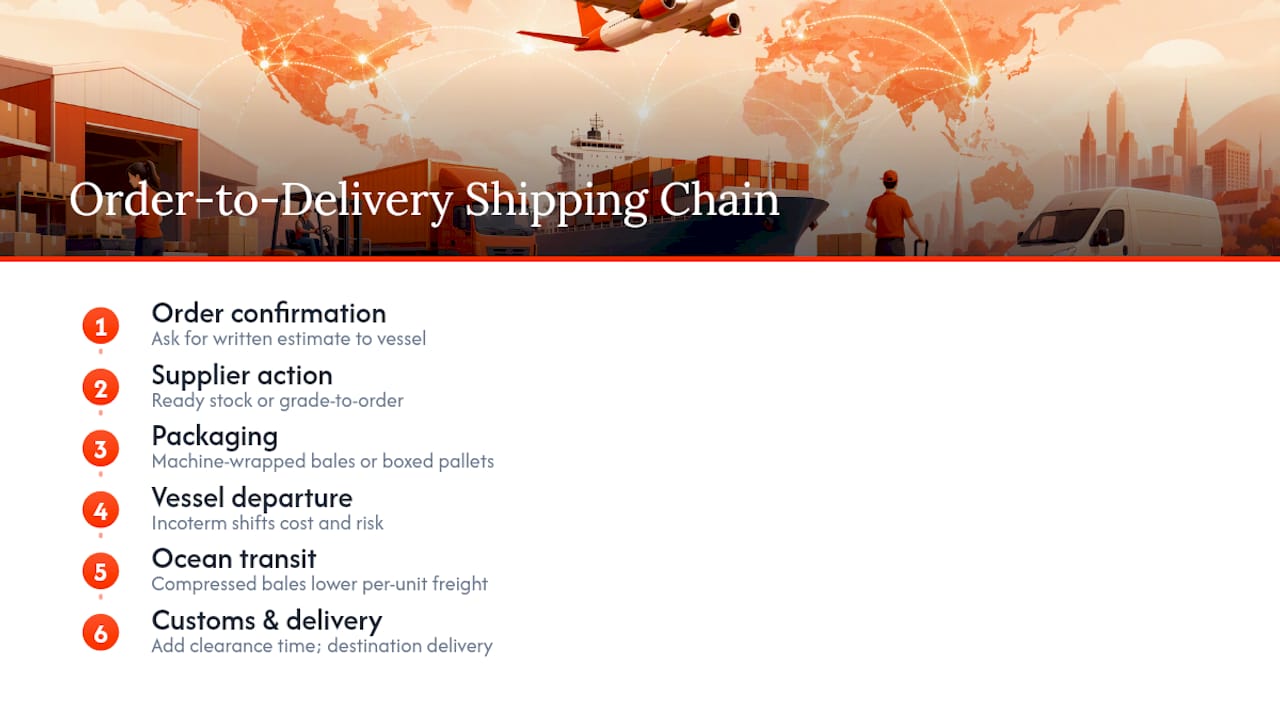
Confirm your Incoterm early, since FOB, CIF, and EXW shift cost and risk responsibility at different points in the shipping chain, and a misunderstanding here is one of the most common sources of disputes between first-time buyers and wholesale suppliers.
Reputable Supplier Types and Where They Operate
Geographic focus matters because freight cost and transit time are often bigger margin drivers than the purchase price itself.
European exporters, particularly those based in Poland and neighboring countries, tend to serve as consolidation points for Western European used clothing, then ship globally by container. Msexpspzoo operates from this region, running a 133,000 square foot warehouse and shipping to more than 40 countries, which gives buyers in Africa, the Middle East, Latin America, and Southeast Asia a single, high-capacity source rather than piecing together supply from several smaller regional traders.
North American liquidation and pallet vendors, like the retail liquidators supplying mixed apparel pallets, typically serve buyers within the same continent due to freight economics on lower-value, higher-volume loads. Textile recyclers tend to operate regionally too, since industrial rag and fiber-recovery lots are heavy relative to their value and don’t justify long-haul shipping unless bundled into larger export containers.
If your resale operation spans multiple continents, working with one or two high-capacity exporters that already handle worldwide logistics is usually simpler than juggling a dozen small regional contacts, each with different documentation standards and payment expectations.
Local Warehouses vs. International Suppliers vs. Online Marketplaces
Local warehouse buys give you the fastest turnaround and let you inspect stock in person, but volume and variety are usually limited to what one regional supplier happens to have on hand that week.
International suppliers, especially established exporters, offer far greater consistency and scale. You trade the ability to physically inspect goods before shipment for standardized grading sheets, sample bales, and photo documentation instead. This trade-off works well once you trust a supplier’s grading process, which is exactly why the vetting checklist above matters before you commit to a large international order.
Online marketplaces and liquidation platforms sit in between. They offer convenience and price transparency, but quality variance is higher since listings often represent lot categories rather than guaranteed grades. The ThredUp 2026 Resale Report notes that supply, not demand, is the primary constraint on resale market growth, which is a strong argument for locking in a reliable international partner rather than depending entirely on marketplace listings that can dry up without warning.
Payment Terms and Negotiation Tips
Standard payment structures in this trade run from full prepayment for smaller first orders to partial deposit plus balance on shipment or delivery for established relationships. Established exporters often ask for 30 to 50 percent deposit with the balance due against shipping documents, a structure that protects both sides once trust is built.
New buyers should expect to prepay smaller trial orders in full. This isn’t a red flag. It’s standard practice, and it’s your opportunity to test a supplier’s grading accuracy and shipping reliability before scaling volume.
When negotiating, price isn’t the only lever. Ask about flexibility on MOQ for a trial order, whether a sample bale can be deducted from the price of a full container order, and whether the supplier will lock in pricing for a fixed period if you commit to recurring shipments. Suppliers with efficient packaging operations and steady throughput are often more willing to negotiate on lead time than on price, since faster turnaround costs them less than a discount does.
Common Scams in the Used Clothing Wholesale Trade
The most common scam in this trade isn’t outright fraud. It’s misgrading: selling utility-grade stock labeled as graded or vintage. Always request a grading sheet in writing and compare it against sample photos before wiring a deposit.
Watch for suppliers who refuse a sample bale, won’t provide a contamination rate, or pressure you to wire full payment before sharing any documentation. Legitimate exporters with real warehouse operations rarely object to a buyer wanting proof before a first large order. Also be cautious with prices that sit far below the regional market rate for a stated grade. Secondhand clothing pricing tracks fairly closely with quality tier, and an outlier low price on a “premium graded” lot usually means the grading claim won’t hold up on arrival.
Payment fraud is another risk, particularly with new international contacts. Verify banking details through a second channel (a phone call, not just email) before wiring funds, since invoice interception scams targeting import payments are common across international B2B trade generally, not just secondhand goods.
Verifying Authenticity and Sustainability Claims
Sustainability claims are easy to make and hard to verify from a listing page alone. Ask a supplier directly where their stock originates, whether it comes from donation collection, industrial takeback programs, or brand partnerships, and whether they can document that chain.
Research on the international secondhand clothing trade makes clear that reuse alone doesn’t automatically guarantee a sustainable outcome; sourcing practices and downstream handling matter just as much as the fact that goods are secondhand. A supplier that can speak specifically to collection sources and sorting practices, rather than offering only broad marketing language about sustainability, is generally more credible.
For vintage or branded lots, ask how the supplier screens for counterfeits during grading. Reputable graded-lot suppliers typically have staff trained to spot common counterfeit markers on labels, stitching, and hardware, and they’ll say so plainly when asked rather than deflecting the question.

Due Diligence Before You Sign
Before finalizing any supplier agreement, confirm four things in writing: the grading standard and contamination rate, the full commercial terms (price, MOQ, Incoterm, payment schedule), the shipping and customs documentation the supplier will provide, and at least one verifiable reference from an existing client.
Run a small trial order before committing to container volumes, even if the per-unit price is slightly worse than a bulk discount. The cost of a bad trial order is far lower than the cost of a bad container order. Keep a written record of every grading claim and price quote; if a dispute arises later over misgraded stock, that paper trail is what protects you.
Msexpspzoo’s Operational Strengths for Resellers and Importers
Buyers need proof, not promises. Msexpspzoo runs a 133,000 square foot warehouse and ships to more than 40 countries using advanced packaging machinery built for fast turnaround. The typical process is straightforward: request a quote, review a sample bale, confirm grading and packaging, then arrange shipping.
— rodrigues
How to Start Buying From Msexpspzoo
Once you’ve run through the checklist above, starting an order is simple. Msexpspzoo works the way most serious wholesale buyers want a supplier to work: fast quoting, real sample bales, and shipping capacity that doesn’t buckle when your order volume grows.
When you send your first inquiry, include your desired grade (graded, vintage, or utility), your estimated monthly volume, your preferred Incoterm, and whether you’d like a sample bale before committing to a full order. If clothing is your focus, start with the bulk used clothing page to see current bale categories and request a quote. Buyers specifically after footwear can go directly to the wholesale used shoes page, and anyone building mixed inventory with bags and small accessories should check the bric and brac category. A 133,000 square foot warehouse and shipping relationships across more than 40 countries mean your first sample request doesn’t sit in a queue for weeks. Reach out today and get a grading sheet and sample bale moving before you commit to a full container.
Sources
- Fashion re-commerce: a state-of-the-art review and future research agenda
- The International Second-Hand Clothing Trade: Contributions to Sustainability and the Circular Economy
- ThredUp’s 2026 Resale Report: Secondhand to Hit $393B by 2030