
The right replacement for Bankvogue isn’t a consumer resale app. It’s a vetted B2B wholesale exporter or vintage specialist that offers graded bales, consistent packing, and international logistics built for large orders. Consumer marketplaces solve a different problem entirely. The rest of this guide breaks down the supplier categories, how to vet one before you commit, and considerations around providers like Msexpspzoo.
TL;DR:
- Wholesale exporters with large warehouses and advanced baling equipment provide consistent, seasonally tailored stock suitable for large-scale resale operations.
- Consumer resale platforms are designed for individual buyers and lack the packaging, documentation, and grading standards needed for wholesale purchasing.
- Verifying supplier credentials through sample bales, clear grading standards, export paperwork, and references substantially reduces risks of quality and customs issues.
- Moving away from Bankvogue typically involves engaging with suppliers who offer full transparency, predictable inventory, and faster dispatch capabilities.
- Buyers should stagger initial orders, confirm grading accuracy, and calculate landed costs to avoid hidden expenses and ensure reliable supply chain management.
Table of Contents
- What are the main categories of Bankvogue competitors?
- Why consumer resale platforms rarely work for wholesale buyers
- How do you vet a wholesale secondhand supplier before ordering?
- Why a vetted wholesale exporter can replace Bankvogue at scale
- How do top alternatives compare on features, fees, and experience?
- What are the tradeoffs of each alternative for resellers?
- How do you choose the right alternative for your business size?
- What happens when resellers actually switch away from Bankvogue?
- What resellers get wrong about switching suppliers
- Ready to move past Bankvogue? Here’s how to start
- Where to verify this information further
- Sources
What are the main categories of Bankvogue competitors?
Buyers hunting for Bankvogue alternatives usually fall into one of five channels, and each one exists for a different reason. Knowing which lane you’re actually shopping in saves you from wasting weeks talking to the wrong kind of supplier.
- B2B wholesale exporters: Companies that buy sorted secondhand goods at volume and ship mixed or graded bales internationally. They are built for resellers who need repeat, predictable stock.
- Vintage-curation specialists: Smaller operations that hand-pick rare or branded pieces, priced per item or in small curated lots rather than by the bale.
- Liquidation and auction houses: Bulk lots sold as-is, often unsorted, where price beats predictability and buyers accept more risk on grading.
- Trade brokers: Middlemen connecting buyers to multiple mills or exporters, useful when you need volume but lack direct supplier relationships yet.
- Consumer resale platforms: Retail-facing marketplaces like eBay, Vestiaire Collective, Vinted, and Depop, built for individual shoppers, not bulk buyers.
If you’re scaling a resale business, wholesale exporters and vintage specialists are where the real supply lives. Auctions can undercut on price but demand more inspection work upfront. Brokers help you scale fast but add a markup layer between you and the source.
Why consumer resale platforms rarely work for wholesale buyers
A platform built for one shopper buying one dress isn’t built for a reseller buying 500 pounds of mixed inventory. That mismatch shows up in three places almost every time.
- Order size and packaging. Consumer sites list single items or small lots. There’s no bale structure, no export-ready packing, and no mechanism for negotiating a 1,000-piece order.
- Grading inconsistency. Peer-to-peer listings depend on individual sellers describing their own items. One “excellent condition” tag means something different from every seller, which turns quality control into guesswork.
- Missing paperwork. Bulk international shipments need commercial invoices, HS codes, and customs documentation. Consumer marketplaces aren’t built to generate any of it.
Consumer resale interest is real and growing — Vogue’s own roundup of top secondhand sites reflects that surge in shopper demand. But that demand describes a retail experience, not a wholesale pipeline. A platform can be popular with individual shoppers and still be the wrong sourcing channel for a business buying in volume. Consumer platforms operate on small-batch, retail-priced transactions; wholesale exporters exist specifically to move sorted bulk lots at the scale importers and resellers actually need.
How do you vet a wholesale secondhand supplier before ordering?
Every bad wholesale purchase traces back to a question that never got asked. Before you commit to a supplier, run through this list.
What to check:
- Sample bale availability before a full order
- Written grading standards (not just verbal claims about “grade A” quality)
- Recent, unedited photos of actual stock, not stock photography
- References from buyers who’ve ordered more than once
- Export documentation and any relevant certifications
- Clear sustainability or sourcing claims you can verify independently
What to ask directly:
- What’s the minimum order quantity, and can it scale with reorders?
- What’s the lead time from payment to dispatch?
- How is the bale packed, and what does landed cost include (freight, duties, port fees)?
- Can they provide export paperwork matching your country’s import requirements?
Calculate landed cost before you compare unit prices. A cheaper price per kilo means nothing if freight and duties eat the margin. Start with one sample bale, confirm the grading matches what was promised, then stagger your first few orders instead of committing to a full container.
Pro Tip: Never accept “trust us on the grading” as an answer. Ask for a grading breakdown by percentage (Grade A, B, cream, and off-grade) on the actual bale you’re buying, not a general company average.
Red flags: no sample policy, reluctance to share references, vague answers about documentation, and pressure to wire full payment before you’ve seen anything physical.
Why a vetted wholesale exporter can replace Bankvogue at scale
Buyers switching away from Bankvogue need a supplier that can actually handle volume, not just promise it. That comes down to warehouse capacity, packing infrastructure, and a track record of doing it consistently.
Msexpspzoo operates from a 133,000-square-foot warehouse in Poland and ships to more than 40 countries, giving buyers the kind of reach and inventory depth that a small curator or a peer-to-peer platform simply can’t match. Advanced baling machinery speeds up packaging turnaround, which matters when you’re trying to keep shelves stocked instead of waiting weeks on backordered lots.
What that translates to for a reseller:
- Consistent supply across seasons instead of one-off availability
- Faster dispatch thanks to on-site packing machinery
- Sorting tailored to category, whether that’s clothing, shoes, or accessories
- Verified quality standards backed by long-term partner relationships
Buyers evaluating any wholesale exporter should expect the same things: pre-sorting, market-aligned curation, and grading discipline that reduces returns downstream. That’s the standard large circular-economy groups have set for the industry, and it’s the bar Msexpspzoo works to meet on every order.
Long-term reseller relationships depend on bale preparation that matches the season and the market, not a generic mixed lot shipped the same way year-round. Suppliers who tailor sorting to a buyer’s actual sell-through reduce returns and build the kind of repeat business that keeps both sides profitable.
For buyers who need bulk, predictable inventory rather than one-off curated finds, that’s the case for treating a wholesale exporter as the direct Bankvogue alternative.
How do top alternatives compare on features, fees, and experience?
Pricing shapes vary more than most first-time buyers expect. Some suppliers price by the kilo across mixed bales, others by grade tier, and a few work on a flat container rate regardless of contents.
| Supplier type | Pricing shape | Typical turnaround | Buyer experience |
|---|---|---|---|
| B2B wholesale exporter | Per kilo or per bale, tiered by grade | Days to a few weeks depending on volume | Direct contact, sample bales, repeat-order relationships |
| Vintage specialist | Per item or per small lot | Days for small orders | High-touch but limited scale |
| Liquidation/auction house | Bid-based or fixed lot price | Variable, often fast | Lower price, higher inspection burden |
| Trade broker | Marked-up per unit | Depends on source supplier | Convenient but less price transparency |
| Consumer resale platform | Per item, retail pricing | Not built for bulk | Retail checkout, no bulk documentation |
Fees also differ in what they cover. A wholesale exporter’s quoted price usually bundles grading and packing labor into the per-kilo rate, while a broker’s markup sits on top of a base supplier price you may never see directly. Auction lots can look cheapest on paper until you factor in the time spent sorting through ungraded stock by hand.
User experience tracks closely with how much support you get post-purchase. Exporters with dedicated account contacts tend to resolve grading disputes and shipping delays faster than platforms where you’re one anonymous buyer among thousands.
What are the tradeoffs of each alternative for resellers?
Every sourcing channel trades something for something else. None of them win on every axis, so the right pick depends on what your business actually needs more of: price, predictability, or rarity.
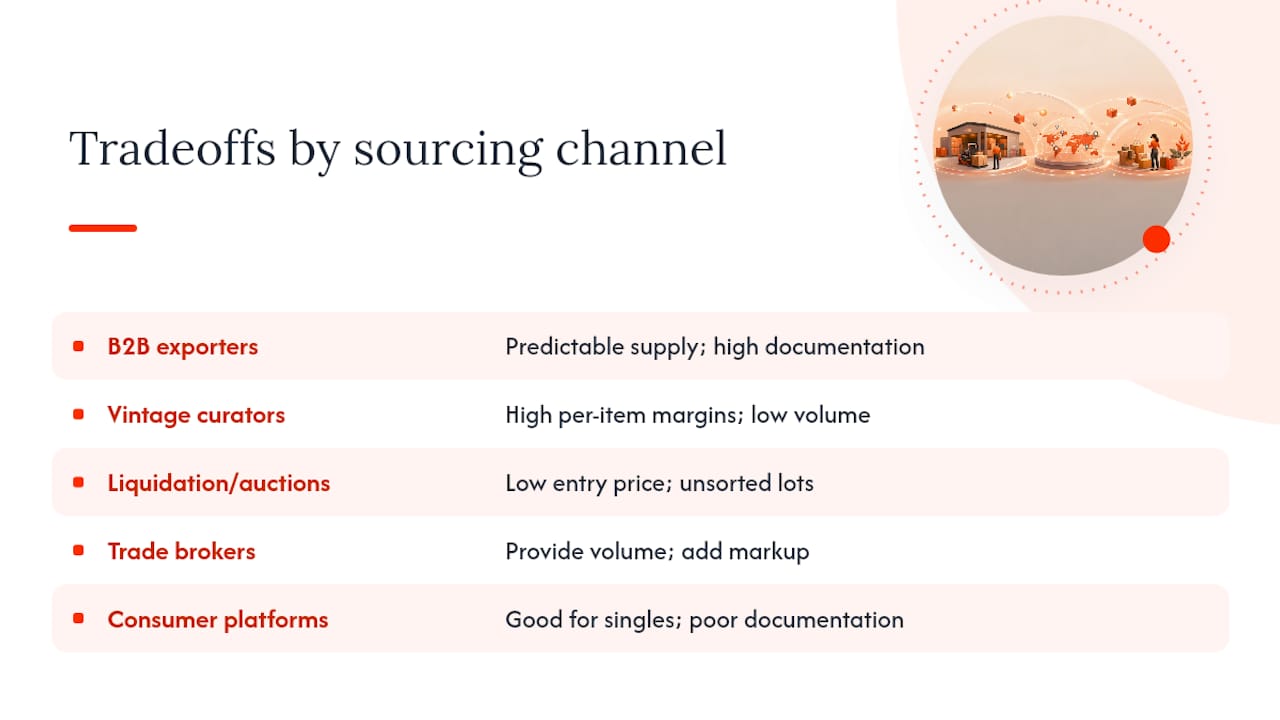
B2B wholesale exporters give you the most predictable supply and the clearest grading standards, but minimum order sizes can be a barrier for a brand-new reseller testing the waters.
Vintage-curation specialists deliver higher per-item margins on rare pieces, though volume is limited and restocking the same style twice is rarely possible.
Liquidation and auction houses offer the lowest entry price per lot, but you’re accepting unsorted or lightly sorted goods, which means more labor on your end before anything is sellable.
Trade brokers are useful for buyers who need volume without direct supplier relationships yet, though the markup on top of the base price cuts into margin over time.
Consumer resale platforms work fine for sourcing single unique pieces to resell individually, but they were never built to supply the volume or documentation a growing resale business needs, and treating them as a bulk channel almost always backfires on cost per unit.
The pattern that holds across all five: reliability and documentation improve as you move toward established wholesale exporters, while flexibility and per-item upside improve as you move toward smaller, curated channels.
How do you choose the right alternative for your business size?
A reseller running a single online storefront has different needs than an importer stocking three brick-and-mortar locations, and the right supplier match changes with that scale.
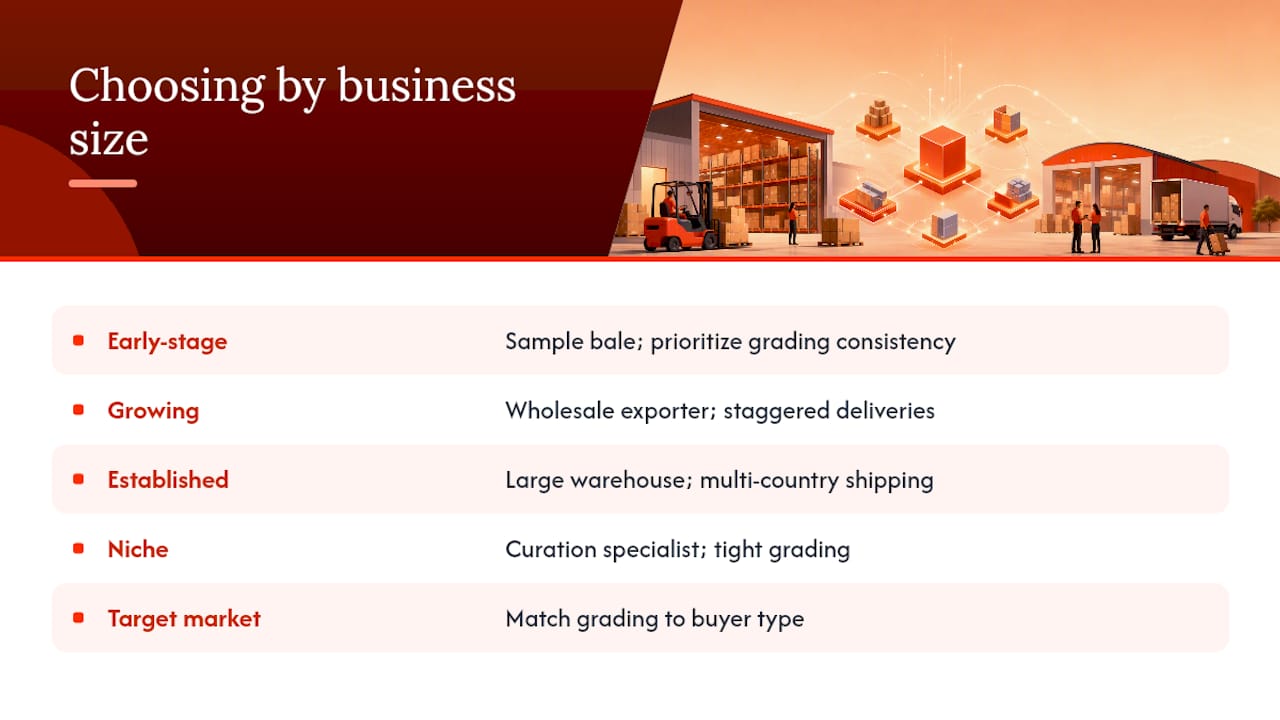
Early-stage resellers testing a new category should start with a sample bale from a wholesale exporter rather than jumping straight to auction lots. The grading consistency matters more than the marginal price difference while you’re still learning what sells in your market.
Growing resellers moving multiple bales a month benefit most from a wholesale exporter relationship with staggered delivery schedules, since that keeps cash flow manageable while building supplier trust for larger future orders.
Established importers stocking multiple markets or storefronts need a supplier with real warehouse depth and multi-country shipping experience, since a single missed shipment can stall inventory across several locations at once.
Niche or rarity-driven resellers targeting collectors or high-end vintage buyers are better served by curation specialists, even at lower volume, because rarity is the product, not scale.
Target market matters just as much as size. A reseller supplying budget resale storefronts needs consistent mixed-grade bales at low cost per kilo. A reseller supplying boutique vintage shops needs tighter grading and category-specific sorting, even if that means paying more per unit and ordering less often.
What happens when resellers actually switch away from Bankvogue?
Buyers who’ve moved away from a single-supplier setup consistently describe the same turning point: the moment they started ordering sample bales from more than one source before committing to a full container.
Resellers who’ve made that switch report fewer disputes over grading once they insisted on written standards upfront instead of accepting a verbal “grade A” promise.
The other common thread is documentation. Buyers moving into new import markets for the first time found that suppliers who provided complete export paperwork from the start avoided the customs delays that plagued their earlier, less formal sourcing arrangements. That’s consistent with how established circular-economy groups structure their partnerships, treating documentation and grading transparency as standard practice rather than an upsell.
Buyers who skipped the sample-bale step entirely, chasing a slightly lower quoted price, were the ones most likely to report inconsistent quality on arrival. The lesson holds across nearly every account of switching suppliers: verify before you scale, not after.
What resellers get wrong about switching suppliers
The biggest mistake I see isn’t picking the wrong supplier. It’s skipping the sample bale to save two weeks, then discovering the grading was inconsistent after committing to a full container.
Underestimating customs and duties comes second. Buyers price-compare per-kilo rates without factoring landed cost, then wonder why the “cheaper” supplier ended up costing more.
Smart resellers build habits around verification instead of trust. Request pre-shipment photos of the actual lot, not stock imagery. Stagger your first three or four orders before locking into a long-term contract. Ask for references from buyers who’ve ordered repeatedly, not just once.
None of this is complicated. It’s just easy to skip when a lower quote is sitting in front of you.
— rodrigues
Ready to move past Bankvogue? Here’s how to start
If you’re weighing consumer platforms, auction lots, and broker markups against each other, the simplest path forward is working directly with an exporter that already handles grading, packing, and international shipping under one roof. Msexpspzoo runs on that model: a 133,000-square-foot warehouse, advanced baling machinery for faster turnaround, and delivery to more than 40 countries, all without the minimum-order guesswork or unsorted risk that comes with auctions and brokers.
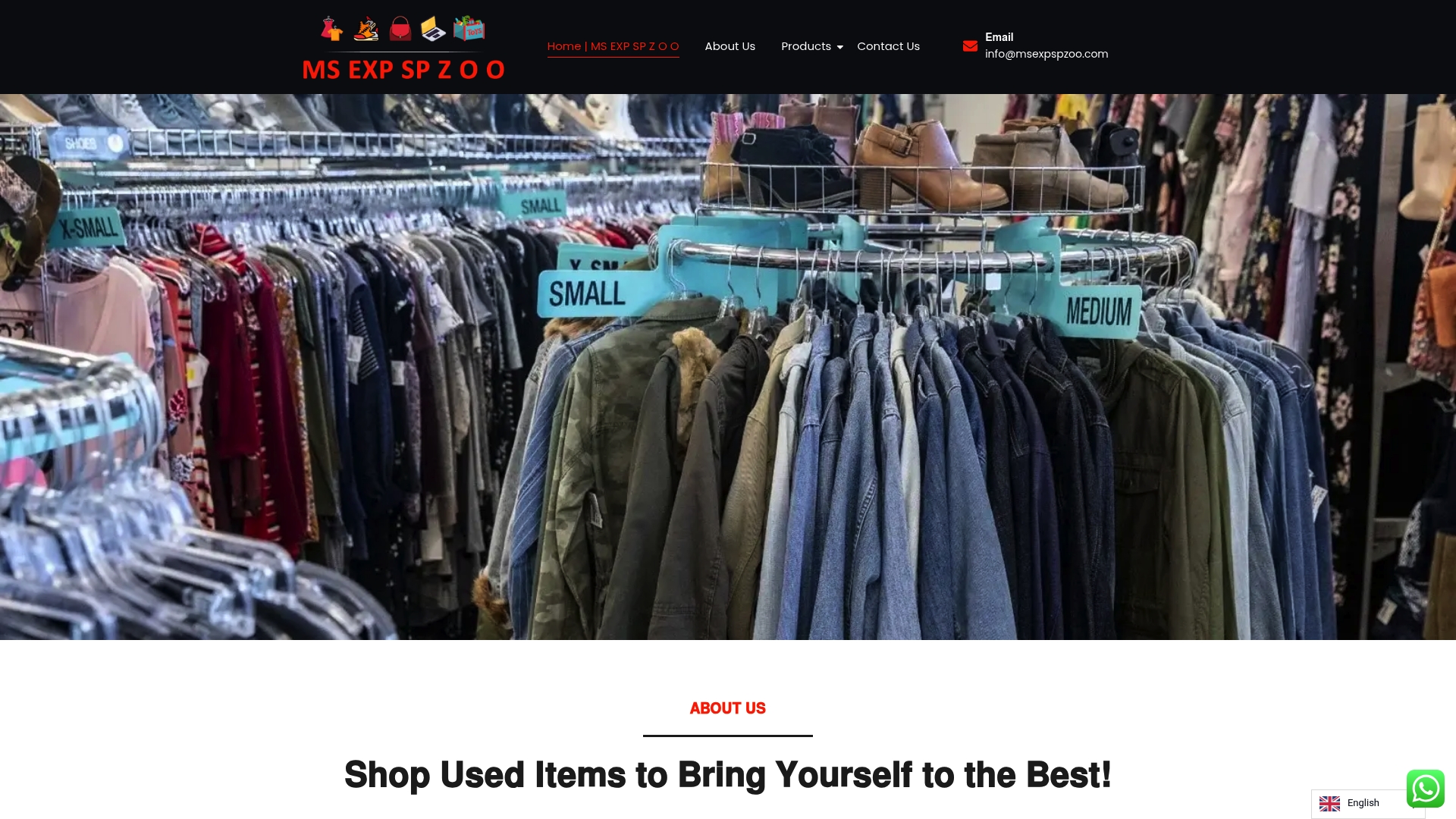
Whether you’re stocking a storefront with mixed apparel or filling out a footwear line, you can start with a focused category. Browse the used clothing export options for bale types and shipping details, or check the used shoes wholesale page if footwear is your priority. Request a sample bale first, confirm the grading matches what’s promised, and build from there.
Where to verify this information further
- Bank & Vogue Group of Companies: industry context on large-scale circular textile operations
- Vogue’s list of top secondhand sites: consumer resale platform examples for comparison
- Oxfam’s secondhand emissions research: sustainability impact of secondhand purchasing
- AeroLeads business directory listing: background reference for cross-verifying supplier claims
Sources
- Bank & Vogue Group of Companies | Department of Economic and Social Affairs
- 13 Of The Best Second-Hand Sites To Shop Online
- Shopping second-hand fashion would prevent harmful emissions, Oxfam
- Bank & Vogue Ltd/Ltée. Company Contacts: Email, Phone & Employees (AeroLeads)