
The fastest way to cut packaging waste is to stop buying packaging you don’t need, then reuse what remains before you recycle anything. That order matters: prevention and reuse consistently outperform recycling on cost and carbon, and the EU’s Packaging and Packaging Waste Regulation now backs that hierarchy with law, requiring all packaging to be recyclable in an economically viable way by 2030.
For sustainability managers and procurement leads, packaging waste reduction breaks down into four levers: eliminate unnecessary packaging, scale reuse and refill systems, design for recyclability with recycled-content targets, and optimize supply-chain packaging so materials aren’t wasted before a product ever reaches a customer.
Start this month with three moves:
- Audit your top two or three SKUs for empty space, mixed materials, and unnecessary layers.
- Set a baseline KPI (packaging mass per unit shipped) before you change anything.
- Open a conversation with your top three packaging suppliers about recycled-content specs and reporting.
Key Takeaways
Reducing packaging waste requires prevention and reuse first, regulatory compliance with PPWR deadlines, and measurable KPIs tracked from a documented baseline.
| Point | Details |
|---|---|
| Prevention beats recycling | Eliminate unnecessary packaging and scale reuse before optimizing recycling programs. |
| PPWR sets hard deadlines | All packaging must be recyclable in an economically viable way by 2030 under EU law. |
| Measure before you redesign | Baseline packaging mass, empty-space ratio, and recycled content before setting targets. |
| Upstream changes pay off fast | Removing dividers and unitizing shipments cuts material without added cost. |
| Verify recycled-content claims | Use certifications like ISCC Plus so supplier declarations hold up under audit. |
Table of Contents
- Strategic Principles: Prevention First, Then Reuse, Then Recycle
- Regulatory Overview: What the EU PPWR Requires and When
- Corporate Examples Worth Copying
- Design, Materials, and Upstream Packaging Tactics
- Measurement and Targets: The KPIs That Actually Matter
- Procurement and Supplier Engagement
- Client Case Spotlight: Packaging Efficiency in Bulk Export
- End-of-Life Options Beyond the Recycling Bin
- Ready to Reduce Packaging Waste in Your Supply Chain?
- Why Most Packaging Advice Undersells Reuse
- Sources
Strategic Principles: Prevention First, Then Reuse, Then Recycle
The waste hierarchy is not a suggestion. Prevention beats reuse, and reuse beats recycling, because every step down the chain still consumes energy and infrastructure. A shipping carton you eliminate saves more than one you recycle perfectly.
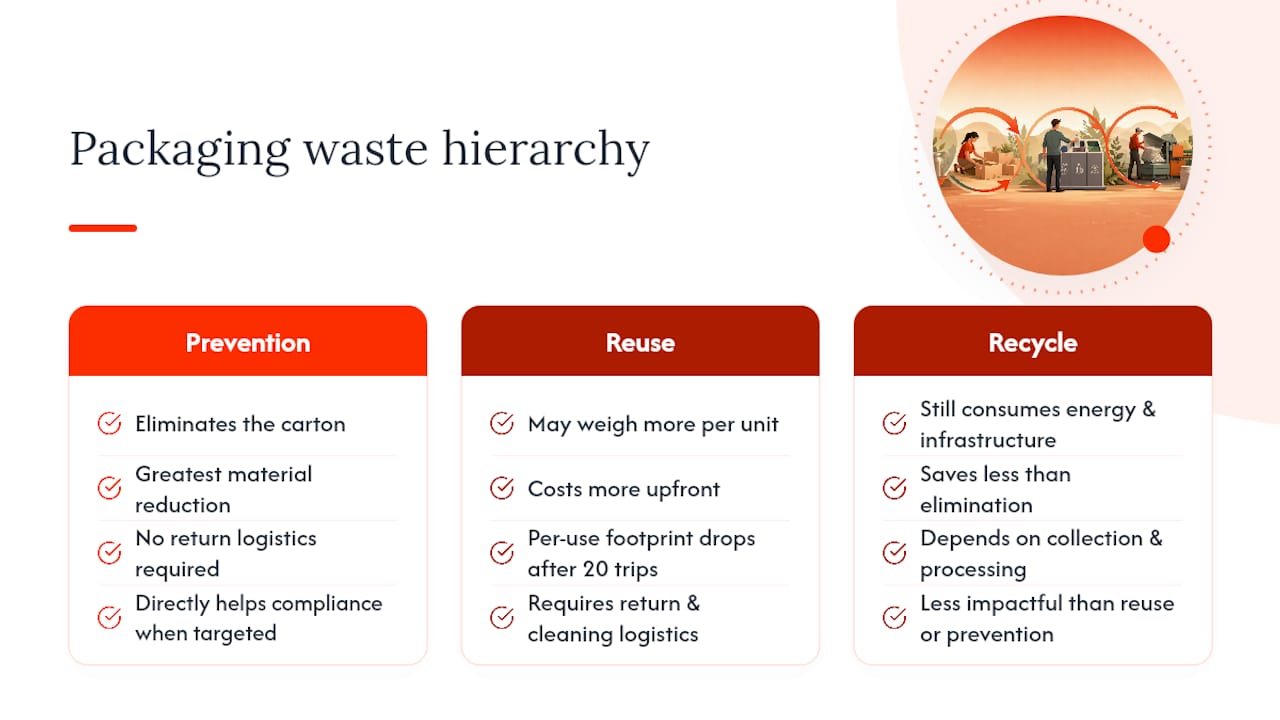
Lifecycle thinking complicates the picture slightly. A reusable container might weigh more per unit and cost more upfront, but if it survives 20 trips before disposal, its per-use footprint collapses below single-use alternatives. The trade-off only pays off if the reuse loop is actually closed, which means logistics for return and cleaning need to exist before you commit capital.
Prioritize levers by three factors: material volume affected, feasibility within your current operations, and how directly the change maps to a compliance deadline. A packaging change that hits your highest-volume product line and satisfies an upcoming regulation should always jump the queue ahead of a smaller, feel-good project.
Pro Tip: Run a two-week prioritization sprint on just two to four product lines. Pull current packaging specs, weigh empty space, and rank changes by tons of material saved per year. You’ll usually find one or two “obvious” fixes that were never actioned simply because nobody owned the decision.
Regulatory Overview: What the EU PPWR Requires and When
The PPWR became applicable across the EU on August 12, 2026, and its core obligations reshape how manufacturers, importers, and exporters design and document packaging.
- Recyclability by 2030: all packaging placed on the EU market must meet defined recyclability criteria.
- Recycled content targets: phased minimums for plastic packaging apply through 2030 and tighten further by 2040.
- Reuse and refill availability: certain sectors, including food and beverage, face specific reuse-system requirements.
- Empty-space limits: e-commerce and grouped packaging face restrictions on empty-space ratio.
- Labelling and reporting: harmonized labelling rules and stricter recycled-content documentation take effect on a phased schedule.
Companies should schedule design reviews now, update labelling systems ahead of enforcement dates, and start collecting supplier evidence for recycled-content claims before auditors ask for it. Cross-border exporters face a layered challenge: packaging compliant in one market may not satisfy another jurisdiction’s rules, so documentation systems need to track origin-specific requirements, not just a single EU-wide standard.
Corporate Examples Worth Copying
You don’t need to invent new tactics. Large operators have already tested most of them at scale, and the ones that stuck share a common trait: they cut material without adding cost.
- Remove inner dividers and consolidate components. Manufacturers have cut upstream packaging waste by redesigning inner packaging to eliminate dividers and combine parts that used to ship separately, reducing both material and handling steps.
- Automate box-sizing. On-demand box-sizing equipment measures each order and cuts a correctly sized carton on the spot, which shrinks void space and cuts the volume of filler material needed per shipment.
- Pilot reuse and deposit-return systems. Retail and food-service operators running refill stations and deposit-return loops for containers have shown that reuse infrastructure works at commercial volume, not just in pilot programs, when the return logistics are designed in from the start.
Design, Materials, and Upstream Packaging Tactics
Design for recycling starts with material simplicity. Single-material packaging, water-soluble or easily separable label adhesives, and components that split apart without tools all raise the odds that packaging actually gets recycled rather than landfilled because a sorting facility couldn’t separate it.
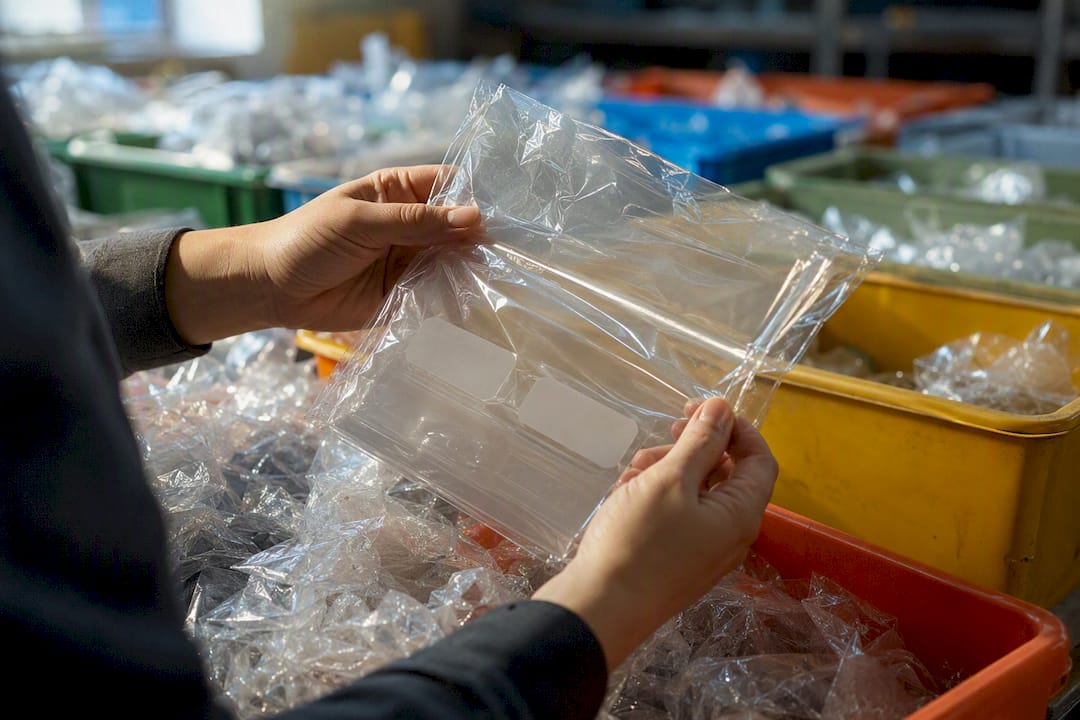
Material substitution deserves a caveat. Biopolymers like PBAT and natural-fiber alternatives to plastic wrap can cut persistent plastic waste in bulk operations such as agricultural baling, but they carry durability trade-offs, including faster degradation in outdoor storage. If you switch, plan for compensating protective layers or revised storage practices rather than assuming a drop-in replacement behaves identically.
Traceability matters just as much as the material choice itself. When you claim recycled content to a buyer or auditor, certification like ISCC Plus provides the chain-of-custody documentation that makes the claim defensible.
Right-sizing tactics:
- Measure your actual empty-space ratio per SKU before setting a target.
- Deploy automated box-sizing or a tiered carton matrix instead of one-size-fits-all shipping boxes.
- Compare paper- and plastic-based void fill on cost, weight, and recyclability, not just price per unit.
- Unitize shipments and reuse transit packaging like pallets and crates instead of single-trip protective wrap.
Pro Tip: Before switching to a “greener” material, ask your supplier for real-world durability data under your actual storage and transit conditions. A material that performs beautifully in a lab test can fail in a humid warehouse, forcing you to add packaging back in, which erases the gain.
Measurement and Targets: The KPIs That Actually Matter
You cannot manage what you don’t measure, and packaging waste reduction has a small set of metrics that cover most of what matters.
- Packaging mass per unit shipped
- Percentage of packaging designed for recyclability
- Percentage recycled content, verified against supplier declarations
- Reuse take-up rate for any refill or deposit system
- Empty-space ratio per shipment
- Packaging-related Scope 3 emissions
| KPI | How to establish a baseline |
|---|---|
| Packaging mass per unit | Weigh a representative sample across top SKUs before any redesign. |
| Recyclable-by-design % | Audit current packaging against single-material and separability criteria. |
| Recycled content % | Collect supplier declarations and cross-check with ISCC Plus certification where claimed. |
| Empty-space ratio | Measure void volume against product volume for e-commerce shipments. |
Set time-bound targets against these baselines rather than vague aspirations. “Cut packaging mass per unit 15% within 18 months” is auditable. “Reduce packaging waste” is not.
Procurement and Supplier Engagement
Procurement teams hold more leverage over packaging waste than almost anyone else in the organization, because packaging specs get written into contracts long before a product ships.
- Write recyclability and recycled-content clauses directly into supplier contracts, specifying minimum percentages and labelling requirements rather than leaving them as informal expectations.
- Build a supplier scorecard that includes design-for-recycling checks, empty-space limits, and periodic sample testing against your stated specs.
- Share redesign costs. Offer co-funding or multi-year volume commitments in exchange for a supplier’s investment in lower-waste packaging tooling, since most redesign resistance comes down to who eats the upfront cost.
Client Case Spotlight: Packaging Efficiency in Bulk Export
Msexpspzoo operates from a 133,000 square foot warehouse in Poland and ships baled second-hand goods, shoes, wiping rags, and vintage items to buyers across more than 40 countries.
- Advanced baling machinery compresses and wraps goods tightly, cutting the packaging material needed per unit of product moved.
- Unitizing large volumes into standardized bales reduces individual protective wrapping compared to shipping loose or small-batch goods.
- Warehouse scale allows faster turnaround, so packaging materials aren’t held or re-wrapped multiple times before reaching a buyer.
…
End-of-Life Options Beyond the Recycling Bin
Recycling gets most of the attention, but it sits near the bottom of the waste hierarchy for good reason: it’s often the most resource-intensive way to keep material in circulation. Circular economy thinking asks a different question first: can this packaging or product be used again in its current form before it’s broken down at all?

For bulk goods and textiles, resale and reuse markets do exactly that. Second-hand clothing, footwear, and industrial rags extend a product’s working life without the energy cost of remanufacturing. But that benefit only materializes if resale actually displaces new production rather than simply adding extra consumption on top. Research on second-hand fashion estimates a displacement rate of roughly three new purchases avoided for every five second-hand items bought, which means resale strategies need to track displacement, not just resale volume, to claim a genuine environmental benefit.
Composting, chemical recycling for mixed materials, and take-back schemes round out the end-of-life toolkit for packaging that truly can’t be reused. But the sequencing still holds: exhaust reuse options, including reused transit packaging and bale wrap, before defaulting to recycling or disposal. Retailers running e-commerce operations can find practical waste-reduction methods for reducing packaging inefficiencies at the point of sale useful alongside upstream sourcing changes.
Ready to Reduce Packaging Waste in Your Supply Chain?
Every tactic in this guide, from right-sizing to reuse pilots, works better when your upstream inputs already carry less packaging waste built in. That’s the advantage of sourcing bulk goods through operations designed around unitization and efficient wrapping from the start. Msexpspzoo ships wholesale used clothing and used footwear in optimized bales to buyers in more than 40 countries, backed by a 133,000 square foot warehouse and machinery built for fast, material-efficient turnaround. If your procurement team is evaluating suppliers on packaging efficiency as part of your PPWR readiness, request a quote to see how bulk baling compares to your current inbound packaging footprint.
Why Most Packaging Advice Undersells Reuse
Most corporate sustainability content treats recycling rates as the finish line. That’s backwards. The PPWR itself signals where policy is heading: toward reuse targets and empty-space limits, not just better sorting bins. Companies that build reuse infrastructure now, while it’s still optional in most categories, will have systems in place before mandates force a rushed retrofit.
The bigger blind spot is measurement discipline. Plenty of organizations announce packaging goals without ever establishing a real baseline, which makes every subsequent claim unverifiable. Sustainability managers should treat a packaging mass audit the way finance treats a balance sheet: unglamorous, but the thing everything else gets checked against.
The second-hand and resale sector deserves particular scrutiny here. Displacement research is a useful gut check for anyone marketing packaging or product circularity as inherently sustainable. Volume isn’t the same as impact, and packaging waste reduction claims that skip that distinction don’t hold up under real scrutiny.
Prioritize the boring stuff first: baseline data, contract language, and supplier scorecards. The flashy material innovation matters less if nobody can prove the numbers moved.
Sources
- New EU rules on packaging enter application
- New packaging rules: less waste and easier recycling
- When ‘sustainable’ fashion backfires on the environment
- Rethinking supply chain packaging to reduce upstream waste