
FOB (Free On Board) means the seller loads your clothing onto the vessel at the origin port, and you take over freight, insurance, and everything after that. CIF (Cost, Insurance, and Freight) means the seller pays ocean freight and buys minimum insurance to your destination port, but here’s what trips up most buyers: risk transfers to you the moment goods clear the ship’s rail at origin under either term. CIF doesn’t protect you from loss during the ocean crossing. It just means the seller arranged and paid for the freight and a thin insurance policy.
For most apparel importers doing repeat business with a freight forwarder, FOB is often preferred as it provides pricing control and the ability to shop freight rates. CIF can be more suitable for one-off orders or shipments backed by a letter of credit that require a bundled cost structure.
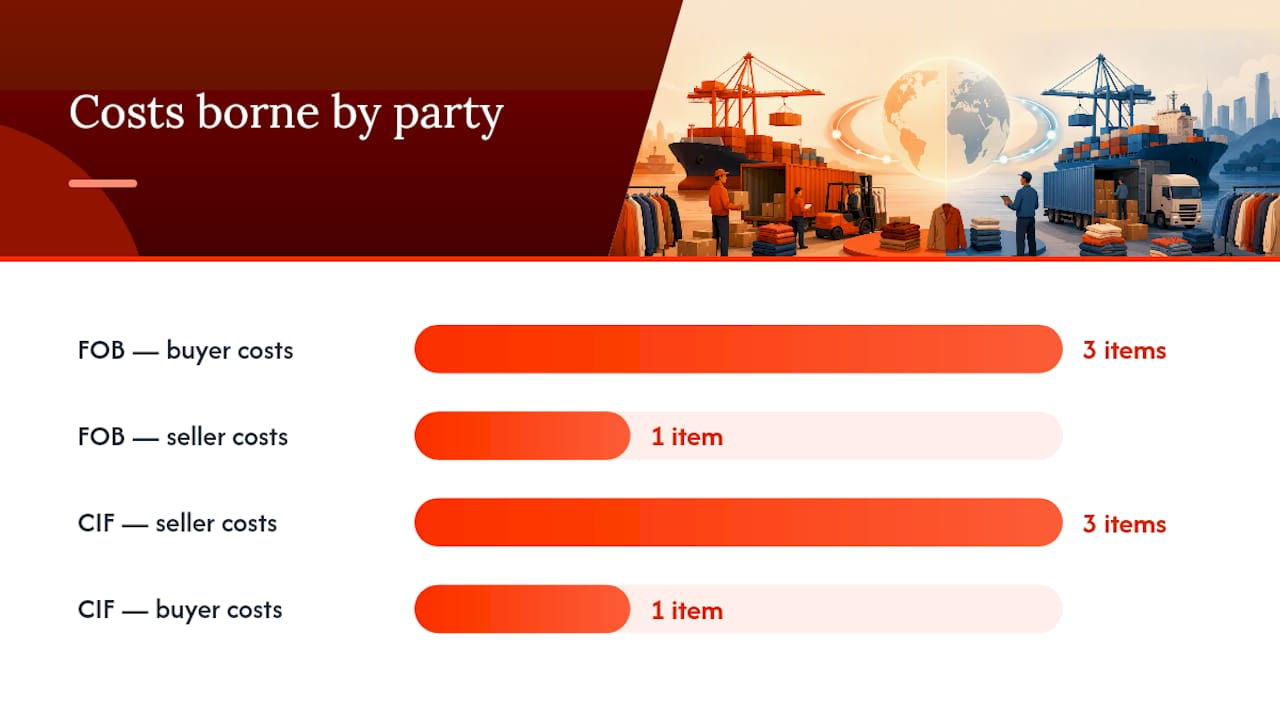
- FOB: buyer arranges and pays ocean freight, insurance, and import clearance
- CIF: seller arranges freight and buys Institute Cargo Clauses C insurance, but risk still shifts to you at origin loading
- Rule of thumb: if your forwarder can beat the supplier’s CIF quote by roughly 15%, take FOB
Key Takeaways
FOB gives apparel importers better freight control and cost transparency, while CIF’s bundled convenience often hides markups that erase its apparent simplicity.
| Point | Details |
|---|---|
| Risk transfers the same way | Under both FOB and CIF, risk shifts to the buyer once goods are loaded at origin. |
| FOB suits repeat importers | Buyers with a forwarder relationship typically get better rates and more control over insurance. |
| CIF’s insurance is minimal | Clause C often excludes moisture, mold, and theft, the most common apparel claim types. |
| Run the 15% test | Compare your forwarder’s freight and insurance quote against the supplier’s CIF price before choosing. |
| Sourcing quality matters too | Msexpspzoo’s export packing and documentation practices are built to support clean FOB handoffs for bulk clothing buyers. |
Table of Contents
- What FOB Means for Your Clothing Shipments
- What CIF Means for Your Clothing Shipments
- FOB vs CIF Clothing: Costs, Risk, and a Real Example
- How to Choose Between FOB and CIF for Your Clothing Business
- Common Pitfalls With Clothing Containers
- MS EXP SP Z O O’s Role in Making FOB Work
- FOB vs CIF for Clothing Brands: Which to Use and Why
- Source Quality Clothing Starts With Better Sourcing
- FAQ: FOB vs CIF Clothing
- Sources
What FOB Means for Your Clothing Shipments
Under FOB, the seller’s job ends at the rail of the ship in the origin port. They handle export packing, trucking the goods to port, customs clearance for export, and loading the cargo on board. Everything after that, ocean freight, marine insurance, import clearance, and last-mile delivery to your warehouse, is on you.
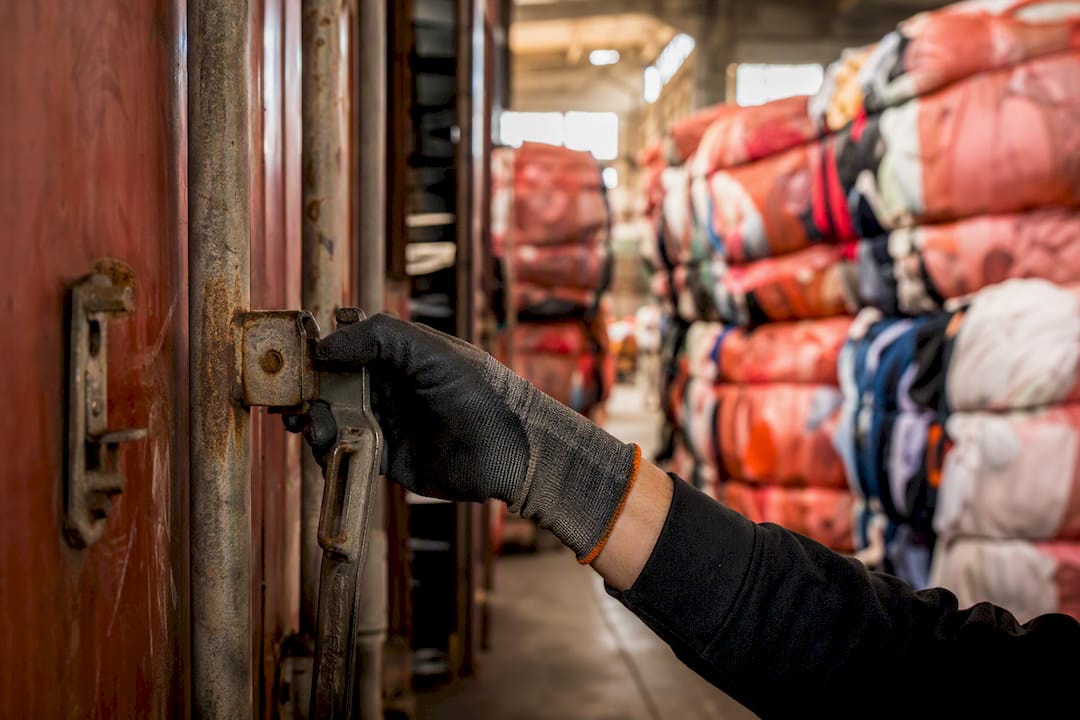
That handoff point matters more for clothing than for most cargo categories. Garments are moisture-sensitive, prone to shifting inside a container, and vulnerable to theft at transshipment hubs. Buying FOB means you control who packs the container and how, which lets you insist on desiccant packs, proper carton stacking, and a stuffing supervisor if the order is large enough to justify one.
- Seller responsibilities: export packing, inland trucking, export customs, loading on board
- Buyer responsibilities: ocean freight booking, marine insurance, import clearance, destination trucking
- Documentation you should demand: packing list, commercial invoice, bill of lading, and loading photos to support any future claim
Pro Tip: Ask your supplier for time-stamped photos of the container stuffing process. If a claim ever comes up over water damage or shortage, those photos are often the difference between a paid claim and a dead end.
What CIF Means for Your Clothing Shipments
CIF looks like the easy button. The seller pays ocean freight and buys minimum marine insurance to your destination port, and you get one number to plan around instead of five separate line items. But the part that catches new importers off guard: risk still transfers to you the second the cargo is loaded at origin, not when it arrives at your port. If the container floods mid-voyage, you’re the one filing the claim, not the seller.
The insurance bundled into a CIF quote is usually the cheapest policy available, Institute Cargo Clauses C, which covers only major casualty events like sinking or collision. It typically excludes the everyday damage that actually happens to garments: moisture intrusion, mold, theft, and rough handling during transshipment.
- Seller pays: ocean freight and a Clause C insurance premium
- Buyer still owns: the risk of loss from origin loading onward
- Common trap: CIF quotes often bury a freight markup and destination handling fees that only surface once the container arrives
CIF can be operationally convenient when your business lacks a forwarder relationship or when you’re placing a single trial order and don’t want to manage freight logistics yourself.
FOB vs CIF Clothing: Costs, Risk, and a Real Example
Run the two terms side by side and the risk-transfer point is identical, whether you buy FOB or CIF, you’re exposed to loss from the moment goods go on board at origin. What changes is who pays for what and who controls the rate negotiation.
| Cost Item | FOB | CIF |
|---|---|---|
| Export packing & inland trucking | Seller | Seller |
| Ocean freight | Buyer negotiates and pays | Seller pays, often marked up |
| Marine insurance | Buyer’s choice of coverage | Seller buys minimum Clause C |
| Destination charges (THC, customs entry, haulage) | Buyer, itemized | Buyer, sometimes hidden in the quote |
The insurance gap is the part apparel buyers underestimate most. Clause C excludes water damage, theft, and most handling losses, exactly the failure modes that hit clothing containers most often. Professional importers frequently buy Clause A or a supplemental policy to close that gap, whether they’re buying FOB or CIF.
Pro Tip: Before accepting a CIF quote, ask the supplier for the actual insurance certificate, not just a line item labeled “insurance.” If it says Clause C, budget for a top-up policy separately.
Here’s a worked example: a supplier quotes CIF at $4,200 per 40-foot container, freight and insurance included. Your forwarder quotes ocean freight alone at $2,850, plus $180 for Clause A cargo insurance. That’s $3,030 versus the freight-and-insurance portion the supplier is charging inside that CIF number, often $3,600 to $3,800 once their margin is baked in. FOB frequently gives buyers better cost control specifically because CIF pricing tends to hide freight markups and destination charges that don’t show up until the container clears port.
How to Choose Between FOB and CIF for Your Clothing Business
Run through this checklist before your next purchase order goes out:
- Order frequency. One-off or trial order? CIF removes a logistics headache you don’t need to solve yet. Repeat containers every month? FOB pays off fast.
- Forwarder relationship. No forwarder yet? CIF is the reasonable interim choice. Already have one quoting you rates? Use them.
- Cargo sensitivity and value. High-value apparel, leather goods, or anything moisture-sensitive justifies the extra control FOB gives you over packing and insurance.
- Payment method. Letters of credit often favor CIF because banks like a single bundled cost figure tied to the documents.
- Supplier logistics capability. Some factories run efficient freight desks with real carrier relationships. Others just mark up a freight forwarder’s rate and add margin.
The numeric test that settles most debates: get a quote from your own forwarder and compare it against the supplier’s CIF price. If the gap is smaller than that, or your forwarder can’t match the supplier’s service level, CIF isn’t costing you much and saves you the coordination work.
Pro Tip: When you request Clause A coverage instead of the default Clause C, ask your forwarder for a per-container premium quote up front. It’s usually a small percentage of cargo value and cheap insurance against a very expensive problem.
Common Pitfalls With Clothing Containers
Garments fail in transit in predictable ways: condensation inside a sealed container, torn cartons from rough handling, and pilferage at transshipment ports. Clause C insurance won’t cover most of it, which is why apparel importers who ship regularly usually buy Clause A or a supplemental policy on top.
There’s also a technical wrinkle worth knowing: ICC guidance actually recommends FCA over FOB for containerized cargo, because container shipments are typically handed to a carrier or forwarder at a container yard, not loaded ship-side the way FOB technically assumes. Factories still quote FOB out of habit, so clarify the exact handover point in your contract to avoid disputes later.
- Insist on desiccant packs and moisture barrier bags for any ocean shipment
- Request supervised container stuffing on larger orders
- Keep pre-shipment inspection photos and documentation on file for every claim
MS EXP SP Z O O’s Role in Making FOB Work
Choosing FOB only pays off if your supplier can execute the origin-side work cleanly, and that’s where sourcing quality matters as much as the Incoterm itself.
- Ships to more than 40 countries with established export documentation practices
- Operates 133,000 square feet of warehouse space for consistent bale supply and fast turnaround
- Uses advanced baling machinery that speeds up packaging without compromising moisture protection
Fast, clean export packing is the difference between an FOB shipment that arrives claim-free and one that generates a dispute over damaged cartons three weeks later.
FOB vs CIF for Clothing Brands: Which to Use and Why
Most guides on this topic treat FOB and CIF as a coin flip between “control” and “convenience.” That framing undersells the real issue for apparel: the insurance gap. Clause C, the default under most CIF quotes, was written for cargo that doesn’t rot, mold, or attract thieves at a transshipment port. Clothing does all three.
The FCA nuance gets skipped in almost every generic comparison, too. If your factory quotes FOB for a container shipment, ask exactly where the goods change hands. Technically, container cargo should move under FCA terms, but the industry hasn’t caught up to that distinction, and contracts still say FOB out of habit.
My honest read: skip the philosophical debate and run the math. Get your forwarder’s freight and Clause A insurance quote, then compare it against the supplier’s CIF number. Anything closer than that, take CIF and stop overthinking it.
Source Quality Clothing Starts With Better Sourcing
Getting your Incoterms right solves the shipping math, but it doesn’t fix a bad supplier relationship. Msexpspzoo exports used clothing, shoes, and accessories to partners in more than 40 countries, with export packing and documentation already built for FOB workflows, so the handoff at origin is clean instead of a guessing game.
If you’re placing repeat container orders and want a supplier who packs to reduce moisture and shipping damage before the goods ever reach your forwarder, that’s exactly the friction Msexpspzoo’s export process is built to remove. Bulk buyers sourcing used clothing can browse current inventory and request a quote directly, and buyers looking to diversify a container with footwear can check the wholesale used shoe supply as well. For coordinating destination-side logistics once your container lands, freight and logistics planning resources can help you line up a forwarder before your next order ships.
FAQ: FOB vs CIF Clothing
Is FOB or CIF better for clothing imports?
FOB is usually better once you have a working forwarder relationship, since it gives you control over freight rates and insurance coverage. CIF works fine for one-off orders or letter-of-credit transactions.
Does risk transfer at the same point under both terms?
Yes. Risk transfers to the buyer when goods are loaded on board at origin under both FOB and CIF. CIF only covers who pays for freight and minimum insurance, not who bears the risk during transit.
What insurance does CIF actually include?
Most CIF quotes include Institute Cargo Clauses C, the minimum tier of marine coverage. It typically excludes moisture damage, theft, and handling losses, so apparel importers often buy a supplemental policy.
Why do factories quote FOB for container shipments if FCA is technically correct?
Habit, mostly. ICC guidance recommends FCA for containerized cargo because containers are usually handed to a forwarder before vessel loading, but the industry has been slow to switch its default terminology.
How much does a forwarder need to beat a CIF quote by to justify switching to FOB?
A gap of roughly 15% in your forwarder’s favor, factoring in ocean freight and comparable insurance coverage, is generally enough to justify the switch to FOB.
Sources
- CIF vs. FOB: Key Differences in International Shipping (Investopedia)
- Incoterms® 2020 (ICC)
- FOB vs CIF: Differences, Costs and Risk (Hisourcing)