
A compliant packing list for wholesale used clothing exports itemizes bale IDs, grade, net and gross weight, and matches the numbers on the commercial invoice and bill of lading. Pack in bulk bales, not retail-ready bags. That last detail matters more than most buyers realize: goods sold under HS code 6309 must show “appreciable wear” and arrive in bulk packaging, or customs can bump the shipment into a higher-duty apparel chapter.
At minimum, your packing list needs to name:
- Seller and buyer (full legal names and addresses)
- Invoice number and shipment date
- Carrier, transport mode, and port details
- Bale counts, net weight, and gross weight per bale
- Unique bale ID numbers tied to grade and lot
Msexpspzoo has built and shipped these documents for buyers in more than 40 countries, and this guide reflects what actually clears customs versus what gets flagged for inspection.
Key Takeaways
A compliant used-clothing export packing list works only when its bale IDs, weights, and grades match the commercial invoice and bill of lading exactly.
| Point | Details |
|---|---|
| Core fields required | List seller, buyer, invoice number, shipment date, carrier, bale counts, and net and gross weights. |
| Bale-level detail wins disputes | Unique bale IDs, grade codes, and photo sets settle questions before they become customs holds. |
| Pack in bulk, never retail bags | Retail-style packaging risks reclassification out of HS 6309 into higher-duty chapters. |
| Cross-check every document | Packing list, invoice, and bill of lading must show identical bale counts and weights. |
| Msexpspzoo builds this in | Every bale shipped carries an ID, grade, weight, and photo record before it leaves the warehouse. |
Table of Contents
- Packing List Template and Fields for Used Clothing Exports
- How Do You Itemize and Label Bales Correctly?
- Which Documents Have to Match the Packing List?
- What Packing and Labeling Practices Prevent Customs Problems?
- How Do You Finalize an Export Packing List Step by Step?
- What Mistakes Should You Avoid on a Used Clothing Packing List?
- What Tools Help You Build an Export Packing List Efficiently?
- How Should Packing List Data Connect to Inventory and Logistics?
- A Publisher’s Perspective on Getting This Right Every Time
- How Msexpspzoo Simplifies Your Bulk Used Clothing Sourcing
- Frequently Asked Questions
- Sources
Packing List Template and Fields for Used Clothing Exports
Every export packing list for used clothing needs two layers of detail: the shipment-level header and the bale-by-bale breakdown. Skip either one and you’re gambling with customs clearance.
The header section should carry the same information buyers see on the invoice. That means seller and shipper name and address, buyer or consignee details, the invoice or purchase order number, shipment date, the carrier’s name, transport mode (ocean, air, or road), and origin and destination ports. This mirrors what Trade recommends, and it’s the first thing a customs officer or freight forwarder checks against the bill of lading.
The bale-level section is where most sloppy paperwork falls apart. Each line should include:
- Bale ID or number (unique, never reused)
- Grade or lot code
- Short content description (“mixed summer wear, appreciable wear”)
- Bale unit count and, where required, item count
- Net weight and gross weight in kilograms
- Dimensions, if the buyer’s customs authority requires them
- Packaging type (bulk bale, not retail bag)
- Marks and seal numbers
Note the clothing’s condition honestly. Buyers and customs agents both look for language confirming “appreciable wear,” the standard that keeps goods classified under HS 6309 instead of getting reclassified into a general apparel chapter with steeper duty.
Pro Tip: Never let a supplier ship used clothing in retail poly bags to “look tidy” for the buyer. Retail-style packaging is one of the fastest ways to trigger reclassification into Chapters 61 through 64, which erases your margin before the container even clears port.
How Do You Itemize and Label Bales Correctly?
Bale-level detail is what separates a document customs trusts from one that gets flagged. The system needs to be simple enough that a warehouse worker can apply it consistently, and specific enough that a customs officer or buyer can verify it against the physical bale.
- Assign a unique bale ID. Combine a sequential number, grade code, and packing date (for example, “US0347-A-0214” for bale 347, grade A, packed February 14). Use the same ID on the physical bale tag, the packing list, and any photos.
- Apply a consistent grade code. Common categories include Grade A (clean, minimal wear, resale-ready), Grade B (moderate wear, still resalable), and mixed or “cream” grades that combine both. The grade tells the buyer what handling and pricing to expect before the bale is even opened.
- Weigh net and gross separately. Net weight covers the clothing itself; gross weight includes wrapping and strapping. Record both, and set a tolerance (many exporters use plus or minus 1 to 2 kilograms per bale) so small scale variances don’t trigger disputes.
- Attach a bale summary sheet. A one-page summary listing every bale ID, grade, and weight gives the buyer’s broker something fast to check against the container.
Bulk bales with clear, photographed markings settle disputes before they start, supporting the importance of ethical manufacturing practices in sustainable clothing supply chains. A photo set showing bale tags and seal numbers, paired with a matching bale summary, gives your buyer’s broker something concrete to check against the container rather than taking your word for it.
Pro Tip: Photograph every bale ID tag at the point of sealing, not after loading. Once bales are stacked in a container, you can’t get clean photos of the ones buried in the middle, and that’s exactly the bale a buyer will ask about if there’s ever a dispute.

Which Documents Have to Match the Packing List?
The packing list doesn’t work alone. Customs officers and freight forwarders cross-check it against three other documents, and any mismatch slows clearance or invites inspection.
Start with the commercial invoice. It needs to state the same bale counts and weights as the packing list, describe the goods’ condition (that “appreciable wear” language again), and reference HS 6309 if that’s the classification you’re claiming.
Next is the bill of lading. A B/L records the parties, cargo description, weight, package count, ports, and shipping terms, and the carrier generates it directly from your shipping instructions. If your packing list says 480 bales and your shipping instructions say 475, the carrier’s B/L will reflect the wrong number and customs will ask why.
Depending on the destination, you may also need a certificate of origin, a fumigation or sanitary certificate, or import permits specific to that country’s textile rules.
Before anything ships, confirm whether the load counts as waste or non-waste under the destination’s rules. Used clothing sold for reuse is typically non-waste, but certain textile shipments require Basel Convention codes such as B3030, and getting that classification wrong can hold a container at port for weeks.
Ask the buyer early which of these documents their customs authority actually requires. It’s a five-minute email that saves a multi-day delay.
What Packing and Labeling Practices Prevent Customs Problems?
Good packing habits protect your margin as much as your paperwork does. A container that’s palletized poorly wastes cube space; a bale that’s mislabeled invites an inspection nobody wanted.
- Pack for the container type you’re using. A 40-foot high-cube can typically hold noticeably more bale volume than a standard 40-foot when floor-loaded correctly, so confirm with your forwarder whether palletizing or floor-loading suits your buyer’s unloading setup.
- Label every bale the same way. Bale ID, grade, weight, and seal number belong on a tag that survives the trip, not a sticker that peels off in humidity.
- Screen for contamination before sealing. Metal detection catches buttons, buckles, and stray hardware; a visual pass catches non-textile items that shouldn’t be in a used-clothing bale at all.
- Run a final QC pass and photo set before the container closes. This is your last chance to confirm bale counts match the packing list.
Textile exporters who sort loads to a consistent specification and remove contamination before shipping see fewer customs holds industry-wide, largely because inspectors can verify contents against paperwork without opening every bale.
How Do You Finalize an Export Packing List Step by Step?
Getting the document right is a sequence, not a single sit-down task. Rushing the last step is where most errors slip through.
Step 1: Gather bale-level data as bales are packed, not after the container is loaded. Weigh each bale immediately, assign its ID, and log the grade before it disappears into a stack.
Step 2: Draft the header section with seller, buyer, invoice number, carrier, and transport details pulled directly from the sales contract, not retyped from memory.
Step 3: Reconcile bale counts against the invoice. If the invoice says 500 bales and your warehouse log says 498, find the missing two before you finalize anything.
Step 4: Cross-check weights against your scale logs. Net and gross weights on the packing list should trace back to actual scale tickets, not estimates.
Step 5: Attach the photo set and bale summary sheet referenced by matching bale IDs.
Step 6: Send a draft to the buyer or their broker for a quick sanity check, especially on first-time shipments to a new destination.
Step 7: Lock the final version and issue it alongside the commercial invoice and shipping instructions on the same day, so all three documents carry identical figures.
Skipping the reconciliation step is the single most common reason a packing list gets rejected at the buyer’s end.
What Mistakes Should You Avoid on a Used Clothing Packing List?
Most rejected packing lists fail for a handful of repeat reasons, not exotic ones.
Mismatched totals top the list: the invoice says one bale count, the packing list says another, and the bill of lading says a third. Customs and brokers notice immediately, and the shipment sits until someone explains the discrepancy.
Vague content descriptions cause the next round of trouble. Writing “used clothes” with no grade, condition note, or reference to appreciable wear gives a customs officer no basis to accept HS 6309 classification, and it invites a manual review.
Retail-style packaging is a mistake that costs real money. A bale wrapped to look retail-ready, even with good intentions, risks reclassification into a higher-duty chapter and can erase the margin on an entire container.
Reused or duplicate bale IDs create confusion the moment a buyer tries to trace a specific bale back to a photo or a weight record. Skipping the photo set entirely removes your fastest way to resolve a dispute without a physical re-inspection. And guessing at destination document requirements instead of asking the buyer upfront is how shipments end up stuck at port waiting for a certificate nobody knew was needed.
What Tools Help You Build an Export Packing List Efficiently?
You don’t need custom software to produce a compliant packing list, but you do need a format that stays consistent across every shipment. A simple spreadsheet template, built once and reused, beats a fresh document typed from scratch each time.
The most efficient setup treats the bale-level data as a structured table: one row per bale, with columns for bale ID, grade code, net weight, gross weight, piece count, and a link to the corresponding photo filename. Export that table as a CSV and attach it alongside the formatted packing list PDF. Brokers and customs systems that accept machine-readable data can cross-check it far faster than they can parse a scanned paper form.
General spreadsheet tools like Google Sheets or Microsoft Excel handle this well for most exporters, especially with a locked template that enforces consistent column headers shipment to shipment. Larger operations sometimes move this into a warehouse management system that generates the packing list directly from scale and scanning data, which removes manual retyping errors entirely. Whatever you use, the goal is the same: one source of truth for bale data that feeds the packing list, the invoice, and your own inventory records without anyone re-entering numbers by hand.
How Should Packing List Data Connect to Inventory and Logistics?
A packing list that lives in isolation from your inventory system creates work twice: once to pack the container, and again to reconcile stock levels afterward. The fix is treating the packing list as an output of your inventory data, not a separate document.
When a bale is weighed and graded at packing time, that same entry should update your inventory count, not just the shipment paperwork. This keeps your warehouse records and your export documents pointing to the same numbers, which matters when a buyer questions a bale weight three weeks after the container has sailed.
On the logistics side, your freight forwarder needs the packing list’s bale counts and weights before they can finalize shipping instructions with the carrier, since those instructions are what the carrier uses to issue the bill of lading. Feeding accurate bale data into that process early, rather than finalizing it after booking, avoids the amendment fees and delays that come with correcting a B/L after the fact.
A Publisher’s Perspective on Getting This Right Every Time
Most packing-list guides treat this as a paperwork exercise. It’s not. It’s a verification system, and the exporters who treat it that way ship fewer disputed containers. Msexpspzoo runs this discipline across a 133,000-square-foot warehouse, serving buyers in more than 40 countries: every bale gets an ID, a grade, a weight, and a photo before it leaves the floor. That’s not bureaucracy. It’s what lets a buyer in another country trust a bale they’ve never physically touched.
How Msexpspzoo Simplifies Your Bulk Used Clothing Sourcing
Msexpspzoo builds the packing list discipline covered in this guide into every bulk order, so you’re not stuck cross-checking a supplier’s spreadsheet against their invoice after the fact. Every bale you buy from Msexpspzoo already carries a bale ID, grade code, and matching weight record before it ships.
That matters because a shipment that arrives with clean, matching documentation clears customs faster and gives you fewer surprises to explain to your own buyers downstream. Msexpspzoo’s 133,000-square-foot warehouse and advanced packaging machinery mean bales move from grading to container loading without the manual bottlenecks that cause weight discrepancies in smaller operations. Whether you’re sourcing mixed clothing bales, used shoes, or industrial wiping rags, the same bale-level documentation standard applies across every product line. Request a custom quote and see a sample packing list before your next container books.
Frequently Asked Questions
What is the difference between net weight and gross weight on a packing list?
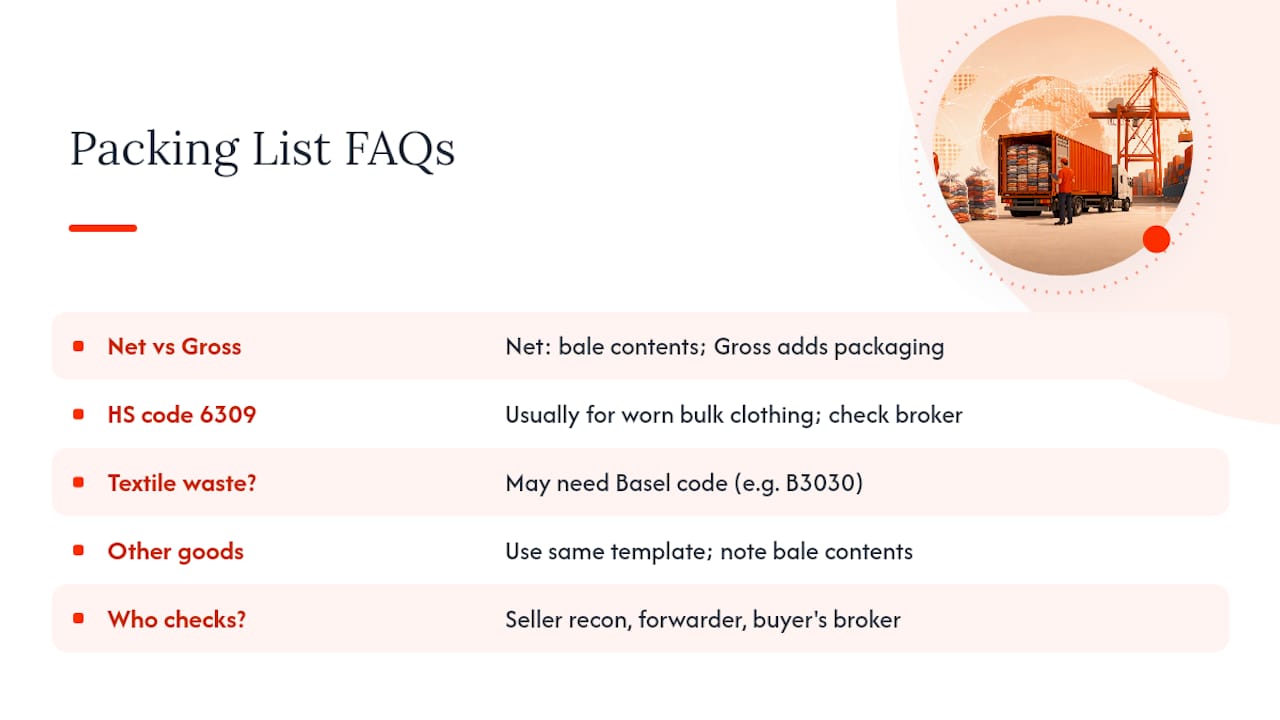
Net weight covers only the clothing inside the bale. Gross weight adds the packaging material, strapping, and wrapping. Both figures belong on the packing list, and customs officers use the difference to sanity-check whether a bale’s packaging matches its declared contents.
Does used clothing always need to be classified under HS code 6309?
Used clothing showing appreciable wear and packed in bulk typically qualifies for HS 6309, but classification depends on condition, packaging, and the destination country’s own customs rulings. Confirm requirements with your buyer’s broker before finalizing documents.
Do I need a separate certificate if my shipment counts as textile waste?
Possibly. Shipments classified as waste rather than reusable goods may require Basel Convention codes such as B3030, depending on the destination’s environmental import controls. Ask the buyer which classification applies before packing.
Can I use the same packing list template for shoes, bags, or mixed lots?
Yes, with adjustments. The header fields (seller, buyer, invoice, carrier) stay the same, but bale-level descriptions should reflect the actual contents, especially for mixed lots combining clothing with shoes or accessories.
Who typically catches errors on a packing list before shipment?
Freight forwarders and the buyer’s customs broker usually review the packing list against the invoice and shipping instructions before the container departs. Catching a mismatch on your end first, through your own reconciliation step, avoids the delay of a broker flagging it later.