
Verify the supplier’s legal identity, get a physical sample in your hands, and pay through an escrow service or letter of credit before any deposit leaves your account. Those three moves catch nearly every fraud attempt and most quality disasters before they cost you money. Used clothing supplier vetting isn’t complicated, but it has an order of operations, and skipping steps is how buyers end up with a container of moldy, mismatched bales and no way to get a refund.
Here’s what should stop you cold:
- No verifiable business registration or a mailing address that turns out to be a UPS box
- No willingness to send a sample before you commit to a bulk order
- Any request to pay a personal bank account or a name that doesn’t match the company
Fast fact: Bitdefender’s guide to vendor scams flags free email addresses and unverifiable physical addresses as two of the most common tells in fake supplier operations. Budget a few weeks for basic vetting, and expect to pay for the sample itself plus shipping. That’s the cost of doing this right.
Key Takeaways
Reliable used clothing supplier vetting depends on confirming legal identity, testing a physical sample, and paying through a secure method before any funds leave your account.
| Point | Details |
|---|---|
| Verify identity first | Confirm registration, legal name, and address against a national company registry before discussing price. |
| Sample before you scale | Request a spec-sheet sample and document grade, composition, and packing deviations before ordering bulk. |
| Call real references | Ask about delivery punctuality and how problems got resolved, not just general satisfaction. |
| Pay safely | Use escrow or a letter of credit for first orders, and treat sudden bank-detail changes as a fraud signal. |
| Consider a pre-vetted exporter | Msexpspzoo offers fast-turnaround bulk bales from a 133,000-square-foot warehouse serving over 40 countries. |
Table of Contents
- What Is the Standard Process for Used Clothing Supplier Verification?
- How Do You Confirm a Supplier’s Legal and Business Registration?
- What Should You Request Before Approving a Used Clothing Sample?
- Which Payment Terms and Contract Clauses Protect You?
- When Should You Walk Away From a Supplier?
- How Long and How Much Does Supplier Vetting Cost?
- Why Sourcing Track Record Still Beats a Perfect Checklist
- How Msexpspzoo Removes the Guesswork From Sourcing Bulk Bales
- Where to Verify Registration, Certifications, and Trade History
- Sources
What Is the Standard Process for Used Clothing Supplier Verification?
Run these checks in order, and don’t skip ahead because a supplier seems friendly on the first call.
- Legal and business checks (KYS). Confirm registration, legal name, and address before anything else.
- Request a sample. Get a physical bale sample, not photos, before discussing volume pricing.
- Call two or three references. Ask about delivery timing, consistency, and how they handle problems.
- Confirm payment and contract terms. Nail down deposit percentage, incoterms, and remedies in writing.
- Commission an audit for large orders. A remote video walkthrough or third-party inspection is worth the fee once you’re placing container-size orders.
Save copies of every registration document, sample photo, and email thread as you go. If a supplier hesitates at step two or three, that’s your answer.
Pro Tip: Keep a shared folder per supplier with registration screenshots, sample photos, and call notes. When you’re comparing five vendors at once, memory fails but a folder doesn’t.
How Do You Confirm a Supplier’s Legal and Business Registration?
Start with the national company registry in the supplier’s home country. Most jurisdictions publish a searchable database where you can confirm the registration number, the legal entity name, and the registered address against what the supplier gave you. If the name on their invoice doesn’t match the registry, ask why before you go further.

Certifications need the same scrutiny. Don’t take a supplier’s PDF certificate at face value. Verify it directly with the issuing body. IAF CertSearch and equivalent national registries let you check whether a certificate is active and tied to the correct entity, since forged or expired certificates are common enough to be a standard fraud vector.
For larger or recurring orders, add a beneficial-ownership check. Supplier due diligence frameworks recommend confirming who actually owns and controls the company, alongside sanctions and watchlist screening, because a shell company can pass a basic registry check while hiding who’s really running the operation, according to Visualping’s due diligence checklist.
- Registry search: legal name, registration number, address
- Certificate verification: confirm directly with the issuing body, never rely on a supplier’s copy
- Beneficial-ownership check: warranted for high-value or repeat orders
- Sanctions/watchlist screening: standard practice for cross-border trade above a modest order size
What Should You Request Before Approving a Used Clothing Sample?
A sample request needs a spec sheet, not a vague “send me a bale.” Specify the grade (cream, A grade, B grade, or mixed), the composition you expect (percentage of specific garment types), packaging density, and bale weight tolerance. Grading definitions and packaging expectations shift landed quality more than almost any other variable in used-clothing sourcing, so put them in writing before the sample ships.
- Build the spec sheet first. List grade, garment mix, weight range, and packing standard in plain terms both sides can point back to.
- Inspect systematically. Sort the sample by condition, check for odor or moisture damage, and count how many pieces match the promised grade versus how many don’t.
- Document every deviation. Photograph mismatches and note the percentage that falls outside spec, not just “some items were bad.”
- Escalate to a factory or warehouse tour for bigger orders. Workus AI’s supplier vetting framework recommends a remote video audit or in-person visit once order size or risk crosses a threshold you’d actually feel if the shipment failed.
A sample alone won’t tell you everything. It’s necessary, but pairing it with references and some visibility into how the supplier actually sorts and packs is what closes the gap.
Pro Tip: Ask for the sample to be packed exactly the way your bulk order would be, including the same strapping and wrapping. A “special” sample bale tells you nothing about what arrives in a container.
Which Payment Terms and Contract Clauses Protect You?
New suppliers should be paid through an escrow service or a letter of credit, not a wire to a personal account or an unfamiliar business name. A moderate deposit is standard for a first order; anything asking for full payment up front is a signal to slow down.
Your contract needs specs in writing (grade, composition, weight), an inspection clause that lets you reject non-conforming bales, clear remedies if quality fails, and agreed incoterms so nobody’s surprised by who pays for what once the shipment leaves the warehouse.
- Payment method: escrow or letter of credit for first orders, never a personal account
- Contract must include: specs, inspection rights, remedies, insurance responsibility, incoterms
- Fraud signal: a sudden change in bank details mid-negotiation, especially by email
- Fraud signal: pressure to skip the contract “because we trust each other”
Fast fact: verified bank details, a phone callback to a known number, and escrow protection are the three simple safeguards J.P. Morgan’s vendor-vetting guide points to as the most effective defense against the scams new buyers actually fall for.
When Should You Walk Away From a Supplier?
Some signals aren’t worth negotiating past. Stop the process when you see any of these:
- No verifiable registration or a physical address that doesn’t check out
- Refusal to sign a contract, or evasive answers when you flag a sample defect
- A request for payment through a personal account or a sudden bank-detail change
- A certificate that doesn’t verify when you contact the issuing body directly
One of these alone is a pause. Two together mean you end the conversation.
How Long and How Much Does Supplier Vetting Cost?
Standard vetting typically runs several weeks for most orders. Legal checks and reference calls take some days; the sample itself adds additional time once you count shipping.
| Vetting Step | Typical Duration | Typical Cost |
|---|---|---|
| Legal/registry checks | 1–3 days | Free to low cost (registry access fees) |
| Sample request and review | 5 days | Sample fee plus shipping cost |
| Reference calls | 1–2 days | No direct cost, staff time only |
| Third-party audit or video tour | 1–2 weeks | Inspection or audit service fee |
A quick legal check is enough for a small, low-risk trial order. Commission a full audit, including a factory or warehouse video tour, once you’re placing a container-size order or working with a supplier you’ve never bought from before. That’s the tiering logic worth building into your process from day one.
Why Sourcing Track Record Still Beats a Perfect Checklist
A checklist catches fraud. It doesn’t guarantee the bales you receive next month look like the sample you approved this month. That’s the part most vetting guides skip, and it’s the part that actually determines whether your resale margins hold up.
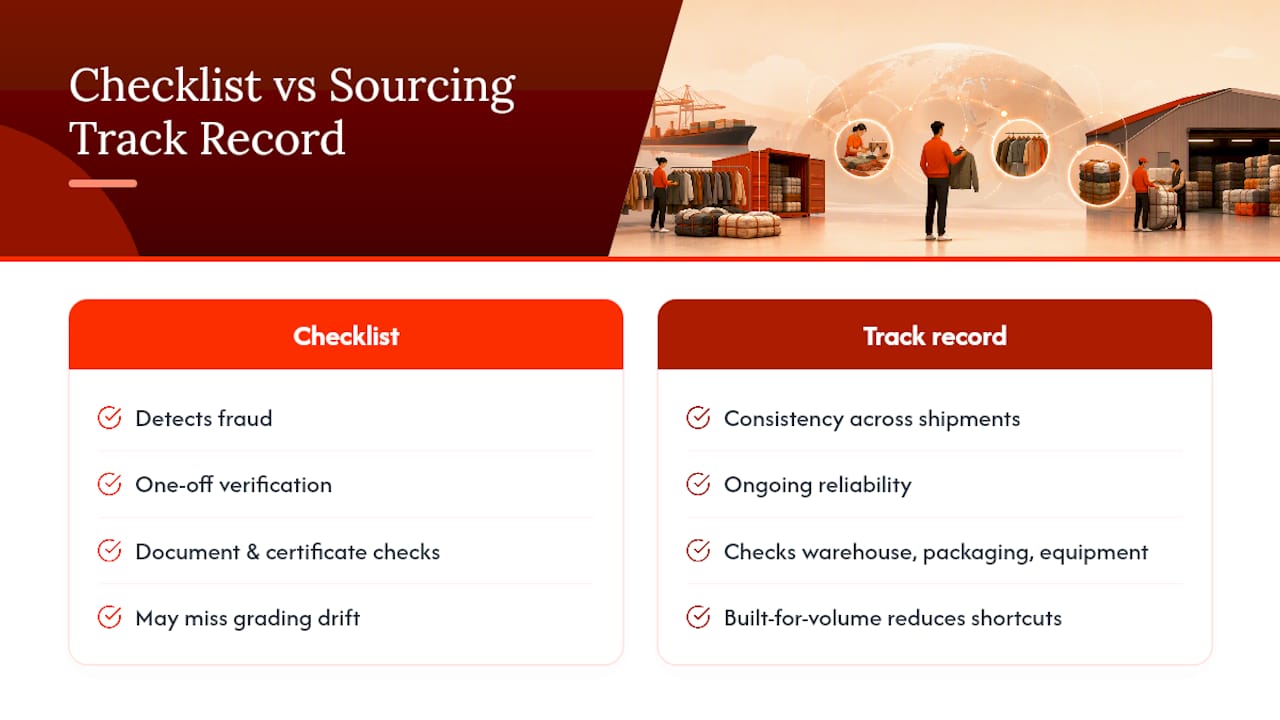
The gap between “verified supplier” and “reliable supplier” is consistency across shipments, not just the first one. A supplier can pass every legal and reference check and still drift on grading standards once volume increases, because sorting quality is a human process that degrades under pressure. That’s why pairing document checks with warehouse capacity and packaging infrastructure matters more than most buyers assume. A supplier running advanced baling equipment out of a facility built for volume is structurally less likely to cut corners under a rush order than one working out of a small back-room operation, simply because they’re not scrambling to meet demand they weren’t built for.
Buyers also underrate how much sustainability claims need scrutiny, not just quality claims. If a supplier markets itself around circularity or ethical sourcing, verify what’s actually behind that language the same way you’d verify a certificate, since circular economy framing gets applied loosely across this industry. The same goes for labor practices upstream in the collection and sorting chain, where ethical manufacturing standards are worth asking about directly rather than assuming.
— rodrigues
How Msexpspzoo Removes the Guesswork From Sourcing Bulk Bales
Msexpspzoo is the vetted supplier option for buyers who’d rather skip weeks of registry searches and cold reference calls. Operating from a 133,000-square-foot warehouse in Poland and shipping to more than 40 countries, the company runs advanced packaging machinery that keeps bale turnaround fast even on large repeat orders, whether you’re buying clothing, shoes, or industrial wiping rags.
Reaching out for sample photos and a turnaround estimate takes minutes, not weeks. If you’re building an inventory pipeline around bulk used clothing, request a quote directly and ask what grade options and packaging formats are available for your first order. It’s the fastest way to compare a real supplier against the checklist you just read.
Where to Verify Registration, Certifications, and Trade History
Confirm registration and certification claims directly with the source rather than trusting supplier-provided copies.
- National company registries for legal name, registration number, and address confirmation
- IAF CertSearch and equivalent bodies for certificate verification
- Structured due diligence templates like Visualping’s checklist for KYS and ownership checks
- Step-by-step vetting frameworks such as SourceReady’s guide for sample and visit protocols
Sources
References are worth calling, but only if you ask specific questions. Skip “were you happy with them” and ask instead: Did shipments arrive on the promised date? Did the grade match what was quoted? What happened the one time something went wrong?
- 10 tips to vet potential vendors & suppliers
- Supplier Vetting 101: Checks Every Buyer Should Run Before Ordering | Workus AI
- How to Vet Suppliers and Avoid Fake Vendor Scams | Bitdefender
- Supplier due diligence checklist (2026 template) | Visualping
- How to vet suppliers: a step-by-step guide | SourceReady
SourceReady’s step-by-step vetting guide frames reference checks and trade-history verification as steps that happen before you negotiate final terms, not after.