
The single action that preserves your remedies is this: quarantine the shipment, document the defects with photos and counts, and send the exporter a written notice that identifies the contract, the quantity affected, and what you found, before you touch or resell any of it. Skip this and you likely forfeit your right to a refund, replacement, or price reduction, even when the goods really are non-conforming.
TL;DR:
- Quarantine the shipment immediately upon arrival, photograph all defects with context and scales, and document counts before handling or reselling any goods.
- File a detailed, specific notice within one week of discovery, including contract info, defect type, affected quantity, and supporting photos or lab reports.
- Build a comprehensive evidence pack with labeled photos, sample counts, independent inspections, and a quantified cost estimate to support your claim.
- Focus on quick operational fixes for minor issues, while reserving legal escalation for high-dollar or recurrent problems, and always consider Incoterms before escalation.
- Use clear contract clauses requiring detailed grading specs, pre-shipment inspections, and defined notice procedures to prevent disputes before they occur.
Table of Contents
- What Counts as Non-Conformity in a Bale Shipment?
- The First 72 Hours: A Timed Receiving Checklist
- How Do You Write a Notice of Non-Conformity That Actually Works?
- Building an Evidence Pack That Survives Scrutiny
- Triage: Choosing Between a Quick Fix and a Legal Fight
- Contract Clauses That Prevent the Next Dispute
- What I’ve Learned Watching Buyers Handle Bad Bales
- How Msexpspzoo Helps You Avoid the Next Dispute Entirely
- Where to Verify This Before Your Next Shipment
- Sources
What Counts as Non-Conformity in a Bale Shipment?
Not every disappointing bale is a legal non-conformity, and knowing the difference determines whether your notice holds up. A defect qualifies when it deviates from what the contract or purchase order actually specified, not just from what you hoped to receive.
The most common categories in bulk used-clothing shipments include:
- Grade mismatch: you ordered Grade A and received a mixed load of A, B, and C stock, or the grading spec sheet doesn’t match what’s in the cartons.
- Contamination: mold, moisture damage, or pest activity, which differs legally from ordinary wear because it can render entire lots unsellable rather than just discounted.
- Shortages and wrong SKUs: missing cartons, incorrect item counts against the packing list, or weight discrepancies between the manifest and what actually landed.
- Missing inserts or accessories: belts, straps, or paired items called out in the spec but absent from the bale.
One distinction matters more than buyers realize: apparent defects (visible on unpacking) trigger the notice clock immediately, while latent defects (contamination that surfaces after storage, for instance) reset the clock to when you reasonably discovered them. Inconsistent grading is one of the leading causes of disputes in this trade, which is exactly why your notice needs to name the specific grade variance, not just “poor quality.”
The First 72 Hours: A Timed Receiving Checklist
What you do in the first three days after a container lands decides whether you have a claim or just a complaint. Treat receiving like evidence collection, not just warehouse intake.
- Quarantine immediately. Isolate the affected cartons or pallets in a separate zone. Tag their locations and do not mix them with conforming stock, even to “make room.”
- Photograph everything with context. Capture carton and bale ID numbers, wide shots showing the pallet as received, and close-ups of specific defects with a ruler or coin for scale and a visible timestamp.
- Sample and count. Pull a structured sample across multiple cartons, not just the top layer, and record exact counts so you can calculate a defect rate rather than describe a “bad shipment.”
- Preserve the paper trail. Save the bill of lading, proof of delivery, arrival receipts, and your own receiving log, since these prove the exact date you discovered the problem.
Pro Tip: Photograph the container seal number and truck arrival before opening anything. If a carrier or customs delay caused the damage, that seal photo separates the exporter’s liability from the shipping company’s.
Following this rhythm mirrors what practitioners recommend for handling quality problems the moment goods arrive: quarantine first, document second, notify third.
How Do You Write a Notice of Non-Conformity That Actually Works?
A vague email saying “the goods are defective” gets rejected more often than it gets honored. Tribunals and counterparties routinely dismiss notices that fail to identify what, exactly, was wrong and how much of the shipment it affected.
Your notice needs these fields, every time:
- Contract or purchase order number and the bill of lading or air waybill number
- Delivery date and the date you discovered the issue
- SKU or lot identifiers matching the packing list
- Affected quantity, stated as a count or percentage, not “a lot” or “most of it”
- A specific defect description for each category found (grade mismatch, contamination, shortage)
- The remedy you’re requesting: replacement, credit, price reduction, or partial refund
Send it through a channel that proves both timing and content: registered mail, email with a delivery or read receipt, or tracked courier. Under CISG Article 39, you must notify the seller within a reasonable time after discovery. Industry practice treats notification within about a week as a common benchmark for apparent defects, and the statute imposes a hard outer limit of two years regardless of when you found the issue. Buyers operating under the UCC face a parallel duty under Section 2-607, which similarly conditions your remedies on timely notice after acceptance. Attach your photos, the pre-shipment inspection certificate if one exists, your sample counts, and any lab report on contamination. A specific, timely notice is often what decides these disputes, not the underlying defect itself.
Building an Evidence Pack That Survives Scrutiny
Photos without identifying marks are close to worthless in a dispute. Every image needs to tie back to a specific carton, bale, or pallet so the exporter cannot claim you’re describing a different shipment or exaggerating scope.
Your sampling protocol matters just as much as your photos. Pull samples from a spread of cartons across the pallet, not a convenient handful from the top, and record your method alongside your counts. That combination lets you calculate a defect rate you can actually negotiate with, such as “14 of 50 sampled units showed mold contamination,” rather than an emotional complaint about a bad load.
- Photo set: carton and pallet IDs, wide context shots, close-up defect photos with scale and date
- Sampling log: sample size, selection method (random across cartons, not top-layer), and calculated defect rate
- Third-party verification: bring in inspectors like SGS or Bureau Veritas when contamination, mold, or hazardous-material claims need independent confirmation
- One consolidated file: PSI report, original packing list, bill of lading, receiving log, and a cost estimate for sorting, repacking, or disposal
That last item, a quantified cost table covering sorting labor, storage, and lost resale value, is what turns your claim into something negotiable rather than emotional. Buyers who show up with a number settle faster than buyers who show up with a grievance.
Triage: Choosing Between a Quick Fix and a Legal Fight
Not every dispute deserves the same response, and treating a minor shortage like a lawsuit wastes time you don’t have. Score each case on three factors: the dollar value at risk, how strong your evidence pack already is, and how much the supplier relationship is worth to your business long term.
- L1, operational fixes: small shortages or minor grade variances that a credit note, partial re-sort, or freight adjustment resolves within about 72 hours.
- L2, commercial negotiation: larger discrepancies where you negotiate a price reduction, replacement shipment, or rework agreement, typically closing within 30 to 60 days.
- L3, legal escalation: contamination claims, repeated bad-faith shipments, or high-dollar losses where arbitration or litigation becomes worth the cost and delay.
Triaging within 48 hours and routing most disputes to L1 or L2 resolves the bulk of cases without ever reaching a courtroom. Before escalating past L2, check your Incoterms: risk transfer points determine whether the carrier or the exporter actually bears liability for transit damage, which changes who your notice should target.
Contract Clauses That Prevent the Next Dispute
The cheapest dispute is the one that never happens, and that starts before the container ships, not after it arrives.
Push for written grading specifications with photo examples showing exactly what “Grade A” and “Grade B” look like, plus a stated acceptable variance rate for mixed grades. Require pre-shipment inspection from a mutually agreed inspector, with a defined sampling method and clear pass or fail criteria written into the purchase order. Lock in inspection windows, notice deadlines, and governing law upfront so nobody argues about “reasonable time” after the fact.
- Detailed grade specs with photo references and named variance tolerance
- Mandatory PSI with agreed sampling method and pass/fail thresholds
- Defined inspection windows and notice procedures tied to a named governing law
- Staged payments, holdbacks, or pilot lots tied to corrective-action commitments
Pro Tip: Ask for a pilot lot on any new supplier relationship. A modest test order with full pre-shipment inspection documentation reveals grading consistency long before you commit to a full container.
What I’ve Learned Watching Buyers Handle Bad Bales
Most disputes I’ve seen play out don’t end in arbitration. They end because one side documented faster and more specifically than the other, and specificity almost always wins the negotiation. A buyer who shows up with carton IDs, sample counts, and a dated notice has leverage a buyer with an angry phone call never gets.
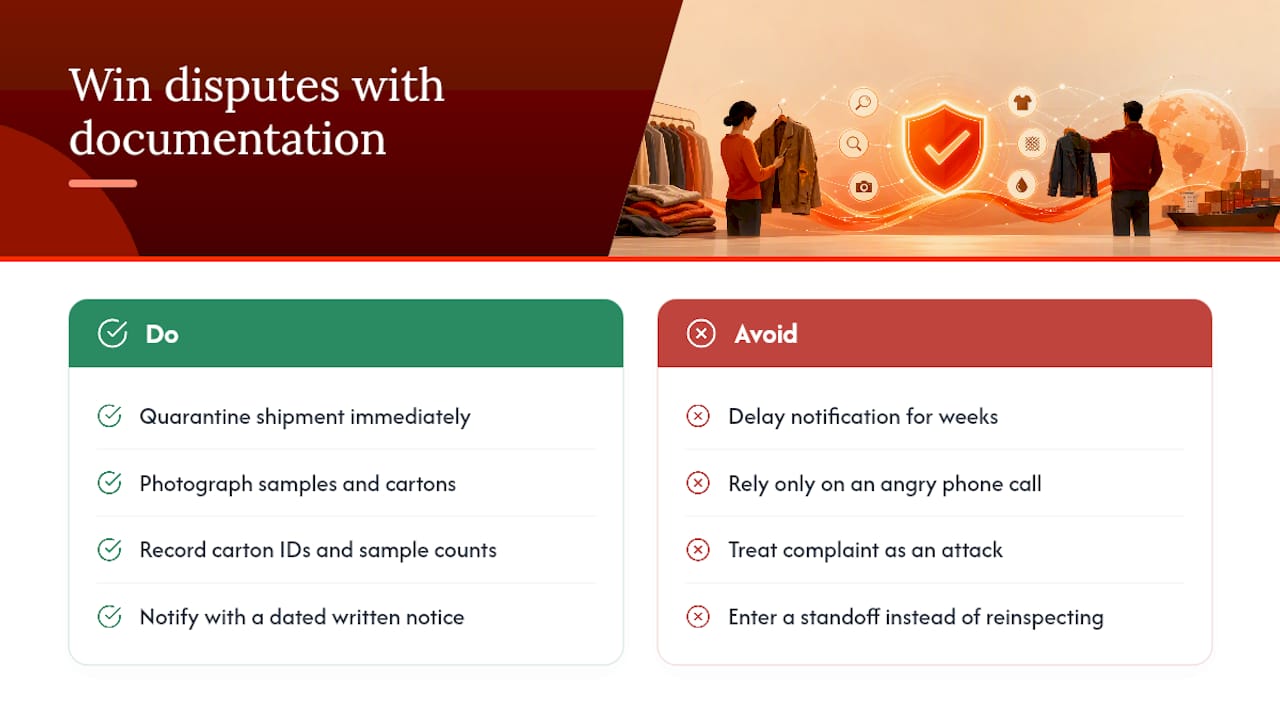
The exporters worth working with treat a documented complaint as useful information, not an attack. That’s the posture behind some operations: large warehouse space and packaging machinery built for fast turnaround exist partly so a re-sort or replacement shipment can move quickly when something genuinely went wrong. If you’ve got a shipment in dispute, the fastest path forward is usually a joint reinspection, not a standoff.
Buyers who build the habit of quarantine, photograph, and notify within days, not weeks, rarely need a lawyer at all.
— rodrigues
How Msexpspzoo Helps You Avoid the Next Dispute Entirely
The best dispute is the one you prevent at sourcing. Msexpspzoo ships documented grading sheets with every bale order, so you know exactly what “Grade A” means before the container leaves Poland, not after you’ve already unpacked a mixed load. Buyers who want proof before committing to volume can request a sample bale with full documentation attached.
Working across more than 40 countries means the company has developed its packaging and warehouse process around fast, accurate turnaround rather than volume alone. If a shipment issue does come up, that same infrastructure supports quick reinspection and rework instead of a drawn-out standoff. Browse the used clothing bale options to see current grading and packaging details, or reach out directly to discuss a trial order with documented grading and pre-shipment inspection coordination built in from the start.
Where to Verify This Before Your Next Shipment
The legal mechanics behind notice deadlines and remedies come straight from primary sources, and it’s worth reading the originals before you draft your next claim letter.
- CISG Article 39 commentary for the statutory notice requirement and two-year outer limit
- TransnationalMatters’ notice of non-conformity guide for what makes a notice specific enough to hold up
- Reevol Academy’s dispute management framework for the 48 hour triage model
- TradeAider’s post-arrival guide for warehouse-level receiving steps
- Independent inspection partners like SGS and Bureau Veritas for contamination or hazard verification
Sources
- CISG Article-by-article: Art. 39 CISG (notice of non-conformity)
- Notice of Non-Conformity: CISG Rules for Non-Conforming Goods — TransnationalMatters
- Post-Arrival Quality Problem Guide · TradeAider