
Importing used tyres comes down to three decisions: which legal category your tyres fall into, what your destination country allows in that category, and whether your supplier can document each shipment to match. Get those right and the container clears. Get one wrong and you face a refused entry, a permit problem or a reclassification as waste. We ship used goods in bulk from Poland to buyers in more than 40 countries, and our used tyres wholesale range is built for importers who need that paperwork to line up.
This guide is for businesses: importers, wholesalers, resellers and market distributors who buy tyres by the container. It is not for someone who needs a single tyre for their own car.
TL;DR
- Used tyres fall into three groups: part-worn tyres for re-use, casings for retreading, and end-of-life tyres. The first two sit under HS 4012, and end-of-life tyres sit under HS 4004 (rubber waste).
- Every destination sets its own rules. Some require a licence per consignment, some set tread or marking standards, and some regulate mainly through biosecurity inspection.
- A tyre treated as waste triggers a separate set of controls under the Basel Convention and national waste law. Classification decides which rules apply.
- Your commercial invoice should state tyre size, condition and quantity so customs can verify the classification.
- Choose a supplier that packs consistently, documents each shipment and understands your destination’s import requirements.
Table of Contents
- The three kinds of used tyre, and why the label matters
- What destination countries require
- Rules are changing for waste-classed tyres
- Documents you should expect to prepare
- How to import used tyres, step by step
- Choosing a supplier and counting the real cost
- Supplying used tyres in bulk
- FAQ
- Sources
The three kinds of used tyre, and why the label matters
Customs officers do not see “used tyres” as one product. The Basel Convention’s technical guidelines on used tyres (the international treaty framework on moving waste across borders) separate them into three groups:
- Part-worn tyres for re-use. These are legally used again for their original purpose. They need a minimum remaining tread depth, sound structure and compliance with the road specifications of the destination country. Some countries set 1.6 mm as the minimum for passenger car tyres.
- Casings suitable for retreading. These cannot go back on the road as they are, but a new tread can be vulcanised onto the casing. The guidelines refer to UN ECE R805 and R806 criteria for this.
- End-of-life tyres. These fail technical examination because of age or carcass damage and are treated as waste.
The first two groups fall under HS 4012 (retreaded or used tyres suitable for further use or retreading). End-of-life tyres fall under HS 4004, which covers rubber waste, parings, powders and granulates. If you are working out the code for a purchase order, our guide to the used tyres HS code 4012.20 walks through it.
The practical point: you want your shipment to be classified as goods for re-use or retreading, and your paperwork has to show why.
What destination countries require
There is no single global rulebook. The examples below, all from official pages, show how widely the requirements differ. Use them to understand the types of control you may meet, then confirm your own destination’s current rules with its customs authority before you order.
Licences and permits
Some countries control used tyres through a licence issued before shipment.
- Malaysia requires an import licence (AP) for each consignment of used tyres under six listed tariff codes. According to the Malaysian guidelines, only qualifying retreaders may import them and other purposes are prohibited.
- Lithuania uses non-automatic licensing for used vehicle tyres “good for exploitation and restoration”. The WTO import licensing entry says there are no quantitative or value limits, but the importer must submit a registration certificate, the export contract, a storage-site chart, a statement on collection of end-of-life tyres and prior quality-check acts.
- Singapore requires a CCMD(Basel) permit in TradeNet before importing, exporting or transiting controlled used tyres. The NEA product code list gives specific codes for car, bus and lorry, aircraft, motorcycle and bicycle tyres, and advises submitting declarations at least five working days before movement.
- Switzerland subjects used-tyre imports and exports to authorization by its environment office. FOEN states that only tyres with sufficient profile depth and suitable for reuse may be classified as goods and exported without that authorization.
Technical standards at the border
Other countries check the tyre itself.
Canada is a good example. Under CBSA Memorandum D19-12-2, used on-road truck tyres for resale must carry an NSM, US DOT or Japanese JIS sidewall symbol, have a rim diameter over 406.4 mm (16 inches), and be load range D or an 8-ply rating. Otherwise entry is denied. The electronic release package includes the importing company’s details, manufacturer, brand, tyre type, size, quantity, a compliance indicator and an import reason code.
The United States treats casings narrowly. NHTSA’s 1982 interpretation says the exception for used casings imported solely for retreading applies to casings with less than 2/32 inch of remaining tread that will not be used or sold as they are. Casings imported for regrooving must be marked “regroovable” on both sidewalls.
Biosecurity
In Australia and New Zealand the main concern is soil, seeds and pests carried on the rubber.
- Australia requires all imported tyres, loose or fitted to machinery, to be free of biosecurity risk material before arrival. Under the Department of Agriculture rules, containerised goods are inspected at an approved arrangement site, and contaminated goods may be treated, exported or destroyed at the importer’s expense.
- New Zealand’s Import Health Standard requires used tyres in enclosed containers to arrive clean and free of regulated pests. Treatment happens either before arrival by an approved provider, or on arrival within 12 hours of unloading (48 hours maximum if vents are sealed).
Clean, well-packed tyres matter in these markets as much as the paperwork does.
Condition and age standards
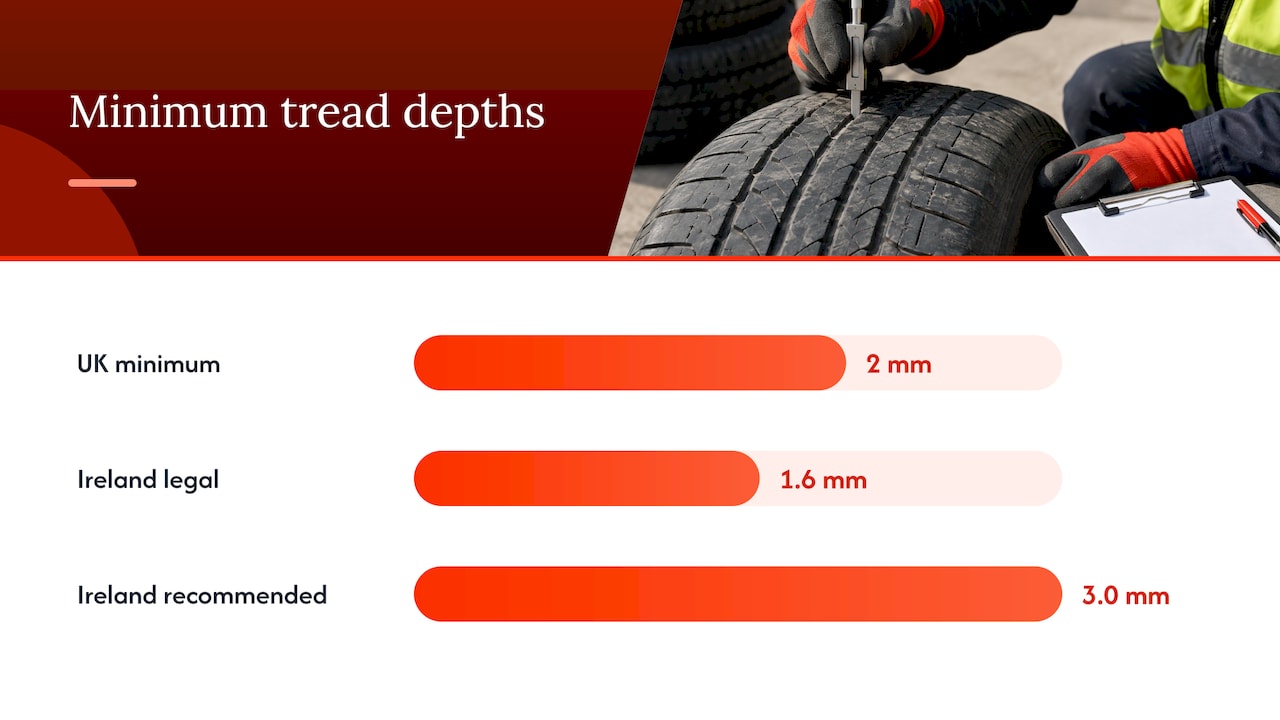
Where a country sets a road-use standard for part-worn tyres, the details are specific. In the UK, Department for Transport guidance says original grooves must be visible throughout and at least 2 mm deep across the full tread width and circumference. Tyres must pass an inflation test, and penetration damage must be repaired to BS AU 159. Unretreaded tyres need the E mark and a permanent, legible “PART-WORN” marking. The guidance also rules out outside cuts beyond 25 mm or 10% of section width (whichever is greater), structural separation causing a lump or bulge, and exposed ply or cord.
Ireland’s Road Safety Authority gives the legal minimum tread depth, including for second-hand tyres, as 1.6 mm and recommends at least 3.0 mm when buying part-worn. It also advises reading the age from the sidewall serial number and watching for sidewall tears, bulges, exposed plies and previous puncture repairs.
If you sell into a market that applies standards like these, build them into your purchase specification so that what arrives can be sold on the road.
Rules are changing for waste-classed tyres
The line between a reusable tyre and waste is getting more attention from regulators, so classification is worth more care than it was a few years ago.
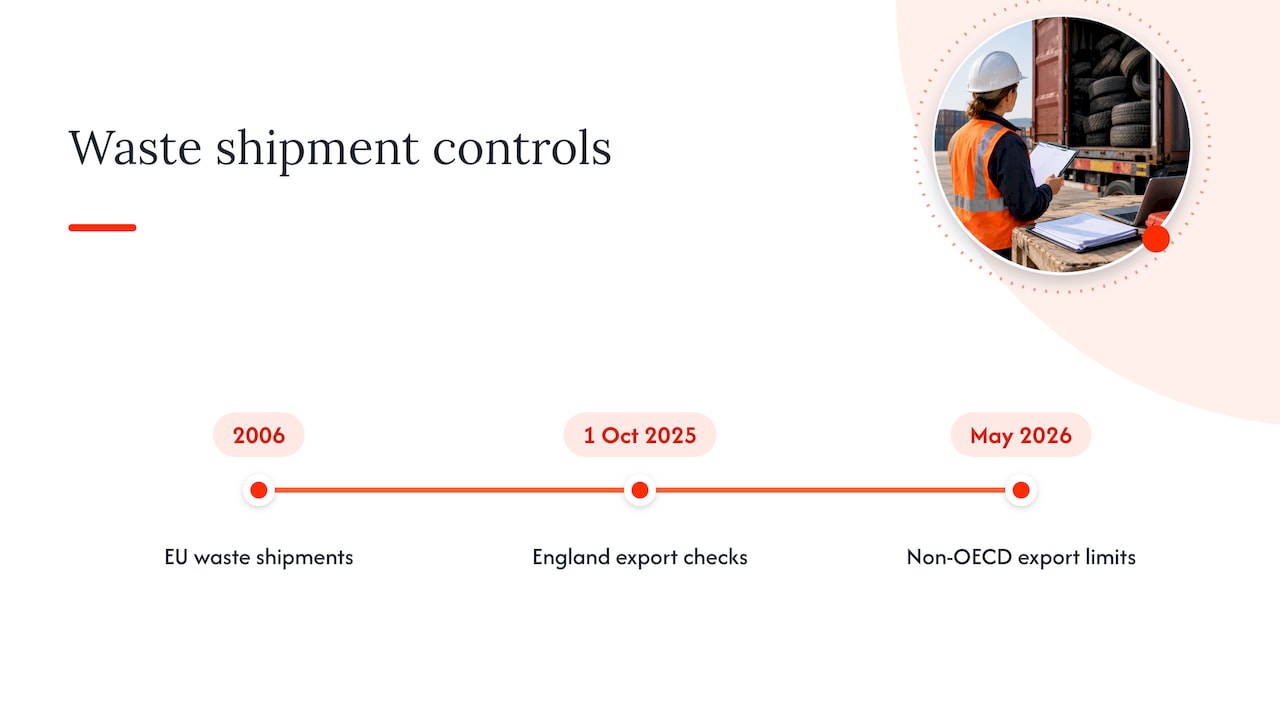
In the EU, tyres classified as waste fall under Regulation 1013/2006 on shipments of waste, and the bloc’s updated Waste Shipment Regulation (2024/1157) tightens exports of non-hazardous waste to non-OECD countries from May 2026, as reported by an industry specialist. In England, the Environment Agency’s implementation plan describes enhanced verification checks from 1 October 2025 on the export destinations of waste tyres.
What this means for a buyer: these controls attach to tyres that are waste. Tyres supplied as part-worn goods for re-use, with documentation showing they are, follow the goods route. Ask your supplier how it classifies each lot, and make sure the invoice says the same thing as the customs code.
Documents you should expect to prepare
Exact requirements depend on the destination, but a used tyre consignment generally needs the following. Confirm the list with your customs broker and the destination authority.
| Document | What it should show |
|---|---|
| Commercial invoice | Tyre size, vehicle type, condition (including tread depth and visible damage), quantity and weight |
| Packing list | Bale or pallet count, tyre counts per unit, gross and net weight |
| HS code on the declaration | 4012 for re-use or retreading; the right sub-code for your market |
| Certificate of origin | Needed where preferential duty or origin verification applies |
| Import licence or permit | Where required: for example a Malaysian AP, a Singaporean CCMD(Basel) permit or a Swiss FOEN authorization |
| Treatment or cleanliness evidence | Where biosecurity rules apply, as in Australia and New Zealand |
For tyres, the tread depth and the age code on the sidewall are the facts officials and buyers return to most. A supplier that records them consistently makes your declaration easier to write.
On duty, check the published tariff for your country. The US tariff listing for HTS 4012.20 shows a free general duty rate across its listed subheadings, but US entry for tyres is governed by the safety rules above as well as duty. Rates elsewhere differ, and VAT or import levies may apply on top.
How to import used tyres, step by step
- Confirm the rules for your market. Find out whether used tyres are allowed at all, whether a licence is needed, and whether only retreaders may import. Ask your customs authority or broker, not only your supplier.
- Decide the category you need. Part-worn for road use, casings for retreading, or another grade. This sets the HS code, the permits and the standards.
- Write a specification. Size range, minimum tread depth, maximum age, markings required by your market, and what damage is unacceptable. Use the standards in your destination as the baseline.
- Obtain the permit before shipment. Where a licence is needed, it is normally issued before the goods leave. Singapore’s guidance, for example, advises declarations at least five working days ahead.
- Agree shipping terms. Settle whether the price is ex-works, FOB or CIF, who books the container, who insures it and who clears customs at the destination.
- Check the documents against the goods. Before the container ships, match invoice, packing list, HS code and permits to what is being loaded.
- Clear customs and pay duty. Your broker lodges the declaration. Keep copies of all documents for later audits.
- Inspect on arrival. Check counts and condition against the packing list while the container is still under customs control.
Choosing a supplier and counting the real cost
The price per tyre is only one line in your landed cost. The others are freight, insurance, duty and VAT, port charges, broker fees, permit costs, and the cost of any shipment that is held or sent back. A refused container costs far more than a slightly more expensive tyre.
When you compare suppliers, look at:
- Consistency of packing. Tidy, uniform loads are quicker to count, load and inspect, which helps both at origin and at your port.
- Documentation. Does each shipment arrive with an invoice and packing list that describe the tyres in the detail your customs office expects?
- Compliance knowledge. Can the supplier explain what your destination requires, not just what it can load?
- Capacity and turnaround. Can it fill repeat orders on time from stock?
- Communication. Who answers when a problem appears at your port?
Our own approach is built around these points. We use advanced packaging machinery that speeds up baling and turnaround, run a 133,000 square foot warehouse in Poland, and document our shipments to help buyers meet import requirements.
Our view
Most failed used-tyre imports we hear about start the same way: the buyer chose on price per piece and left classification and paperwork until the container was already at sea. By then, the choices are to pay for a fix or take the loss.
We work from the other end. Our shipments are consistently documented, our packaging machinery gives us fast turnaround, and our warehouse is large enough to supply repeat orders without stretching lead times. We also provide detailed compliance support for global import requirements, because we serve buyers in over 40 countries and no two customs offices ask for exactly the same thing.
If you are building a tyre line next to clothing, shoes or other second-hand goods, a single supplier that ships all of them in bulk also simplifies your freight planning and your supplier relationships.
rodrigues
Supplying used tyres in bulk
Our used tyres range is sold wholesale to importers, resellers and market traders, and shipped worldwide in bulk. If you are planning a first order or a regular programme, go to our used tyres wholesale page and tell us your destination country, the category you need and your target volume. We will go through the requirements for your market with you.
If you also buy other second-hand goods, we supply used clothing, used shoes, bags, toys and industrial wiping rags from the same warehouse. Our used clothing regulations guide explains the equivalent import rules for apparel.
FAQ
Is it legal to import used tyres?
It depends on the destination country and on the tyre’s category. Many countries allow part-worn tyres or retreadable casings under conditions, such as a licence, minimum tread depth or required markings, while a few limit imports to retreaders only. Check the rule for your market before ordering.
What HS code do used tyres use?
Part-worn tyres and casings suitable for retreading fall under HS 4012. Used pneumatic tyres not retreaded are generally 4012.20. Tyres that are end-of-life are classified as rubber waste under HS 4004, and that triggers waste controls. Your national tariff adds further digits, so confirm the full code with your broker.
How much tread depth do used tyres need?
Standards differ. Some countries set 1.6 mm as the legal minimum, Ireland’s road safety body recommends at least 3.0 mm for a part-worn purchase, and UK guidance asks for at least 2 mm across the full tread. Set your specification to the strictest standard that applies in your market.
Can I import used tyres into the United States?
US rules focus on safety compliance. NHTSA’s interpretation allows a narrow exception for casings with less than 2/32 inch remaining tread imported solely for retreading, and regroovable casings must be marked as such on both sidewalls. Work with a licensed customs broker on the entry.
Sources
- Basel Convention technical guidelines on used tyres
- Malaysia: guidelines for import licence (AP) on used tyres
- WTO import licensing: used vehicles tyres, Lithuania
- Singapore NEA: CCMD(Basel) product codes
- Switzerland FOEN: used tyres
- Canada CBSA: Memorandum D19-12-2, Importation of Tires
- NHTSA 1982 interpretation on used casings
- Australia: importing motor vehicles, motorcycles, tyres and machinery
- New Zealand: Import Health Standard for vehicles, machinery and parts
- UK Department for Transport: buying part-worn tyres
- Ireland RSA: part-worn or used tyres
- Environment Agency implementation plan on waste tyre exports
- Used tire export ban and EU Waste Shipment Regulation
- HTS 4012.20 duty rate listing