
Lithium batteries can be shipped, but they are regulated as hazardous material, and the rules depend on the battery’s size, whether it is installed in a device, the transport mode and the carrier. In the US, PHMSA states that lithium batteries must meet the Hazardous Materials Regulations (49 C.F.R. Parts 171 to 180) when offered for transport by air, highway, rail or water. For a reseller importing used laptops in volume, the practical rule is simple: know the watt-hour (Wh) rating, keep the charge low, pack and mark the package correctly, and buy from a supplier whose shipments are documented from the start.
This guide explains the rules in plain terms for importers, wholesalers and resellers who move used goods, including laptops, across borders.
TL;DR
- Lithium batteries are hazardous material under US law, and every leg of an international shipment has its own rule set. Air is the strictest, sea is next, and road is the most permissive.
- The “smaller battery” line is 100 Wh per lithium-ion battery and 20 Wh per cell. Most laptop batteries fall under it, but a single laptop and a pallet of laptops are not treated the same way in practice.
- From 1 January 2026, batteries packed with equipment above 2.7 Wh must be at or below 30% state of charge for air transport, unless the relevant States approve otherwise.
- Packages need rigid outer packaging, protection against short circuits and, in most cases, the lithium battery mark. Damaged, defective or recalled batteries are forbidden by air.
- Carriers can be stricter than the regulation, so confirm the carrier’s own policy before you book.
Table of Contents
- Why the rules differ by route and transport mode
- The size thresholds that decide everything
- Shipping laptops: installed, packed with, or loose
- The 30% state-of-charge rule
- Packing, marking and labelling
- Damaged, defective and recalled batteries
- A short pre-shipment checklist
- Buying used laptops with the shipping side in mind
- FAQ
- Sources
Why the rules differ by route and transport mode
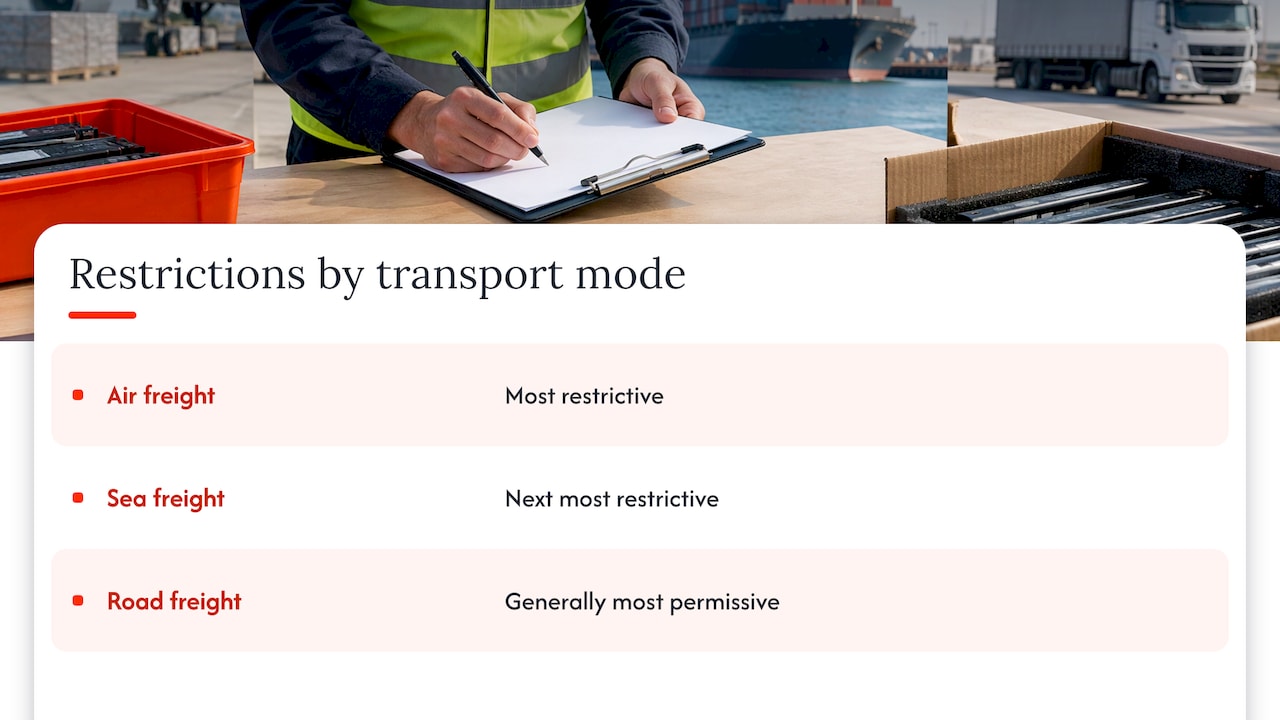
There is no single worldwide lithium battery rulebook. Each mode of transport follows its own regulation, and a shipment that moves by truck, then ship, then aircraft is governed by a different set at each stage. A FIDI guide to lithium-ion battery shipments ranks air freight as the most restrictive mode, followed by sea freight, with road generally the most permissive.
In practice, this is why a buyer in Lagos, Nairobi, Dubai or Karachi should ask early how the goods will travel. A lot of laptops going by sea container faces a different checklist from the same lot going by air. Air carriers also use their own safety assessments. PHMSA’s Lithium Battery Guide advises shippers to check with the air carrier or the ICAO and IATA publications for country-specific and carrier-specific policies.
The FAA makes the same point in its interactive shipping guide: carrier requirements can be more restrictive than the regulations, the guide does not replace the regulations or training, and people who perform dangerous goods functions must be trained.
Which edition of the air rules applies
For air shipments, the IATA Dangerous Goods Regulations are the working standard. Per FIDI, the 67th Edition applies until 31 December 2026, and the 68th Edition takes effect on 1 January 2027. If your shipment is booked near the turn of the year, check which edition governs the actual flight date.
The size thresholds that decide everything
Lithium rules start with size. A battery is made of one or more cells, and the limits are set per cell and per battery. According to PHMSA’s 2024 Lithium Battery Guide, the US “smaller battery” thresholds are:
| Battery type | Per cell | Per battery | Highway and rail only |
|---|---|---|---|
| Lithium ion | 20 Wh or less | 100 Wh or less | Cells up to 60 Wh, batteries up to 300 Wh |
| Lithium metal | 1 g or less | 2 g or less | Cells up to 5 g, batteries up to 25 g |
Above these limits, the shipment falls under the more restrictive provisions. PHMSA also notes that since 10 May 2024, the Wh rating must be marked on the outside case of all lithium-ion batteries, whatever their size (49 CFR 173.185(a)(5)). If you buy used electronics, a battery with no legible Wh marking is a problem you want to catch before it reaches a carrier.
The US DOT’s “Check the Box” fact sheet adds that most consumer electronics contain smaller batteries, up to 100 Wh for lithium ion or 2 g of lithium content for lithium metal.
How Wh is calculated
If the case shows volts and amp-hours but not watt-hours, multiply them: volts times amp-hours gives Wh. A 11.1 V, 4.4 Ah laptop battery is about 48.8 Wh, well under 100 Wh. Check the figure printed on the battery or in the specification and compare it with the thresholds above.
Shipping laptops: installed, packed with, or loose
The same battery is treated differently depending on how it travels. Under the UN numbering used across the rules, the main cases for laptops are:
- UN3481: lithium-ion batteries contained in or packed with equipment, which is the normal case for a laptop shipped with its battery.
- UN3480: lithium-ion batteries shipped on their own, including spare batteries and, per FIDI, power banks.
- UN3090 and UN3091: the lithium metal equivalents, relevant to small coin-type batteries and some devices.
A laptop with its battery installed is the easiest case. A pile of loose spare batteries is the hardest. Under DHL’s published regulation table for lithium-ion shipments, loose batteries at 20 Wh per cell and 100 Wh per battery are limited to cargo aircraft only, at 30% charge and 10 kg net per package, while batteries packed with equipment have a 5 kg net limit and must be limited to those needed to power the equipment plus two spare sets. That table is a carrier summary of the IATA rules, so treat it as an illustration of how tight the numbers get, and confirm the current limits with your carrier.
Small-shipment allowances versus a wholesale lot
The regulations include relaxed provisions for small shipments. The FAA guide, for example, exempts packages with no more than four cells or two batteries installed in equipment from the lithium battery mark, where the shipment has no more than two packages. Those limits describe a personal or small-business parcel. A wholesale lot of used laptops is far beyond them, so plan it as a fully regulated dangerous goods shipment: trained personnel, correct packaging, marks, labels and paperwork, rather than relying on a small-parcel exception.
The 30% state-of-charge rule
Charge level matters because a fully charged cell stores more energy to release if something goes wrong. IATA’s battery guidance document states that UN 3480 and UN 3551 batteries must be shipped at no more than 30% of rated capacity. It adds that from 1 January 2026, lithium-ion batteries packed with equipment (PI 966 Section I) and Section II batteries above 2.7 Wh must also be at or below 30%, unless approved by the relevant States.
For a laptop reseller, this means asking one question of any supplier: at what charge level are the batteries when the goods are packed? A battery that arrives at 90% has to be discharged before it can fly.
Packing, marking and labelling
The DOT fact sheet sets out the basics:
- Protect against short circuits, shifting and accidental activation. Use manufacturer-sealed packaging, or non-metallic inner packaging that fully encloses the batteries and separates them from conductive materials.
- Use rigid, strong outer packaging. Padded envelopes and paper mailers are not suitable.
- Apply the lithium battery handling mark with all applicable UN numbers (UN3480, UN3481, UN3090, UN3091) in most cases.
- Keep incompatible goods out of the box. The FAA guide notes that lithium batteries must not share an outer package with explosives (other than Division 1.4S), flammable gases, flammable liquids, flammable solids or oxidizers.
The mark itself is changing. According to IATA’s Battery Shipping Regulations page, the 2027 edition phases out the legacy lithium battery mark that carries a telephone number, and requires battery marks on the same package surface as other hazard labels. If you reuse old packaging stock or labels, check them before the new edition applies. Our separate guide to which battery mark or label your package needs goes through the mark and label choices in detail.
Paperwork that travels with the goods
Marks are only half the job. Shipments need an accurate description of the goods on the packing list, and importers need consistent product descriptions for customs. See what belongs on a packing list for used clothing exports; the same discipline of listing quantities, weights and contents applies to mixed consignments that include electronics. For sea shipments, container weight limits and VGM decide how a load can be built.
Damaged, defective and recalled batteries
Used goods raise a question new goods do not: what if a battery is swollen, dented or recalled? Under Special Provision A154, IATA’s guidance treats safety-defective or recalled batteries as forbidden for air transport. The same guidance clarifies that non-safety defects, such as an LED that does not show charge, an incorrect model number or a battery that does not hold enough charge, do not by themselves bar air shipment. Returned laptops where the device, not the battery, is faulty are also not prohibited.
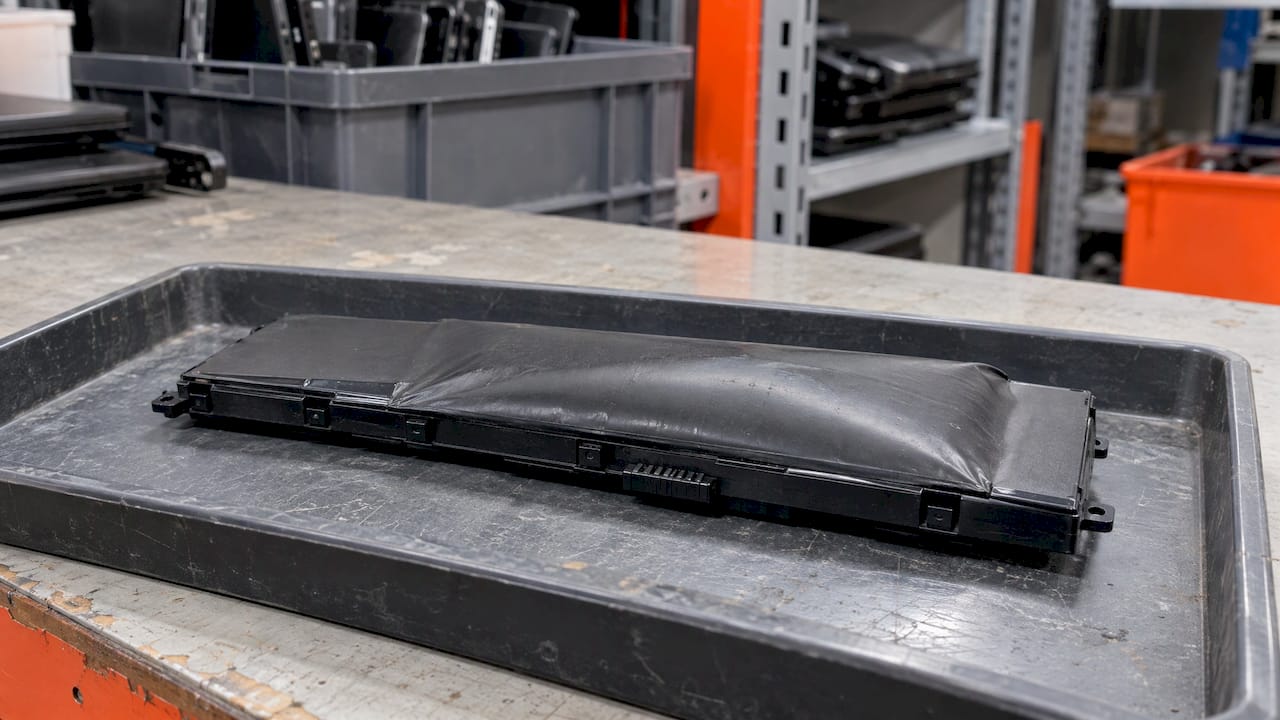
Ireland’s aviation authority takes the same line in its 2026 labelling and documentation notice: batteries identified as damaged or defective under A154 are forbidden for transport, and all cells and batteries must be protected against short circuits, including contact with conductive materials in the same package.
The working rule for a reseller: inspect for swelling, heat damage, leakage and recall status, and keep any suspect unit out of the consignment. Damaged items are not a candidate for air freight at all.
A short pre-shipment checklist
- Confirm the Wh rating on each battery and that it is legibly marked.
- Confirm the state of charge is at or below 30% for air shipments.
- Identify the correct UN number for how the batteries travel: installed, packed with equipment or standalone.
- Pack in rigid outer packaging with protection against short circuits and movement.
- Apply the lithium battery mark and any other required labels.
- Check the carrier’s own policy, and the edition of the regulations that applies on the shipping date.
- Make sure everyone who prepares the shipment has the training the regulations require.
What we see in this trade
We export used goods in bulk from Poland to buyers in more than 40 countries, and the pattern is consistent: shipments move smoothly when the paperwork is clear before the goods leave the warehouse. Our advanced packaging machinery lets us turn bales around quickly, and our shipments are documented so that an importer’s broker and carrier see the same description we do.
For laptops, that discipline matters even more than for clothing. A buyer who knows the Wh rating, the charge level and the packing method before booking avoids the delays that come from a carrier asking questions at the dock.
Our 133,000 square feet of warehouse space means we can supply a broad range of goods from one source, and we support buyers with the compliance requirements of global import. If you are building an assortment that mixes apparel, shoes, bags and electronics, putting it with one documented supplier keeps your paperwork consistent.
rodrigues
Buying used laptops with the shipping side in mind
If your business resells used laptops, source them from an exporter that treats documentation as part of the product. We supply used laptops worldwide, and our shipments are documented from our Polish warehouse. See our used laptops offer for the range, or start from our main site if you are putting together a mixed order of clothing, shoes, bags and other used goods.

If you also import apparel, the same preparation habits apply: accurate HS codes prevent port holds, as covered in our guide to HS codes for used clothing imports, and our overview of used clothing regulations covers what importers must know.
FAQ
Is it possible to ship lithium batteries?
Yes. Lithium batteries can be shipped by air, road, rail and sea, but they are regulated as hazardous material. In the US, they must meet the Hazardous Materials Regulations when offered for transport. The size of the battery, whether it is installed in equipment, and the carrier’s own policy decide what you must do.
What is the 100 Wh limit for laptop batteries?
The US “smaller battery” threshold for lithium-ion batteries is 100 Wh per battery and 20 Wh per cell. Most laptop batteries are below 100 Wh, which keeps them under the less restrictive provisions. Batteries above that line fall under the stricter rules, so check the Wh figure printed on the battery case.
Do batteries have to be partly discharged for shipping?
For air transport, yes. All standalone lithium-ion batteries (UN 3480) must be at or below 30% state of charge. Since 1 January 2026, the same limit applies to batteries packed with equipment and to Section II batteries above 2.7 Wh, unless the relevant States approve a higher charge.
Can I ship damaged or recalled laptop batteries?
Not by air. Safety-defective or recalled batteries are forbidden under Special Provision A154. Batteries with only non-safety defects, such as a faulty charge indicator, can still be shipped by air. Keep any swollen or heat-damaged unit out of the consignment.
Does the lithium battery mark always have to be on the package?
Usually, but not always. The FAA guide exempts, for example, packages with no more than four cells or two batteries installed in equipment in a shipment of no more than two packages. A bulk lot of laptops is outside those limits, so plan to mark it. Marks with a telephone number are being phased out in the 2027 IATA edition.
Sources
- PHMSA: Transporting Lithium Batteries
- PHMSA Lithium Battery Guide, 2024
- FAA Interactive Guide to Shipping Lithium Batteries, 2026
- US DOT: Check the Box for Lithium Batteries
- FIDI Li-ion battery shipment guide, 2026
- IATA battery guidance document, 2026
- IATA Battery Shipping Regulations
- Irish Aviation Authority: Shipping Lithium and Sodium Batteries, labelling, marking and documentation, 2026