
A used clothing bale breaks for four reasons: the textile springs back after pressing, the load is uneven, the straps are slack or poorly placed, or someone mishandles it on the way to your warehouse. Each cause has a fix, and most of the fixes cost little. This guide covers the whole chain, from the baler to the container to your receiving dock, for wholesalers, importers and market traders who buy bales of clothing, shoes, bags and rags.
Most pages on this topic are about hay and crop balers. Textile bales behave differently. Clothing is elastic, bulky and often damp, so the advice below is written for that.
TL;DR
- Textile bales split mainly because fibers rebound once pressure is released. Stable compression, correct bale height and enough dwell time before tying reduce it.
- Load the press evenly, remove slack before knotting, and keep knots close to the bale.
- Wet or damp goods weaken a bale and a container load. Keep them apart from dry goods and control moisture.
- Inside the container, spread weight evenly, stow tightly and block against sliding, without overtightening lashings.
- On arrival, open doors slowly, inspect before unloading, and record damage the same day.
Table of Contents
- Why used clothing bales break open
- Filling and compressing: where most breakage is decided
- Strapping and binding that holds
- Moisture: the quiet cause of weak bales
- Handling and stacking in the warehouse
- Loading the container without crushing or shifting bales
- Checklist by stage
- What buyers should check on arrival
- Our perspective: breakage is a process problem, not bad luck
- Buy bales packed with breakage in mind
- FAQ
- Sources
Why used clothing bales break open
A bale is a spring held shut by straps. Clothing, rags and fibers rebound when pressure is released, and if the press opens too quickly the bale can expand and become difficult to tie. One equipment maker lists the factors behind that springback: material elasticity, fiber structure, moisture, irregular shapes, feed method, compression cycles and density.
These are manufacturer explanations, not lab studies, but they match what packers see on the floor. In practice the causes group into five:
- Elastic mix. Knitwear, fleece, padded jackets and synthetic blends push back harder than flat cotton shirts.
- Moisture. Damp textile adds weight and unpredictable rebound, and it is a mold risk in transit.
- Uneven filling. Heavy items piled on one side, or bulky items such as shoes and coats in one corner, create a lopsided bale.
- Rushed release. Opening the press before the load has settled lets the bale swell before the straps take the load.
- Weak or badly placed binding. Slack straps, knots far from the bale and thin material all let the bale grow.
Breakage after shipping is often blamed on the carrier, but a bale that was marginal at the press will fail at the first rough stack or forklift touch. Fix the press first.
Filling and compressing: where most breakage is decided
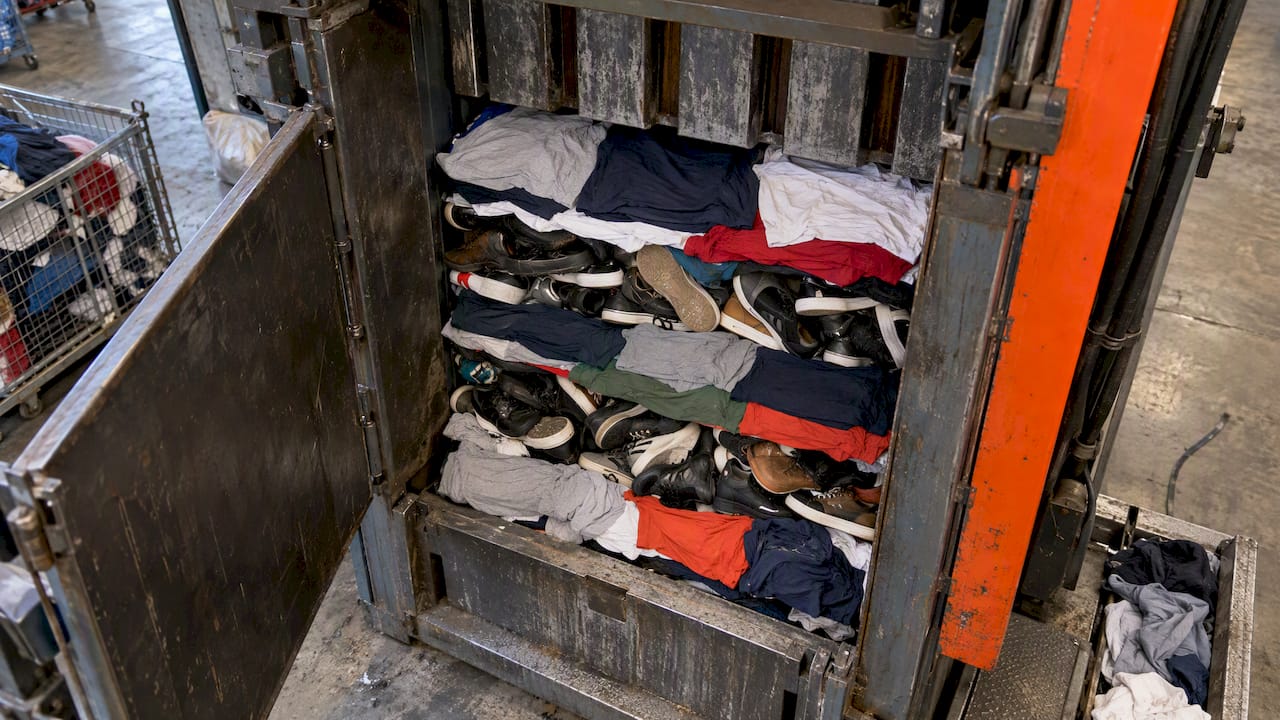
The operator manual for one common baler family gives a clear sequence. Operators should load material evenly, place a large base sheet to catch the ties, cover the top of the bale with material wide enough to catch all wires or bands, and keep the compression head down while tying. Those are manufacturer instructions for that machine, so follow your own machine’s manual, but the principles carry over.
Even loading
Feed the chamber in layers rather than dumping a pile in one spot. Mix bulky and flat items through the load. A bale with a hard core of shoes and a soft shell of T-shirts will lean, and a leaning bale does not stack.
Height and dwell time
Stable compression, correct bale height and sufficient dwell time all reduce expansion before tying. Dwell time is the pause with the head held down before the bale is released. Skipping it saves seconds and costs you bales. Overfilling to reach a target weight has the same effect: the bale carries more stored energy than the straps were chosen for.
Sorted, dry input
Breakage control starts before the baler. Sorting by grade and category means each bale has a consistent texture. Drying damp stock before pressing is cheaper than losing a bale to mold. If you buy rather than press, ask your supplier how stock is kept dry between sorting and baling, and read our guide to storage of used clothing for what good conditions look like.
Strapping and binding that holds
The strap is the only thing between a dense bale and a pile of clothing. Three habits matter most.
- Remove slack before knotting. The baler manual says to take up slack in the matching wires or bands before knotting them, and to keep the knots close to the bale. A loose loop lets the bale swell and then loads the knot at its weakest point.
- Match the strap to the load. One polyester strapping product sheet describes its STARstrap-plus as particularly suited to highly compressed textile bales. Whatever material you use, choose it for a compressed, elastic load, not a generic carton.
- Cover the sharp edges. Wrapping or a cover sheet that catches all bands keeps wires and bands from cutting into loose garments and keeps the bale surface from snagging during handling.
Plastic wrapping alone is not a substitute for strapping. HSE notes that plastic wrapping is particularly prone to slipping in a stack, so a wrapped bale needs good straps underneath.
For the packing specifications that sit around strapping, such as machine settings and CTU Code references, see our article on used clothing packaging methods. If you are weighing bales against cartons for a particular product, baling versus box packing covers the cost side.
Moisture: the quiet cause of weak bales
Damp goods are heavier, grow mold and rebound unpredictably. Moisture is on the list of springback factors above, and the shipping guidance is blunt about it: keep wet or damp goods apart from dry goods, and the CTU Code says to avoid wet or damp cargo where possible.
In practice:
- Reject or re-dry stock that feels cold or damp before pressing.
- Store pressed bales off the floor and away from walls that sweat.
- Use moisture control inside the container where the route calls for it. We explain dosing in desiccants for clothing bales.
- Treat contamination as a related problem, since wet, soiled or mixed-in foreign items weaken a bale and a shipment’s acceptance. See bale contamination control.
Handling and stacking in the warehouse
A well-pressed bale can still be wrecked by a forklift. HSE lists dangerous vehicle loading and unloading, unsafe lifting equipment, unstable stacking, poor manual handling, unsafe bale opening and inadequate work systems as hazards behind serious injuries. That is UK guidance, but the physics applies anywhere bales are stacked.
HSE also says stack instability comes from poor initial stacking, disturbance while adjacent stacks are built or removed, forklift impact and bale slippage. Translate that into floor rules:
- Build stacks on a flat, clean surface, with bales squared on the layer below.
- Do not pull a bale out of the middle of a stack. Work from the top or the end.
- Train forklift drivers to approach bales squarely and lift without dragging or jabbing the forks into the side.
- Limit stack height to what the bottom bales and the floor can take, and keep aisles clear so no one has to improvise.
- Check for leaning stacks at the start of every shift.
Opening a bale is a risk too. Cut straps away from your body and face, and expect the bale to expand. Stand clear of the direction of release. Our checklist of seven bale specs for used clothing warehousing goes further on receiving and storage.
Loading the container without crushing or shifting bales
Most transit breakage happens inside the container: bales shift, the load tips, or a hard corner punctures a wrapped bale. Three official and professional sources agree on the basics.
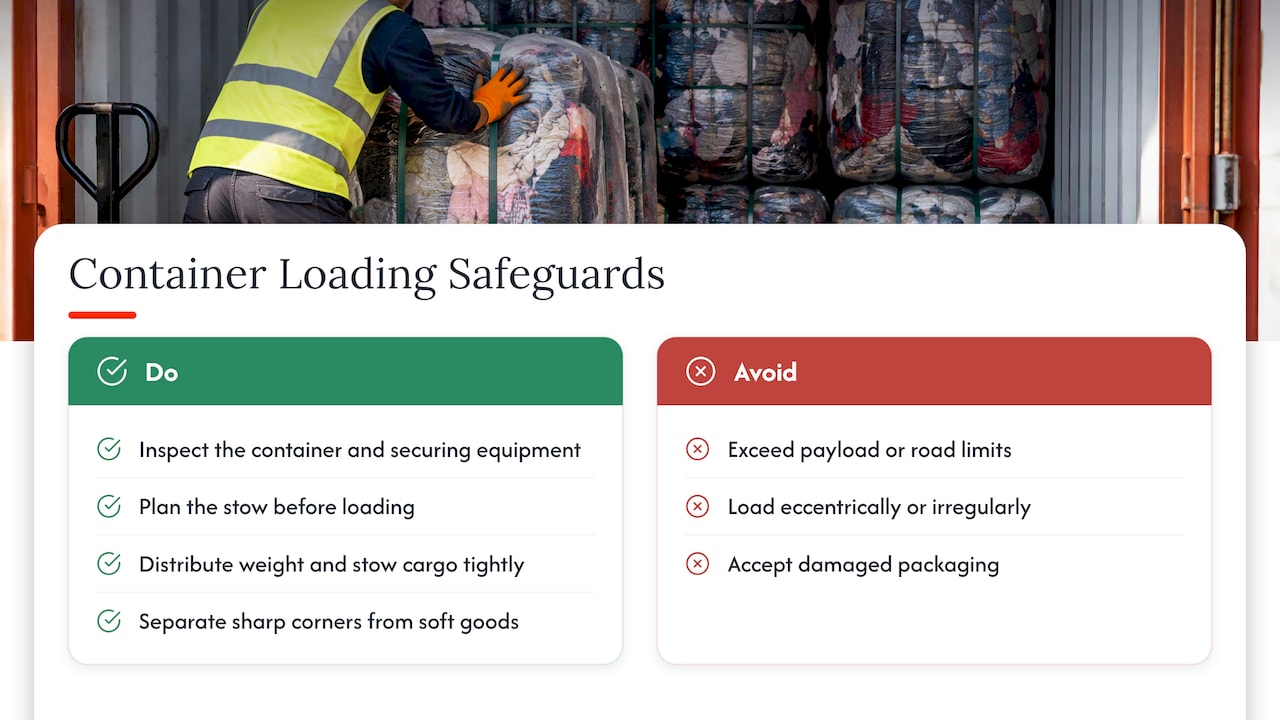
The International Chamber of Shipping advises a pre-stow plan, respecting container payload and road limits, distributing weight evenly, stowing cargo tightly, separating sharp corners from soft merchandise, and refusing damaged packaging. It also says to inspect the container before stuffing. The IMO/ILO/UNECE CTU Code asks packers to pick a suitable unit, prepare a packing plan when needed, check the container and securing equipment, spread weight appropriately and avoid eccentric or irregular loading.
Block, then lash, but do not overtighten
The CTU Code requires cargo to be secured against sliding and tipping with blocking, lashing or both. Securing forces should be spread over suitable areas, equipment must not be overstressed, and lashings must not be tightened enough to damage packaging or goods. For bales, this means a strap pulled hard against a corner can cut the bale it is meant to protect. Use edge protection and spread the force.
A simple loading routine
- Inspect the floor, walls and doors for damage and moisture before the first bale goes in.
- Plan the stow so heaviest bales are low and the load is balanced left to right and front to back.
- Fill gaps. Empty space lets bales move, so use blocking or dunnage so the final row cannot slide.
- Keep different categories apart. Shoe bales, rag bales and clothing bales have different densities and should not be mixed haphazardly.
- Photograph the loaded container before closing the doors.
Checklist by stage
| Stage | Main risk | What to do |
|---|---|---|
| Sorting and storage | Damp or mixed-texture stock | Dry stock, sort by category, keep off the floor |
| Pressing | Springback and uneven fill | Load in layers, hold the head down, keep correct height |
| Tying | Slack and loose knots | Remove slack, knots close to the bale, suitable strap |
| Warehouse | Stack collapse, forklift damage | Square stacks, trained drivers, check each shift |
| Container loading | Shifting, tipping, punctures | Pre-stow plan, even weight, tight stow, no overtightening |
| Arrival | Hidden damage, unsafe opening | Open doors slowly, inspect, photograph, record |
What buyers should check on arrival
Breakage prevention does not end at your supplier’s gate. The CTU Code and shipping guidance both stress opening container doors cautiously before unloading, because cargo can lean against them. After that:
- Photograph the container interior before moving anything.
- Count bales against the packing list. Clear labels make this fast, so see bale labeling standards.
- Note any bale with loose straps, a bulge, torn wrapping or damp patches, and record it the same day.
- Sample bales for quality using a method that avoids seller bias. Our guide on bale sampling methods describes three.
- Track rejects over time. If rejects are creeping up, AQL checks put a number on it.
When the same fault repeats, such as loose straps on the same bale position, the cause is in the pressing or loading, and that is a conversation to have with your supplier with photos in hand.
Our perspective: breakage is a process problem, not bad luck
We pack and export used clothing, shoes, bags, wiping rags and other second-hand goods from Poland to buyers in over 40 countries. Our view is that a bale should be judged on how it arrives, not how it looks leaving the press.
That is why we invested in advanced packaging machinery: it lets us turn bales around quickly without hurrying the steps that keep them tight. Our warehouse space of 133,000 square feet gives us room to sort, stage and store goods properly instead of stacking them wherever there is a gap. And we document our shipments, because a buyer who can see how a container was loaded can tell us exactly where a problem began, and we can fix it.
To anyone buying bales, we would say: ask your supplier how they fill, tie, store and load, and ask to see it in documents or photos. A supplier who answers in detail has usually thought about breakage. One who answers with a general promise has not.
— rodrigues
Buy bales packed with breakage in mind
If you resell used clothing, we can supply it in bulk bales with documented shipments and compliance support for your import market. Start with our used clothing range, or see our used shoes if footwear is your line. Tell us your destination, container size and preferred categories, and we will explain how the bales will be packed and loaded.
FAQ
Why do compressed clothing bales swell after pressing?
Textile fibers store elastic energy under pressure and rebound when it is released. Moisture, irregular shapes, density and the number of compression cycles all affect how much. Stable compression and enough dwell time before tying reduce the effect.
Is plastic wrap enough to keep a bale intact?
No. Wrap protects against dirt and some moisture, but it can slip in a stack, and HSE notes that plastic wrapping is particularly prone to slipping. The bale still needs properly tensioned straps with knots close to the bale.
How do I stop bales shifting in a shipping container?
Plan the stow, spread weight evenly, pack tightly and use blocking or lashing against sliding and tipping. Do not overtighten lashings, since the CTU Code warns that they can damage packaging or goods. Inspect the container floor and walls before loading.
What should I do when a bale arrives broken?
Photograph it before moving it, note the bale label and position in the container, and record the damage the same day. Compare the count with the packing list and send your supplier the evidence. Repeat damage in the same position usually points to loading or strapping, not a one-off accident.
Sources
- Textile and Fiber Baling: What Makes Soft Materials Difficult to Compress
- Why Does a Bale Expand After Waste Is Compressed?
- RAM-PACK 400, 500 and 600 Operator Manual
- STARstrap, STARstrap-plus and Polyester strap product sheet
- Bales and bale handling, HSE
- IMO/ILO/UNECE CTU Code
- Safe Transport of Containers by Sea, International Chamber of Shipping