
Shoe bale grading is the way a sorter sorts used footwear into condition tiers, usually cream, Grade A, Grade B and a lower tier, before the pairs are pressed into bales. The grade tells you roughly how much of a bale you can sell at full price. It does not tell you the exact condition of every pair, because there is no single industry standard behind the letters. This guide shows what the grades usually mean, how to check a bale, and what to write into your order so a letter on a quote becomes something you can enforce.
TL;DR
- Cream and Grade A are the top tiers for wear, clean soles and intact uppers. Grade B is wearable but shows visible use. The lowest tier is for repair, parts, recycling or disposal.
- A, B and C are common commercial labels, not a universal standard. Two suppliers can use the same letter for different stock.
- Bales are sold by weight and grade, so ask for net weight, a written grade description, the size and type breakdown and photos before you pay.
- Check destination rules early. Some countries, such as Kenya, restrict certain used footwear and require specific bale labels.
- Sample first, then scale. A small trial order shows you the real grade of a supplier’s stock.
Table of Contents
- What shoe bale grading actually means
- The grades you will meet, and what they usually mean
- Why a grade letter is not a guarantee
- How to read the numbers on a quote
- How to inspect a shoe bale before and after you order
- Know the rules of your destination
- Our perspective: grade the bale against your market, not against a letter
- Matching grade to sales channel
- Buy used shoes in bales from us
- FAQ
- Sources
What shoe bale grading actually means
A used shoe bale is a compressed, wrapped block of pairs. Before baling, sorters pull the pairs through several passes. They remove what cannot be resold as footwear, then split the rest by condition, type and sometimes brand or season. Each tier becomes its own bale or its own share of a mixed bale.
The grade does three jobs for you:
- It predicts the share of pairs you can put on a shelf or market table without repair or cleaning.
- It sets the price per kilogram or per pound.
- It tells you which sales channel fits: boutique, open market, online resale or export onward.
What it does not do is guarantee uniformity. A Grade A bale from one sorter may be tight, with few visible flaws. From another it may allow light scuffing and a few weak soles. That is why the contract matters more than the letter.
The grades you will meet, and what they usually mean
Names vary, but most second-hand shoe exporters use some version of this ladder. Treat the table as a starting vocabulary for questions to ask, not as a standard.
| Grade | Typical condition | Typical use |
|---|---|---|
| Cream (premium) | Little or no wear, clean, intact soles, often branded and current in style | Boutiques, online resale, higher-income markets |
| Grade A | Minimal wear, no major defects, no sole separation, clean inside | Shops and strong market stalls |
| Grade B | Visible wear, scuffs, light staining, mismatched cosmetic wear, still wearable | Open markets, price-sensitive buyers |
| Grade C / lower | Heavy wear or functional defects, some repairable | Repair, refurbishment, parts, or recovery |
| Salvage | Severe wear, missing parts or mismatched pairs | Recycling, parts, donation channels |
Some of these tiers come from supplier descriptions of the trade. The lowest ones are described as the repair, parts or recovery tier, and footwear with serious functional defects that could injure the wearer is often considered for destruction rather than resale. A reputable seller will not hide such pairs in a higher grade.
Cream and Grade A
These tiers are judged on four things: the sole and heel, the upper, the lining and insole, and cleanliness and odor. Look for a sole that is attached with no degumming, an upper without cracks or holes, intact straps and closures, and an interior that is clean. Brand tags and current styling push a pair toward cream.
Grade B
Grade B is where margin often lives for market traders. Pairs are wearable, but you should expect scuffs, softened leather, worn heels and the occasional pair that needs cleaning. Buyers who budget for a cleaning and re-sorting step do well here. Buyers who price B stock as if it were A do not.
Lower grades and salvage
Lower tiers include pairs with sole wear-through, broken zippers, or mismatches. Some buyers want exactly this stock for repair shops or recycling. If you do not, make sure the contract caps the share of lower-lane pairs inside a higher grade.
Why a grade letter is not a guarantee
Two things cause most disputes. The first is definitions: each sorter writes its own. The second is tolerance: even within a definition, a bale will contain a small share of off-grade pairs. If neither is written down, you have nothing to point to when the bale arrives.
The advice repeated by sourcing specialists is to write your own grading requirements into the purchase order and inspection specification, rather than relying on generic labels. In practice that means specifying:
- The allowed defects per tier, in plain words (for example, no sole separation, no holes, no strong odor).
- The maximum share of off-grade pairs, as a percentage of pairs or of weight.
- Pair integrity: matched pairs only, or a stated share of singles.
- Category and mix: men’s, women’s, children’s, sneakers, boots, dress, sandals.
- Size range and approximate size spread.
- Whether pairs are tied or loose, and the bale weight.
If you also list your pairs online, clear photography helps you hold the supplier to the same standard you promise your own customers. Resellers who build product pages can use footwear 3D visualization to show soles, uppers and wear in one view, which also doubles as a record of what you actually received.
The same logic holds across categories. Our guides on how used clothing grading works, sportswear bale grades and vintage footwear grading show how the tiers shift by product type.
How to read the numbers on a quote
Bales are sold by weight and grade, not by a fixed pair count, so the first number to pin down is net weight. A heavier shoe type means fewer pairs per bale. Boots and work shoes weigh much more than sandals or sneakers, so a kilogram price tells you little until you know the mix.
Before you compare two quotes, line up these items:
| Item to confirm | Why it changes the real price |
|---|---|
| Net weight per bale | Gross weight with wrapping inflates the apparent bale size |
| Grade wording in writing | Decides which pairs are in or out of tolerance |
| Pairs per bale (estimate) | Lets you work out price per pair |
| Category and size breakdown | Boots, sneakers and sandals sell at different speeds |
| Packing method and bale size | Affects freight, handling and container fit |
| Incoterm and port | Decides who pays freight and insurance |
| Payment terms | Splits between deposit and balance affect risk |
I will not give you a price per kilogram for a “typical” shoe bale here. Prices move with grade, mix, origin and freight, and any single figure would go stale. Ask each supplier for a current written quote on the same grade wording and bale weight, then convert to price per sellable pair after your expected losses. Our note on payment terms for used clothing covers deposit and balance structures that apply equally to shoes.
A worked comparison
Say two quotes both read “Grade A, 45 kg”. Quote one allows up to 5% off-grade pairs and comes with photos. Quote two has no tolerance written and no photos. The cheaper one is not cheaper if you lose 15% of the pairs to Grade B pricing. Compare the price per sellable pair: price per bale divided by the pairs you expect to sell at your target grade price. That single calculation resolves most arguments about which supplier is expensive.
How to inspect a shoe bale before and after you order
Before you pay
- Ask for photos of the actual bales and of opened sample pairs from the same lot.
- Ask for the written grade description and the tolerance for off-grade pairs.
- Order a sample first. Our guide on sampling 5 to 10 percent first explains how resellers verify graded stock before committing to volume.
- Confirm cleaning or disinfection steps. Our buyer’s compliance guide on disinfecting used shoes covers what to request.
When the bale arrives
Photograph the seals, wrapping and labels before you open anything, then sort at once into ready-to-sell stock and lower-lane or damaged stock. That record is your evidence if you need to claim.
Then run the same checks on a random sample of pairs:
- Soles and heels: look for separation, cracks, heavy wear-through and missing tread.
- Uppers: check seams, holes, peeling and stretched leather.
- Interior: look at lining, insoles, odor and moisture or mold.
- Pairs and sizes: confirm that pairs match, and count sizes against the breakdown you were promised.
- Closures: test zippers, laces, buckles and Velcro.
Count what lands in each lane, and note the percentages. Those percentages are what you take back to the supplier, and what you use to price the next order.
Know the rules of your destination
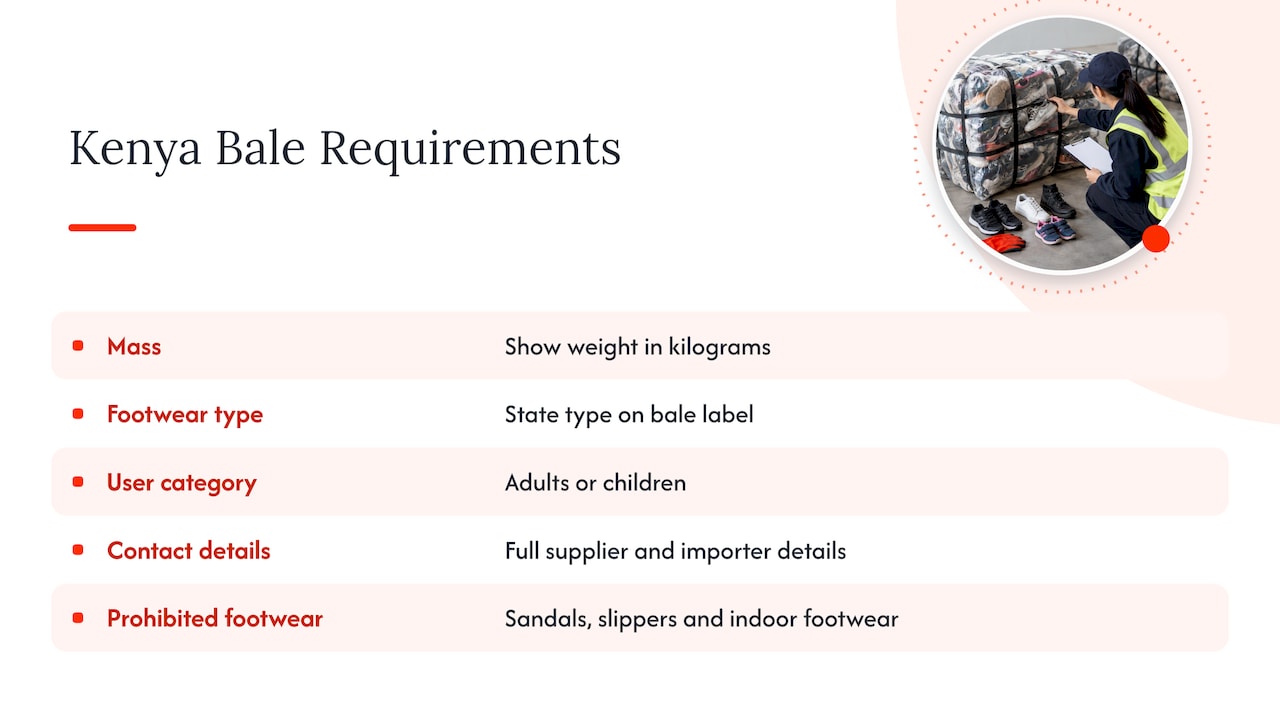
Grade is only one filter. Many markets also restrict which used footwear may enter, and customs can hold a container with the wrong labels. Kenya is a clear example. Its official protocols for used textiles and shoes, issued in 2020, require bale labels that show mass in kilograms, the type of footwear, the user category (adults or children) and full contact details for the supplier and the importer or consignee. The same protocols, guided by the 1999 Code of Practice (KS 1533:1999), prohibit certain used footwear, including sandals, slippers and indoor footwear.
That means a “Grade A” bale full of sandals could be a problem at a Kenyan port, whatever its condition. Other countries have their own rules, and they change. Read our overview of used clothing import bans in nine countries and our market data and supplier checklist for used shoes in Africa, then confirm current requirements with your own customs authority or clearing agent before you order.
Our perspective: grade the bale against your market, not against a letter
We export used clothing, shoes and related goods from Poland to buyers in more than 40 countries, and the same conversation repeats. A buyer says “I need Grade A”, and what they mean is “I need pairs my customers in Lagos, Nairobi or Dubai will pay a good price for.” Those are not always the same thing.
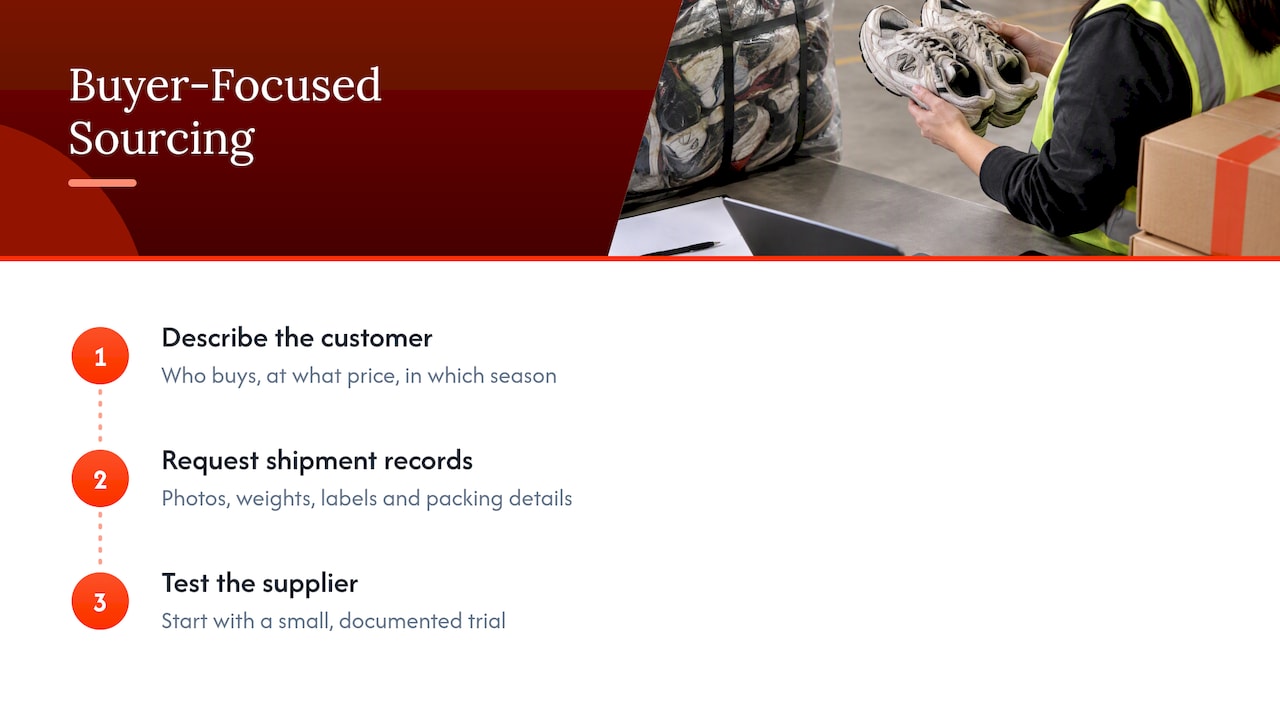
So we suggest buyers do three things. First, describe the customer, not just the grade: who buys, at what price, in which season. Second, ask for documented shipments: photos, weights, labels and packing details that match what arrives. Third, treat the first order as a test. A small, well-documented trial tells you more about a supplier than any brochure.
Our warehouse covers 133,000 square feet and our packaging machinery lets us turn bales around quickly, but speed only helps if the contents match the spec. That is why we put documentation and compliance support at the center of how we work with importers. Our write-up on getting faster used footwear export quotes explains what information makes a quote quick and accurate.
— rodrigues
Matching grade to sales channel
The best grade is the one that leaves you the widest margin in your channel, not the highest one.
- Boutique or online resale: cream and Grade A, with photography and careful listing. Brand and style matter as much as condition.
- Open market stalls and distributors: a Grade A and B blend is common, because B pairs sell fast at a lower price and keep the stall full.
- Repair, refurbishment or recycling: lower tiers, bought deliberately and priced accordingly.
- Vintage: a separate logic, where condition is judged zone by zone and the era matters. See our vintage footwear grading guide.
A useful habit is to track, per supplier and per grade, the share of pairs you sold at target price, the share you discounted and the share you wrote off. After two or three orders you have your own grading standard, built on your actual sales.
Buy used shoes in bales from us
If you import or resell footwear, you can see what we offer on our used shoes page. Tell us your destination country, your sales channel, the footwear types you want and the grade wording you need. We will respond with a quote built around your specification, with documentation to support customs clearance.
FAQ
What are the grades of used shoes?
The common ladder is cream or premium, Grade A, Grade B and a lower grade for repair or recovery, with some sellers adding extra tiers. The names are commercial labels, so each supplier defines them in its own way. Always ask for the written description of each grade.
How much does a bale of shoes cost?
It depends on grade, shoe type, bale weight, origin and freight, and sellers usually quote per kilogram or per pound. Ask for a current written quote that states net weight and the grade wording. Then work out the price per sellable pair so you can compare suppliers fairly.
Is Grade A the same everywhere?
No. Grade A has no universal definition, so one supplier’s Grade A can differ from another’s. Put your defect limits and the allowed share of off-grade pairs into your purchase order.
How can I check a bale before I commit to a large order?
Request photos of the actual lot, order a small sample, and inspect soles, uppers, interiors and pair matching on arrival. Photograph seals and labels before opening, then sort into ready-to-sell and lower-lane stock. Use the percentages you record when you negotiate the next order.
Sources
- Footwear Quality Inspection: Sorting & Grading Guide
- How to Master Footwear Quality Inspections, Sorting & Grading
- Protocols for Importation of Used Textiles and Used Shoes, Kenya (2020)