
For most bulk orders of used clothing, shoes and other second-hand goods, a sea-freight term where the seller handles export and the buyer handles import is the practical choice: FOB, CFR or CIF. DAP and DDP suit buyers who want the supplier to carry the goods all the way to a named place. Which one is right depends on who can book freight more cheaply, where you want risk to pass, and who is able to clear the goods through your customs. This guide walks through each term as it applies to baled used goods, so you can write the right wording into your next purchase contract.
TL;DR
- Incoterms are the ICC’s standard trade terms. They split transport costs, risk, customs clearance and insurance between seller and buyer. They do not set price, payment or when ownership passes.
- Incoterms 2020 is the current edition, so write the year into the contract: for example “CIF [port] Incoterms 2020”.
- CFR and CIF are sea-only rules and risk passes when the goods are on board at origin. DAP and DDP work for any transport mode and the seller carries risk to your named destination.
- DAP leaves import clearance and duties with you. DDP puts them on the seller, which is often hard to do in a foreign market.
- A term only works with matching paperwork: the invoice, the packing list and the HS code must agree with what is in the bales.
Table of Contents
- What Incoterms actually decide
- Which edition applies
- The two families that matter for bales
- FOB, CFR and CIF for used clothing and shoes
- DAP and DDP: when the seller carries it to you
- How to pick: five questions
- Customs: the term cannot fix a paperwork problem
- Contract wording that prevents disputes
- Why a documented supplier makes the term work
- Promo: bulk used goods from Poland
- Perspective
- FAQ
- Sources
What Incoterms actually decide
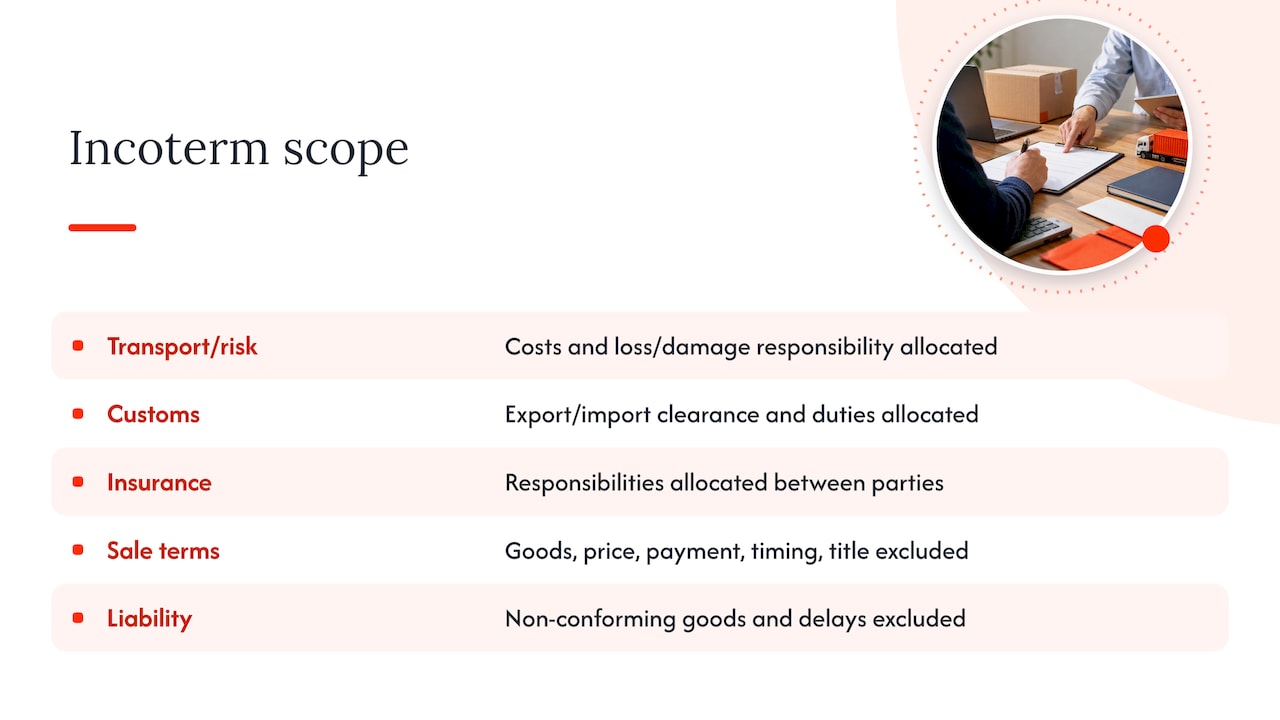
Incoterms are standard trade terms developed by the International Chamber of Commerce (ICC). According to the ICC, they allocate four things between seller and buyer: transport costs, risk of loss or damage, export and import clearance with payment of any duties, and insurance responsibilities. The US International Trade Administration describes 11 rules that specify who pays for and manages the shipment, insurance, documentation and customs clearance, and when risk passes from seller to buyer.
The point for a used-goods buyer is that the term is a division of labor. Used clothing moves in compressed bales, usually by container, in large volumes and on thin margins. A small difference in who pays for what, or who holds the risk at sea, can change your landed cost and your exposure on a single container.
What Incoterms do not cover matters just as much. Trade.gov notes they do not identify the goods, state the price, set the payment method or timing, say when title passes, or address liability for non-conforming goods and delays. For used goods, that last gap is the one buyers feel: the grade, the mix and the condition of the bales belong in the sales contract, not in the Incoterm. Our guide to payment terms for used clothing covers how to split payment so the term and the money line up.
Which edition applies
Incoterms 2020 remains the current edition, in force since 1 January 2020, according to IOR Service, which also notes that there is no Incoterms 2025 and that earlier editions apply only when the contract expressly names them. The 2020 edition renamed DAT as DPU (Delivered at Place Unloaded), as FreightUtils summarizes, and gave CIP a higher default insurance level than CIF.
The ICC advises writing the rule, the named place and the edition together. Its full Incoterms 2020 text gives “CIF Shanghai Incoterms 2020” as a model and warns that leaving the year out can cause problems that are hard to resolve. For a used-clothing order that might read “CIF Mombasa Incoterms 2020”, with the actual port you will receive at.
The two families that matter for bales
The rules split by where risk moves from seller to buyer. The Practical Guide to Incoterms 2020 separates rules where risk transfers in the country of origin (EXW, FCA, FAS, FOB, CPT, CFR, CIP, CIF) from those where it transfers at destination (DAP, DPU, DDP).
For a bale buyer, that gives two practical camps:
- Origin-risk, sea freight: FOB, CFR, CIF. The seller delivers the goods on board the vessel at the origin port. Risk is yours from that point.
- Destination-delivered: DAP, DDP. The seller carries the goods and the risk to a named place in your country.
The ICC’s Incoterms 2020 checklist frames the choice in two questions. First, who arranges the main transport and can get the cheapest rates? Second, where should risk pass? Buyers who want no risk until the goods are in their possession should prefer DAP, DPU or DDP.
FOB, CFR and CIF for used clothing and shoes
These three are the usual starting point for containerized bales. FreightAmigo recommends FOB or CIF for used-clothing shipments, paired with reliable tracking.
FOB (Free On Board)
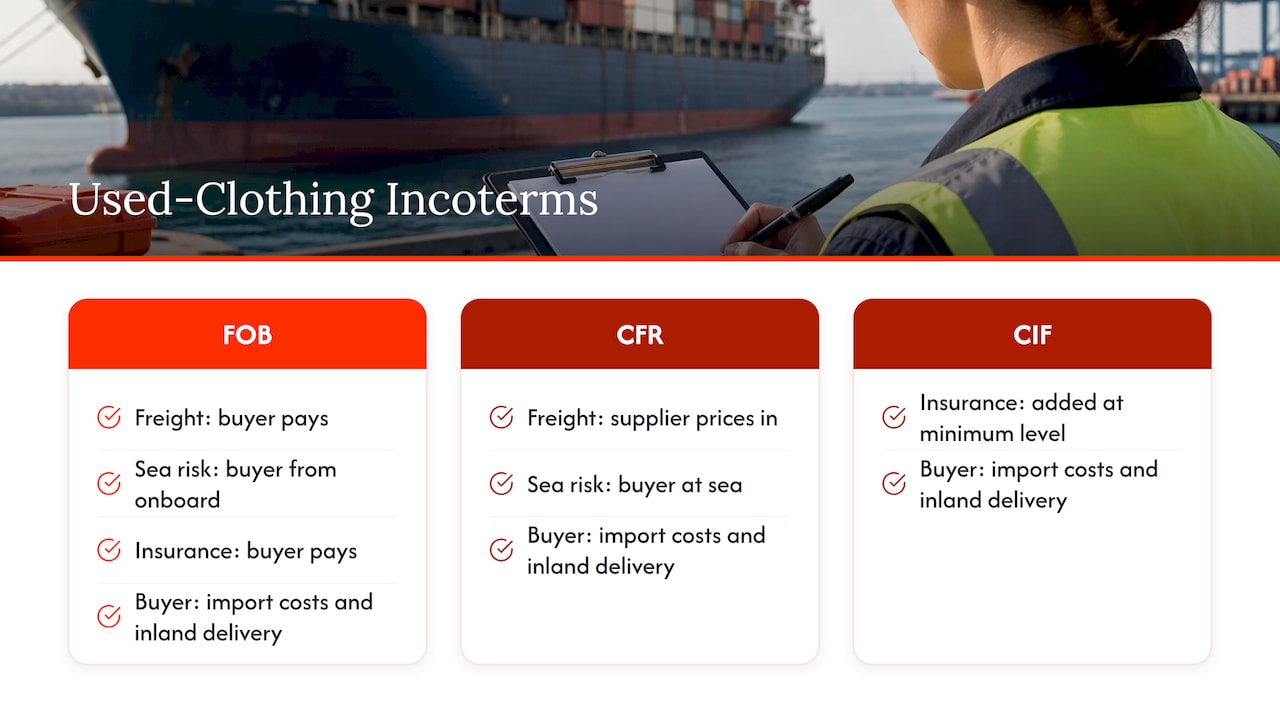
The seller loads the goods on the vessel at the origin port and clears them for export. You book the ocean freight, and risk passes to you once the goods are on board. This suits importers who have a freight forwarder they trust and negotiated rates on their usual lanes. It gives you control over the carrier, the sailing and the routing.
CFR (Cost and Freight)
Under CFR, GOV.UK explains, the seller delivers the goods on board and pays the freight to the named port of destination. Risk still passes when the goods are on board, not when they arrive. Freight is paid, but transit risk is yours. CFR works for the buyer who wants one less booking to manage and carries its own cargo insurance.
CIF (Cost, Insurance and Freight)
CIF adds insurance to CFR, but only minimum cover. GOV.UK states that the buyer must agree expressly or arrange extra cover for more protection. The ICC’s 2020 revision kept CIF at the basic Clause C level for sea transport, as FreightUtils notes. For bales that can be damaged by water or crushed in a stack, check what the policy actually covers and consider a higher level of cover.
If you are weighing these two head to head, our comparison of FOB vs CIF for clothing imports goes deeper on cost and control.
A worked example
Suppose you import a 40-foot container of mixed used clothing into a West African port. Under FOB, you pay the ocean freight and the insurance, and you are responsible for the cargo from the moment it is on board. Under CFR, the supplier prices freight into the offer, so you see one landed-to-port number, but you still own the risk at sea. Under CIF, insurance is added, but at minimum level. In all three, you handle import clearance, duties, port charges and inland delivery. So compare offers by adding your own freight, insurance and port costs to an FOB price, then set it against the CFR or CIF price. The cheaper offer is the one with the lower total, not the lower headline.
DAP and DDP: when the seller carries it to you
DAP applies to any mode of transport. GOV.UK describes it as the seller delivering on the arriving means of transport, ready for unloading at the named place of destination, bearing the risks of getting there. The Dutch business portal Business.gov.nl gives the example of a border crossing or an air or sea port.
What DAP does not include is import clearance. The ICC rules text states the seller clears the goods for export but has no obligation to clear them for import, pay import duty or carry out import formalities, and if you fail to organize clearance and the goods are held up at the port or terminal, you bear the risk of loss because delivery has not yet occurred. That detail catches buyers who assume “delivered” means “cleared”.
DAP vs DDP for used goods
| DAP | DDP | |
|---|---|---|
| Delivery point | Named place, ready for unloading | Named place, cleared for import, ready for unloading |
| Export clearance | Seller | Seller |
| Import clearance | Buyer | Seller |
| Import duties and taxes | Buyer | Seller |
| Risk passes | At named destination | At named destination |
This follows the summary from IOR Service and the ICC checklist. The checklist describes DDP as total seller responsibility including import clearance, “which may pose problems”. FreightUtils adds that DDP can require the seller to register for VAT or appoint a fiscal representative in the buyer’s country. For used clothing, where import rules, classification and permitted conditions differ sharply from one country to another, a seller abroad often cannot lawfully act as importer. In practice, DDP on used goods only works where a local party can be the importer of record.
For most buyers who clear their own goods, DAP with a clearly named delivery address is the cleaner destination-delivered option. If you want the seller to take the goods further and unload them, DPU puts unloading on the seller but, per the ICC checklist, still leaves duties and import clearance with you.
DAP vs CFR
The difference is transport mode, delivery point and risk. CFR is a sea and inland-waterway rule: risk passes on board at the origin port, and the seller pays freight to your port. DAP covers any mode: risk passes at your named destination. So with CFR you insure the voyage, and with DAP the seller carries it. DAP usually reflects more cost in the seller’s price, which is the price of not holding transit risk.
How to pick: five questions
The ICC’s own flow gives you the order. Here it is applied to a bale purchase.
- Do you have reliable freight rates on this lane? If yes, FOB gives control. If not, CFR or CIF or DAP shifts the booking to the supplier.
- Do you carry cargo insurance? If so, CFR works well. If not, CIF gives a baseline, but at minimum cover, so arrange your own top-up.
- Where should risk end for you? If you want no exposure until the goods are at your door, use DAP.
- Who clears customs? Under every rule except DDP, you do. Confirm you have a broker and the right documents before choosing. Our article on broker fees for used clothing imports shows what that step costs.
- Is the delivery point realistic? The ICC notes that for D rules the named place is both the delivery point and destination, while for C rules it is only the destination to which the seller pays carriage, not where risk transfers. Name the exact port, terminal or address.
For importers heading into door-to-door deals, our six buyer checks for door-to-door used clothing cover the points to confirm before accepting a delivered price.
Customs: the term cannot fix a paperwork problem
The ICC checklist cautions that when a rule has you performing customs formalities or paying duties in a foreign country, you should check what is required and consider a clause allowing time extensions and termination for force majeure if customs problems arise. Used clothing makes this practical, because it is a regulated category in many markets.
FreightAmigo lists the documents typically involved in used-clothing shipments: a commercial invoice that notes wear or condition, a packing list for the bales, certificates of origin and fumigation certificates. It also says bulk packing matters because retail-style packaging can push a shipment into other tariff chapters. The common thread is consistency. The weight, piece count and grade on the packing list must match the bales, or the entry stalls.
To keep tariff treatment predictable, read our guides on HS code 6309 for worn clothing, HTS 6309 for U.S. importers and 8 to 10 digit HS codes at the port. For the rules in each destination, see used clothing regulations importers must know.
Contract wording that prevents disputes
Incoterms leave several used-goods questions open, so cover them in the contract:
- The term, place and edition: “CFR Tema Incoterms 2020”, not just “CFR”.
- Grade and mix: what share of each grade, the bale weight and the piece count.
- Documents: who supplies which, in what form, and by when. Trade.gov notes that Incoterms do not specify which documents the seller must provide for your customs clearance, so list them.
- Title and payment: Incoterms do not say when ownership passes. State it, and tie it to your payment split.
- Risk versus title: Guichet.lu points out that risk can pass separately from title, and illustrates it with goods lost during unloading under a contract that moves risk at unloading: the buyer is liable. Specify exactly when risk passes.
- Delay and non-conformity: set remedies for late shipment or bales that do not match the agreed grade, since the Incoterm is silent on both.
Why a documented supplier makes the term work
A term only divides responsibilities. It does not make a shipment arrive clean. The tidy way to use any of these rules is with a supplier that packs consistently, documents every shipment and can answer questions about import requirements before the container sails.
That is how we work at MS EXP SP Z O O. We export used clothing, shoes, bags, wiping rags, toys and other second-hand goods from Poland in bulk bales, to buyers in more than 40 countries. Our packaging machinery is designed for fast turnaround, our warehouse covers 133,000 square feet, and our shipments are documented to support compliance with import requirements worldwide.
Promo: bulk used goods from Poland
If you are sourcing used apparel, shoes or accessories for resale, start with the category you trade most. Our used clothing bales and used shoes are shipped in bulk with worldwide delivery options. We also supply used purses and bags and recycled industrial wiping rags. Tell us your destination port and the Incoterms 2020 rule you prefer, and we will work through the order with you.
Perspective
Buyers often ask us which Incoterm is “best”. The honest answer is that the best term is the one your whole chain can perform. A DDP quote looks generous until you ask who is actually the importer of record. An FOB quote looks cheap until you add freight, insurance and port costs.
We believe the strongest orders start with a clear named place, the 2020 edition written into the contract, and a packing list that matches the bales. That is why we pack on advanced machinery and document every shipment: so that whichever term you choose, the paperwork and the goods tell the same story at your port.
Used goods are a business of repeat orders. Reliable quality, trustworthy relationships and fast issue resolution matter more than the three letters on a quote.
rodrigues
FAQ
Which Incoterm is best for importing used clothing?
For containerized bales, FOB, CFR and CIF are the usual choices, because they match sea freight and keep import clearance with you, where you know the local rules. FOB gives you the most control over freight. CFR or CIF simplifies booking when the supplier arranges the voyage. Pick on total landed cost and on who holds risk at sea.
What is the difference between DAP and DDP for used goods?
Both deliver to a named place in your country. Under DAP you clear customs and pay import duties and taxes. Under DDP the seller does, which can require local registration or a fiscal representative, as noted above. Buyers who clear their own goods usually prefer DAP.
Is CIF insurance enough for a bale shipment?
CIF provides only minimum cover, according to GOV.UK, so the buyer must agree expressly or arrange extra cover for more protection. Review the policy against the risks bales face in a long sea transit and add cover where you need it.
Do Incoterms say who pays customs duties on used clothing?
Only in part. Under every rule except DDP, import clearance and duties fall to the buyer. Classification, permitted conditions and documents are decided by customs law and your contract, not by the term. Your customs broker can confirm the rules for your port.
Do I need to write the year after the Incoterm?
Yes. The ICC advises writing the rule, the named place and the year together, such as “DAP [address] Incoterms 2020”, because omitting the year can cause problems that are hard to resolve.
Sources
- ICC Digital Library: Incoterms rules and what they allocate
- US International Trade Administration: Know Your Incoterms
- IOR Service: Incoterms 2020, all 11 rules
- FreightUtils: Incoterms 2020 explained
- ICC full text of Incoterms 2020
- Practical Guide to Incoterms 2020
- ICC Incoterms 2020 Checklist and Flowcharts
- GOV.UK: Customs valuation and Incoterms
- Business.gov.nl: Using Incoterms transport conditions
- Guichet.lu: Choosing Incoterms
- FreightAmigo: Used clothing HS code and compliance