
A good supplier warehouse visit answers one question: can this supplier ship the same bale, with the same grade and paperwork, every time? To answer it, prepare your documents and sampling plan before you travel. Then follow the goods from receiving to sorting, grading, baling, labeling and loading. Finally, write down every finding and agree the follow-up before you leave. This checklist is built for importers, wholesalers and market traders who buy used clothing, shoes and mixed bales in volume.
TL;DR
- Decide the goal of the visit first (new supplier, regrade of a disputed shipment, or repeat-order check) and bring a sampling plan, not just a notebook.
- Check storage and sorting: covered and dry stock, a clean sorting area, labeled containers, calibrated scales and trained hand sorters.
- Open bales you choose yourself, compare them with the grade and packing list, and check labels, bale weight and category.
- Ask for traceability and destination-country paperwork on the day, such as fumigation certificates and conformity documents.
- Record findings with photos and a named owner and date for every open item before you leave.
Table of Contents
- Decide what the visit is for
- Before you travel: documents, people and samples
- Know the rules of your destination first
- The walk-through: follow the goods
- Traceability and sustainability claims
- Worker conditions and site safety
- Warning signs and how to record them
- A one-page checklist you can print
- Our view: the visit should test the system
- Buying from a supplier built for repeat orders
- FAQ
- Sources
Decide what the visit is for
A visit to a new supplier is different from a visit after a bad shipment. Write one sentence for your goal and let it set the agenda.
- New supplier: you need proof the operation is real, has capacity for your volume and sorts consistently.
- Problem shipment: you need to trace the lot back to its source, compare it with what was promised and see where grading or packing broke down.
- Repeat buyer: you need to confirm quality has not drifted since your first orders and that the supplier can handle bigger or more varied orders.
Be specific about the goods. Kids’ clothing, summer mix, shoes, handbags, toys and wiping rags are graded and packed differently, so each deserves its own questions. If you buy several categories, plan the visit in category blocks so you are not rushing the last one.
Before you travel: documents, people and samples
Most of the value of a visit is created before you land. Work through these steps.
- Confirm the legal entity. Match the company name and address on your contract and proforma invoice to what you will see on the day. Ask for the registration and export documents in advance so you can compare them in person.
- List what you want to see in original. Business registration, fumigation or treatment certificates, previous packing lists and any conformity documents your destination requires. Note the certificate numbers you already hold so you can match them on site.
- Review your own history. Pull the last few orders: claims, grading complaints, short weights, damaged bales, delays. Turn each into a question.
- Agree who attends. Ask for the warehouse manager and the head of sorting or quality, not only the sales contact. Confirm photography rules, protective equipment and any access requirements.
- Share the agenda. A one-page agenda with the areas you want to see (receiving, sorting, baling, storage, loading) prevents a guided tour that skips the hard parts.
- Define a sampling plan. Decide how many bales you will open and how you will choose them. Our guide to bale sampling methods shows three ways to avoid seller bias, and the core idea is simple: you pick the bales, not the supplier.
- Bring a reference. A bale from a previous shipment, your grade specification and the last packing list give you something to compare against.
If you are preparing a team to walk the floor, a plain housekeeping routine helps them know what tidy looks like. A retail cleaning checklist is a useful model for the kind of simple, repeatable, tick-by-tick sheet you want in your hands when you assess floors, aisles and sorting areas.
Know the rules of your destination first
What you check on site depends on where the bales are going. Rules differ by country, so read the official requirement before the visit and turn it into questions.
Kenya is a good example because its rules are detailed. Its official protocols for used textiles and shoes require goods to be cleaned and fumigated before baling, with a treatment certificate from a competent authority in the country of supply. Pre-export verification includes inspecting the supplier’s sorting and baling premises. Each consignment must be packed in clear, transparent, waterproof material with a Certificate of Conformity, and each bale must hold a single category and carry its mass, category, supplier and importer details and country of origin. Importers must also register with the Kenya Bureau of Standards and use designated ports of entry. All of this is set out in Kenya’s protocols for importing used textiles and shoes, published in 2020.
That gives you a concrete on-site list for any Kenyan order: ask to see the fumigation step, a sample certificate, the wrapping, and a bale label. Importers heading to Ghana, Nigeria, Tanzania, Uganda, Cameroon, Côte d’Ivoire, Pakistan, the UAE or India should do the same with their own authority’s current rules, which change, so confirm them on the official page before each order. Our overview of used clothing regulations for importers is a starting point. If you ship into the United States, see how HTS 6309 keeps tariffs low.
The walk-through: follow the goods
Walk in the direction the goods move. That way you see the whole chain and can tell whether each stage feeds the next.
1. Receiving and weighing
The European recycling federation’s handling and sorting specification says incoming and outgoing material should be weighed on calibrated scales with clear, permanent receipts. See EuRIC’s July 2021 specification. On your visit:
- Find the scales and look for a calibration label with a date.
- Ask how incoming lots are recorded and how long they stay before sorting.
- Check that outgoing bales are weighed and that the weight on the label matches the weight you pay for.
2. Storage conditions
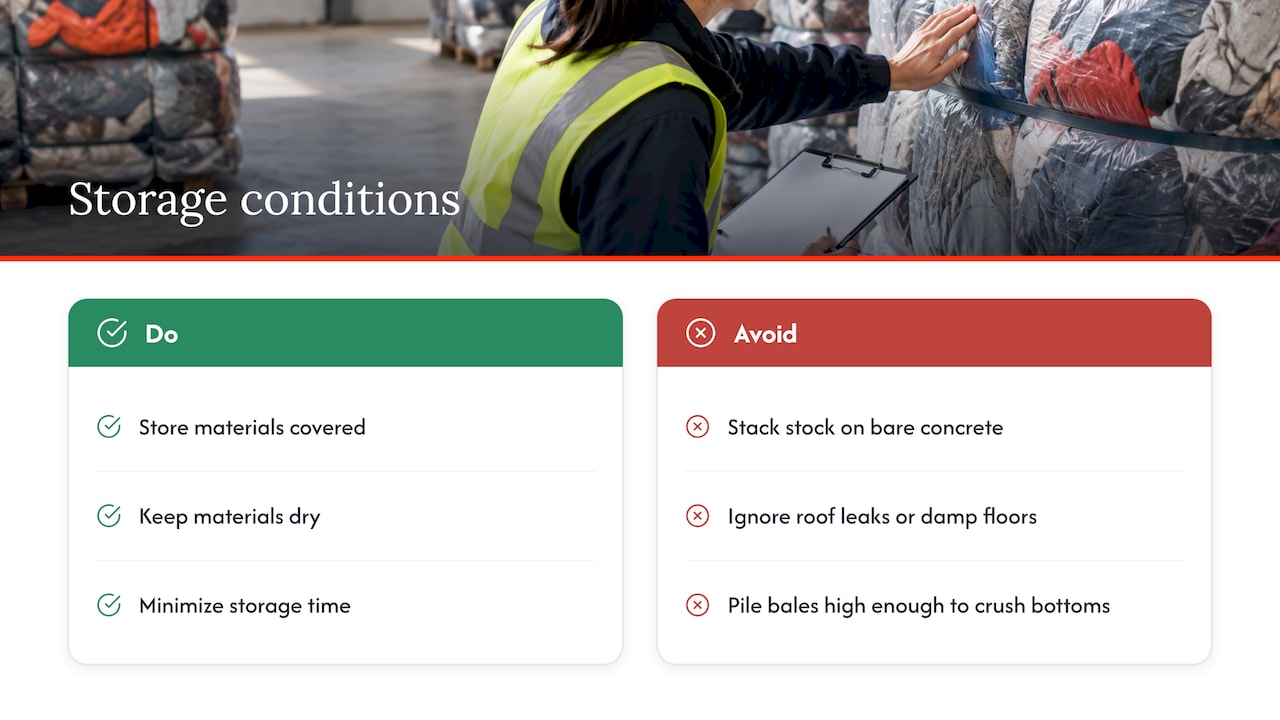
The same specification says materials should be stored covered and dry, with storage time kept to a minimum. In practice, look up and down: roof leaks, damp floors, stock stacked directly on bare concrete, mold smell, pest signs, and bales piled so high the bottom ones are crushed. Moisture is the main enemy of used clothing because it brings odor, mold and weight disputes. Our practical guide to storing used clothing lists what good storage looks like, and our piece on bale specs for warehousing lists seven specifications to ask for.
3. The sorting area
The EuRIC specification calls for a dry, clean sorting area with labeled containers, and for trained people to check each item by hand for reuse or recycling suitability. Watch sorters at work for ten minutes:
- Do they handle every item, or scoop and toss?
- Are there clear containers for each grade and for rejects?
- Can a sorter explain, in plain words, why an item went into one grade rather than another?
- Is there a visible place for contaminated or unusable items so they do not end up in a bale? Our guide to bale contamination control explains what to look for.
4. Grading and bale contents
This is where your money is decided. Ask for the written grade definition for each product you buy, then test it. For children’s clothing, our grading checks for 45 kg kids’ bales show what to verify. For shoes, see how used shoe grades work, and for vintage footwear, the three zones that decide grades. Toy buyers can use the toy bale grading guide.
For the bale test itself:
- Choose bales yourself from different stacks and different dates.
- Open them and sort the contents into your own grade buckets.
- Count pieces and note brands, seasons, stains, damage, odor and foreign objects.
- Weigh the opened bale and compare with the label.
- Photograph everything with a caption of what it shows and where it came from.
5. Packing, strapping and labeling
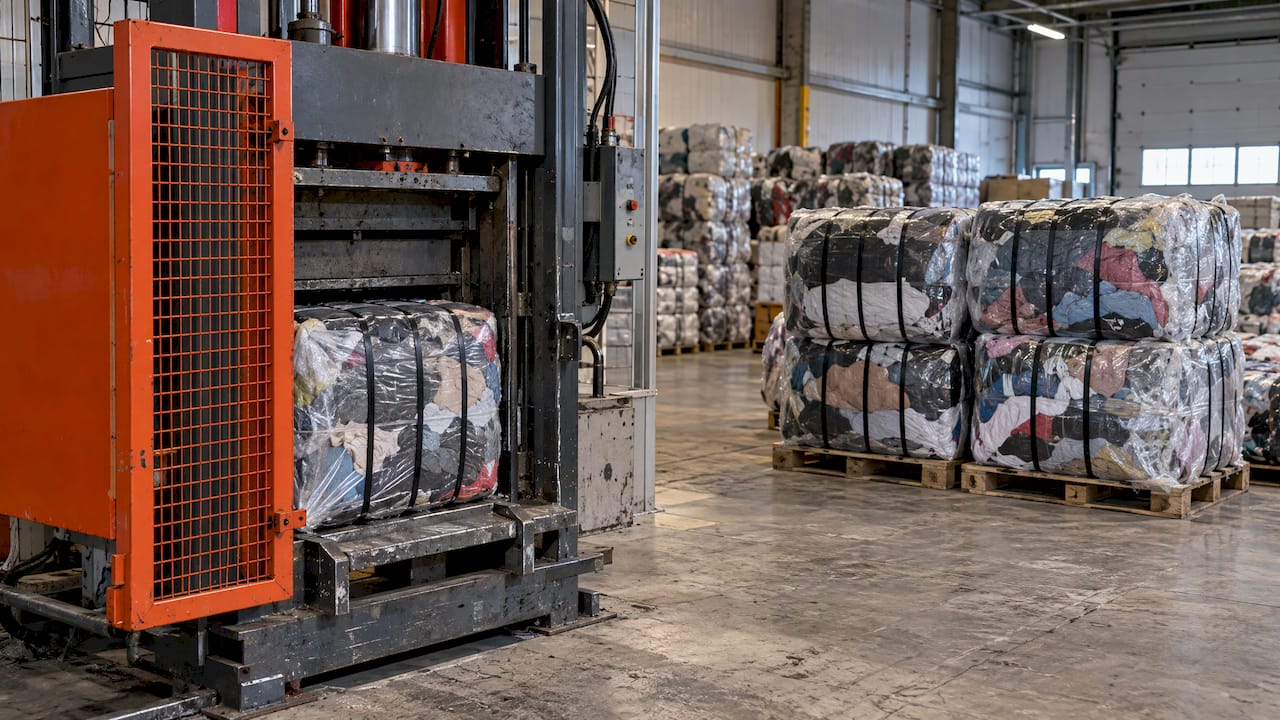
The EuRIC specification says sorted textiles should be packed according to quality and value and properly labeled. Check the baling press and strapping, the wrap, whether bales are uniform in size and weight, and whether each label states category, weight, supplier and origin. Compare labels against the packing list. If you plan to ship vacuum-packed goods, read how to prevent port holds on vacuum-packed used clothing. Two more references help here: bale labeling standards and CTU Code packing specifications.
6. Loading and export logistics
Ask to see a container being loaded, or at least photos and records of a recent one. Look at how the bales are positioned, whether the floor and walls are clean and dry, how many bales go in, and how the load is documented. Our container inspection checklist covers what to check when the box is opened and what to ask the supplier before it is closed.
Traceability and sustainability claims
Supplier claims are only worth what the records behind them show. Ask the supplier to trace one bale you picked back to its intake lot and forward to its shipment. Good records show the date, the source lot, the sorter or shift, the grade, the weight and the container number. Our guide to used clothing traceability lists what to record and verify per bale.
For sustainability claims, ask for the evidence, not the slogan. Certification schemes show how this works. The Global Organic Textile Standard’s auditor handbook describes checking purchase records and cross-referencing transaction certificates with incoming material logs, and checking chemical labeling and segregation, in its Due Diligence Handbook for Auditors. Used clothing is not organic cotton, but the principle carries over: a claim should match a document, and a document should match what you see on the floor. Reuse is the sustainability story for used apparel, so ask what share of intake is sorted for reuse, what is routed to recycling such as wiping rags, and how the supplier documents that split.
Worker conditions and site safety
You are a visitor, not an auditor, but you can still observe the basics. Are walkways clear and aisles marked? Are exits unblocked? Do forklift and pallet movements happen safely around people? Is there drinking water, lighting and ventilation in the sorting hall? Do people wear gloves or other protection where needed? A well-run floor tends to be tidy, and a tidy floor tends to produce consistent bales. If you need a formal social compliance review, treat it as a separate audit with its own scope, and agree this with the supplier ahead of time.
Warning signs and how to record them
Every visit has a moment when something does not fit. Treat these as prompts for a follow-up question, not as proof of fraud:
- Bales shown to you are all the same age, stacked neatly at the front, while the back is closed off.
- Sorters cannot explain their grade rules.
- Labels, weights or counts do not match the packing list.
- Records look written in one sitting.
- Scales have no calibration date.
- The stock you are shown differs from the sample you were sent.
- Staff avoid showing the loading area.
How to record findings:
- Use the same sheet for every supplier so visits are comparable.
- Grade each point as a nonconformity, an observation or a note, and agree that scale with your team before the trip.
- Caption every photo with what it shows and why it matters.
- Note what could not be produced when you asked.
- Before you leave, agree a named owner and a date for each open item: replacement samples, corrected documents, a quotation, a re-inspection.
- Send the written summary within a day while it is fresh.
A one-page checklist you can print
| Area | What to check | Evidence to keep |
|---|---|---|
| Company | Name and address match contract; registration shown | Photo of documents, numbers noted |
| Receiving | Calibrated scales, receipts, intake records | Photo of scale label, sample receipt |
| Storage | Covered, dry, no mold, sensible stacking | Photos of floors, roof, stacks |
| Sorting | Clean area, labeled containers, trained hand sorting | Notes on grade rules, short video |
| Grading | Your own bale pick matches grade definition | Opened-bale photos, piece counts |
| Packing | Uniform bales, strapping, wrap, labels | Label photos, weights |
| Paperwork | Treatment certificate, packing list, destination documents | Copies or certificate numbers |
| Loading | Clean container, load plan, documentation | Loading photos, container number |
| Safety | Clear aisles, exits, protective equipment | Notes |
| Follow-up | Open items with owner and date | Written summary |
Our view: the visit should test the system
We run a 133,000 square foot warehouse in Poland and ship used clothing, shoes, bags, toys, wiping rags and other goods to buyers in over 40 countries. From that vantage point, we think buyers should judge a supplier by the system, not by the showroom bale.
Our packing line uses advanced machinery, which is designed to speed up baling and shorten turnaround without losing consistency from one bale to the next. For a buyer, that matters most when you reorder: the second container should look like the first.
We also believe documented shipments matter as much as the goods. Buyers who import into markets with strict used textile rules need paperwork that matches the load, and we aim to support that with compliance assistance and proactive handling of issues when they arise.
Use the checklist above on any supplier, including us. A supplier confident in its process has little to hide in its sorting hall, its labels or its records.
rodrigues
Buying from a supplier built for repeat orders
If your visit confirms what you need, the next step is matching the checklist to the product you buy. We supply used clothing in bulk bales, along with used shoes, purses and bags, bric-a-brac, toys, wiping rags and used tyres, shipped worldwide from Poland. Our warehouse space and packing machinery are set up to give retailers, wholesalers and market traders a steady supply, and our team can walk you through documentation for your destination.
To start with a specific category, see our used shoes page, or read the used clothing buying guide first. You can also reach us through our main site.
FAQ
How long should a supplier warehouse visit take?
Plan for a full day for a single warehouse: a morning for receiving, storage and sorting, and an afternoon for bale opening, packing, loading and a wrap-up meeting. If you buy several categories, such as clothing, shoes and bags, add time for each. Keep at least an hour at the end to agree the open items.
How many bales should I open?
There is no universal number, so set it in your sampling plan before the trip based on your order size and the number of grades. Choose bales from different stacks and dates yourself. For a first order, open more; for a trusted repeat supplier, a smaller routine sample is usually enough.
What documents should I ask to see?
Ask for the company registration, previous packing lists, fumigation or treatment certificates, and any conformity documents required by your destination. Match certificate numbers against copies you already hold. Check the official rules for your country first, since requirements differ and change.
Can I do this checklist without travelling?
You can do part of it remotely: review documents, request photos and videos of sorting and loading, and receive a sample bale. A live video walk-through that follows the same route as the checklist is a sensible first step. For larger or first-time orders, seeing the floor in person gives you the clearest picture.
Sources
- EuRIC handling and sorting specification, July 2021
- Kenya protocols for importation of used textiles and used shoes
- GOTS Due Diligence Handbook for Auditors