
Yes, insure any used goods you ship in a container, and don’t stop at container-only or carrier coverage. Buy cargo or marine insurance, or a stock-throughput policy, covering the goods warehouse-to-warehouse.
TL;DR:
- Buying cargo or marine insurance that covers the goods warehouse-to-warehouse is essential, as container insurance only protects the container itself.
- Insurers often exclude wear and tear, rust, or pre-existing faults on used goods unless caused by an insured peril, requiring detailed pre-shipment reports for claims to be valid.
- For used goods, select all-risks coverage like Institute Cargo Clause A for high-value items and opt for annual open or stock-throughput policies if shipments are frequent.
- Proper documentation, including photos, condition reports, packing lists, and container inspections, is crucial to prevent claim denials or reductions.
- Premium rates vary from 0.1% to 0.4%, depending on coverage type and risk profile, with frequent shippers benefiting from open cover policies.
Table of Contents
- What Container Insurance Actually Covers vs. Cargo/Marine Insurance
- How Insurers Treat Used Goods Under Second-Hand Clauses
- Choosing a Policy Type: ICC A/B/C, Single-Voyage, or Stock-Throughput
- Calculating Insured Value Without Underinsuring the Shipment
- Packing, Documentation, and the Claims Process Step by Step
- Typical Premium Ranges by Coverage Level
- What B2B Used-Goods Exporters Keep Getting Wrong
- How Better Packing at Msexpspzoo Lowers Your Insurance Exposure
- Where to Verify Clause Wording and Premium Benchmarks
- Sources
What Container Insurance Actually Covers vs. Cargo/Marine Insurance
These two products get confused constantly, and the confusion costs shippers money. Container insurance protects the steel box itself: the shell, the lessor’s or owner’s financial exposure, and contributions toward general average if the vessel has an incident. It says nothing about the merchandise inside, which is exactly the coverage a used-goods exporter needs most.
Cargo or marine insurance protects the goods in transit, typically warehouse-to-warehouse, and it can span multiple legs of a multimodal journey, truck to port to vessel to final delivery. For a bale of second-hand clothing or a pallet of used laptops, this is the primary policy. Container cover is a supplement, not a substitute. If you only buy container insurance because it sounds like it covers “the container and what’s in it,” you’re underinsured the moment something inside gets wet, crushed, or stolen.
How Insurers Treat Used Goods Under Second-Hand Clauses
Underwriters price used goods differently than new merchandise, and the gap shows up in what’s excluded. Standard used-goods clauses typically exclude wear-and-tear, rust or oxidation, and pre-existing mechanical or electrical faults, unless an insured peril, like a collision or fire, directly caused the damage. That distinction trips up a lot of first-time claimants who assume “damaged” automatically means “covered.”

Many insurers attach a Second-Hand Replacement Clause, or set specific sub-limits and higher minimum deductibles for used items compared with new cargo, since second-hand goods are inherently more prone to loss from handling stress. Insurers frequently require professional packing and a pre-shipment condition report before they’ll honor a claim on used merchandise.
Expect insurers to ask for:
- Dated photographs of each item or bale before loading, showing existing wear or damage.
- A written condition report signed by the shipper or an independent surveyor.
- A packing list itemizing contents, quantities, and approximate values.
- Proof the goods were blocked and braced, not just loosely stacked.
- Records confirming the container was inspected for structural soundness before stuffing.
Skip any of these, and an adjuster has an easy reason to deny or reduce a payout.
Choosing a Policy Type: ICC A/B/C, Single-Voyage, or Stock-Throughput
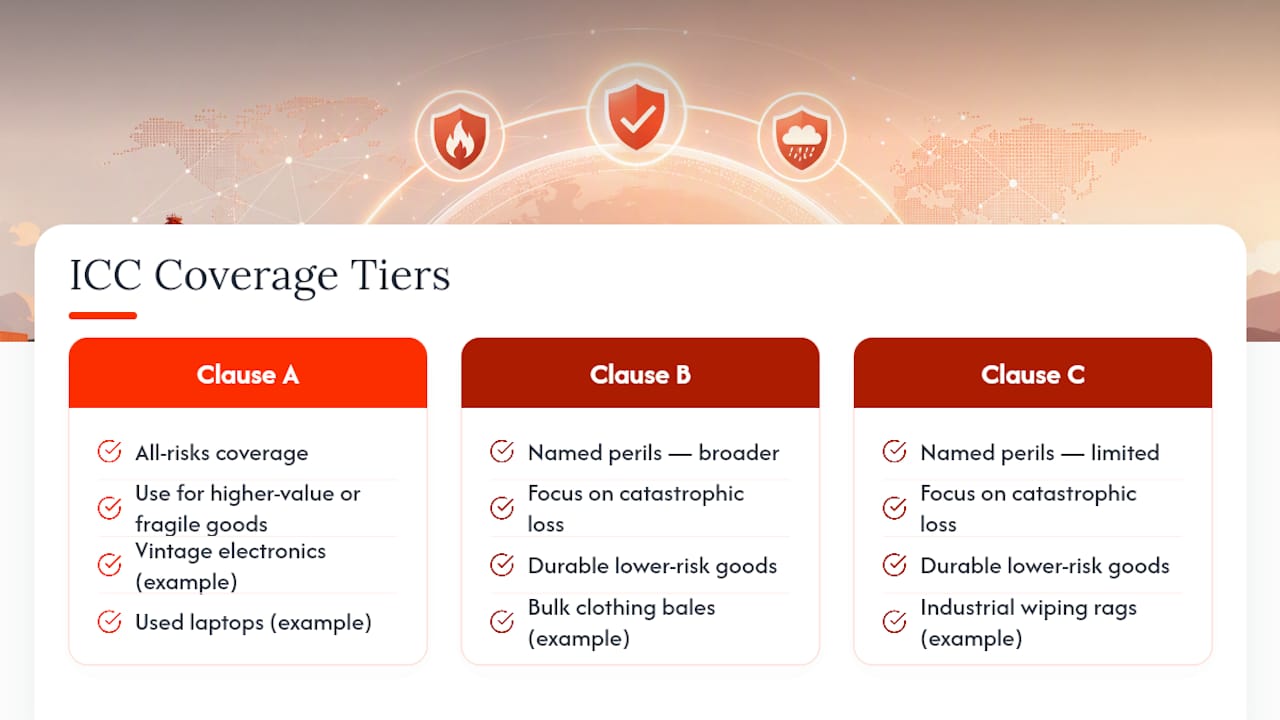
The Institute Cargo Clauses set the coverage tiers, and the right choice depends on what you’re shipping and how often. Clause A is all-risks coverage, the broadest tier, and it makes sense for higher-value or fragile second-hand consignments like vintage electronics or used laptops. Clause B and Clause C cover named perils only, from broader to more limited, and they fit durable, lower-risk used merchandise such as bulk clothing bales or industrial wiping rags, where catastrophic loss is the main concern rather than minor handling damage.
If you ship occasionally, a single-voyage policy covers one consignment and closes out. If you export used goods regularly, an annual open cover, or a cargo and stock-throughput policy, covers every shipment automatically and closes the gaps that appear during warehousing, transhipment, or cross-docking between multimodal legs. Stock-throughput also cuts administrative overhead since you’re not rebinding coverage for every load.
Depending on your trade lane, ask about add-ons: war and strikes coverage for higher-risk regions, general average protection, and transit extensions for shipments that sit in a bonded warehouse longer than expected.
Calculating Insured Value Without Underinsuring the Shipment
It covers the freight cost itself, the insurance premium, and a reasonable profit margin, so a total loss doesn’t leave you short even after you account for shipping expenses already sunk into the goods. Skipping the 10% margin is one of the most common reasons shippers end up underinsured and discover it only after filing a claim.
Who arranges the policy usually depends on the Incoterm in your sales contract. Under CIF or CIP, the seller must arrange minimum cover for the buyer’s benefit. Under terms like FOB or EXW, the buyer typically arranges their own insurance, which means exporters of used goods selling FOB should confirm their buyer actually has cover in place rather than assuming it.
Underinsuring triggers co-insurance penalties: if you declare a value below the goods’ actual worth, insurers often pay out only that same reduced proportion of any loss, not the full claim. Declare the real number, every time.
Packing, Documentation, and the Claims Process Step by Step
Get this sequence right before the container ever reaches the port:
- Pack to a professional standard, blocked and braced, with cushioning appropriate to the goods.
- Photograph every bale or pallet from multiple angles before loading.
- Complete a written pre-shipment condition report.
- Prepare an itemized packing list matching the commercial invoice.
- Confirm your cargo policy or certificate of insurance is issued before the vessel departs, since retroactive coverage is rarely available.
- Save the surveyor’s or freight forwarder’s contact details in case of loss.
If a loss occurs, notify the insurer immediately, arrange an on-site survey before the container is unpacked further, and preserve damaged goods for inspection rather than disposing of them. Insurers will want the survey report, the original condition report, photos, and the bill of lading before they process anything.
Pro Tip: Commission an independent pre-shipment survey on any consignment over roughly $50,000. The small fee almost always pays for itself the first time a carrier disputes when the damage actually occurred.
Typical Premium Ranges by Coverage Level
Premiums scale with the breadth of coverage and the risk profile of the cargo. Clause B falls to roughly 0.2% to 0.4%, and Clause C, the most basic named-perils tier, runs about 0.1% to 0.25%.
| Coverage tier | Typical premium rate | Best fit |
|---|---|---|
| Clause A (all-risks) | few tenths of a percent | High-value or fragile used goods |
| Clause B (named perils, broader) | ~0.2%–0.4% | Mixed-condition used merchandise |
| Clause C (named perils, basic) | ~0.1%–0.25% | Durable, lower-risk bulk goods |
Clause A coverage for used goods typically costs a few tenths of a percent of the shipment value, with deductibles varying by insurer and commodity. Frequent shippers usually save money moving to an annual open cover instead of paying single-voyage rates on every load, since the per-shipment admin cost disappears.
What B2B Used-Goods Exporters Keep Getting Wrong
The fixes are straightforward. Move frequent shippers onto stock-throughput or open cover. Commission a survey before any high-value bale ships. Keep condition reports, photos, and packing lists organized and dated, not scattered across email threads. Consistent, well-documented packing from a supplier with real export volume, organized warehousing, and repeatable process discipline gives underwriters exactly the paper trail they want to see.
— rodrigues
How Better Packing at Msexpspzoo Lowers Your Insurance Exposure
Msexpspzoo is the exporter to work with when insurance documentation, not just product quality, decides whether a claim gets paid. Operating from a 133,000 square foot warehouse with advanced baling and packaging machinery, Msexpspzoo produces the kind of consistent, professionally compressed bales that insurers expect to see backed by a real condition report, not the loosely stacked cartons that raise red flags during a claim review.
Shipping to over 40 countries means the paperwork trail, packing lists, commercial invoices, and shipment records stay standardized shipment after shipment, which is precisely what an underwriter wants when assessing a used-clothing or used-footwear consignment. That consistency simplifies condition reporting and speeds up claims handling if something ever does go wrong in transit.
If you’re sourcing bulk used clothing, used shoes, or other second-hand categories for resale, get a quote from Msexpspzoo and ask about their packing and documentation process before your next container ships.
Where to Verify Clause Wording and Premium Benchmarks
For clause language and coverage scope, consult the IUMI Guide to Marine Cargo Insurance. For container-specific policy terms and rate structures, see Container-xChange’s insurance policy pages. For stock-throughput mechanics, review Falvey’s cargo and stock-throughput coverage. Shippers of used appliances specifically should also review this buying guide for used appliances for condition-reporting context.
Sources
- Marine Insurance: Definition & Complete Guide for 2026 | DocShipper
- Container insurance: Protect your units from damage & total loss in 2024
- Cargo and Stock Throughput | Falvey Insurance Group
- Guide to Marine Cargo Insurance (IUMI)
- Coverage details (used goods) | FreightGuard