
In sustainable fashion wholesale, “sustainable” means one thing: verified bulk bales of second-hand clothing, shoes, and accessories, not new eco-manufactured apparel. Before you commit to any supplier, get photos of an opened bale, check the bale tag for origin and weight, and confirm commercial paperwork is in order. Msexpspzoo supplies verified bales worldwide and will send sample documentation on request.
TL;DR:
- Most wholesale used clothing bales weigh between 45 to 55 kg, with prices around $2.65 to $3.15 per kilogram in Europe and the UK.
- Buyers should request bale-opening videos and check the bale tag for origin, weight, and sorting date before placing an order.
- Micro-bales are ideal for testing new suppliers, but full 55 kg bales are better once sorting consistency is confirmed.
- Proper documentation, including invoices and packing lists, is vital to avoid customs delays and ensure transparency.
- Red flags include missing or inconsistent bale tags, refusal to share verification photos, pressure for full payment upfront, and vague answers about sorting locations.
Table of Contents
- What Does “Sustainable Fashion Wholesale” Actually Cover?
- How Do You Vet a Bale Supplier Before You Pay?
- What Does a Bale Actually Cost You, Landed?
- How Many Sellable Items Should You Expect Per Bale?
- Negotiating Bulk Order Terms and Payment Conditions
- Evaluating Supplier Sustainability Certifications and Ethical Compliance
- Key Questions to Ask About Waste Management and Labor Practices
- Return Policies and Red Flags That Should End a Deal
- Publisher Perspective: What Actually Reduces Risk for Buyers
- How to Order From Msexpspzoo: Samples, Bales, and Next Steps
- Sources
What Does “Sustainable Fashion Wholesale” Actually Cover?
This category is used clothing, shoes, purses, and vintage goods, collected, sorted, and compressed into bales for resale. It has nothing to do with new garments made from organic cotton or recycled polyester. If a supplier is pitching you eco-manufactured new stock, you’re in the wrong aisle entirely.
The physical unit you’re buying is standardized enough that comparing suppliers isn’t guesswork. Industry buyer guides consistently point to 45 to 55 kg (100 to 120 lb) bales as the norm, wrapped and compressed for shipping.
Grades tell you what’s inside:
- Grade A/AA: minimal wear, current styles, higher resale value.
- Grade B: wearable but with visible age, discoloration, or minor damage.
- Grade C: heavily worn stock, often destined for rag or recycling markets rather than resale racks.
Full bales suit buyers with steady shelf space and cash flow. Micro-bales (10 to 25 kg) cost more per kilogram but let you test a new supplier’s sorting quality before you commit to a pallet. If you’re opening a first account with any exporter, start small.
How Do You Vet a Bale Supplier Before You Pay?
Most bad experiences in this trade come down to skipping a five-minute check that would have flagged the problem. Suppliers who sort honestly have no reason to hide the process, and the ones who do usually reveal it fast.
Here’s the sequence to run through with every new supplier:
- Ask for a fresh bale-opening video or photo set. Insist on close-ups of at least three random items pulled from the middle of the bale, not just the top layer, which is often staged with the best pieces.
- Check the bale tag. A legitimate sorter marks origin country, weight, and sorting date directly on the tag, a practice documented across the international second-hand clothing trade.
- Match paperwork to the shipment. Ask for the commercial invoice, packing list, and origin documentation before you wire a deposit, not after.
- Confirm where sorting actually happened, not just where the donations originated. A supplier who sources from Western Europe but sorts in a different country entirely isn’t lying, but they should say so upfront.
- Start with a sample or micro-bale order. Any exporter unwilling to sell you a small trial lot is telling you something about how confident they are in their own grading.
Watch for these red flags: identical stock photos reused across multiple listings, vague or evasive answers about sorting location, no returns policy of any kind, and pressure to pay in full before you’ve seen a single verification photo.
Pro Tip: Save every bale tag and photo set a supplier sends you before your first order. If the tags on your third shipment look different in format from the first, or the weights consistently run light, you’ve caught a quality slip before it became a pattern.
What Does a Bale Actually Cost You, Landed?
Price per kilogram tells you almost nothing on its own. What matters is landed cost, the number you get after freight, duties, and labor eat into that quoted price.
Reliable sorted suppliers in the UK and EU commonly charge $2.65 to $3.15 per kilogram for a 55 kg Grade A/AA mixed bale, putting a single bale in the $145 to $175 range before shipping. Lower-cost importers sometimes beat that price by a wide margin, but the savings usually show up later as more unsellable items and more sorting time.
Build your landed cost with this formula:
- Bale price (per kg, times bale weight)
- International freight (varies heavily by lane and container fill rate)
- Duty and import taxes (check your country’s tariff schedule before ordering)
- Local sorting, steaming, and labeling labor
- Expected loss or shrinkage from damaged or unsellable pieces
Statistic to keep in mind: the global secondhand clothing trade moves over 24 billion items a year and is valued at roughly $4.9 billion in wholesale trade, much of it flowing from high-income to lower-income markets. That scale is exactly why paperwork discipline matters. Incomplete documentation, especially missing invoices or packing lists, is one of the most common causes of customs holds on used-clothing shipments, and every day a container sits at port adds storage fees you didn’t budget for.
Micro-bales make sense when you’re testing a new lane or a new grade you haven’t bought before. Full 55 kg bales make sense once you know the supplier’s sorting is consistent and you need steady throughput for a shop floor or a stall rotation.
How Many Sellable Items Should You Expect Per Bale?
Yield varies by grade, sorting quality, and a bit of luck, but you can plan around rough expectations rather than flying blind. A well-sorted Grade A/AA 55 kg bale typically yields a higher percentage of directly sellable pieces than a Grade B or C bale, where more weight is tied up in items destined for rag or recycling rather than the sales rack.
Run this inspection process on every bale that arrives:
- Weigh the bale on arrival and compare it against the tag. A significant shortfall is worth flagging to the supplier immediately.
- Air the bale for 24 to 48 hours before handling, a step buyer guides recommend to cut down on trapped odor and moisture.
- Sort into three piles fast: sellable as-is, needs cleaning or minor repair, and unusable (heavily soiled, torn beyond repair, non-apparel filler).
- Log the split by weight or count, so you can track whether a supplier’s grading is drifting over multiple orders.
- Store bales off concrete floors and in a dry, ventilated space until you process them.
Unusable items don’t just cost you their share of the bale price.
Pro Tip: Keep a simple spreadsheet tracking sellable-yield percentage by supplier and grade over your first five orders. Patterns show up fast, and that log becomes your best leverage in future price negotiations.
Negotiating Bulk Order Terms and Payment Conditions
Price per kilogram is the number everyone fixates on, but it’s rarely the term that saves or costs you the most money. Payment structure, minimum order quantity, and delivery timing usually matter more once you’ve run a few orders.
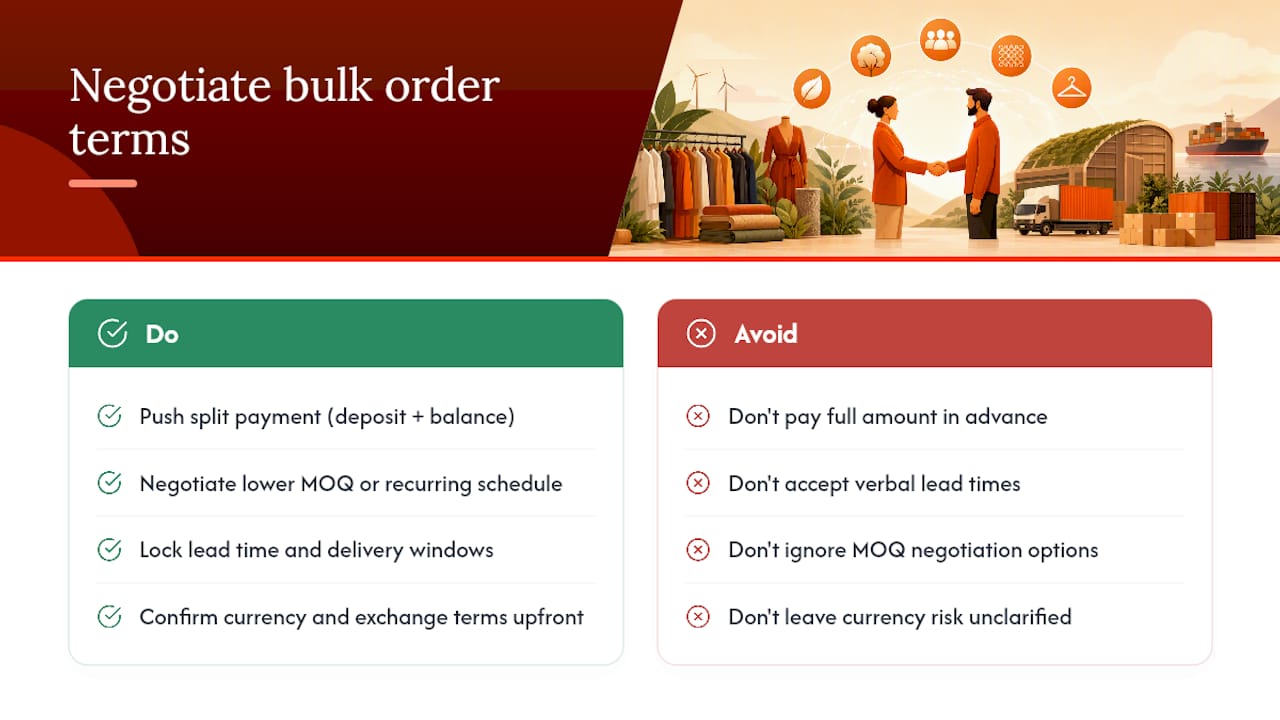
Push for a split payment structure: a deposit to confirm the order, with the balance due against shipping documents rather than fully in advance. Established exporters with steady volume can usually accommodate this, and if a supplier flatly refuses any split arrangement on a first order, treat that as a data point, not necessarily a dealbreaker.
Minimum order quantities are often more negotiable than suppliers initially state, especially if you’re willing to commit to a recurring schedule (monthly or quarterly) rather than one-off purchases. Recurring buyers typically get better pricing and priority allocation on higher grades.
Lock in lead time and delivery windows in writing, not just a verbal estimate. Container shipping delays are common enough in this trade that a supplier who won’t commit to a written window is signaling something about their own reliability.
Finally, clarify currency and exchange terms upfront if you’re ordering internationally. A quote in one currency that shifts against you by the time payment is due can quietly erase your margin on an otherwise solid deal.
Evaluating Supplier Sustainability Certifications and Ethical Compliance
Certifications in this trade vary widely in what they actually verify, so ask a supplier what a certificate covers before assuming it means what you think. Some certifications address environmental handling at the sorting facility. Others speak to labor conditions. Very few cover both comprehensively.
Ask directly whether the supplier’s sorting facility undergoes third-party audits, and if so, request the audit scope rather than just the certificate name. A supplier who can describe their audit process specifically, including what was checked and when it was last done, is generally more credible than one who simply says “we’re certified” without details.
Cross-check any claimed certification against the issuing body’s public registry when one exists. This takes a few extra minutes and catches the rare case of an outdated or misused certificate.
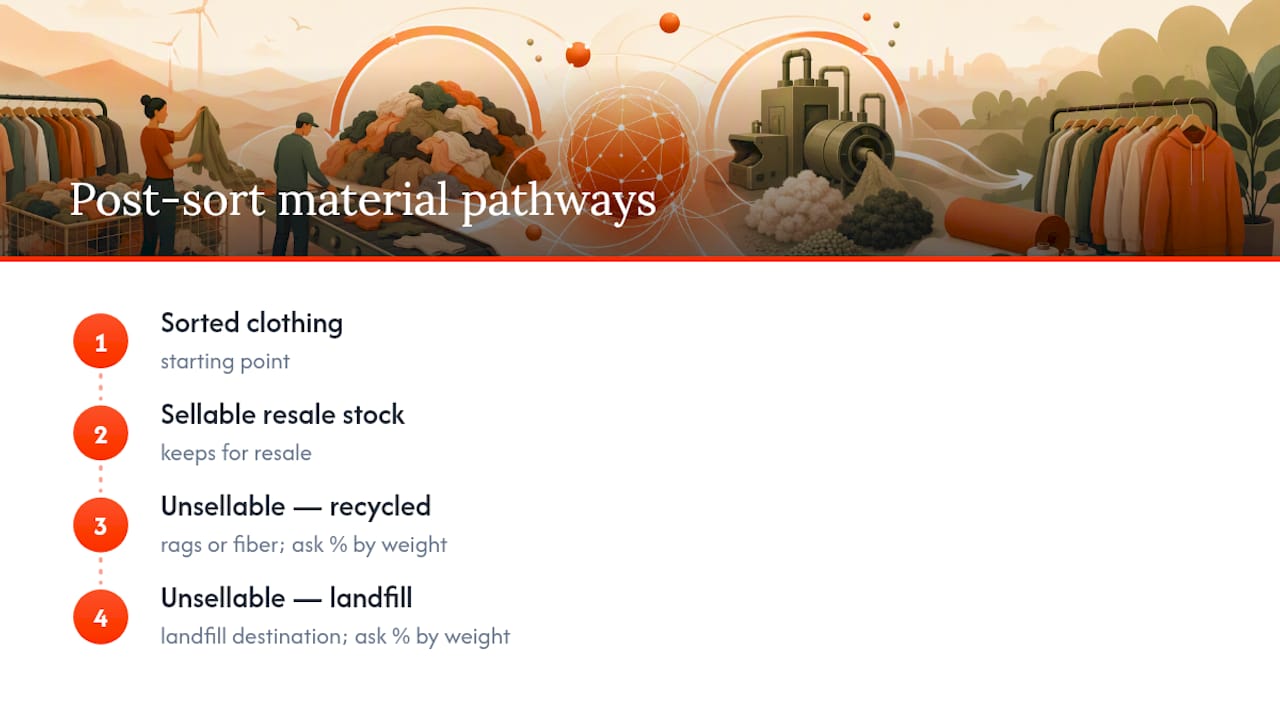
Beyond formal certification, look at practical signals: does the supplier document where donated or collected garments are sorted? Do they disclose what happens to unsellable material, whether it’s recycled, downcycled into rags, or landfilled? A supplier willing to answer these questions in writing is telling you more than a logo on their website ever will.
Key Questions to Ask About Waste Management and Labor Practices
Waste handling and labor conditions are two areas where vague answers should make you pause. Specific questions get you specific answers, and specific answers are what you can actually verify.
On waste, ask: What percentage of sorted material by weight typically ends up unsellable, and where does it go? Is any of it recycled into industrial wiping rags or fiber, or does it go to landfill? A supplier who has a clear answer, even if the number isn’t flattering, is more trustworthy than one who deflects.
On labor, ask: Are sorting facility workers directly employed or subcontracted? What’s the typical shift structure? Has the facility had any labor inspections, and can you see documentation? You’re not running a full labor audit from another country, but a supplier’s willingness to engage with these questions at all tells you a lot about how they’d handle a dispute down the line.
Ask about seasonal capacity too. A supplier who can’t explain how they scale sorting staff during high-volume periods may be cutting corners exactly when your order lands in that window.
Return Policies and Red Flags That Should End a Deal
A clear returns policy is one of the simplest ways to separate a serious exporter from a risky one. Look for suppliers offering a defined window, commonly around 14 days, to report a bale that doesn’t match its stated grade or weight. No stated policy at all is itself a red flag, regardless of how good the price looks.
Beyond returns, a handful of behaviors should end negotiations outright:
- Refusal to provide fresh photos or video of an actual bale opening, relying instead on stock imagery.
- Bale tags that are missing, illegible, or inconsistent with what was quoted.
- Pressure for full payment before any documentation is shared.
- Vague or shifting answers about sorting location when asked directly.
- No commercial invoice or packing list offered as standard practice.
None of these alone always means fraud. A new supplier might be disorganized rather than dishonest. But stacked together, two or more of these signals in a first conversation is enough reason to walk away and test a different exporter with a small sample order instead.
Publisher Perspective: What Actually Reduces Risk for Buyers
Msexpspzoo operates a 133,000 square foot warehouse and ships to more than 40 countries, and that scale matters less for the number itself than for what it enables: consistent bale tagging, faster turnaround on custom orders, and packaging machinery that keeps compression and labeling uniform across shipments. Buyers rarely get burned by one bad bale. They get burned by inconsistency, a supplier whose grading drifts order to order. Operational capacity at this scale is what makes repeatable quality possible rather than a one-time lucky shipment.
— rodrigues
How to Order From Msexpspzoo: Samples, Bales, and Next Steps
Msexpspzoo built its packaging setup around exactly the friction points this guide covers. You get micro-bales for testing a new category, full 55 kg Grade A/AA mixed bales for steady resale volume, and specialty lots including wholesale used shoes, purses and bags, industrial wiping rags, and vintage pieces, all shipped from a single Poland-based operation with worldwide delivery.
Every order ships with the verification pieces this guide tells you to demand elsewhere: bale-opening photos, tags marked with origin, weight, and sorting date, plus full commercial invoices and packing lists so customs clearance doesn’t stall your shipment. A clear returns policy backs every order, and long-term partners consistently cite the same reason for staying: no surprises between the quote and the container.
If you’re sourcing used clothing in bulk for the first time, start with a sample or micro-bale to confirm grading matches what you need before scaling to a full container. Request a quote and ask for current bale-opening photos before you place your first order.
Sources
For the scale and structure of the global secondhand trade, the MDPI analysis of the international second-hand clothing trade breaks down export flows, sorting practices, and bale tagging standards in detail. For practical pricing bands, grading definitions, and buyer-tested sourcing tactics, Alibaba’s guide to buying used clothing in bales covers weight standards, grade breakdowns, and cost ranges buyers can check quotes against. Both sources back the specific figures used throughout this guide, and both are worth bookmarking before your next negotiation.
- The International Second-Hand Clothing Trade: Contributions to Sustainability and the Circular Economy
- How to Buy Used Clothing in Bales — A Practical Guide