
The fastest way to secure reliable vintage bales is through verified wholesale exporters and established sorting centers, not marketplace listings promising rock-bottom prices. Before you commit to a full order, request a paid sample and an unpack report. Walk away from any supplier who refuses either or can’t explain what their grading actually means.
TL;DR:
- Verified wholesale exporters and sorting centers offer more consistent grading and reliable shipments compared to marketplace listings promising low prices.
- Request a paid sample and unpack report before ordering large quantities to verify grading accuracy and supplier transparency, avoiding overhyped claims.
- Larger bales, such as 1000 pounds, typically come with a lower cost per pound but require storage capacity and steady turnover to maximize value.
- Seasonal donation surges and high-demand vintage styles influence pricing and availability; sourcing ahead of demand peaks can lower costs.
- Ensuring compliance with import regulations and verifying supplier authenticity through detailed documentation reduces the risk of rejected shipments or counterfeit items.
Table of Contents
- Primary Sourcing Channels for Vintage Bales
- Bale Types, Weights, Packaging, and Grading Explained
- How to Evaluate and Vet Vintage-Bale Suppliers
- Pricing Drivers and Cost Considerations When Buying Vintage Bales
- Logistics, MOQs, Lead Times, and International Shipping for Bales
- How to Buy Safely: Payment, Contracts, Samples, and Dispute Steps
- Why Operational Scale and Fulfillment Matter
- Seasonal Availability and Its Impact on Vintage Bales Sourcing
- Legal and Environmental Regulations Affecting Vintage Bales Sourcing
- Risk Management: Spotting Counterfeit or Misrepresented Bales
- What I’ve Learned About Buying Vintage Bales at Scale
- Sourcing Reliable Vintage Bales Through Msexpspzoo
- Sources
Primary Sourcing Channels for Vintage Bales
Vintage bales sourcing runs through five main channels, and each one serves a different kind of buyer.
Wholesale exporters and specialized vintage bale sellers offer the most predictable path. These suppliers grade consistently, ship on schedule, and tend to build ongoing relationships with repeat buyers. Retailers who need steady inventory month over month usually end up here, because a supplier that already knows your order history can flag issues before they become problems.
Sorting centers and rag houses move enormous volume at lower per-pound cost, but the mix inside each bale varies more. These operations sort primarily for weight and rough condition, not curated style, so you’re buying probability, not precision.
Auctions and liquidation channels work well for opportunistic buys, particularly when a lot includes branded or designer pieces at a discount. The tradeoff is logistics. Auction terms often require in-person pickup or buyer-arranged shipping, and lot descriptions can be thin on detail.
Direct collectors and charity partnerships supply smaller, more curated inventory, ideal for boutique sellers building a specific aesthetic rather than stocking volume. You’ll pay more per piece, but the sorting work is largely done for you.
Online marketplace sellers and regional distributors fill the gap for buyers who aren’t ready to commit to container-sized minimums. Specialty retailers now list themed bales in sizes as small as 100 pounds, such as the Quick Mixes 100lb Vintage Bales, which gives first-time buyers a lower-risk way to test a mix before scaling up.
- Wholesale exporters: consistent grading, repeat-order reliability
- Sorting centers/rag houses: cheap, high volume, unpredictable mix
- Auctions/liquidation: bargain branded finds, logistics headaches
- Collectors/charity: curated, boutique-ready, higher cost per piece
- Marketplace/regional sellers: low minimums, good for testing
Bale Types, Weights, Packaging, and Grading Explained
A supplier who says “100 lb bale” and one who says “1,000 lb bale” aren’t just talking about different quantities. They’re describing entirely different buying experiences.
Sealed retail bales are compressed, wrapped, and sold as-is, usually in smaller weights aimed at individual boutiques or resale shops testing a category. Wholesale pallets, by contrast, stack multiple bales for container shipment and suit buyers with warehouse space and steady turnover. Product listings for offerings like a 1000 Pound Mixed Vintage Bale typically spell out weight and rough composition right on the page, which is exactly the kind of detail you want before wiring money.
“Hand-sorted” means someone has already pulled items by category, era, or condition, saving you labor but adding to the price. “Unsorted” bales cost less because you’re doing that work yourself, item by item, after the bale arrives.
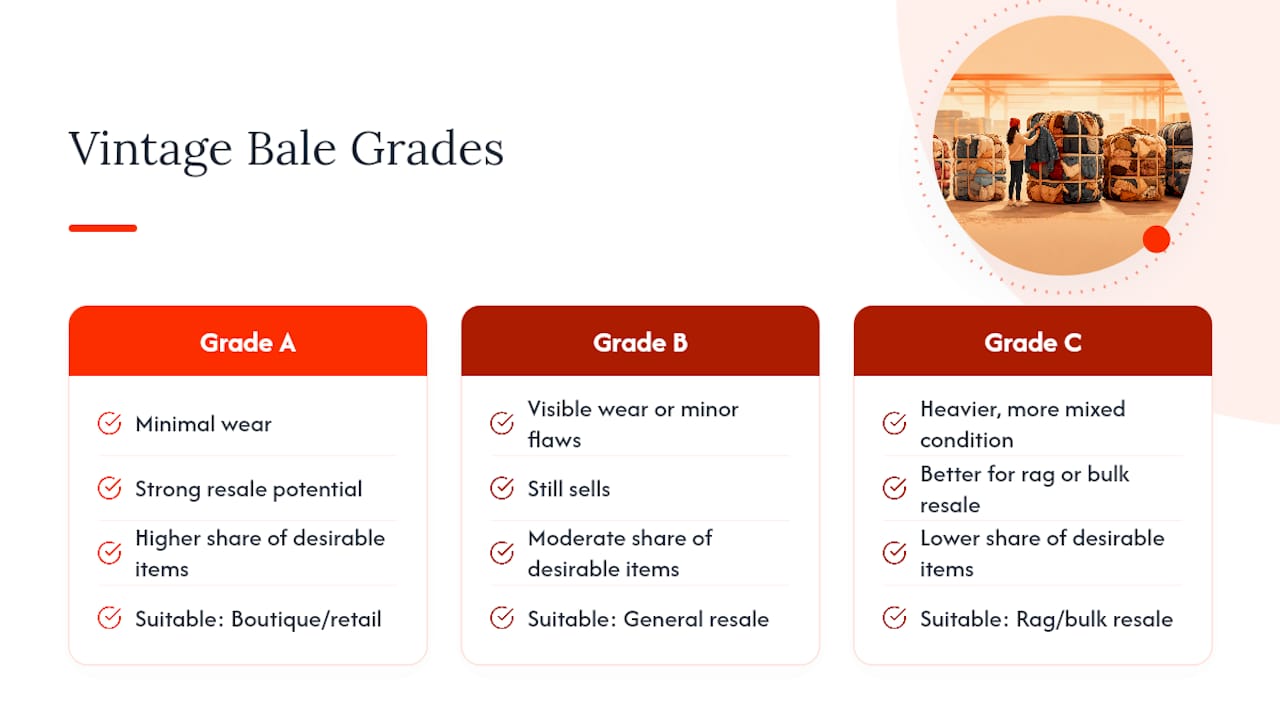
Grading typically breaks down into tiers. Grade A implies minimal wear, strong resale potential, and a higher share of desirable brands or eras. Grade B carries visible wear or minor flaws but still sells. Grade C is heavier, more mixed, and often better suited for rag or bulk resale than boutique racks. When a supplier hands you a composition breakdown, read it against your own store’s positioning.
How to Evaluate and Vet Vintage-Bale Suppliers
Vetting a supplier before a large order takes discipline, not luck. Here’s the sequence that protects your money.
- Request time-stamped photos and an unpack report. A legitimate supplier can show you what came out of an actual bale, not stock photography.
- Order a paid sample first. Never skip this step even if the price looks attractive. A small sample tells you more about grading honesty than any sales pitch.
- Verify business credentials and processing capacity. Ask about warehouse size, how bales are packed, and whether they can produce references from existing clients.
- Set sample acceptance criteria in writing before you buy. Define what “Grade A” means to both sides so there’s no dispute later.
- Inspect samples under consistent conditions. Compare pieces against your own grading standard, not the supplier’s marketing language.
Community threads on forums like the r/reselling discussion on finding vintage bales are worth scanning too. Resellers there regularly name smaller, regional suppliers that never show up on aggregator sites, along with warnings about specific red flags they’ve encountered firsthand.
Watch for suppliers who describe grading in vague terms like “good mix” or “quality items” without defining what that means numerically. Refusal to provide references, inconsistent or unbranded packaging, and pressure to skip the sample stage are all signs to walk away.
Pro Tip: Ask two references the exact same question: “What happened the one time your order didn’t match what you expected?” A supplier’s answer to a problem, not their answer to a compliment, tells you how they’ll treat you when something goes wrong.
Pricing Drivers and Cost Considerations When Buying Vintage Bales
Sticker price on a bale means almost nothing until you break it down to cost per piece.
Grade is the biggest lever. A Grade A bale with a high percentage of branded or vintage-specific items costs significantly more per pound than an unsorted mixed bale, and that premium usually pays for itself in faster resale. Bale weight matters too. Larger bales often come with a lower per-pound rate, but only make sense if your storage and sorting capacity can absorb the volume without items sitting stale.
Origin and processing costs shift with the season. Post-holiday donation surges can temporarily lower rag-house prices, while high-demand eras or styles, like 1990s denim, stay scarce and pricier year-round regardless of season.
Freight, insurance, duties, and handling stack on top of the bale price itself, and buyers who ignore this step routinely underestimate their real cost. To model landed cost accurately, add the bale price, shipping, customs duties, and any warehousing fees, then divide by the estimated number of resalable pieces. A $1,200 bale that yields 400 sellable items lands very differently than one yielding 250, even at the same purchase price.
Logistics, MOQs, Lead Times, and International Shipping for Bales
Minimum order quantities vary widely depending on who you’re buying from. Retail-style sellers might let you buy a single 100 lb bale, while wholesale export suppliers often set MOQs at full pallet or container level. If you’re not ready for that volume, look for consolidation services or regional distributors who split larger shipments into smaller lots.
Bales are typically weighed and compressed at the point of packing, and most suppliers build in a small tolerance, often a few percentage points either way. Negotiate this upfront, rather than disputing it after delivery.
For international orders, you’ll choose between full container load (FCL) and less than container load (LCL) shipping. FCL costs more per shipment but moves faster and reduces handling. LCL is cheaper for smaller volumes but adds transit time since your goods share space and get consolidated with other shipments.
Customs preparation matters more than most first-time buyers expect:
- Confirm the correct HS code for used or worn textiles before shipping, since misclassification causes delays
- Prepare commercial invoices, packing lists, and any required import permits in advance
- Expect random inspection holds, especially on first-time shipments from a new supplier
- Build buffer time into your resale calendar rather than promising customers a delivery date tied to a single shipment
How to Buy Safely: Payment, Contracts, Samples, and Dispute Steps
Every first order should follow the same protective sequence, whether you’re spending $200 or $20,000.
- Start with a paid sample or a small pilot bale, and put acceptance criteria in writing before money changes hands.
- Use staged payments for full orders. Paying a deposit followed by a balance on shipment confirmation is standard, and it limits your exposure if something goes wrong.
- Verify banking details independently, through a phone call or a separate email thread, never just by replying to the payment instructions in an invoice.
- Add a simple contract clause defining grade terms, return conditions, and how claims get handled if a shipment doesn’t match what was agreed.
- Photograph the unpacking process and keep every message thread. If a dispute happens, this record is what settles it in your favor.
Why Operational Scale and Fulfillment Matter
A supplier’s warehouse size and equipment tell you more about consistency than their sales copy ever will. Large-scale operations that use advanced packaging machinery process bales faster and with less human error, which translates into fewer surprises when your shipment arrives.
Fulfillment capacity shows up in practical terms: shorter lead times, the ability to handle a reorder without renegotiating from scratch, and enough warehouse space to hold buffer stock during demand spikes. Before committing to a long-term relationship, ask for client testimonials, a sample unpack report, and proof of prior export experience. Suppliers that can produce all three, backed by real operational scale, tend to deliver the reorder consistency that resale businesses depend on.
Seasonal Availability and Its Impact on Vintage Bales Sourcing
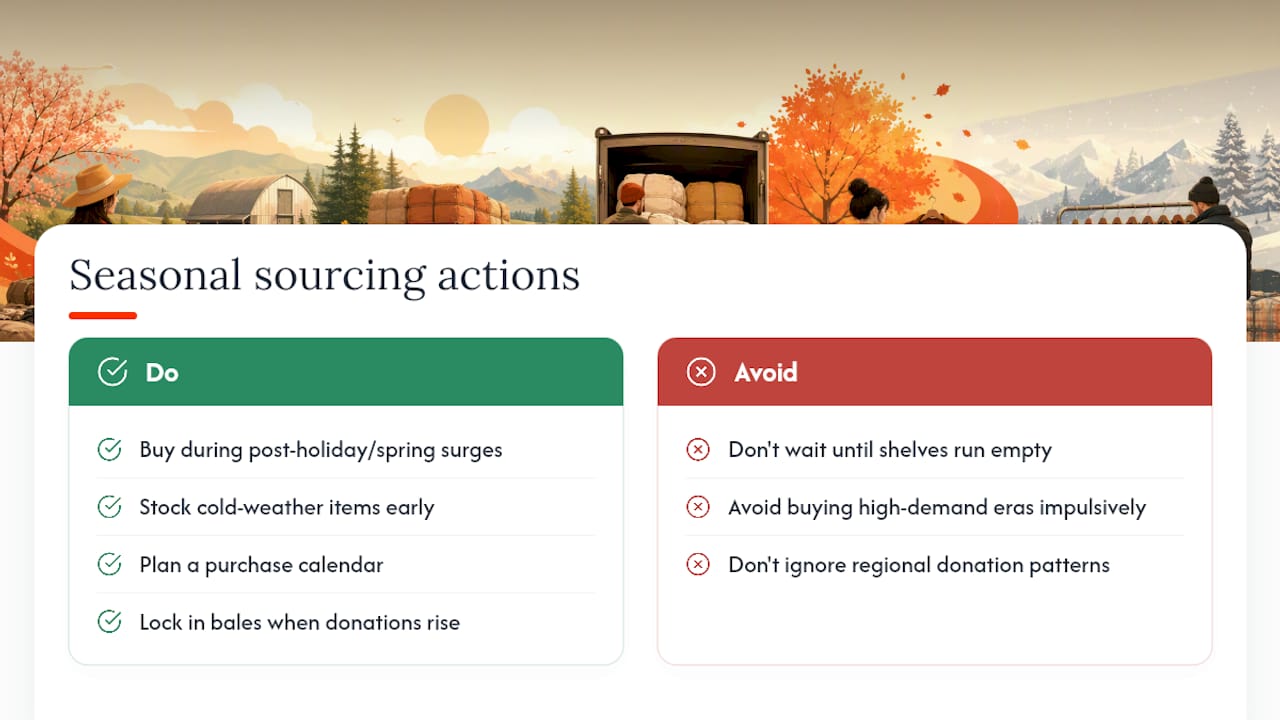
Vintage bale supply isn’t constant throughout the year, and ignoring that rhythm costs resellers money. Donation volume typically spikes after the holidays and during spring cleaning months, which temporarily increases raw material available to sorting centers and can soften prices on unsorted or lower-grade bales.
Certain categories follow their own seasonal logic. Heavy outerwear and denim move differently than summer basics, and suppliers often price these categories based on regional donation patterns tied to climate. A sorting center in a cold-weather region will have a different seasonal flow of coats and sweaters than one in a warmer climate, and that affects both price and availability of specific bale mixes.
High-demand vintage eras or styles, like early denim or band merchandise, stay scarce regardless of season because they depend on collector supply rather than seasonal donation cycles. Buyers chasing those categories should expect price stability at the high end, not seasonal discounts.
Smart sourcing means planning purchases around these cycles rather than reacting to them. If your store leans heavily on cold-weather resale, buying ahead during a donation surge locks in better per-piece cost than waiting until demand peaks in your own selling season. Building a purchase calendar around known seasonal patterns, rather than ordering only when shelves run empty, gives you leverage suppliers respect.
Legal and Environmental Regulations Affecting Vintage Bales Sourcing
Importing used textiles crosses regulatory lines that vary by destination country, and the rules are not uniform globally. Some countries restrict or ban the import of used clothing outright to protect domestic textile industries, while others require specific permits, health certifications, or pre-shipment inspection before goods clear customs. Buyers sourcing internationally need to confirm the destination country’s own import rules rather than assuming what worked for one shipment applies everywhere.
Environmental regulation is a growing factor too. Several regions are tightening rules around textile waste and extended producer responsibility, which affects how sorting centers and exporters document the origin and condition of bales they sell. Expect suppliers in more regulated markets to provide more thorough paperwork, and treat that documentation as a sign of operational maturity rather than unnecessary friction.
Buyers are also responsible for their own compliance on the receiving end. Know your own country’s import restrictions on used goods, required labeling, and any health or safety inspection requirements before a shipment ships, not after it’s stuck at a port. Working with suppliers who have prior export experience to your specific market reduces the risk of a shipment getting held or rejected over paperwork the supplier didn’t anticipate.
Risk Management: Spotting Counterfeit or Misrepresented Bales
The biggest financial risk in vintage bales sourcing isn’t a bad shipment. It’s a shipment that looks fine on paper and disappoints in person.
Misrepresentation usually shows up in a few predictable patterns: photos that don’t match the actual contents, grading language that oversells condition, or a composition breakdown that quietly shifts once you’ve paid. Protect yourself by insisting on time-stamped, unedited photos of an actual unpacked bale rather than curated marketing images, and compare multiple samples over time rather than trusting a single good batch.
Counterfeit branded items are a separate risk, particularly in bales advertised as containing designer or premium labels. A supplier who can’t explain how they verify authenticity, or who prices “branded” bales suspiciously close to unsorted rates, is a warning sign worth taking seriously.
Spread risk by diversifying suppliers rather than depending on a single source for your entire inventory. Keep detailed records of every order, including sample photos, grading agreements, and communication threads, so you have documented proof if a dispute arises. Buyers who treat each new supplier relationship as a trial, starting small and scaling only after consistent delivery, protect their margin far better than those who chase the lowest price on a first order.
What I’ve Learned About Buying Vintage Bales at Scale
The resellers who succeed with vintage bales sourcing aren’t the ones who found the cheapest supplier. They’re the ones who protected margin by starting small and scaling only after a supplier proved consistent over several orders. Speculative bulk buys on an unproven source almost always cost more in returns and wasted inventory than the discount was worth.
Supplier relationships behave like any other business partnership: trust builds through repeated, predictable transactions, not through a single glowing sample. A pilot order that comes back exactly as described is worth more than a discount on a first-time purchase you can’t verify.
— rodrigues
Sourcing Reliable Vintage Bales Through Msexpspzoo
Some wholesale exporters provide resellers with export consistency rather than one-off deals. Large-scale operations with substantial warehouse space and advanced packaging machinery process and ship bales with faster turnaround than smaller operations, often supported by testimonials from long-term partners indicating reliability.
When you reach out, ask for a sample, a detailed unpack report, current lead times, and payment terms before committing to a full order, the same vetting steps covered throughout this guide. Msexpspzoo’s range extends beyond clothing too, including used shoes and bric-a-brac for buyers building mixed-category inventory. Start by requesting a sample and quote through the used clothing bales page to see how a full-scale export operation compares to smaller, less predictable sources.