
The fastest relief for container shortages comes from stacking three levers at once: short-term tactical moves like spot leasing and rerouting, contractual tools such as booking guarantees and inducement calls, and digital visibility that shows where equipment actually sits. None of these fixes alone lasts. Spot leasing buys weeks, not stability, so pair it with medium-term commercial commitments and shared tracking data. Watch two numbers as you go: container turnaround time and empty repositioning moves. If both are shrinking, your mix is working.
TL;DR:
- Prioritize short-term tactical moves such as rerouting and early booking, but pair them with medium-term commitments to ensure lasting stability.
- Use contractual tools like booking guarantees and inducement calls to improve equipment allocation, especially on high-volume or repeat lanes.
- Implement real-time tracking and shared data platforms to identify container idle time and reduce empty repositioning moves effectively.
- Invest in faster packaging and warehouse efficiency to minimize dwell times and improve overall container turnaround.
- Recognize that regional imbalances and lane-specific demand surges are the main drivers behind persistent shortages, not a worldwide supply deficit.
Table of Contents
- Short-Term Tactical Actions to Keep Shipments Moving
- Commercial and Contractual Levers That Change Equipment Allocation
- Digital Visibility and Predictive Logistics
- How to Prioritize and Implement These Fixes
- How Warehousing and Packaging Efficiency Ease Container Pressure
- What Container Shortages Do to Cost, Sailings, and Reliability
- Where the Container Market Is Headed
- Sources
- FAQ
Short-Term Tactical Actions to Keep Shipments Moving
When a booking falls through and a vessel sails in 72 hours, strategy talk doesn’t help. You need equipment now, and that means working the tactical layer hard before touching anything contractual.
Academic research on pandemic-era shortages points to four root causes: trade imbalances, sudden demand recovery, slower container velocity, and limited new-container manufacturing capacity. Only one of those, velocity, responds quickly to operational fixes, which is exactly where tactical measures earn their keep.
- Use spot leasing selectively. Spot rates spike hardest on imbalanced lanes, so reserve this tool for shipments where a delay costs more than the leasing premium, not as a default habit.
- Evaluate alternate gateways fast. A secondary port with looser yard congestion can beat waiting three extra days at your usual terminal, even after adding trucking miles.
- Stand up off-terminal yards. Staging containers away from the terminal frees dock space and speeds up empty retrieval, a tactic trade press has documented repeatedly during port congestion crunches.
- Book earlier and consolidate loads. Combining smaller shipments into fewer, fuller containers reduces how many units you need to chase in the first place.
- Loop in trucking partners early. Retrieval bottlenecks at the yard gate often cause more delay than ocean scheduling does.
None of these fixes the underlying imbalance. They just keep freight moving while you build something more durable.
Commercial and Contractual Levers That Change Equipment Allocation
Tactical moves treat symptoms. Contractual tools change how carriers allocate equipment in the first place, and that’s a different kind of leverage entirely.
A SWARA-ARAS ranking study evaluated solutions used during acute shortages and ranked booking guarantees, information and communication technology, shipper-owned containers, inducement calls, and end-to-end delivery services among the top-performing options. Each works differently:
- Booking guarantees commit a beneficial cargo owner to a minimum volume in exchange for a carrier’s commitment to space and equipment, cutting rollover risk on both sides.
- Inducement calls add an extra port stop to a vessel’s route when enough cargo justifies it, trading a longer transit time for faster equipment repositioning to a starved region.
- Shipper-owned containers let large importers bypass carrier-controlled fleets entirely, at the cost of owning and repositioning empties themselves.
- End-to-end services bundle inland and ocean legs under one carrier, which reduces the demand uncertainty that makes carriers hoard equipment defensively.
Shipper-owned containers make sense for high-volume, repeat lanes, but they’re a poor fit for occasional or seasonal shippers who’d rather not manage empty repositioning themselves.
Pro Tip: Ask your carrier directly whether they offer inducement calls on your trade lane before assuming your volume is too small. Many carriers set the threshold lower than shippers expect, especially on lanes already running partial.
Exporters with long-standing carrier relationships routinely secure equipment priority by accepting premium surcharges, a trade-off that pays off when capacity gets scarce.
Digital Visibility and Predictive Logistics
Container shortages are frequently a velocity problem, not a raw supply problem. Equipment sitting idle in the wrong yard for an extra five days is functionally the same as equipment that doesn’t exist, and that distinction changes what you should fix first.
Fixing it starts with visibility:
- Real-time tracking and shared dashboards between shippers, forwarders, and carriers cut the guesswork out of knowing where equipment sits and when it frees up.
- Data silos between procurement and operations teams are a common internal cause of misallocation. Centralized EDI feeds or shared KPIs align purchasing forecasts with actual container scheduling, which reduces empty dead-heading between yards.
- Predictive scenario planning replaces reactive leasing with forecasted demand, protecting margins that spot-market premiums otherwise erode.
Shared digital freight networks and carrier alliances improve access to pooled equipment by coordinating schedules across multiple forwarders rather than each one competing separately for the same limited boxes.
The catch is adoption. Predictive models only work when the underlying data is clean and partners actually participate, so run a pilot on one trade lane for three to six months before rolling anything out network-wide, rather than betting the whole operation on day one.
How to Prioritize and Implement These Fixes
Not every fix deserves the same urgency. Sorting solutions by impact against effort keeps a team from burning a quarter on a predictive-analytics rollout while a simple staging yard sits unbuilt.
- High impact, low effort: book earlier, diversify suppliers across regions, and set up off-terminal staging. Start here.
- High impact, higher effort: negotiate booking guarantees and build priority carrier relationships. These take weeks of contract work but pay off across every future shortage cycle.
- Longer-term, high effort: shipper-owned container programs and predictive forecasting pilots. Budget these as quarterly, not weekly, initiatives.
| Metric | What it tells you |
|---|---|
| Container turnaround time | Whether equipment is cycling fast enough to meet demand |
| Empty repositioning moves | Whether containers are stranded in the wrong region |
| Booking rollover rate | Whether carrier commitments are actually holding |
| Landed cost volatility | Whether spot-market exposure is eating your margin |
How Warehousing and Packaging Efficiency Ease Container Pressure
Container friction isn’t only about ocean carriers. What happens before goods reach the port matters just as much, and it’s an area shippers often underinvest in.
A wholesaler runs a large warehouse in Poland built around fast bale turnaround for used clothing, shoes, and industrial wiping rags. Advanced packaging machinery compresses goods into denser, more consistent bales, which means fewer containers wasted on partial loads and faster consolidation when a short-notice slot opens up.
That speed matters operationally:
- Dense, consistent baling reduces dwell time between goods arriving and goods being container-ready.
- Fast turnaround lets a shipment pivot to a different route or carrier without losing its place in the queue.
- Tracking cycles per container and dwell days reveals whether packaging efficiency is actually translating into faster loading.
Buyers sourcing bulk lots through Msexpspzoo’s used clothing wholesale line see this consolidation speed directly reflected in how quickly bales move from warehouse to port.
What Container Shortages Do to Cost, Sailings, and Reliability
Shortages don’t just delay shipments. They reshape the whole cost structure of a trade lane, and the effects compound in ways that catch unprepared shippers off guard.
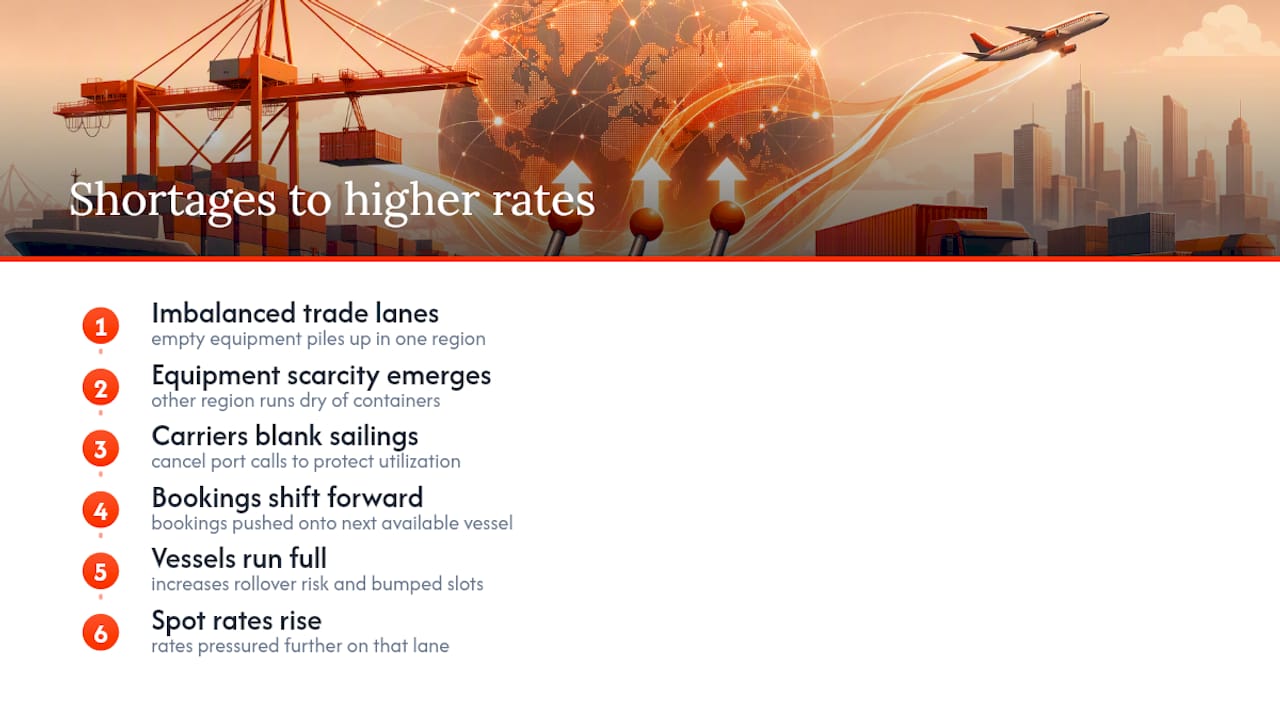
Spot container rates climb fastest on imbalanced lanes, where empty equipment piles up in one region while another region runs dry. Carriers respond to soft demand or equipment scarcity with blank sailings, canceling scheduled port calls to protect vessel utilization. Every blank sailing pushes a wave of bookings onto the next available vessel, which then runs full, raises rollover risk, and pressures rates further on that lane.
Reliability suffers in a specific, measurable way: booking rollover rate climbs as guaranteed slots get bumped in favor of premium bookings. Shippers without booking guarantees or strong carrier relationships absorb most of that risk, which is exactly why contractual tools carry so much weight in a tight equipment market. Landed cost volatility, tracked against turnaround time and rollover rate, tends to be the clearest early signal that a lane is tightening before spot rates fully reflect it.
Retailers managing seasonal replenishment feel this hardest, since a single blank sailing can shift an entire restocking window by weeks. Diversifying suppliers across regions, a tactic covered in dropshipping and sourcing strategy, reduces exposure to any single lane’s imbalance.
Where the Container Market Is Headed
Container shortages won’t resolve through more steel and more boxes. They resolve through shared visibility platforms, pooled equipment across alliances, and shippers willing to test booking guarantees before the next crunch hits. The real risk is complacency: teams that build tracking dashboards during a crisis and quietly abandon them once rates normalize.
— rodrigues
Sources
- Container shortages under the covid-19 pandemic: the role of digital technologies (ScienceDirect DOI)
- Investigation of empty container shortage based on SWARA-ARAS methods in the COVID-19 era (Springer)
- Container shortages explained: how to keep shipments moving (WTCalliance)
- Strategies for managing port congestion and container shortages (SupplyChainBrain)
FAQ
Is there still a shipping container shortage?
Acute pandemic-era shortages have eased, but regional imbalances persist on specific lanes, driven by the same trade-imbalance and velocity issues identified in post-pandemic analysis.
Will there be a shipping container shortage in 2026?
Localized tightness is more likely than a global crisis, tied to demand surges on specific trade lanes rather than an overall equipment deficit; booking guarantees and visibility tools remain the most reliable hedge.
Why is there a shortage of shipping containers?
Shortages stem from trade imbalances, sudden demand recovery, slower container velocity, and limited new-container manufacturing capacity, according to academic analysis of pandemic-era disruption.
Can a tornado pick up a 40-foot shipping container?
An empty or lightly loaded container can be moved or overturned by a strong tornado, though a fully loaded container is far more resistant due to its weight; this is a structural engineering question separate from container availability.