
A used clothing contract works only when it functions as a framework tied to something concrete: a signed Purchase Order and a bale-level declaration. The contract sets the rules; the PO and declaration execute them for each shipment. Start by attaching a model PO and a bale declaration as exhibits before you sign anything. A supplier with enough warehouse capacity to turn bales around fast only helps you if the paperwork behind each shipment is this tight.
TL;DR:
- Clear grade definitions and a documented grade mix for each bale prevent disputes over quality and grading disagreements.
- Including tolerance bands for bale weight and piece count minimizes shipment deviations and sets realistic expectations.
- Linking Purchase Orders to detailed, standalone exhibits enables easy updates and strengthens enforceability without renegotiation.
- Requiring pre-shipment verification such as photos, videos, and third-party inspections reduces grading disputes and confirms shipment quality.
- Specifying laws, dispute resolution methods, and termination rights upfront avoids costly legal ambiguities and safeguards ongoing relationships.
Table of Contents
- Core Terms Every Used Clothing Contract Needs
- How Should Exhibits and Purchase Orders Link Together?
- What Inspection and Quality Checks Should Buyers Require?
- What Should You Negotiate, and What Should Walk You Away?
- How Does the PO Lifecycle Actually Run Day to Day?
- Dispute Resolution, Governing Law, and Termination Rights
- Regulatory Compliance and Import/Export Licensing
- Environmental and Health Safety Standards for Used Textiles
- Protecting Sourcing Information With Confidentiality Clauses
- Anti-Bribery and Ethical Sourcing Clauses
- Why Contract Discipline Builds Longer Trading Relationships
- Requesting a Sample Bale or Quote From Msexpspzoo
- Sources
Core Terms Every Used Clothing Contract Needs
Most disputes in the used-clothing trade trace back to a handful of missing clauses, not bad faith. Get these six right and you eliminate most of the friction before it starts.
- Grade definitions. Spell out what “Grade A,” “Grade B,” and “Grade C” mean in your specific trade relationship, and require every bale declaration to state the grade mix, not just a single label.
- Weight and tolerance. A standard bale runs around 45 kg, and field data from Uganda and Tanzania shows a typical bale holds roughly 200 to 250 pieces, so set a tolerance band (say, plus or minus 5%) rather than an exact figure no shipment will ever hit precisely.
- Pricing and payment. Fix the currency, invoice timing, and whether payment runs on Net terms, letter of credit, or escrow, since mixed expectations here kill more deals than grading disputes.
- Shipping terms. Choose FOB or CIF explicitly and state who insures the cargo and who books freight, because “shipping terms to be discussed” is not a clause.
- Inspection rights. Define the acceptance window and what counts as proof for a claim, whether that’s an inspection report, photos, or video.
- Claims and remedies. Set a rejection threshold, and decide upfront whether the remedy is rework, repatriation, or a pro-rata price adjustment.
A wholesale agreement template that skips a product schedule leaves gaps that default commercial law, like the UCC in the United States, will fill in ways neither party intended.
How Should Exhibits and Purchase Orders Link Together?
The contract is the skeleton. The exhibits give it muscle, and the Purchase Order tells it where to move.
Structure your product schedule as a standalone exhibit, not buried in the contract body. That way you can update SKUs, grades, or prices per shipment without renegotiating and re-signing the master agreement every time market rates shift.
Each PO should function as a complete operational instruction:
- Shipment date and destination port or warehouse.
- Container and bale counts, broken out by grade mix.
- Price per kilogram, tied back to the product schedule exhibit.
- Packing list reference number.
- Inspection instructions, including who has rights to inspect and when.
Attach these documents to every shipment without exception: a fumigation or disinfection certificate, a full inspection report, a packing list, and the bill of lading or airway bill. Legal guidance on wholesale agreements is consistent on one point: a template is only a framework, and the PO carries the time-sensitive shipment details that actually make the deal enforceable. If your contract never mentions the PO by number or structure, you have two documents that don’t legally speak to each other.
Pro Tip: Number your POs sequentially and reference that numbering scheme directly in the master contract’s definitions section. It sounds bureaucratic, but it’s what lets a judge or arbitrator connect a disputed shipment back to the governing agreement in minutes instead of weeks.
What Inspection and Quality Checks Should Buyers Require?
Verification doesn’t need to be expensive to be effective, but it does need to happen before goods leave the warehouse, not after they clear customs.
At minimum, require warehouse photos, a pre-shipment video, and a live video bale opening session where an actual bale gets cut open on camera. This single step catches more grading disputes than any clause you could write.
- Warehouse photos showing stacked, labeled bales ready for loading.
- Pre-shipment video confirming container loading matches the packing list.
- Live bale opening on a sample selected by the buyer, not the seller.
- Ratio sampling across a percentage of bales per container for larger orders.
For orders above a meaningful dollar threshold, bring in a third-party inspector. Industry guidance puts third-party inspection costs at roughly $150 to $300 per inspection, a small number against the cost of a misgraded 20-foot container. Your fumigation certificate should record the treatment method, date, batch or container number, and the certifying body, and you should retain that record for as long as your destination country’s customs authority requires it.
Warehouse scale matters here too. A facility running mechanized packing equipment across a large footprint can standardize bale weight and documentation in ways that scattered smaller operations struggle to match consistently.
What Should You Negotiate, and What Should Walk You Away?
Negotiation in this trade rewards precision over ambition. Chasing an airtight warranty clause wastes time; nailing down the grade definition and the acceptance window prevents the disputes that actually happen.
- Push for grade definitions with concrete language, not adjectives like “good quality,” and tie every bale declaration to those definitions.
- Negotiate a price adjustment formula for grade shortages or excess waste up front, rather than arguing over it after a container lands.
- Set a liability cap tied to invoice value, and write force majeure language that names cross-border risks explicitly: port closures, customs strikes, and shipping route disruptions.
- Treat unsigned exhibits, a vague PO reference, or missing fumigation paperwork as deal-breakers, not paperwork to chase down later.
Bulk commodity contracts in adjacent industries, and grain trade templates from organizations like GAFTA, treat tolerance bands and per-shipment terms as standard practice rather than points of contention. Used clothing contracts benefit from the same discipline.
Pro Tip: If a supplier resists putting grade percentages in writing, that reluctance is itself information. A supplier confident in their sorting process has no reason to keep grading vague.
How Does the PO Lifecycle Actually Run Day to Day?
Contract terms only matter once they translate into a repeatable operational sequence both sides can run without renegotiating each time.
- Buyer issues a PO referencing the master contract and product schedule by number.
- Seller confirms the PO, locks the bale mix, and schedules production or pulling.
- Seller ships the required documents, fumigation certificate, packing list, and bill of lading, alongside the shipment.
- Buyer inspects within an agreed window, commonly 5 to 10 business days after arrival.
- Buyer either accepts, or files a claim with photos, video, or an inspection report as evidence.
- Unresolved claims escalate: notification, then formal inspection report, then negotiation, then mediation or arbitration if needed.
Keep every document from every shipment on file: the signed contract, each PO, inspection reports, and shipping paperwork. That trail is what protects you if a dispute ever reaches arbitration.
Dispute Resolution, Governing Law, and Termination Rights
Every cross-border used clothing contract needs a governing law clause, and it needs to be a country whose commercial law both sides actually understand, not just whichever jurisdiction one party’s lawyer suggested. Ambiguity here turns a $30,000 shipment dispute into a $50,000 legal bill before anyone even argues the merits.
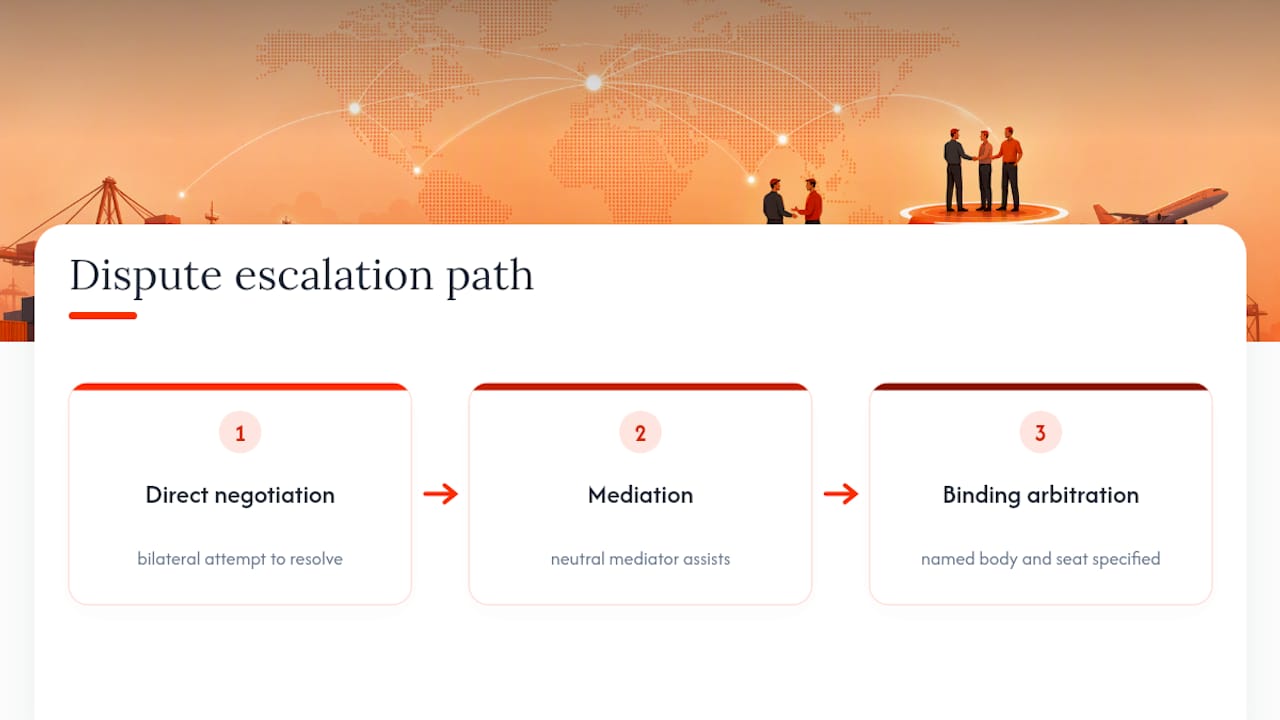
Specify the dispute resolution mechanism in order of escalation: direct negotiation first, followed by mediation, then binding arbitration if mediation fails. Name the arbitration body and seat explicitly, whether that’s a regional chamber of commerce or an international body, because “arbitration as mutually agreed” is not enforceable when the relationship has already broken down.
Termination rights deserve equal attention. Define what constitutes material breach, missed payment beyond a grace period, repeated grading failures, or failure to provide required certificates, and separate that from termination for convenience, which usually requires 30 to 60 days’ written notice. Without this distinction, either party can claim breach opportunistically to exit a contract that’s simply become less profitable.
Include a clause addressing what happens to open POs at termination: do in-transit shipments still get honored under the old terms, or does termination void anything not yet loaded? Leaving this unanswered guarantees an argument the moment either side wants out.
Regulatory Compliance and Import/Export Licensing
Used clothing crosses more regulatory lines than buyers often expect. Export licensing requirements vary by origin country, and import restrictions on used textiles vary even more sharply by destination. Some countries require pre-shipment sorting certification; others restrict used clothing imports entirely for certain categories, or cap volumes by permit.
Your contract should require the seller to confirm export eligibility from their jurisdiction and require the buyer to confirm import eligibility in theirs, with each party responsible for its own side of the compliance chain. Trade groups tracking the sector note a shift toward stricter enforcement, with regulators increasingly demanding documented sorting standards and traceability before shipments clear customs at all.
Build a clause that shifts responsibility for licensing failures to whichever party controls that piece of the process. If the seller ships without a required export permit, that’s a seller breach. If the buyer’s import license lapses mid-contract, that risk sits with the buyer. Splitting this cleanly avoids the finger-pointing that happens when a container gets stuck at a port and nobody agrees whose paperwork failed.
Reference the HS code classification for used clothing explicitly in the contract, since misclassification is one of the most common causes of customs delays and unexpected duty assessments on secondhand textile shipments.
Environmental and Health Safety Standards for Used Textiles
Health and safety requirements for used clothing center on one core risk: contamination, whether from pests, mold, or residual biological material from prior use. Destination countries increasingly treat this as a customs and public health issue, not just a quality one.
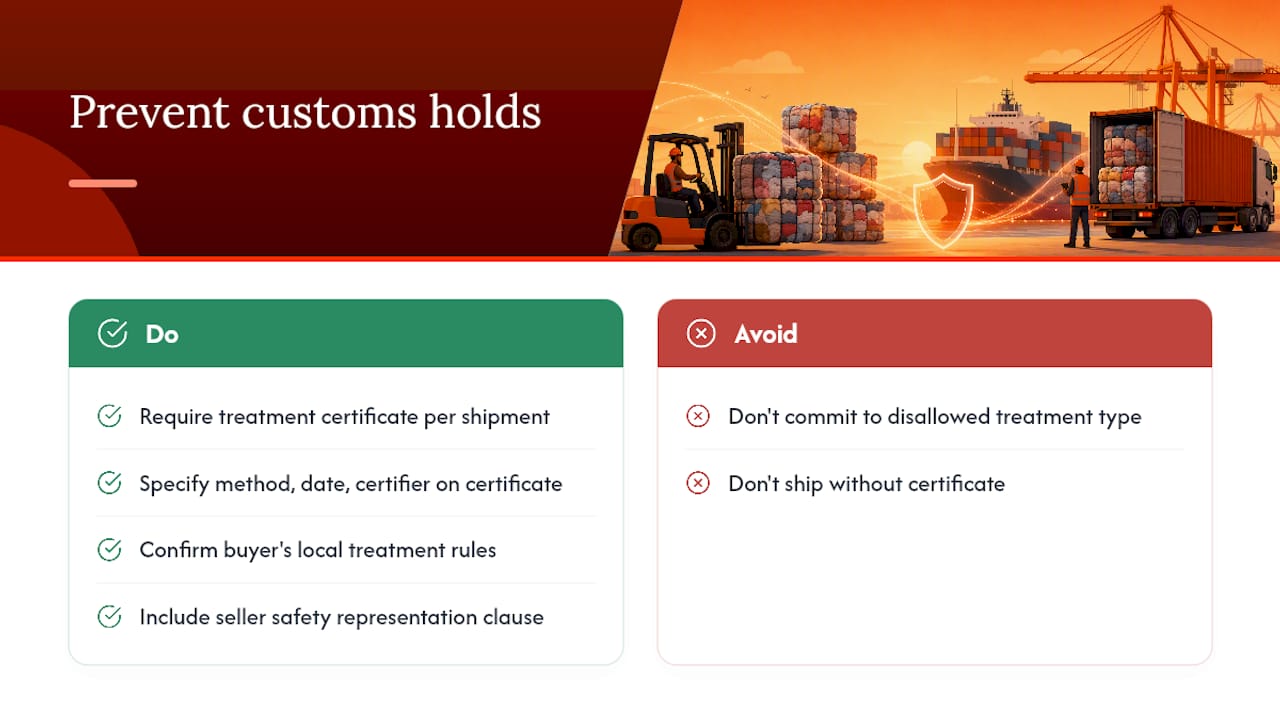
Your contract should mandate a disinfection or fumigation certificate for every shipment, specifying the treatment method (heat treatment, chemical fumigation, or another approved process), the date of treatment, and the certifying body’s name. Some destination markets require specific treatment types, so confirm the buyer’s local requirements before the seller commits to a method that won’t pass customs on arrival.
Environmental standards are tightening too, particularly around packaging materials and any residual chemical treatments used in the sorting or cleaning process. Include a representation clause where the seller confirms the goods meet the destination country’s textile safety standards as understood at the time of shipment, since regulations shift and neither party can guarantee compliance with rules that don’t exist yet.
Store fumigation and disinfection records for as long as the destination country’s customs retention period requires, commonly one to three years depending on jurisdiction. A missing certificate on a single container can trigger a hold that costs more in storage fees than the inspection would have cost in the first place.
Protecting Sourcing Information With Confidentiality Clauses
Your sourcing network, the collection points, sorting facilities, and pricing relationships that let you deliver consistent bale quality, is competitive information worth protecting explicitly, not assuming is protected by default.
A confidentiality clause should cover pricing terms, supplier and sub-supplier identities, and any proprietary grading criteria disclosed during the relationship. Set a duration, commonly two to five years post-termination, since confidentiality obligations that expire the moment the contract ends are close to worthless if a buyer immediately approaches your source directly.
Non-circumvention language matters as much as non-disclosure here. If a buyer meets your sourcing contact through the deal, a non-circumvention clause prevents that buyer from cutting you out and dealing with your source directly on the next order. This single clause prevents more long-term revenue loss in this trade than almost any other contract term, because sourcing relationships take years to build and can be poached in one conversation.
Specify what happens to shared data (pricing sheets, sourcing lists, inspection reports) at contract termination: return, destruction, or continued confidentiality obligation. Silence on this point means your counterpart keeps everything indefinitely with no legal obligation to protect it.
Anti-Bribery and Ethical Sourcing Clauses
Reputational risk in the used-clothing trade doesn’t only come from bad product. It comes from association, and buyers increasingly get asked by their own retail customers where goods came from and how they were sourced.
An anti-bribery clause should prohibit either party from offering or accepting payments to customs officials, inspectors, or freight handlers to expedite clearance or influence grading outcomes. This isn’t boilerplate. Facilitation payments are common enough in cross-border secondhand goods logistics that naming the prohibition explicitly, with termination rights attached to a violation, closes a real gap.
Pair that with an ethical sourcing representation: a clause where the seller confirms goods were acquired through legitimate donation, collection, or purchase channels, not through channels involving forced labor or unlicensed collection operations. Buyers selling into markets with conscious consumers, a trend traceability advocates in direct-to-consumer apparel have been pushing for years, increasingly need this representation in writing to satisfy their own downstream retail partners.
Tie a breach of either clause to immediate termination rights, not just a cure period. Reputational damage from a bribery finding or an ethical sourcing scandal happens fast, and a 30-day cure period does nothing to undo the damage once it’s public.
Why Contract Discipline Builds Longer Trading Relationships
A wholesale buyer once flagged a grading discrepancy on arrival, no photos, no inspection report, just a phone call claiming the bales ran lighter on Grade A than promised. Without a signed PO specifying the grade mix and an inspection window, that dispute had nowhere to go. Contracts that name their POs by number and require photo evidence within a defined window resolve that exact scenario in days, not months.
Operational proof matters more than promises in this trade. A supplier’s warehouse capacity and export reach tell you more about reliability than any warranty clause could. MS EXP SP Z O O’s scale, worldwide shipping to more than 40 countries and mechanized packing that speeds bale turnaround, functions as a trust signal precisely because it’s verifiable, not just claimed.
The buyers who avoid repeat disputes aren’t the ones with the longest contracts. They’re the ones who tie every clause to a document someone actually has to produce.
— rodrigues
Requesting a Sample Bale or Quote From Msexpspzoo
If you’re ready to move from contract theory to an actual shipment, a well-equipped wholesale supplier gives buyers a faster path than sourcing through scattered independent traders. Operating from a large warehouse with mechanized packing equipment, such a supplier can turn around bulk bale orders for buyers worldwide without the sourcing delays smaller suppliers often carry.
Buyers can request a sample bale before committing to a full container, coordinate a live video bale opening to verify grade mix firsthand, and arrange third-party inspection alongside standard fumigation certification on every shipment. Whether you’re sourcing used clothing, shoes, or purses and bags, the same documentation standards apply across categories. Visit the used clothing wholesale page to request a quote, specify your grade mix and bale count, and get a sample shipment scheduled against a real Purchase Order, not a verbal estimate.
Sources
- Wholesale Agreement Template: What to Include – LegalClarity
- Secondhand clothing field survey (UNCTAD, 2024)
- Used Clothing Wholesale on Alibaba.com: Quality, Compliance & Global Market Guide 2026
- What to include in a wholesale agreement – Legalvision