
Three EU instruments now govern used clothing compliance in Europe: the amended Waste Framework Directive, the Ecodesign for Sustainable Products Regulation’s destruction ban, and Regulation (EU) 2024/1157 on waste shipments. If you import, sort, or resell used garments in or into the EU, register with a Producer Responsibility Organization in each market where you sell, and lock down separate collection with documented professional assessment for every bale.
TL;DR:
- Businesses must register with a Producer Responsibility Organization in each EU country where they sell used clothing to comply with upcoming textile waste laws.
- Accurate bale-level records, including weight, material, origin, and signed assessments, are essential for proving used clothing status at customs.
- Exporters should verify and document destination country eligibility, ensure shipments are assessed for reuse, and hold detailed proof for inspections.
- The destruction ban, effective from July 2026 for large companies, prohibits discarding unsold clothing and requires documentation of how stock is managed.
- Customs inspections rely on professional assessment and chain-of-custody records, making traceability and proper storage critical for defense against liability.
Table of Contents
- Understanding Used Clothing Compliance in Europe: The Basics
- Your Compliance Checklist for 2026
- What the New EU Rules Actually Require
- What Documentation and Registration Actually Look Like
- How Customs Inspections and Penalties Work
- How High-Volume Exporters Keep Shipments Defensible
- Where Compliance Spending Actually Pays Off
- Sources
- FAQ
Understanding Used Clothing Compliance in Europe: The Basics
Used clothing compliance in Europe means proving, on paper, that what you’re moving is a used good and not waste. That distinction drives everything else: which permits you need, what customs can seize, and who pays if a shipment gets challenged at the border. Regulations for secondhand clothing Europe once treated as a patchwork of national rules are now converging into a single EU framework, and 2025 through 2027 is when most of it takes effect.
The standard industry term for the underlying legal mechanism is Extended Producer Responsibility, or EPR. It shifts the cost of managing textile waste from municipalities onto the businesses that place garments on the market, including importers. If your compliance plan doesn’t already reference EPR schemes, waste shipment classification, and the ESPR destruction ban, it’s incomplete.
Your Compliance Checklist for 2026
Start with registration, then move to documentation, then close the loop on exports.
- Join a Producer Responsibility Organization (PRO) in every EU Member State where you place used clothing on the market. Member States are standing up textile EPR schemes under the amended Waste Framework Directive, and registration is typically the first legal gate, not an afterthought.
- Set up bale-level records: weight, material composition, origin, and a signed professional assessment form for each batch you receive or ship.
- Photograph representative samples from every bale before it leaves your warehouse, dated and tied to a batch number.
- Stop any destruction of unsold apparel if your company falls under the ESPR ban’s scope, and document what happens to unsold stock instead.
- Verify export eligibility before shipping outside the EU: confirm the receiving country isn’t subject to the phased restrictions on green-listed textile waste and keep a non-waste declaration on file.
Pro Tip: Build a single shared folder per shipment container, with weights, photos, and assessment forms named identically. When customs asks for proof, you want to hand over one file, not reconstruct a paper trail from memory.
What the New EU Rules Actually Require
Three separate legal instruments interact here, and each controls a different part of your operation.
The Waste Framework Directive amendment requires Member States to run separate collection systems for textiles from January 1, 2025, keeping used clothes out of general waste streams. It also assigns EPR to producers, meaning Member States must build textile EPR schemes that fund collection, sorting, and reuse infrastructure, with reuse prioritized over recycling under the waste hierarchy.
The ESPR destruction ban takes effect July 19, 2026 for large companies, prohibiting the destruction of unsold clothes, accessories, and footwear. Medium-sized businesses get more runway, with obligations phasing in later in the decade. This directly affects how you manage excess or returned inventory. A retailer or importer sitting on unsold stock can no longer default to landfill or incineration once the ban applies to them.
The Shipments Regulation phases in a ban on exporting non-hazardous, green-listed textile waste to non-OECD countries, reaching full effect May 21, 2027. Exceptions require the receiving country to prove it can manage the material in an environmentally sound way.
One detail trips up more shippers than any other: separately collected textiles are presumed waste unless professionally assessed as fit for re-use. That assessment, not your invoice or your intent, is what determines whether a bale is a used good or regulated waste.
What Documentation and Registration Actually Look Like
A PRO doesn’t just collect fees. It reports your volumes to national authorities, funds collection infrastructure, and, in most schemes, offers eco-modulated fee structures that reward durable, recyclable products over disposable ones.
Beyond PRO registration, build these into your standard operating procedure:
- Reporting cadence: most schemes expect periodic data on weights placed on the market, material composition, and unsold-product volumes.
- REACH and General Product Safety Regulation (GPSR) checks: screen for restricted substances and flag anything requiring entry into the SCIP database for articles containing substances of concern.
- Sorting evidence: signed checklists plus photos at the point of professional assessment, not after the fact.
- Retention: keep electronic records for a minimum of five years, since customs and competent authorities increasingly demand documentary proof rather than accepting a seller’s word.
EU buyers increasingly treat voluntary certifications like GRS or OEKO-TEX as unofficial market-entry requirements alongside these legal baselines, according to CBI market-entry guidance. Businesses new to European import rules more broadly may also find value in a general legal checklist for cross-border sellers useful for cross-checking obligations that extend beyond textiles.
Pro Tip: Assign one person to own the audit trail per shipment, not a rotating team. Inconsistent documentation across staff is the single most common reason a defensible file falls apart under inspection.
How Customs Inspections and Penalties Work
Customs authorities reclassify a shipment as waste when documentation doesn’t back up the “used goods” claim, and that reclassification is where liability starts. Regulation (EU) 2024/1157 gives Member States explicit power to inspect and distinguish waste from used goods, closing the loophole of shipping waste “under the guise” of secondhand goods.
Once a shipment is challenged, you may bear the cost of sampling, storage, laboratory analysis, and return or disposal, sometimes running into thousands of euros per container. Member States are required to apply penalties that are effective, proportionate, and dissuasive, language that gives national regulators wide latitude on fine size.
Reduce your exposure with a few concrete habits:
- Standardize photo documentation across every bale and container.
- Maintain chain-of-custody logs from collection point to export.
- Keep signed professional assessment forms on file, not just internal notes.
- Consider financial guarantees or insurance for high-volume export lanes into markets with active enforcement.
How High-Volume Exporters Keep Shipments Defensible
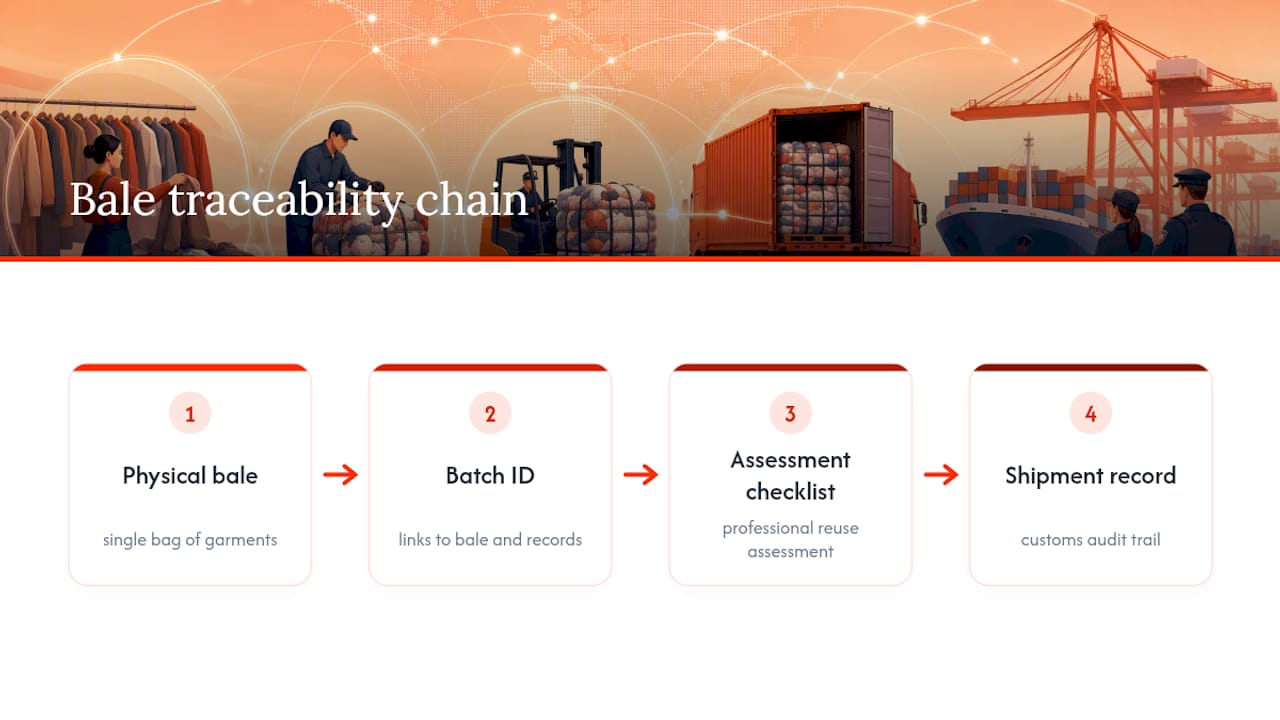
Batch-level labeling is the backbone of a clean audit trail. Every bale needs an identifier that links back to its professional-assessment checklist, so a customs officer or auditor can trace a physical bag of clothing to the paperwork proving it passed reuse assessment, not just a warehouse invoice number.
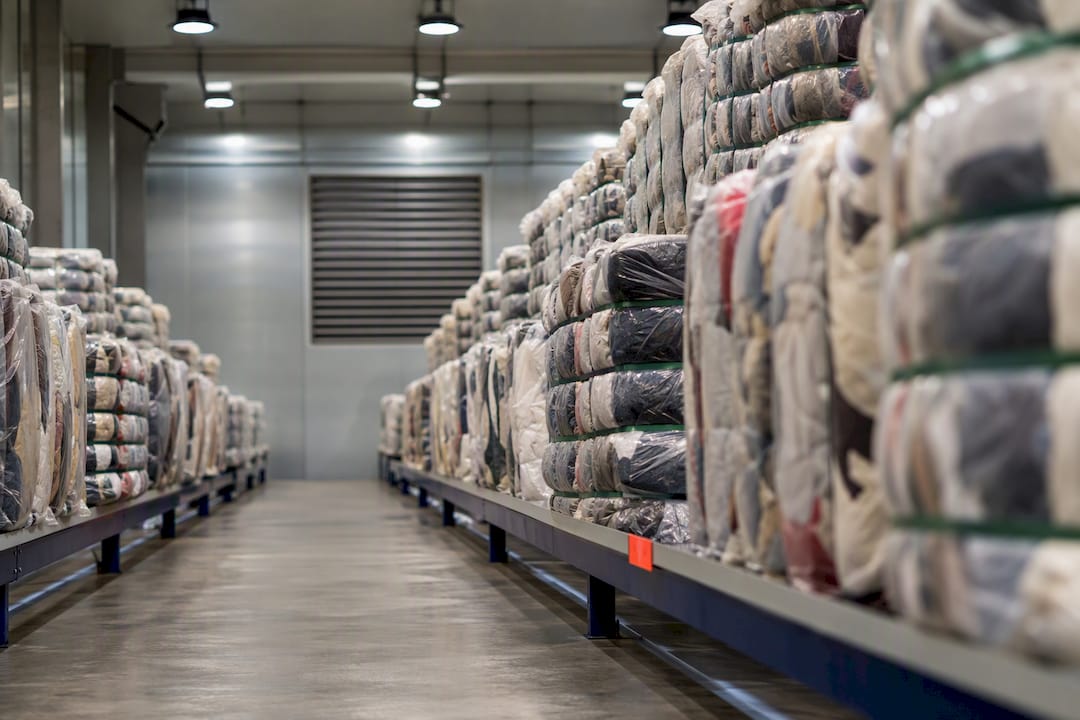
Storage and packaging matter more than most importers assume. Moisture damage or cross-contamination with genuinely unusable material can push an entire bale out of “fit for re-use” status, turning a compliant shipment into a liability overnight. Facilities running high-volume operations, including bulk used clothing export and adjacent categories like industrial wiping rags, typically separate sorting lines by material grade specifically to protect that status.
On the fee side, exporters who reconcile PRO reporting with existing warehouse management software, rather than running it as a separate manual process, cut duplicate data entry and catch reporting gaps before a filing deadline, not after.
Where Compliance Spending Actually Pays Off
Spend first on professional assessment capacity and traceable documentation. That’s where inspection risk concentrates, and it’s the cheapest problem to fix before an audit compared to after one.
Expect EPR fees to climb as schemes mature and eco-modulation penalizes low-durability products more heavily. Budget for that now rather than treating it as a surprise line item in 2027.
Talk to national competent authorities and your PRO early. Implementation timelines and interpretation of “professional assessment” vary by Member State, and the businesses caught off guard are usually those who waited for a problem before asking questions.
— rodrigues
Sources
For the full legal text and country-level implementation details, go to the primary sources rather than secondary summaries:
- Directive – EU – 2025/1892 – EN – EUR-Lex
- Commission press release on the targeted revision of the Waste Framework Directive
- Regulation (EU) 2024/1157 on shipments of waste (EN text)
Businesses sourcing compliant, professionally sorted bulk inventory can review Msexpspzoo’s used clothing export operations as one option for building a documented, EU-ready supply chain, alongside related categories like used shoes and used purses and bags.
FAQ
Is used clothing legal in Europe?
Yes. Used clothing assessed as fit for re-use is legally a used good, not waste, provided it passes professional assessment and carries documentation to prove it if challenged at customs.
What is the HTS code for used clothing?
Used clothing typically falls under Harmonized System heading 6309 for worn clothing and textile articles, though the exact tariff classification depends on the destination country’s specific customs schedule.
Can you catch anything from secondhand clothes?
Health authorities generally consider the risk low for clean, properly handled used clothing, and standard sorting and professional assessment practices are designed to catch contaminated or unsuitable items before resale.
Are jeans okay to wear in Europe?
Yes, there’s no EU restriction on wearing jeans or any denim garment; compliance rules in this article govern business import, sale, and disposal of used clothing, not personal apparel choices.
What is the deadline for the ESPR destruction ban on unsold clothes?
The ban applies to large companies starting in mid-2026, with medium-sized businesses phased in on a later timeline as ESPR implementation continues through the rest of the decade.