
Most customs seizures start as a preventable paperwork problem, not a smuggling case. Validate your HS classification, match your invoice to your packing list, confirm your Importer of Record status, and file any required advance entries before departure. If a notice arrives anyway, don’t treat it as a shipping delay: confirm exactly what stage you’re at, calendar every deadline printed on the notice, and get your customs broker and, if it’s a seizure, a customs attorney involved the same day.
TL;DR:
- Accurate classification, matching documentation, and timely filing of advance entries are essential to prevent seizures caused by paperwork errors.
- Most seizures result from misclassification, undervaluation, or missing permits, which can be mitigated through consistent, systemized compliance processes.
- Setting clear ownership and mandatory checks before booking, including binding rulings and standardized templates, helps avoid information inconsistencies that trigger reviews.
- Responding promptly to notices and understanding the legal stages of hold, detention, and seizure prevents automatic forfeitures and reduces penalties.
- Engaging legal counsel immediately for seizures and implementing root-cause analysis post-incident strengthens defenses and reduces future risk.
Table of Contents
- How Do You Avoid Customs Seizures With Pre-Shipping Checks?
- Why Do Shipments Get Seized? Common Triggers to Watch
- Building a Pre-Booking Compliance System That Sticks
- Detention vs. Seizure: What Happens at Each Stage
- What Penalties and Cost Exposures Should You Plan For?
- Broker or Attorney? Knowing When to Escalate
- Fixing Root Causes After a Seizure or Detention
- From Reactive Fixes to Proactive Compliance
- Why Documentation-Ready Freight Reduces Your Seizure Risk
- Where to Verify These Rules Yourself
- Sources
- FAQ
How Do You Avoid Customs Seizures With Pre-Shipping Checks?
Prevention happens before the container leaves the dock, not after it lands. Build a pre-booking data packet for every SKU and treat it as a gate that has to clear before you confirm a booking, not a formality you backfill later.
- Validate HS/HTS codes in advance. Assemble plain-English technical descriptions, supplier declarations, and country-of-origin evidence that actually support the code you’re using, not just the code that’s easiest to file.
- Confirm your Importer of Record. Make sure IOR registration and ID numbers are active in the destination country’s system before goods move, not while they’re sitting at the port.
- File advance entries on time. For U.S.-bound freight, that means the Importer Security Filing (ISF) and any required Partner Government Agency permits, filed before departure, not on arrival.
- Match every document exactly. Your commercial invoice, packing list, and transport document need identical, specific descriptions. Vague terms like “clothing” or “mixed goods” are exactly the kind of shorthand that triggers deeper review.
- Declare full, supported transaction value. Keep proof of payment and purchase terms on file so a valuation question doesn’t stall the whole shipment.
- Label cartons and provide load maps. A clear load map speeds up any physical exam and removes a common point of dispute if an officer needs to inspect specific cartons.
Pro Tip: Run your pre-booking packet past whoever handles customs at destination before you confirm the freight booking, not after it’s already loaded. A 20-minute review can save lengthy detention periods.
Why Do Shipments Get Seized? Common Triggers to Watch
Seizures rarely come out of nowhere. They tend to follow a small set of recognizable patterns, and knowing them lets you prioritize which controls matter most for your specific goods.
- Misclassification and vague descriptions. A wrong or ambiguous HS/HTS code is one of the fastest ways to invite an in-depth review of an otherwise routine shipment.
- Undervaluation or inconsistent values. When your invoice, insurance paperwork, and payment records don’t tell the same story, customs officers treat that gap as a valuation problem worth investigating.
- Prohibited or restricted goods without permits. Missing phytosanitary certificates, health clearances, or chemical safety documentation turns an admissible shipment into an inadmissible one overnight.
- Intellectual property violations. Counterfeit or unauthorized-brand claims lead straight to IPR seizures, often with little room for negotiation.
- Transshipment and circumvention concerns. Evidence that goods were rerouted to dodge tariffs falls squarely under CBP’s Anti-Circumvention enforcement, and scrutiny here has only intensified.
- A history of noncompliance. Automated targeting systems weigh your past entries. Repeated errors, even small ones, push future shipments into higher-risk lanes.
Most of these triggers share a root cause: information that doesn’t hold together across documents. Fix that, and you eliminate a large share of your exposure before a shipment ever reaches a port.
Building a Pre-Booking Compliance System That Sticks
A checklist only works if someone owns it. The importers who avoid repeat problems build a governance layer around the checklist so the same mistake can’t quietly resurface six months later.
- Centralize your classification database. Link every HS code to the specific evidence that justified it: specs, supplier declarations, photos, lab reports. When a code gets challenged, you want that file open in seconds, not assembled from scratch.
- Name an owner for pre-booking sign-off. Someone specific needs to approve HS classification, country of origin, IOR status, and permits before a booking gets confirmed. Shared responsibility usually means no responsibility.
- Use binding rulings when classification is genuinely uncertain. A pre-clearance request costs time upfront but removes the guesswork that leads to costly reclassification down the line.
- Standardize your templates. Your invoice, packing list, and entry data should all pull from the same validated source file. Manual re-entry across systems is exactly where drift creeps in.
- Trigger automatic re-review on change. New supplier, new component, new trade lane: any of these should force a fresh look at classification and documentation, not a carryover of what worked last time.
CBP’s own informed compliance guidance makes a similar point: consistency across bookings, not heroics after a hold, is what keeps your entries out of secondary review.
Pro Tip: Treat classification data the way you’d treat financial records. If you can’t produce the evidence behind an HS code in five minutes, that code is a liability, not an asset.

Detention vs. Seizure: What Happens at Each Stage
A hold is an operational pause, usually while an officer requests more information or schedules an exam. Nothing legal has happened yet, and most holds clear within days once the missing piece arrives.
A detention is more formal. Under the detention framework, customs generally has up to 30 days to decide whether to release, seize, or exclude the merchandise. This is your window to respond, and it closes faster than most import teams expect.
A seizure means customs has taken legal custody of the goods because it believes they may be subject to forfeiture. This isn’t a delay anymore. It’s a legal proceeding, and the response has to match that.
- Confirm exactly what stage you’re at. Read the notice carefully. A Form 6051D typically signals a hold or exam; a Notice of Detention starts your 30-day clock; a Notice of Seizure moves you into forfeiture territory.
- Calendar every deadline on the notice immediately. Missing a stated deadline, even by a day, often results in automatic or deemed forfeiture under Title 19 CFR Part 162.
- Respond to holds and detentions with exactly what’s requested. Provide classification support, country-of-origin evidence, or permits, coordinate exam drayage, and pay any approved charges promptly.
- After a Notice of Seizure, choose your legal path deliberately. Options include a petition to Fines, Penalties & Forfeitures (FP&F), an offer in compromise, requesting judicial action, or, if you take no action, allowing administrative forfeiture to run its course.
Ignoring a notice is never a neutral choice. Silence is functionally the same as accepting forfeiture.
What Penalties and Cost Exposures Should You Plan For?
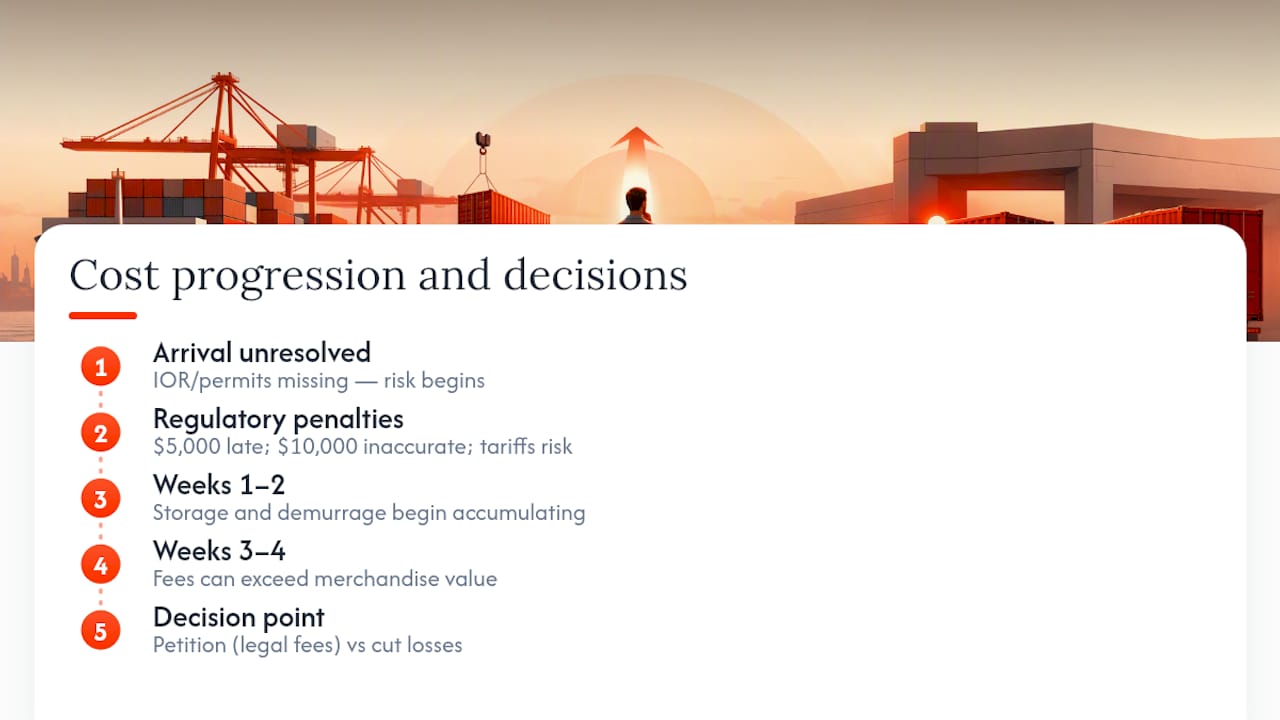
The financial risk here goes well beyond losing the merchandise. Late Importer Security Filings carry a $5,000 penalty, and inaccurate ISF filings can run up to $10,000 per violation. The August 2025 Anti-Circumvention Rule adds another layer, imposing steep tariff exposure on shipments found to involve transshipment aimed at dodging duties.
Storage, demurrage, and abandonment fees compound fast when IOR status or permits aren’t sorted before arrival, sometimes exceeding the value of the merchandise itself within a few weeks. That math matters when you’re deciding whether to fight a seizure through petition or simply cut losses. Cost exposure isn’t just about the fine on paper. It shapes whether pursuing mitigation is even worth the legal fees.
Broker or Attorney? Knowing When to Escalate
Your customs broker handles the operational side: filings, document coordination, routine liaison with customs officers, and day-to-day compliance questions. That covers the overwhelming majority of shipments and most holds.
- Escalate to a customs attorney for seizures, not detentions. Once forfeiture is on the table, a broker’s authority ends and legal representation becomes necessary.
- Bring in counsel immediately for UFLPA or forced-labor allegations. These cases move fast and rarely get resolved through operational fixes alone.
- The same applies to IPR seizures or any hint of criminal referral. Waiting to see how things develop usually narrows your options.
- Brief counsel with one consolidated packet. Timeline, invoices, purchase orders, supplier declarations, and a copy of the notice itself save days of back-and-forth.
Pro Tip: Keep your broker and attorney working in parallel, not in sequence. Operational fixes and legal filings often need to happen at the same time, not one after the other.
Fixing Root Causes After a Seizure or Detention
Once a shipment clears, don’t file the incident away. Use it.
- Run a root-cause review. Was it classification, valuation, a supplier document gap, an origin claim, or a labeling error? Name the specific failure, not a vague “documentation issue.”
- Update your classification evidence files. Force a re-review on every SKU affected by the same code or supplier.
- Document your corrective actions in writing. If you’re negotiating an offer in compromise or filing a petition, showing concrete fixes strengthens your position considerably.
- Build the fix into your systems. Add a checklist item, a training module, or a system flag so the exact same error can’t slip through again.
From Reactive Fixes to Proactive Compliance
The shift that actually saves money isn’t a bigger legal budget. It’s moving compliance checks earlier, before booking, not after a hold notice lands. Operations that treat packaging discipline and documentation accuracy as part of the same workflow, the kind of consistency you see in bulk export operations with high shipment volume and repeatable packing standards, tend to spend far less time firefighting. Compliance isn’t separate from supply-chain efficiency. It’s a core part of it.
— rodrigues
Why Documentation-Ready Freight Reduces Your Seizure Risk
Msexpspzoo isn’t a customs broker or a law firm, but the way a shipment gets packed and documented at the source is part of what keeps it out of secondary inspection in the first place. As a bulk exporter of used clothing, shoes, purses, and industrial wiping rags shipped worldwide, this supplier relies on advanced packaging machinery and consistent bale documentation practices built specifically for fast, predictable turnaround across multiple countries.
That operational discipline, matched cartons, consistent load specifications, a warehouse built for volume, gives importers one less variable to worry about when their own compliance team is validating HS codes and country-of-origin evidence. If you’re sourcing bulk lots and want shipments that arrive with documentation your team can actually reconcile against customs paperwork, browse Msexpspzoo’s used clothing export catalog or reach out for a shipping readiness conversation before your next booking.
Where to Verify These Rules Yourself
Check CBP’s admissibility and prohibited items guidance and importer/exporter tips directly, along with Title 19 CFR Part 162 and 18 U.S.C. § 545 on smuggling statutes. If your imports rely on low-value exemptions, review current handbag import duty and de minimis rules before assuming an exemption still applies.
This article is general information, not a substitute for advice from a qualified lawyer. Consult a qualified legal professional about your own circumstances before acting on anything here.
Sources
- Clearit — Customs hold, detention, seizure explainer
- e-CFR — Title 19, Part 162 (Seizure and Forfeiture)
FAQ
Can I Ignore a Customs Seizure Letter?
No. Ignoring a Notice of Seizure typically leads to administrative forfeiture, meaning you lose any right to contest the seizure once the stated deadline passes.
How Can I Prevent Customs Holds Before They Happen?
Validate your HS classification, match your invoice and packing list exactly, confirm your Importer of Record status, and file required advance entries like the ISF before departure rather than after arrival.
How Do You Know if Customs Has Seized Your Package?
You’ll receive a formal Notice of Seizure, distinct from an earlier Notice of Detention or Form 6051D, and it will state the legal basis for the seizure along with your response deadline.
What Does “Customs Seizure” Mean?
A customs seizure means the agency has taken legal custody of your goods because it believes they may be subject to forfeiture, moving the matter from an operational hold into a formal legal proceeding.
Should I Use a Broker or a Lawyer for a Seizure?
Brokers handle filings and routine compliance, but once a shipment is seized, only a customs attorney can pursue petitions, offers in compromise, or judicial action on your behalf.