
Most used clothing bales sold internationally run 45 kg, 80 kg, or 100 kg, with the 500 lb (about 226.8 kg) reference tied to cotton’s Gin Universal Density standard occasionally cited for comparison. A T-shirt-heavy bale can yield roughly 4 to 6 pieces per kilogram, while jackets or jeans might give you closer to 1 to 2 pieces per kilogram. Those numbers shift with compression, moisture, and grade, so before you commit to an order, get the net weight, tare weight, grade, and a certificate of analysis in writing.
TL;DR:
- The actual net weight of a bale, after removing tare, is critical for accurate piece count estimates, which vary significantly by garment type and size distribution.
- Typical piece-per-kilogram ratios include 4 to 6 T-shirts, 3 to 5 shirts, and 1 to 2 jackets, making precise garment mix essential for pricing and logistics calculations.
- Bale weights commonly range from 45 kg to 100 kg, with smaller premium or category-specific bales weighing 25 to 50 kg, depending on sorting and target market.
- Compression, moisture, grade mix, and garment size distribution all influence the final piece count and internal volume, even when bale weights are identical.
- Buyers should demand detailed documentation, including net weight, grade certificates, and photos, to prevent discrepancies and ensure consistency before confirming orders.
Table of Contents
- What Do Clothing Bale Weights Actually Mean for Buyers?
- How Many Pieces Are in a Clothing Bale?
- What Are the Common Bale Types and Weights?
- What Changes a Bale’s Net Weight and Piece Count?
- How Do You Convert Bale Weights Into Order Estimates?
- What Packaging Standards Should You Require?
- How Does Grading Affect Bale Weight and Pricing?
- Msexpspzoo’s Approach to Bale Weights and Buyer Assurance
- How to Request a Quote or Sample
- Where to Verify Bale Packaging Standards
- Sources
- FAQ
What Do Clothing Bale Weights Actually Mean for Buyers?
A “100 kg bale” is a nominal figure, not a guarantee. It tells you what the seller intends the bale to weigh before it leaves the warehouse, but the real number you should care about is net weight after tare (the bag, straps, and any tags) gets subtracted.
Buyers new to sourcing often assume weight translates directly into piece count on a fixed ratio. It doesn’t. A 45 kg bale of children’s T-shirts might hold twice as many garments as a 45 kg bale of men’s winter coats, simply because the fabric and cut differ so much. That’s why serious buyers ask for both the weight and the garment mix before they price an order.
The standard industry term for this category is “secondhand clothing bales” or “used textile bales,” and you’ll see both used interchangeably with “clothing bale weights” across supplier catalogs and trade documentation. Either way, weight is the starting point for your math, not the finish line.
How Many Pieces Are in a Clothing Bale?
Pieces per kilogram vary enormously by garment type, and getting this wrong is the fastest way to misprice a bulk order. Buyer guides commonly cite 4 to 6 T-shirts per kilogram for lightweight cotton tees, but that range narrows or widens depending on sizing and fabric weight.
Rough piece-per-kilogram ranges by category:
- T-shirts and tank tops: 4 to 6 pieces per kg
- Shirts and blouses: 3 to 5 pieces per kg
- Jeans and trousers: 1.5 to 2.5 pieces per kg
- Sweaters and hoodies: 2 to 3 pieces per kg
- Jackets and coats: 1 to 2 pieces per kg
- Shoes (pairs): 2 to 4 pairs per kg, depending on style and size
Pro Tip: *Ask for a garment-count sample from the exact bale grade you’re buying, not a generic catalog average.
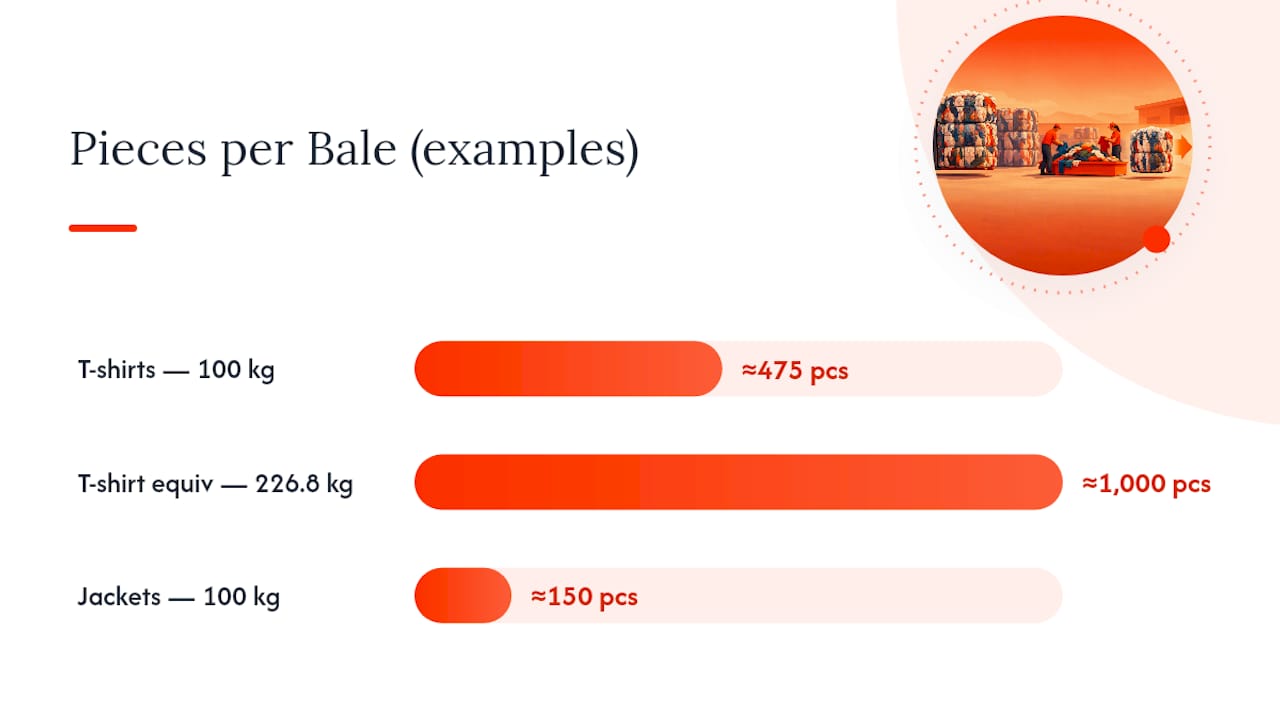
Here’s the math in practice. A 100 kg bale of mostly T-shirts, using the middle of that 4 to 6 range, lands around 450 to 500 pieces. Scale that to a 500 lb Gin UD reference bale (226.8 kg) and you’re looking at roughly 900 to 1,100 T-shirt-equivalent pieces, assuming similar garment mix and no allowance for tare weight. Swap that bale for jackets instead, and the same 100 kg might only give you 100 to 200 pieces. Same weight, wildly different unit economics.
Variance comes down to four things: garment size distribution (a bale skewed toward S/M runs lighter per piece than one skewed L/XL), fabric grams per square meter, whether garments carry linings or metal hardware like zippers and buttons, and seasonal packing habits, since winter sorting runs naturally push heavier items into bales.
What Are the Common Bale Types and Weights?
Sellers generally offer three bale formats, and knowing which one you’re looking at changes how you should read the weight on the label.
Mixed clothing bales combine multiple garment types and sizes without sorting for a single category. These typically run 45 to 100 kg and suit buyers who want variety for general retail or market stalls.
Category-specified bales are sorted by garment type (all jeans, all children’s wear, all summer dresses) and tend to weigh 45 to 80 kg, since sorting labor makes smaller batches more economical to produce.

Branded or premium bales isolate higher-value labels and often come in smaller nominal weights, 25 to 50 kg, because the sorting standard is stricter and yield per bale is lower.
Bale format tends to track buyer type:
- Small nominal bales (45 to 80 kg) suit boutique retailers and market traders who want to sample quality before scaling up
- Mid-size bales (80 to 100 kg) work for regional wholesalers running steady turnover
- Container-format loads, stacked from many individual bales, suit importers buying at volume
For a sense of what a truly standardized bale looks like, the cotton industry’s Gin Universal Density bale weighs about 500 lb (226.8 kg), measures roughly 54 to 55 inches long by 20 to 21 inches wide, with bulge thickness capped near 33 inches, at a density around 28 lb per cubic foot. Used clothing bales rarely hit that level of formal standardization, which is exactly why written specs matter more in this trade than in raw cotton.
What Changes a Bale’s Net Weight and Piece Count?
Net weight is what’s inside the bale after you strip out tare, the bag material, straps, and any tags or labels attached during packing. Gross or nominal weight is the number stamped on the outside, and the gap between the two can run a few kilograms on a 100 kg bale depending on bagging material and strap count.
Compression is the other variable that trips up buyers. Two bales both labeled “100 kg” can hold noticeably different piece counts if one was pressed at higher density. Tighter compression squeezes more garments into the same nominal weight bracket, though it can also make sorting and inspection slower once the bale is opened.
Four factors to confirm before you order:
- Net weight versus gross weight — ask the supplier to quote both, not just one
- Compression level — higher density bales often means more garments per kilogram, but check for damage risk from over-pressing
- Moisture content — damp garments weigh more and can affect both grade and shelf life; inconsistent press management and moisture control are documented causes of weight variability in bale production generally
- Grade mix — a bale marked “mixed grade A/B” will have a different usable yield than one marked straight grade A
Pro Tip: Request pre-shipment photos of the bale exterior and, if possible, a partial-opening photo. Sellers who hesitate to provide this are worth a second look before you wire a deposit.
How Do You Convert Bale Weights Into Order Estimates?
Start with nominal weight, subtract estimated tare, then apply your garment-specific pieces-per-kilogram range to land on an expected unit count. For a 100 kg nominal bale with roughly 2 kg of tare (bag and straps), your working net weight is 98 kg, which you then multiply by whatever piece rate matches the garment category.
Container planning adds a second constraint on top of piece math: volume. Ocean freight containers have both a weight limit and a cubic capacity, and bale density determines which one you hit first. A 20-foot container typically handles up to roughly 28 metric tons by weight, but loosely packed bales can fill the cubic space long before you approach that ceiling. Density, not nominal weight alone, is what determines how well bales use container space, since two bales of the same weight but different compression can occupy very different volumes.
A worked example: 10 bales at 80 kg nominal gives you 800 kg gross, or about 780 to 784 kg net after typical tare. If those are mixed clothing bales in the middle of the piece-count range, expect somewhere in the neighborhood of 2,000 to 2,800 pieces total, depending on garment mix.
For less-than-container-load (LCL) shipments, ask your freight forwarder for volumetric weight calculations early. LCL pricing often charges by whichever is greater, actual weight or volumetric weight, and loosely compressed bales can push your shipping cost up even when the piece count stays modest.
What Packaging Standards Should You Require?
Packaging specifications exist precisely so two parties on opposite sides of the world can agree on what a “bale” means without a shared warehouse to inspect it in person. The JCIBPC packaging specifications define density calculations, tare weight standards, approved bagging materials, and certificate of analysis requirements used across bulk trade, and while they originate in the cotton industry, the same logic applies to used clothing bales.
Bale density itself is a simple calculation: net weight divided by length times width times thickness, with thickness measured tie-to-tie across the crown of the bale. ISO 8115 recommends nominal bale dimensions and densities in the range of 360 to 450 kg per cubic meter specifically to improve how bales fit inside standard shipping containers.
Strapping matters more than most first-time buyers expect. Industry tie specifications call for strap widths of at least 0.75 inches with minimum break strengths between 2,400 and 4,000 pounds depending on bale type, numbers that exist because underspecified straps fail in transit and split bales open mid-container.
A short checklist worth copying into any purchase order:
- Certificate of analysis (COA) confirming grade and content mix
- Net weight tolerance stated as a percentage (commonly ±3% to ±5%)
- Bagging material specification (woven polypropylene is standard)
- Number and type of straps or ties per bale
- Pre-shipment photos of both bale exterior and a sample opening
How Does Grading Affect Bale Weight and Pricing?
Grade labels tell you what percentage of a bale is likely resalable as-is versus what needs rework or gets diverted to industrial use. “Retailable” or “cream” grades carry the highest usable yield, often above 80%, while “near-retailable” mixes run lower, and industrial-grade lots destined for wiping rags assume most of the content won’t be worn again as clothing.
Heavier garment categories cost more per piece even at identical bale weight, since a 100 kg bale of jackets simply contains far fewer units than a 100 kg bale of T-shirts. That math should shape how you negotiate price per kilogram versus price per piece, especially on mixed-content lots where sorting time adds real labor cost for the buyer downstream.
Contract terms that reduce risk on grading disputes:
- A pre-shipment sample matching the exact grade and lot being purchased
- A written COA with grading definitions spelled out, not just a grade letter
- An acceptance window after delivery to flag discrepancies before final payment
Msexpspzoo’s Approach to Bale Weights and Buyer Assurance
Msexpspzoo has built its packaging process around a simple problem: buyers get burned when nominal weight and actual content don’t match expectations. Operating from a 133,000 square foot warehouse and shipping to more than 40 countries, the company uses advanced packaging machinery to keep bale density consistent and turnaround fast, which matters when a buyer is trying to lock in container timing.
The product range extends well beyond clothing into shoes, industrial wiping rags, and vintage goods, all moving through the same warehouse infrastructure. Long-term partners cite consistent quality and responsive support as reasons they keep reordering, and that track record is worth weighing when you’re deciding which supplier to trust with a first bulk shipment.
If you’re sourcing bales for the first time, the practical habit worth adopting regardless of supplier: always request net weight, grade documentation, and photos before wiring a deposit. It costs the seller nothing to provide, and it costs you everything if you skip it.
— rodrigues
How to Request a Quote or Sample
Getting an accurate quote starts with specifics, not a vague “send me pricing” message. Tell the supplier your target nominal bale weight, the grade you need, your destination port, and whether you require a certificate of analysis before shipment.
Some suppliers’ advantage for buyers weighing bale options is straightforward: packaging machinery built for speed without sacrificing the documentation that prevents disputes later, meaning buyers get consistent bale weights and the paperwork to back them up on a turnaround timeline that fits real order deadlines. If you’re comparing suppliers on weight consistency and packaging transparency, that combination is worth putting to the test.
Before you reach out, gather your desired bale weight range, preferred grade, and destination details. Then request a quote or a pre-shipment sample through the used clothing page and ask specifically for net weight figures, tare breakdown, and current photos of available lots. If your order includes footwear, the used shoes line runs through the same packaging process and can be quoted alongside a clothing order.
Where to Verify Bale Packaging Standards
Three documents underpin most of the packaging language suppliers reference: the JCIBPC packaging specifications cover density, tare, and COA requirements; cotton.org’s bale description defines the Gin UD reference bale’s dimensions and weight; and ISO 8115 sets recommended dimensions and densities for container efficiency. Each one verifies a different piece of the puzzle, from bagging material to volumetric fit.
Sources
- U.S. Cotton: Bale description (Gin Universal Density bale example)
- ISO 8115: Cotton bales—Dimensions and density
FAQ
How Many T-Shirts Are in a 100-Pound Bale?
A 100-pound bale (about 45 kg) of mostly T-shirts typically holds roughly 180 to 270 pieces, based on the commonly cited 4 to 6 pieces per kilogram range for lightweight cotton tees. Actual counts shift with size distribution and fabric weight, so treat this as a planning estimate rather than a guarantee.
How Much Is a 500-Pound Bale of Cotton Worth?
Cotton bale pricing depends on daily commodity markets and grade, not on the used-clothing trade this article covers, so no fixed value applies universally. The 500 lb Gin Universal Density bale is referenced here mainly as a standardized weight and dimension benchmark, not a used-clothing product.
What Is the Standard Weight of a Clothing Bale?
There’s no single universal standard for used clothing bales, but 45 kg, 80 kg, and 100 kg are the most commonly offered nominal weights across the trade. Buyers should always confirm net weight after tare rather than relying on the nominal figure alone.
How Much Does a Bale of Clothing Cost?
Pricing varies by grade, garment mix, and weight, and depends on current market conditions rather than a fixed rate. Msexpspzoo lists current availability and grade options on its used clothing page, where buyers can request a quote directly.
Why Do Two Bales of the Same Weight Have Different Piece Counts?
Compression level, garment size mix, and fabric weight all change how many pieces fit into the same nominal weight. A bale packed at higher density with smaller-sized garments will contain more pieces than one packed loosely with larger sizes, even at an identical 100 kg label.