
For most industrial maintenance and shop uses, Grade B recycled cotton or polyester blends and medium-weight cotton sheeting give the best balance of absorbency, durability, and cost. Grade A cotton fits lighter-duty cleaning and finishing work where fewer defects matter. Low-lint polyester or engineered nonwovens earn their higher price only when particle control, residue limits, or chemical compatibility are part of the job.
TL;DR:
- Rags used for heavy-duty shop cleanup should be Grade B recycled cotton or polyester blends, which balance absorbency, durability, and cost effectively.
- Material choice and construction (woven, terry, knit, nonwoven) significantly influence a rag’s performance for specific tasks, especially regarding chemical compatibility and particle control.
- ISO 9073-6 and ISO 9073-10 tests separately measure absorbency and lint generation, so suppliers should provide both results to verify performance.
- When ordering, specify grade, weight, defects, and test standards in writing; inspecting lots against clear defect thresholds ensures consistent quality.
- A supplier’s detailed documentation of lot traceability, packaging, and proof tests reliably supports long-term supply quality and reduces sourcing risks.
Table of Contents
- Understanding wiper rag quality grades: A, B, and economy
- Material and construction choices that change how a rag performs
- What ISO 9073 test results actually tell you about a rag
- Matching the rag grade to the task at hand
- Building a procurement spec buyers and suppliers can both follow
- What supplier proof actually looks like
- What the grade table doesn’t tell you
- How our recycled industrial wiping rags fit your needs
- Sources
- FAQ
Understanding wiper rag quality grades: A, B, and economy
Grade definitions exist because buyers need a shorthand for how clean, consistent, and durable a batch of rags will be. Government procurement specifications, including DLA-style wiping rag standards, break rags into weight bands and defect tolerances that private suppliers commonly mirror.
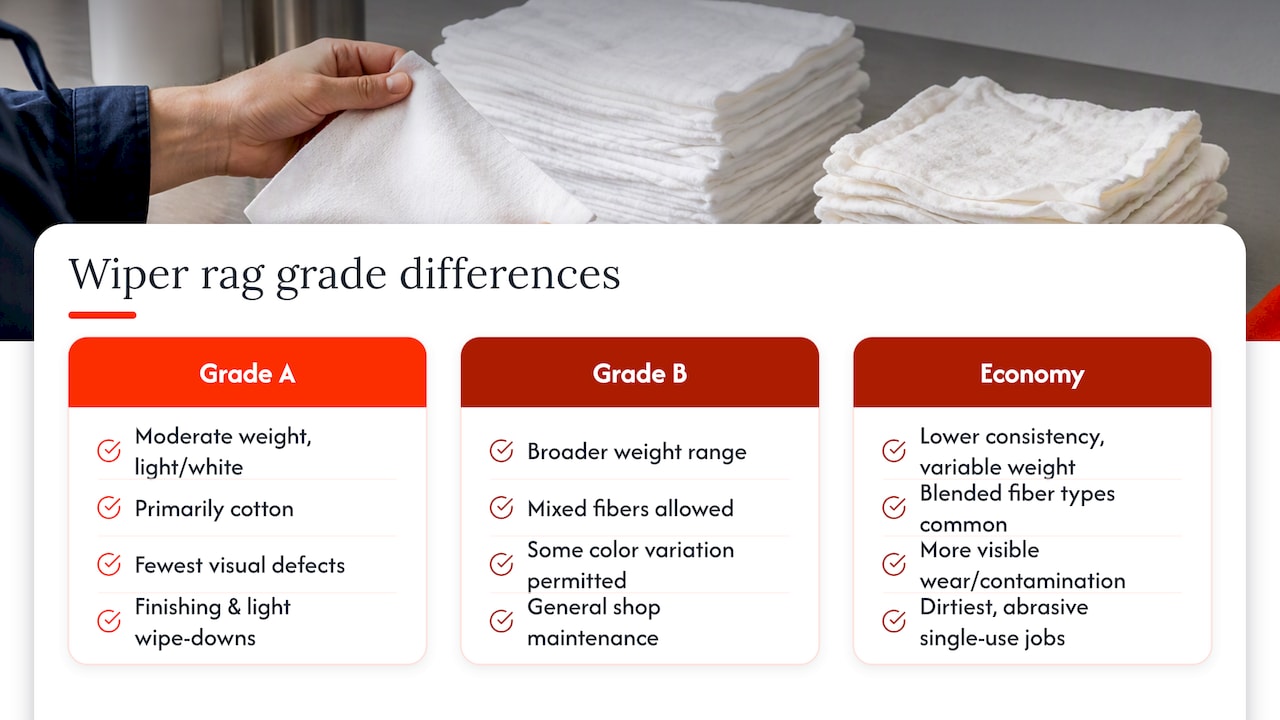
Grade A cotton typically ranges in moderate weight, skews toward white or light colors, and carries the fewest visual defects. It suits finishing work, light equipment wipe-downs, and tasks where a stray thread or discoloration could ruin a surface.
Grade B covers a broader range of weights and allows mixed fiber sources and some color variation. This is the workhorse grade for general shop maintenance: engine bays, machine shops, warehouse cleanup, and anywhere absorbency matters more than appearance.
Economy or Grade C material sits below both in consistency. It often blends fiber types, carries more visible wear, and tolerates a wider range of contamination. It belongs on the dirtiest, most abrasive jobs where the rag itself will be discarded after one heavy use, not on tasks where residue transfer is a concern.
Government-style specifications also spell out what disqualifies a rag outright, and procurement teams should copy this language directly into purchase orders, such as stains, hardened areas, unremoved fittings, and excessive fraying that could affect performance or safety.
Knowing these thresholds before a shipment arrives turns a subjective quality argument into a checklist an inbound inspector can run in minutes.
Material and construction choices that change how a rag performs
Grade tells you about weight and defect tolerance. Construction and fiber content tell you how the rag actually behaves on the job, and the two are often confused.
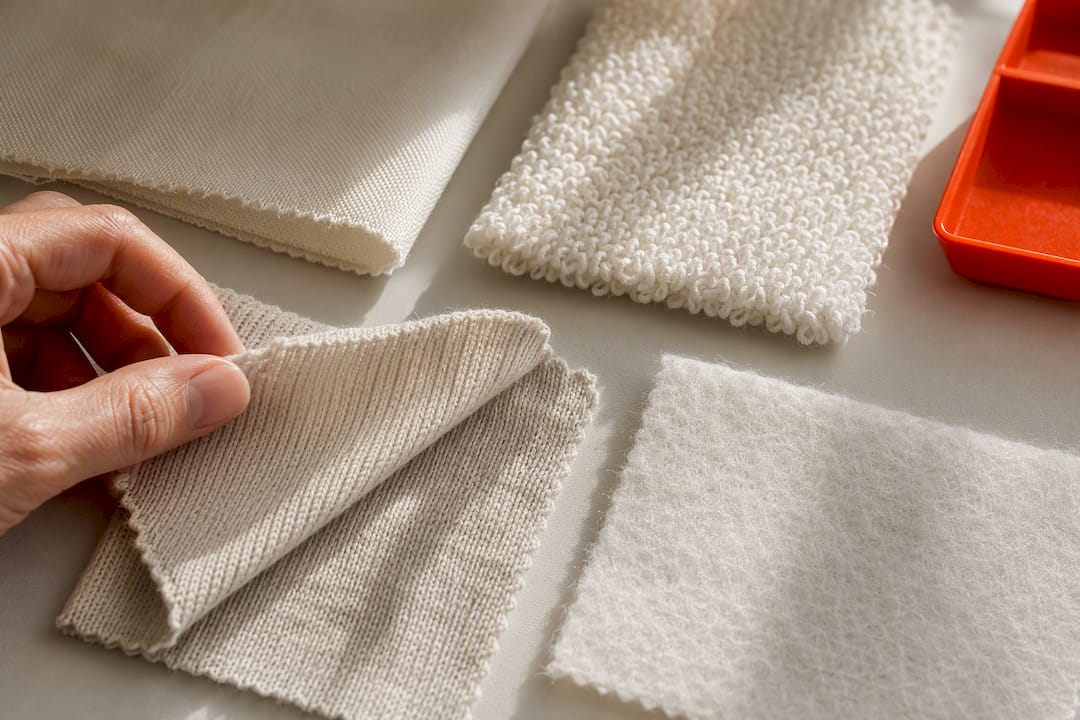
Woven cotton sheeting is a flat, tightly constructed fabric that absorbs steadily and holds up under repeated folding, which makes it a reliable general-purpose choice. Terry cloth, with its looped pile, grabs more liquid per square inch and works well for spills and heavier degreasing. Knit fabrics stretch and conform to irregular shapes, useful for wiping around fittings and curved parts, but they can shed more at cut edges unless the border is finished. Nonwoven material, bonded rather than woven or knitted, is engineered for a specific absorbency or lint profile and tends to be more consistent batch to batch than recycled woven rags.
Fiber content drives a separate set of trade-offs. Cotton absorbs quickly and handles oil, water, and grease well, which is why it dominates general maintenance use. Polyester resists abrasion and many solvents better than cotton and sheds less lint, making it the default for tasks where particle control matters. Blends split the difference, usually trading some absorbency for durability. Abaca and wood-pulp nonwovens, less common but worth knowing, are formulated for controlled environments and can meet specific cleanroom classifications while remaining biodegradable, a detail worth flagging when sustainability is part of the procurement brief.
Construction and fiber choice should follow the job, not the price sheet, according to guidance on cleanroom wiper materials: cotton is generally practical for oil and general maintenance, while polyester knits or engineered nonwovens are preferable when low particle release or chemical compatibility is the priority. Treating “cotton” and “low lint” as interchangeable is one of the most common sourcing mistakes.
For engineered wipes used in sensitive environments, ask suppliers for specific published attributes rather than marketing claims:
- Sealed or laser-cut borders that reduce edge fraying and loose fiber release.
- Cleanroom laundering and packaging that supports lot traceability.
- Published nonvolatile residue (NVR) and ion content data for chemical-sensitive processes.
Pro Tip: Request a physical sample before committing to volume. A five-minute solvent-wipe test under a magnifier tells you more about lint behavior than any label on the packaging.
What ISO 9073 test results actually tell you about a rag
“Lint-free” and “highly absorbent” are marketing phrases, not measurements. The two properties are tested separately, and a rag can excel at one while performing poorly at the other.
ISO 9073-6:2025 measures liquid absorbency in nonwoven fabrics through three metrics: absorbency time (how fast the material takes up liquid), absorptive capacity (how much it holds relative to its weight), and wicking rate (how far liquid spreads across the material). This standard does not apply to fabrics containing super-absorbent additives, so a supplier citing it for a superabsorbent product is misapplying the test.
ISO 9073-10 covers dry-state lint and particle generation, a completely separate property from absorbency. A material can pass a lint test with excellent scores and still absorb liquid poorly, or the reverse. Standards measuring lint do not imply anything about absorbency performance, and procurement teams should request both sets of results when both properties matter for the application.
Reading a supplier’s test report comes down to three questions: which standard was used, what was the numeric result, and does that result match the specific failure mode you are trying to prevent. A vendor who can only offer a general “low-lint” label without a particle count or a test method reference has not actually demonstrated anything.
Lint and absorbency are tested independently under ISO 9073-6:2025 and ISO 9073-10, and one score never substitutes for the other. Buyers writing an RFP for particle-sensitive work should request the specific particle count from an ISO 9073-10 report rather than accepting a generic “lint-free” claim.
When specifying rags for critical work, put these lines directly into the RFP:
- Request the ISO 9073-6:2025 absorbency time and absorptive capacity figures, not just a pass/fail statement.
- Request the ISO 9073-10 lint particle count rather than a marketing label.
- Ask which lot or batch the test results apply to, since fiber sourcing can shift between production runs.
Matching the rag grade to the task at hand
The fastest way to waste money on wiper rags is to buy one grade for every job. A simple decision sequence keeps procurement and floor technicians aligned.
- Oil and grease cleanup: choose heavier Grade B cotton or recycled cotton blends. Absorbency and bulk matter more than appearance, and the lower cost per rag supports high-volume disposal.
- Paint prep and finish work: choose clean, low-lint white sheeting or laundered Grade A cotton. Any residue or loose fiber left on a surface before painting becomes a visible defect in the finished product.
- Solvent wiping: choose a chemically compatible polyester or nonwoven material. Cotton can react with or break down under certain solvents faster than synthetic fibers, so a compatibility check matters more than absorbency here.
- Optics and printing environments: choose engineered, low-lint cleanroom wipes with published particle and NVR data. General shop rags, even clean ones, are not built to the particle tolerances these tasks require.
Before signing a supply agreement, ask every candidate supplier three questions: what are your lint test results and under which standard, what absorbency metrics can you provide, and can you supply chemical compatibility certificates for the solvents your process actually uses. A supplier who answers all three with documents rather than assurances is the one worth a trial order.
On the floor, three operational habits extend the value of a good grading decision: color-code storage bins by intended use so a solvent-only rag never ends up on a paint prep cart, track contamination levels informally by noting when a bin needs resorting, and set a replacement trigger, such as visible fraying or three uses, rather than leaving disposal to guesswork.
Pro Tip: Label bins by task, not by grade. “Solvent only” and “paint prep, low lint” mean something to a technician in a hurry; “Grade B” does not.
Building a procurement spec buyers and suppliers can both follow
A written spec prevents the two most common disputes in bulk rag purchasing: inconsistent lots and disagreement over what counts as a defect.
Tariff classification is the first line item to confirm. Wiping rags fall under HS heading 6310, which covers used or new textile rags, with subheading 631010 typically applied to sorted wiping rags and 631090 to other or unsorted material. National tariff lines and waste import controls vary by country, so confirm the exact classification and any import restrictions with local customs authorities before finalizing an international order.
An ordering checklist should specify, in writing:
- Grade and weight range, referencing the specific band, for example, Grade B within a specified weight range appropriate for the application.
- Color sorting requirements, since mixed-color lots are acceptable for heavy shop use but not for finish work.
- Defect thresholds, listing stains, hardened areas, fittings, and fraying limits explicitly rather than leaving them to interpretation.
- Packing format, bales versus boxes, and the weight or count per unit.
- Lot traceability, so a quality issue can be traced back to a specific production run.
- Test report requirements, specifying which ISO standard applies and what numeric threshold is acceptable.
On inbound inspection, reject lots that show the same disqualifying conditions used in grade definitions: chemical stains, hardened sections, unremoved buttons or zippers, or fraying beyond the agreed threshold. A retail cleanout checklist built for receiving large lots of used textiles offers a useful model for structuring acceptance and disposal steps around exactly these criteria.
What supplier proof actually looks like
A grade table and a test report tell you what a rag is. Supplier proof tells you whether you can count on getting that rag consistently, order after order.
Before committing to volume, ask a supplier to document:
- Packaging and baling machinery that supports consistent lot sizes and turnaround times.
- Typical bale turnaround from order to shipment.
- Warehouse capacity, since a supplier working from limited stock is more likely to substitute materials mid-order.
- Lot traceability records that let you trace a quality complaint back to its source batch.
Detailed product pages and documented customer relationships reduce onboarding friction because they let a new buyer verify claims before placing a first order rather than after a problem shows up.
What the grade table doesn’t tell you
Most guidance on wiper rags treats the grade letter as the whole decision. It isn’t. A Grade B rag from one production run can outperform a Grade A rag from a poorly controlled one, because grade describes weight and visual defect tolerance, not lint behavior or chemical compatibility.
The conventional advice, pick a grade and order by the case, skips the two questions that actually prevent costly mismatches: what does the ISO 9073-10 lint number say, and does the fiber content tolerate the solvent or process it will touch. Buyers who ask for these two data points before a large order catch more problems than buyers who rely on grade labels alone.
If you take one thing from this guide, make it this: treat “lint-free” and “high absorbency” as claims that require a specific test result attached, not descriptions you accept on faith. A supplier willing to hand over that documentation before you order is telling you more about reliability than any grade letter ever will.
— rodrigues
How our recycled industrial wiping rags fit your needs
A supplier provides recycled industrial wiping rags in bulk bales, built around the general-purpose grades most shop and maintenance operations rely on for oil, grease, and heavy cleanup work.
Advanced packaging machinery helps keep bale turnaround fast, and large warehouse capacity means consistent supply for repeat orders rather than one-off shipments. The supplier offers shipping to multiple global locations, supporting buyers with complex logistics. Before placing a large order, request a sample lot and the test reports that back it, the same documentation this guide recommends asking any supplier for. You can review specifications and request a quote directly on our recycled industrial wiping rags page.
Sources
FAQ
What are the different types of cleaning rags?
Cleaning rags generally fall into woven cotton sheeting, terry cloth, knit fabrics, and nonwoven materials, each with different absorbency and durability profiles. Fiber content, cotton, polyester, or blends, further changes how a rag handles liquids, chemicals, and repeated use.
What is the HS code for wiping rags?
Wiping rags typically fall under HS heading 6310, which covers used or new textile rags, with sorted wiping rags commonly classified under subheading 631010 and unsorted material under 631090. National tariff lines and import controls vary by country, so confirm the exact classification with local customs before shipping.
What is the best material for cleaning rags?
There is no single best material because the right choice depends on the task: cotton suits general oil, water, and grease cleanup, while polyester knits or engineered nonwovens fit tasks requiring low particle release or chemical compatibility. Matching material to the specific job, rather than defaulting to one fabric for everything, prevents both wasted cost and performance failures.
What kind of rags are lint free?
No rag is absolutely lint free, but engineered polyester knits and controlled nonwovens tested under ISO 9073-10 come closest, since their lint generation is measured and documented rather than assumed. Buyers should request the specific particle count from that test rather than relying on a “lint-free” label alone.